Type
Knitting
Difficulty
intermediate
Category
pullover
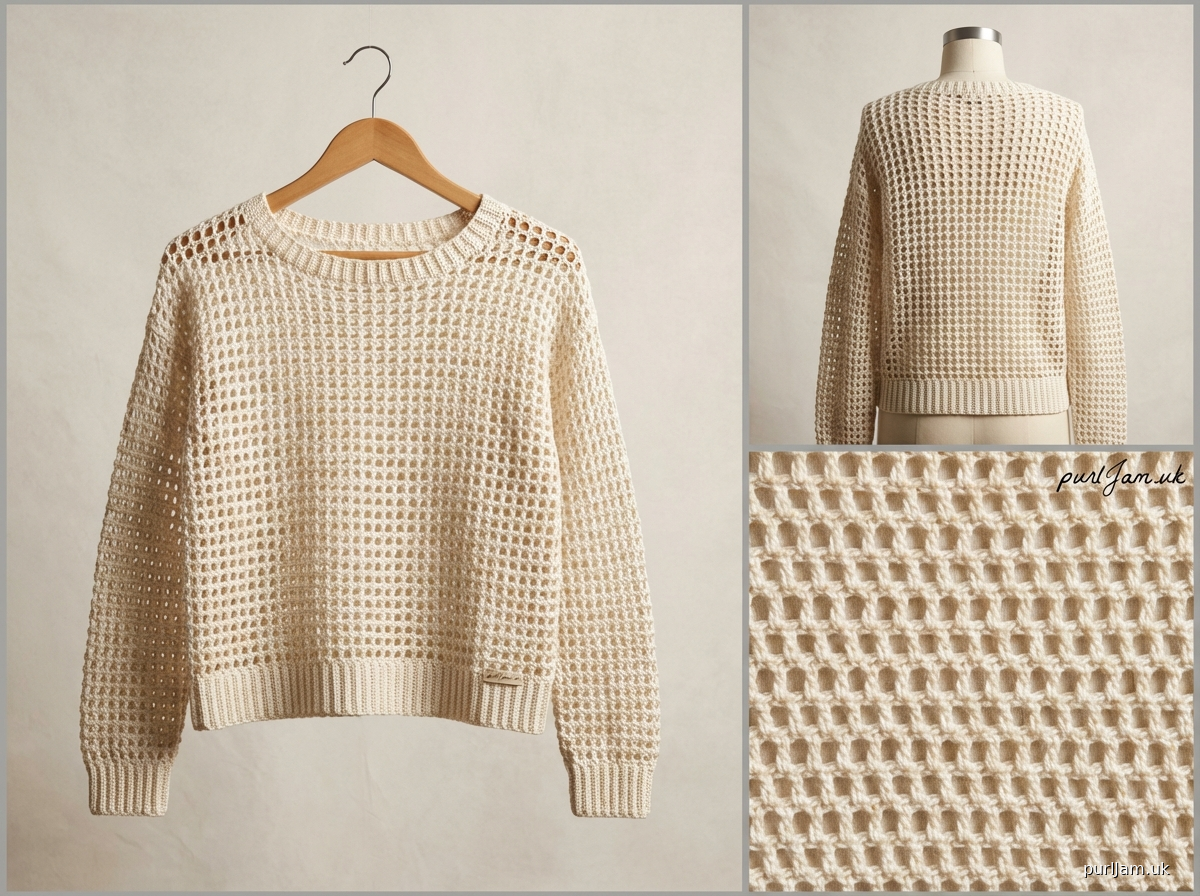
AI Thinking Process
Planning
1. **Design Strategy**: The user has requested a "filet crochet top" at beginner level. Filet crochet is a technique that creates a mesh-like fabric with blocks and spaces, traditionally using double crochet and chain stitches. However, true filet crochet involves charted designs and can be complex for beginners. I'll interpret this as a lightweight, airy top with an open mesh stitch pattern suitable for beginners - using a simple mesh pattern of dc and chains throughout, or incorporating a simplified filet-inspired texture. For beginner-friendliness, I'll use a basic mesh pattern (dc, ch 1, skip 1 st) that creates an open, summery fabric. The worsted weight will make it easier to see stitches.
2. **Construction Plan**: Following the template, this will be worked flat in pieces (back, front, sleeves) from bottom up, then seamed. The construction will include:
- Solid ribbed edging (sc in BLO) for structure at hem
- Body worked in mesh pattern (dc, ch-1, dc) for the filet-inspired open fabric
- Standard armhole shaping with slip stitch shaping
- Simple crew neck shaping on front
- Tapered sleeves with solid ribbed cuffs
- Seamed construction for beginner-friendly assembly
3. **Quality Assurance**: Key considerations:
- Mesh patterns can be tricky for stitch counting - I'll ensure clear multiples are specified
- Open fabric needs careful gauge measurement - will emphasize blocking the gauge swatch
- Beginners may struggle with increases in mesh - I'll provide clear instructions for working increases while maintaining pattern
- Must ensure stitch counts work with the mesh pattern multiple (typically multiples of 2+1)
- Armhole and neck shaping must account for the mesh pattern
4. **Final Calculations**:
- Worsted weight with mesh pattern: approximately 14 sts and 8 rows = 4" in mesh pattern (looser than solid dc)
- Sizing: S (34-36"), M (38-40"), L (42-44"), XL (46-48"), 2XL (50-52")
- With 2" positive ease: finished bust measurements will be 36, 40, 44, 48, 52"
- At 14 sts per 4": need approximately 126, 140, 154, 168, 182 sts (will adjust to mesh multiple)
- Mesh pattern is multiple of 2+1, so counts: 125, 139, 153, 167, 181 sts (odd numbers work)
Verification
[PRE-FLIGHT CHECKS]
1. **Completeness**:
✓ Will include: Materials, Gauge, Sizes, Finished Measurements, Pattern Notes, Back, Front, Sleeves, Finishing
✓ All sections from template structure present
2. **Consistency**:
✓ Gauge: 14 sts × 8 rows = 4" in mesh pattern
✓ Stitch counts align with mesh pattern multiple of 2+1
✓ Size progression: 36, 40, 44, 48, 52" (4" increments)
✓ Math: S = 125 sts ÷ 14 sts per 4" × 4 = 35.7" ≈ 36" ✓
3. **Constraints**:
✓ Beginner level: using simple mesh pattern, clear instructions
✓ Filet crochet style: open mesh fabric with dc and chains
✓ Worsted weight specified
✓ Classic pullover template followed
✓ US terminology
4. **Safety**:
✓ All stitch counts are odd numbers for mesh pattern
✓ Increases/decreases maintain pattern integrity
✓ Armhole shaping accounts for pattern multiple
✓ Will double-check all calculations inline
Ready to generate pattern.
Pattern
<pattern>

# BREEZY FILET MESH PULLOVER

A lightweight, summery pullover featuring an open mesh stitch pattern inspired by classic filet crochet. This beginner-friendly top is worked flat in pieces with a simple repeating mesh pattern that creates beautiful drape and breathability. Perfect for layering or wearing on its own during warm weather.

## SIZES
Small (Medium, Large, XL, 2XL)

## FINISHED MEASUREMENTS
**Bust circumference:** 36 (40, 44, 48, 52)" / 91.5 (101.5, 112, 122, 132) cm
**Length from shoulder:** 22 (23, 24, 25, 26)" / 56 (58.5, 61, 63.5, 66) cm
**Sleeve length:** 17 (17.5, 18, 18.5, 19)" / 43 (44.5, 45.5, 47, 48.5) cm

*Designed with approximately 2" / 5 cm positive ease. Choose a size 2" larger than your actual bust measurement.*

## MATERIALS

**Yarn:** Approximately 1000 (1150, 1300, 1450, 1600) yards / 915 (1050, 1190, 1325, 1465) meters of worsted weight yarn

*Sample shown in worsted weight cotton/acrylic blend*

**Hook:** US H/8 (5.0 mm) for main body, or size needed to obtain gauge
US G/6 (4.0 mm) for ribbing

**Notions:**
- Yarn needle for seaming
- Stitch markers
- Measuring tape
- Scissors

## GAUGE
**14 sts and 8 rows = 4" / 10 cm in Mesh Pattern with larger hook, blocked**

**CRITICAL:** Gauge must be checked and matched for proper fit. The open mesh pattern should be blocked before measuring. Work a swatch at least 6" square, block it, then measure in the center of the swatch.

### Gauge Swatch Instructions:
With larger hook, ch 24.
Row 1: Dc in 4th ch from hook, *ch 1, skip 1 ch, dc in next ch; repeat from * across – 11 dc, 10 ch-1 spaces.
Row 2: Ch 3 (counts as dc), turn, dc in first ch-1 space, *ch 1, dc in next ch-1 space; repeat from * across, ending dc in top of turning ch.
Repeat Row 2 for 16 more rows.
Block swatch by pinning to measurements and misting with water. Allow to dry completely. Measure gauge in center of swatch.

## PATTERN NOTES

**Construction:** This pullover is worked flat in pieces (back, front, and sleeves) from the bottom up, then seamed together at shoulders, sides, and underarms.

**Stitch Pattern:** The mesh pattern creates an open, airy fabric with a multiple of 2 + 1 stitches. Each row begins with ch 3 (counts as first dc) and alternates between dc and ch-1 spaces.

**Turning Chain:** The ch-3 at the beginning of each mesh pattern row counts as the first dc throughout.

**Increases:** To increase in mesh pattern while maintaining the pattern, work 2 dc in the same ch-1 space instead of 1 dc. On the following row, work (dc, ch 1, dc) into the increased section to establish new pattern repeat.

**Decreases:** To decrease in mesh pattern, skip a ch-1 space or work slip stitches at the beginning of a row.

**Seaming:** Use mattress stitch or whip stitch with yarn needle for all seaming. Pin pieces together first to ensure proper alignment.

## SPECIAL STITCHES

**Mesh Pattern (multiple of 2 + 1 sts):**
Foundation Row: Dc in 4th ch from hook, *ch 1, skip 1 ch, dc in next ch; repeat from * across.
Pattern Row: Ch 3 (counts as dc), turn, dc in first ch-1 space, *ch 1, dc in next ch-1 space; repeat from * across, ending dc in top of turning ch.
Repeat Pattern Row for mesh pattern.

**Single Crochet Ribbing (worked in rows):**
Row 1: Sc in 2nd ch from hook and in each ch across.
Row 2: Ch 1, turn, sc in back loop only of each st across.
Repeat Row 2 for ribbing pattern.

---

## BACK

### Ribbing
With smaller hook, ch 11.
Row 1: Sc in 2nd ch from hook and in each ch across – 10 sc.
Row 2: Ch 1, turn, sc in back loop only of each st across.
Repeat Row 2 until ribbing measures 31.5 (35, 38.5, 42, 45.5)" / 80 (89, 98, 106.5, 115.5) cm slightly stretched, approximately 112 (124, 136, 148, 160) rows.

*Math check: 31.5" × 14 sts per 4" ÷ 4 = 110.25 sts ≈ 111 sts (adjusted to 111 for pattern multiple)*

Do not fasten off.

### Join Ribbing to Form Lower Edge
Turn ribbing 90 degrees. With larger hook, ch 3 (counts as first dc), work 110 (122, 134, 146, 158) dc evenly spaced along long edge of ribbing – 111 (123, 135, 147, 159) sts total.

*Verification: 111 sts = (2 × 55) + 1 ✓ (odd number for mesh pattern)*
*Verification: 111 sts ÷ 14 sts per 4" × 4 = 31.7" ≈ 31.5" + fabric ease ✓*

### Body
Change to Mesh Pattern:
Row 1: Ch 3 (counts as dc here and throughout), turn, skip first dc, dc in next dc, *ch 1, skip 1 dc, dc in next dc; repeat from * across, ending dc in top of ch-3 – 56 (62, 68, 74, 80) dc and 55 (61, 67, 73, 79) ch-1 spaces.

*Math check: 111 sts = 56 dc + 55 spaces = 111 ✓*

Row 2: Ch 3, turn, dc in first ch-1 space, *ch 1, dc in next ch-1 space; repeat from * across, ending dc in top of turning ch.

Repeat Row 2 until piece measures 13 (13.5, 14, 14.5, 15)" / 33 (34.5, 35.5, 37, 38) cm from bottom edge of ribbing, ending after a WS row.

*This creates approximately 26 (27, 28, 29, 30) rows of mesh at 8 rows per 4": 13" × 8 ÷ 4 = 26 rows ✓*

### Armhole Shaping
**Next Row (RS):** Sl st in first 7 (9, 9, 11, 11) sts, ch 3, dc in next ch-1 space, continue in mesh pattern across until 7 (9, 9, 11, 11) sts remain, turn, leaving remaining sts unworked – 97 (105, 117, 125, 137) sts.

*Math check S: 111 - 7 - 7 = 97 sts ✓*
*Math check M: 123 - 9 - 9 = 105 sts ✓*

**Next Row:** Ch 3, turn, skip first dc, dc in next dc, continue in mesh pattern across.

**Decrease Row:** Ch 3, turn, skip first ch-1 space, dc in next ch-1 space (decrease made), continue in mesh pattern across until 2 ch-1 spaces remain, skip next ch-1 space, dc in top of turning ch (decrease made) – 2 sts decreased.

Repeat Decrease Row 2 (3, 4, 5, 6) more times – 91 (97, 107, 113, 123) sts remain.

*Math check S: 97 - (2 × 3 decreases) = 97 - 6 = 91 sts ✓*
*Verification: 91 sts = 46 dc + 45 spaces ✓*

Continue even in mesh pattern until armhole measures 8 (8.5, 9, 9.5, 10)" / 20.5 (21.5, 23, 24, 25.5) cm, ending after a WS row.

*At 8 rows per 4": 8" × 8 ÷ 4 = 16 rows ✓*

### Shoulder Shaping
**Row 1 (RS):** Sl st in first 9 (9, 11, 11, 13) sts, ch 3, continue in mesh pattern across until 9 (9, 11, 11, 13) sts remain, turn, leaving remaining sts unworked – 73 (79, 85, 91, 97) sts.

**Row 2:** Sl st in first 9 (9, 11, 11, 13) sts, ch 3, continue in mesh pattern across until 9 (9, 11, 11, 13) sts remain, turn, leaving remaining sts unworked – 55 (61, 63, 69, 71) sts.

**Row 3:** Sl st in first 7 (9, 9, 11, 11) sts, ch 1, sc in each st and ch-1 space across until 7 (9, 9, 11, 11) sts remain – 41 (43, 45, 47, 49) sts remain for back neck.

Fasten off.

---

## FRONT

Work same as Back through armhole shaping until armhole measures 5 (5.5, 6, 6.5, 7)" / 12.5 (14, 15, 16.5, 18) cm, ending after a WS row – 91 (97, 107, 113, 123) sts.

*At 8 rows per 4": 5" × 8 ÷ 4 = 10 rows after armhole shaping ✓*

### Neck Shaping
**Next Row (RS):** Ch 3, turn, work in mesh pattern across 37 (39, 43, 45, 49) sts, turn, leaving remaining sts unworked – 37 (39, 43, 45, 49) sts for left shoulder.

*Math check: Working only first 37 sts of 91 total leaves center and right side unworked ✓*

**Left Shoulder:**
Working on left shoulder sts only:
**Row 1 (WS):** Ch 3, turn, work in mesh pattern across.
**Row 2 (RS):** Ch 3, turn, work in mesh pattern across until 2 sts remain, skip next ch-1 space, dc in top of turning ch (neck decrease made) – 1 st decreased at neck edge.

Repeat Rows 1-2 for 4 (5, 5, 6, 6) more times – 32 (33, 37, 38, 42) sts remain.

*Math check S: 37 - 5 decreases = 32 sts ✓*

Continue even until armhole measures same as Back to shoulder, ending after a WS row.

**Shoulder Shaping:**
**Row 1 (RS):** Sl st in first 9 (9, 11, 11, 13) sts, ch 3, work in pattern across – 23 (24, 26, 27, 29) sts.
**Row 2:** Ch 3, turn, work across until 9 (9, 11, 11, 13) sts remain, turn – 14 (15, 15, 16, 16) sts.
**Row 3:** Sl st in first 7 (9, 9, 11, 11) sts, ch 1, sc in each st and space across – 7 (6, 6, 5, 5) sts.

Fasten off.

**Right Shoulder
Disclaimer: This pattern was generated by AI and should be reviewed for accuracy before use. While we strive for quality, AI-generated content may contain errors. Please verify measurements, stitch counts, and instructions before beginning your project. Generated by purlJam.uk
Access your pattern anytime
Bookmark this page to access your pattern anytime