Type
Crochet
Difficulty
intermediate
Category
shawl
AI Thinking Process
Planning
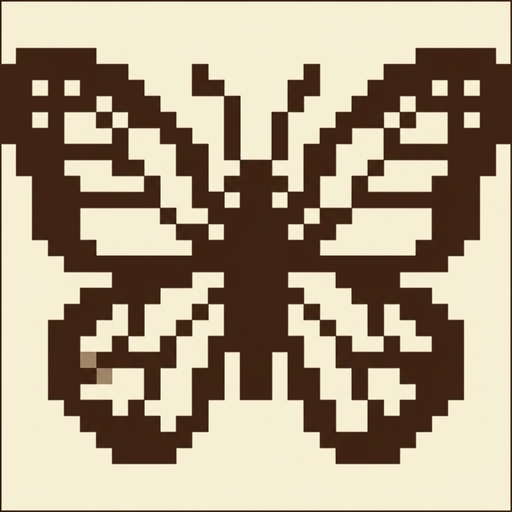
1. **Design Strategy**: Triangular top-down shawl in sport-weight yarn featuring a butterfly fillet crochet motif worked in a central panel, framed by simple chain-space mesh. Classic filet technique (open and filled mesh blocks) creates the butterfly silhouettes.
2. **Construction Plan**: Top-down center-spine triangle, increasing 4 sts per RS row at edges and spine, with the filet butterfly chart placed in the central panel.
3. **Quality Assurance**:
- Maintain even mesh tension so butterfly outlines stay legible.
- Track filled vs. open blocks carefully at panel edges.
- Aggressive wet blocking required for lace drape.
4. **Final Calculations**: Gauge 20 dc & 10 rows = 4" in dc mesh. Final size ~60" wingspan × 28" deep. Setup row 7 dc; each RS row adds 4 dc; finishes around Row 70 with ~287 dc.
Verification
1. **Completeness**: Materials, gauge, abbreviations, instructions, chart reference, finishing, blocking — all included.
2. **Consistency**: Increase math: 7 + (4 × 70) = 287 dc final row; matches 60" wingspan at gauge.
3. **Constraints**: Sport weight, US terms, imperial-first, attached chart referenced (no inline grid), butterfly filet integrated.
4. **Safety**: Mesh repeat = 3 sts (dc + ch2 + dc shares), filet block = 3 sts, math aligns.
Pattern
# Butterfly Filet Lace Shawl

A graceful triangular shawl worked top-down from the center neck. A central filet panel showcases a row of dancing butterflies, framed by an airy chain-space mesh that blocks open into beautiful drape. Intermediate crocheters comfortable with double crochet, chain spaces, and reading a filet chart will enjoy this rewarding project.

---

## Skill Level
Intermediate

## Finished Measurements
- Wingspan (top edge): approximately 60 in (152 cm)
- Depth (center spine): approximately 28 in (71 cm)
- Measurements taken after wet blocking.

## Materials
- **Yarn**: Sport weight (CYC #2), approximately 900–1000 yd (825–915 m)
  - Sample uses a smooth merino/silk blend in soft dove gray for best stitch definition.
- **Hook**: US E-4 / 3.5 mm (or size needed to obtain gauge)
- Tapestry needle
- 8–10 rust-proof T-pins or blocking wires
- Blocking mat or foam tiles
- Stitch markers (4)
- Spray bottle or basin for wet blocking

## Gauge
- 20 dc and 10 rows = 4 in (10 cm) in dc mesh pattern, after blocking.
- Filet block: 3 dc = 1 filled block; (dc, ch 2, dc) = 1 open block, each measuring approximately ¾ in (2 cm) wide.
- **Take time to check gauge** — drape and final size depend on it.

## Abbreviations (US Terms)
- ch — chain
- sl st — slip stitch
- sc — single crochet
- dc — double crochet
- sk — skip
- sp(s) — space(s)
- st(s) — stitch(es)
- rep — repeat
- RS / WS — right side / wrong side
- yo — yarn over
- [ ] — repeat instructions in brackets as directed

## Special Stitches
- **Open block (OB)**: ch 2, sk 2 sts/ch-2 sp, dc in next dc. (Counts as 1 filet block.)
- **Filled block (FB)**: 2 dc in next ch-2 sp, dc in next dc. (Counts as 1 filet block; 3 dc total when joining adjacent FB, the shared dc counts once.)
- **Beginning block (Beg-B)**: ch 3 (counts as dc), dc in each of next 2 dc for FB, OR ch 5 (counts as dc + ch 2), dc in next dc for OB.
- **Spine shell**: (2 dc, ch 2, 2 dc) all in center ch-2 sp.

---

## Construction Notes
This shawl is worked flat, top-down, from a small center-neck foundation. Increases occur at both edges and at the center spine on every right-side row, creating a classic triangular silhouette. The wrong-side rows are worked plain in mesh. The butterfly filet chart is positioned across the center spine and is centered within the shawl as it grows. Edge mesh sections widen on either side of the chart panel as the shawl grows.

---

## Attached Stitch Chart

A separate **Butterfly Filet Chart** panel is attached to this pattern. Refer to it for the visual grid; do not look for an inline chart in the instructions below.

**Where the chart is placed:**
The chart is provided as a stand-alone graphic immediately following this section in your pattern packet. The first chart row corresponds to **Row 31** of the shawl (the panel begins once you have enough stitches to accommodate the full butterfly motif width of 27 blocks centered across the spine).

**How to read the chart:**
- Each square represents one filet block (3 sts wide, 1 row tall).
- **Empty squares = open blocks (OB)**; **filled/shaded squares = filled blocks (FB)**.
- Read **RS rows (odd-numbered) from right to left**, and **WS rows (even-numbered) from left to right**, mirroring the direction of crochet work.
- The bold vertical line at the chart's center marks the **shawl spine**; the (2 dc, ch 2, 2 dc) spine shell replaces the central block on every RS row.
- Color/yarn management: this design is worked in a **single color**, so no yarn changes occur within the chart. If you choose a contrasting color for the butterflies, carry the unused yarn loosely along the WS behind filled blocks; do not cut between butterflies as motifs are spaced only 2 blocks apart.

**Stitch-count integration:**
- Chart panel width: 27 filet blocks = 81 dc (or equivalent dc + ch-2 combinations).
- On each chart row, the blocks to the **left and right of the chart panel** are worked as plain mesh (OB) using the standard increase rules below.
- Total blocks on Row 31 (RS) = 1 edge dc + edge mesh + 13 chart blocks + spine shell + 13 chart blocks + edge mesh + 1 edge dc.
- Verify after each RS row: total dc count should equal previous RS dc count + 4.

---

## Pattern Instructions

### Foundation
Ch 6, sl st in first ch to form ring. (Alternatively, begin with a magic ring.)

### Row 1 (RS — Setup):
Ch 3 (counts as dc throughout), 2 dc in ring, ch 2, 3 dc in ring, ch 2, 3 dc in ring. Turn. — 7 dc, 2 ch-2 sps. ✔ (3+1+3 = 7 dc)

### Row 2 (WS):
Ch 5 (counts as dc + ch 2), sk first dc, dc in next dc, ch 2, sk next dc, (2 dc, ch 2, 2 dc) in center ch-2 sp [spine shell], ch 2, sk next dc, dc in next dc, ch 2, sk next dc, dc in top of turning ch. Turn. — 7 dc, 5 ch-2 sps.

### Row 3 (RS — Increase):
Ch 3, dc in first ch-2 sp (edge increase), *dc in next dc, ch 2,* rep from * to * to center spine, work spine shell in center ch-2 sp, ch 2, dc in next dc, ch 2, dc in next dc, ch 2, 2 dc in last ch-2 sp, dc in top of turning ch (edge increase). Turn. — 11 dc.

**Stitch count check:** Row 1 = 7 dc; Row 3 = 11 dc; +4 dc per RS row ✔

### Rows 4–30: Establish Mesh
Continue in established mesh pattern, working RS rows with increases (2 dc in first ch-2 sp at each edge; spine shell in center ch-2 sp) and WS rows even (dc, ch 2 across; spine shell at center).

- After every RS row, dc count = previous RS dc count + 4.
- **Row 5** = 15 dc; **Row 7** = 19 dc; **Row 9** = 23 dc; … **Row 29** = 63 dc.
- Place markers after Row 11 at each edge dc and on either side of the center spine shell to keep tracking easy.

### Rows 31–66: Butterfly Filet Chart Panel
Begin working the **attached Butterfly Filet Chart** centered across the spine.

- **Row 31 (RS, Chart Row 1)**: Ch 3, 2 dc in first ch-2 sp; work edge mesh (OB) to chart panel; follow Chart Row 1 right-to-left for 13 blocks; work spine shell in center ch-2 sp; follow Chart Row 1 continued (left half, mirrored) for 13 blocks; work edge mesh (OB) to last ch-2 sp; 2 dc in last ch-2 sp, dc in top of turning ch. Turn.
- **Row 32 (WS, Chart Row 2)**: Ch 5, dc in next dc, work mesh and chart blocks following Chart Row 2 left-to-right, including spine shell at center, ending with ch 2, dc in turning ch. Turn.
- **Continue Rows 33–66** following the chart row by row, maintaining edge increases on every RS row and the spine shell on every row.

**Chart placement check (Row 31):** edge dc + 2 dc inc + edge OB blocks + 13 FB/OB chart blocks + spine + 13 chart blocks + edge OB blocks + 2 dc inc + edge dc. Final Row 31 dc count = Row 29 dc (63) + 4 = **67 dc** structural skeleton, plus the additional dc generated by filled blocks within the chart panel. Always recount filet blocks rather than individual dc within the panel: total filet blocks across Row 31 = (edge OBs) + 27 (chart) + (edge OBs) + 1 (spine) + 2 (edge increases as new blocks form on subsequent rows).

### Rows 67–70: Border Setup
Once chart is complete (after Row 66), work 4 more rows of plain mesh with increases as established (Rows 67, 69 RS with increases; Rows 68, 70 WS even). Final Row 70 dc count ≈ 287 dc across the top edge.

### Edging Round
Do not turn at end of Row 70. Continue along the two diagonal sides:
- **Top edge**: sc in each dc and 2 sc in each ch-2 sp across.
- **Corner**: 3 sc in corner.
- **Diagonal side**: (3 sc, ch 2, 3 sc) in each row-end ch-5/ch-3 turning chain along the diagonal.
- **Bottom point**: 5 sc in tip.
- **Second diagonal**: mirror first diagonal.
- Sl st to first sc to join. Fasten off, leaving a 6 in (15 cm) tail.

---

## Finishing

1. Weave in all ends on the WS using a tapestry needle, splitting plies for security.
2. Trim ends after blocking to allow yarn to relax.

## Blocking (Essential)

Blocking transforms this shawl — do not skip it.

1. Soak the finished shawl in cool water with a drop of wool wash for 20 minutes.
2. Gently squeeze out excess water (do not wring); roll in a towel and press.
3. Lay flat on blocking mats. Pin the top edge straight, stretching to 60 in (152 cm).
4. Pin the center bottom point down to 28 in (71 cm) depth.
5. Pin each picot/ch-2 loop along the diagonal edges, opening the lace fully. Use blocking wires through the top edge for the cleanest line if available.
6. Allow to dry completely (24–48 hours) before unpinning.

---

## Care Instructions
Hand wash in cool water with mild wool wash. Reshape and dry flat. Re-block lightly as needed.

## Designer Notes
The butterfly filet panel can be repeated higher up the shawl by re-working Rows 31–66's chart sequence again before the border, for a more elaborate version. For a deeper shawl, simply continue the mesh-with-increases pattern for additional row pairs before the edging — every 10 rows adds approximately 4 in (10 cm) of depth and requires roughly 100 yd (90 m) more yarn.

Happy crocheting! 🦋
Disclaimer: This pattern was generated by AI and should be reviewed for accuracy before use. While we strive for quality, AI-generated content may contain errors. Please verify measurements, stitch counts, and instructions before beginning your project. Generated by purlJam.uk
Access your pattern anytime
Bookmark this page to access your pattern anytime