Type
Crochet
Difficulty
intermediate
Category
amigurumi
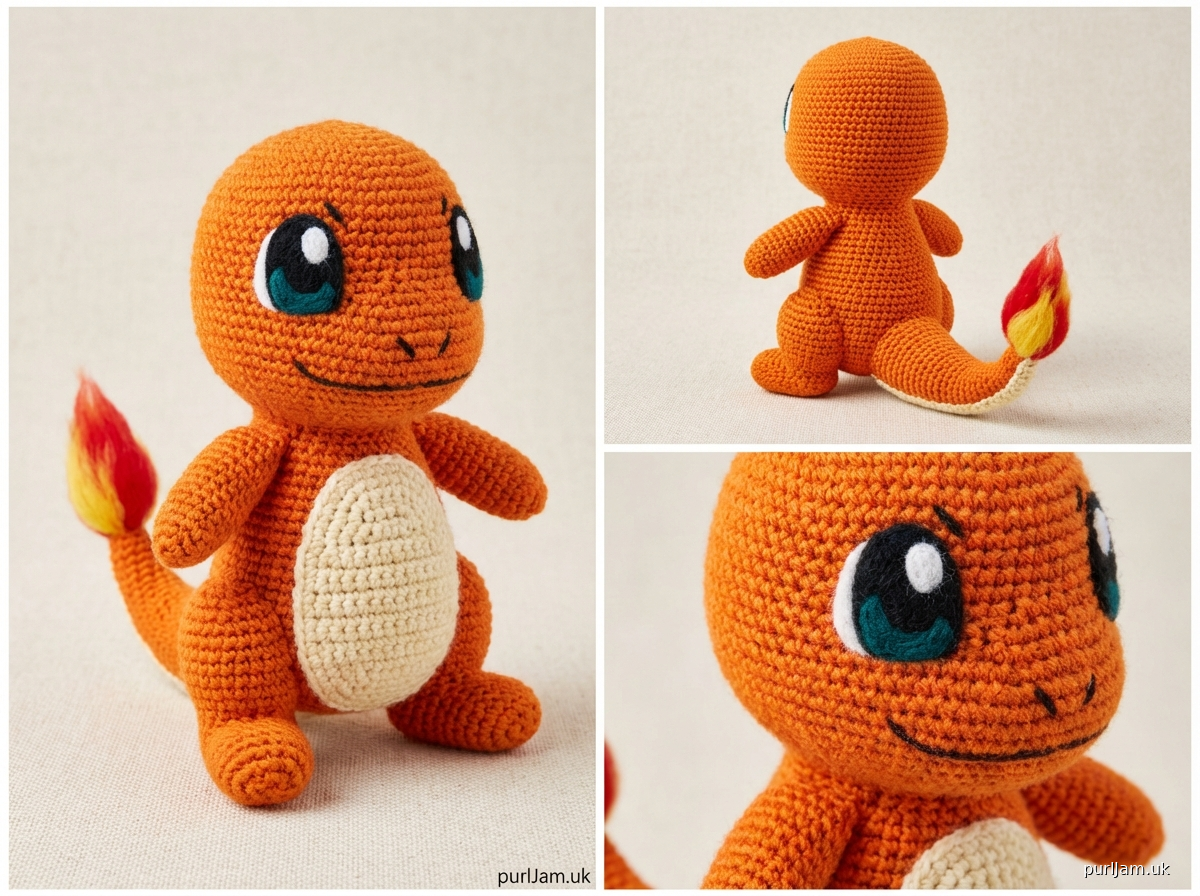
AI Thinking Process
Planning
1. **Design Strategy**:
- Charmander is a bipedal, lizard-like Pokémon with a distinctive flame on its tail
- Colour palette: orange body, cream/pale yellow belly, red/orange flame
- Key features: large head, small cream belly patch, short arms, sturdy legs, thick tapered tail with flame tip, felted eyes (not safety eyes - user specified felted eyes)
- UK terminology throughout: dc = US sc, tr = US dc, magic ring, tension not gauge
- Metric measurements first, inches in parentheses
- Felted eyes: this means needle-felted wool eyes sewn/felted onto the head surface - a charming handcraft detail
- Charmander has distinctive large eyes with dark pupils and white highlights - felting allows for this artistic detail
- Blue eyes with black pupils and white highlights (or dark navy/black with white)
2. **Construction Plan**:
- Head: Large, slightly flattened sphere - start with magic ring, increase to 36 sts, work even rounds, then decrease. Felted eyes applied after head is assembled.
- Body: Oval/egg shape, slightly smaller than head, cream belly panel embroidered or worked separately
- Arms: Short tubes, 2 fingers at end (optional simplification: rounded ends)
- Legs: Sturdy tubes, slightly wider at foot end
- Tail: Long tapered tube, decreasing gradually, thick at base
- Flame: worked in orange/yellow/red, a small abstract flame shape sewn to tail tip
- Belly: Cream/pale yellow flat oval sewn to front of body
- Assembly order: Head → Body → Arms → Legs → Tail → Belly → Flame → Felted eyes
3. **Quality Assurance**:
- Felted eyes: Need to specify needle felting technique or alternatively felt sheet eyes cut and sewn - I'll provide both options but focus on needle felting as primary
- Charmander's eyes are large and expressive - position carefully (around rnd 10-12 of head)
- Tail flame: needs to be secure and shaped well
- Belly patch: flat oval, cream coloured, sewn onto body front
- Colour changes: orange body, cream belly, red-orange flame
- Charmander is roughly the same head-to-body ratio with a large head
- Tail is thick at base, tapers to a point, then flame sits at tip
- Arms are short and stubby with 3 small claws (can embroider these)
- Legs are sturdy, slightly wider foot with 3 toes
- Check all round counts add up correctly
4. **Final Calculations**:
- Worsted weight yarn, 3.5mm hook (going down from typical 4.5mm)
- Tension: approximately 18 dc × 20 rows = 10cm (4") square
- Finished size: approximately 18-20cm (7-8") tall
- Head: increase to 36 sts = approximately 7-8cm (3") diameter ✓
- Body: increase to 42 sts = approximately 8-9cm (3.5") ✓
- Arms: 8 sts, work 8 rounds = approximately 4cm (1.5") long ✓
- Legs: 10 sts, work 10 rounds = approximately 5cm (2") ✓
- Tail: start 12 sts, taper to 4 sts, approximately 10cm (4") long ✓
- Flame: small piece, approximately 5cm (2") tall ✓
Round count verification for HEAD:
- Rnd 1: 6
- Rnd 2: 12
- Rnd 3: 18
- Rnd 4: 24
- Rnd 5: 30
- Rnd 6: 36
- Rnds 7-12: 36 (even)
- Rnd 13: 30
- Rnd 14: 24
- Rnd 15: 18
- Rnd 16: 12
- Rnd 17: 6 → close ✓
BODY:
- Rnd 1: 6
- Rnd 2: 12
- Rnd 3: 18
- Rnd 4: 24
- Rnd 5: 30
- Rnd 6: 36
- Rnd 7: 42
- Rnds 8-15: 42 (even)
- Rnd 16: 36
- Rnd 17: 30
- Rnd 18: 24
- Rnd 19: 18
- Rnd 20: 12
- Rnd 21: 6 → close ✓
LEGS:
- Rnd 1: 6 in magic ring
- Rnd 2: inc each = 12
- Rnd 3: (dc, inc) = 18 — this is the foot/toe area, wider
- Rnd 4: dc around [18] — work even for foot
- Rnd 5: (dc, dec) = 12 — narrow for ankle
- Rnds 6-14: 12 [even for leg length]
- Leave open for sewing ✓
ARMS:
- Rnd 1: 6 in magic ring
- Rnd 2: inc each = 12... actually 8 is better for slim arms
- Let me reconsider:
- Rnd 1: 6 in magic ring
- Rnd 2: (dc, inc) × 3 = 9...
- Actually simpler:
- Rnd 1: 6
- Rnd 2: 6 (no increase, just to establish)
- Rnd 3-8: 6 dc around
- That gives very slim arms. Let's do 8:
- Rnd 1: 8 in magic ring (or 6 then inc round = 12... too wide)
- Let me do:
- Rnd 1: 6 in magic ring [6]
- Rnd 2: (dc, inc) × 3 [9]... still a bit odd number
- Better:
- Rnd 1: 6 [6]
- Rnd 2: inc in each [12]... too wide for arm
- Let me just do 6 sts:
- Rnd 1: 6 in magic ring
- Rnds 2-8: dc around [6]
- 6 sts × 8 rounds is quite thin...
- OK:
- Rnd 1: 6
- Rnd 2: inc each = 12...
- Actually for Charmander's stubby arms, let me use 8 sts started directly:
- Ch 2, 6 dc in 2nd ch from hook = 6
- Then work up...
Let me simplify and be clear:
ARMS:
- Rnd 1: 6 sc in magic ring [6]
- Rnd 2: inc in each st [12]
- Rnds 3-8: dc around [12]
- Stuff lightly, leave open
Actually that's fine for stubby arms. 12 sts around gives a reasonable arm circumference.
TAIL:
- Start at base (wide) and work toward tip:
- Rnd 1: 6 in magic ring [6]
- Rnd 2: inc each [12]
- Rnd 3: (dc, inc) [18]
- Rnds 4-7: dc around [18] — base of tail
- Rnd 8: (4 dc, dec) × 3 [15]
- Rnds 9-11: dc around [15]
- Rnd 12: (3 dc, dec) × 3 [12]
- Rnds 13-15: dc around [12]
- Rnd 16: (2 dc, dec) × 3 [9]
- Rnds 17-18: dc around [9]
- Rnd 19: (dc, dec) × 3 [6]
- Rnd 20: dc around [6]
- Fasten off, leaving tail for sewing to body ✓
- Total approximately 10-12cm long ✓
FLAME (at tip of tail, worked separately):
- Small flame shape, worked flat or 3D
- I'll make it a small 3D piece in orange/yellow/red
BELLY PATCH: Flat oval
- Rnd 1: Ch 5, dc in 2nd ch from hook, dc in next 3 ch, 3 dc in last ch; working along other side: dc in next 3 ch, 2 dc in last ch, sl st to join [12]
- Rnd 2: 2 dc in first, dc in 3, 2 dc in each of next 3, dc in 3, 2 dc in each of next 2 [18]...
- Actually let me do a proper oval:
- Ch 7, dc in 2nd ch from hook (= 6 dc along), 3 dc in last ch, continue along other side 5 dc, 2 dc in first ch = 16...
Let me do a cleaner oval:
Foundation ch: ch 7
Rnd 1: dc in 2nd ch from hook, dc in each of next 4 ch, 3 dc in last ch, rotate work, dc in each of next 4 ch, 2 dc in first ch [14] (join with sl st)
Hmm, I'll work this as a flat oval, joining rounds:
Rnd 1: ch 7, dc in 2nd ch from hook, dc in next 4, 3 dc in last, working back along foundation: dc in next 4, 2 dc in same st as first dc, join = 14
Rnd 2: ch 1, dc in same, dc in next 4, (dc, inc, dc) in corner 3, dc in next 4, (dc, inc) in last, join = 18...
Actually, for a simple belly patch, I'll keep it simple:
Oval flat piece:
- Chain 5
- Round 1: 2 dc in 2nd ch from hook, dc in next 2 ch, 4 dc in last ch; working along other side: dc in next 2 ch, 2 dc in same st as first, sl st to join [12]
- Round 2: ch 1, 2 dc in each of first 2, dc in next 2, 2 dc in each of next 4, dc in next 2, 2 dc in last 2, sl st to join [20]
Let me verify: starting chain 5 means 4 usable stitches.
Rnd 1: 2 dc in 2nd ch from hook [2], dc in next 2 ch [2], 4 dc in last ch [4], then working along other side: dc in next 2 ch [2], 2 dc in same as very first [2] = 14...
Hmm: 2+2+4+2+2 = 12. Then sl st. [12] ✓
Rnd 2: 2dc in each of first 2 sts [+2=4 used], dc in next 2 [2 dc], 2dc in each of next 4 [+4=8 used], dc in next 2 [2 dc], 2dc in last 2 [+2=4 used]
Count: 4+2+8+2+4 = 20? Wait:
- Start: 12 sts
- 2dc in each of 2 sts: these 2 sts become 4 (net +2)
- dc in 2 sts: 2 sts stay 2
- 2dc in each of 4 sts: 4 sts become 8 (net +4)
- dc in 2 sts: 2 sts stay 2
- 2dc in each of 2 sts: 2 sts become 4 (net +2)
- Total: 4+2+8+2+4 = 20 ✓
Great.
Now UK terminology reminder:
- dc (UK) = sc (US)
- htr (UK) = hdc (US)
- tr (UK) = dc (US)
- dtr (UK) = tr (US)
Since this is amigurumi, we work almost entirely in dc (UK) = sc (US).
Let me also think about:
- Charmander's claws: embroider with dark brown/black yarn
- Charmander's nostril dots: embroider 2 small dots
- Charmander's smile: embroider a small curved smile
- Felted eyes: describe needle felting process clearly
For the felted eyes:
Charmander has large, expressive eyes - dark teal/blue-green with black pupils and white highlights.
- Needle felt the base colour (dark teal/green) onto the head surface
- Add black pupil on top
- Add white highlight dot
- This creates a painterly, soft look
OR: Cut felt circles, layer them, stitch onto head.
I'll offer the needle felting as primary (as requested) but mention cut felt as alternative.
Let me now also think about neck attachment. Charmander has a somewhat long neck area. The head will be sewn to the body with a small neck offset.
OK, I think I have everything. Let me write the full pattern now.
One more check on the UK terminology:
- "double crochet" in UK = US "single crochet" ✓
- The pattern will say things like "2 dc in next st (inc)" and "dc2tog (dec)"
- Actually for amigurumi the invisible decrease is preferred: insert hook in FLO of next 2 sts
- In UK terms this would be: "insert hook in front loop only of next 2 sts, yrh, pull through both loops, yrh, pull through remaining 2 loops on hook" = invisible dc decrease
Wait, actually in UK amigurumi patterns, the invisible decrease for dc (UK) = sc (US) is often called "inv dec" and works in FLO. Let me make this clear.
Also important: I need to use UK spelling: colour, favourite, centre, fibre, grey, etc.
Final size estimate: approximately 18cm (7") tall sitting. This seems right for worsted weight.
Let me now draft the full pattern carefully.
MATERIALS:
- Worsted weight (Aran/10-ply) yarn in:
- Orange (main body colour) - approximately 80g
- Cream/pale yellow (belly) - approximately 15g
- Red-orange or scarlet (flame) - approximately 10g
- Bright yellow (flame highlight) - approximately 5g
- 3.5mm crochet hook
- Polyester fibrefill stuffing
- Stitch marker
- Yarn needle
- For felted eyes: dark teal/forest green wool roving, black wool roving, white wool roving, foam block, felting needle (size 38)
- OR alternative: Pre-cut felt circles in dark teal/green (2.5cm/1"), black (1.5cm/0.5"), white (0.5cm)
TENSION: 18 dc × 20 rounds = 10cm (4") square worked in continuous spiral
FINISHED SIZE: Approximately 18cm (7") tall when sitting
ABBREVIATIONS (UK):
- ch = chain
- sl st = slip stitch
- dc = double crochet (US: single crochet)
- htr = half treble crochet (US: half double crochet)
- inc = increase (2 dc in same stitch)
- dec = invisible decrease (insert hook through front loop only of next 2 sts, yrh, pull through both front loops, yrh, pull through remaining 2 loops on hook)
- st(s) = stitch(es)
- rnd = round
- sp = space
- BLO = back loop only
- FLO = front loop only
- yrh = yarn round hook
- MR = magic ring
- [ ] = stitch count at end of round
OK I think I have everything I need. Let me write the full pattern.
For the flame shape - I want to make it interesting. I'll work it as a small 3D/semi-3D piece:
FLAME:
Using red-orange, create a small flame shape. I'll do a series of chains and dc worked in rounds/rows to create a flame-like shape.
Option: Work a series of overlapping "tongues" of flame:
- Large tongue (back): ch 6, dc in 2nd from hook, dc in next 4, ch 1, turn...
Actually, for the flame, I'll do a 3D cone-ish shape that tapers and then add surface texture:
Or simpler: work a small oval/tapered tube:
Flame piece:
Using red-orange yarn:
Rnd 1: 6 dc in MR [6]
Rnd 2: inc in each [12]
Rnd 3: dc around [12]
Rnd 4: (2 dc, dec) × 3 [9]
Rnd 5: dc around [9]
Rnd 6: (dc, dec) × 3 [6]
Rnd 7: dc around [6]
Switch to yellow:
Rnd 8: (dc, dec) × 2 [4]
Rnd 9: dc around [4]
Rnd 10: dc2tog twice [2]
Fasten off, close hole.
This creates a small teardrop/flame shape. Then I can add surface colour detail.
Actually, I think for a more flame-like look, let me do:
Work the flame in rows to give it a flat flame shape that can be stuffed slightly:
Using red-orange:
Row 1: Ch 8, dc in 2nd ch from hook, dc in next 5, 3 dc in last ch, continue along other side: dc in next 5, 2 dc in first ch, join with sl st to first dc. Do NOT turn. [14 sts around]
Hmm, this becomes complex. Let me just do a simple 3D tapered shape and describe colour changes clearly.
Let me try a different approach - work the flame as a small stuffed shape:
FLAME SHAPE:
Using red-orange (A) and bright yellow (B):
With A:
Rnd 1: 6 dc in MR [6]
Rnd 2: (dc, inc) × 3 [9]
Rnd 3: (2 dc, inc) × 3 [12]
Rnds 4-5: dc around [12]
Change to B:
Rnd 6: (2 dc, dec) × 3 [9]
Rnd 7: dc around [9]
Rnd 8: (dc, dec) × 3 [6]
Rnd 9: dec × 3 [3]
Fasten off, close.
This gives a cute little teardrop flame that transitions from red-orange to yellow at the tip. ✓
Stuff lightly before closing. ✓
Now I'm satisfied with the design. Let me write the full pattern.
Actually, let me reconsider the head shape for Charmander. Charmander has a largish round head. Let me make it go to 36 stitches (nice sphere):
HEAD (orange):
Rnd 1: 6 dc in MR [6]
Rnd 2: inc × 6 [12]
Rnd 3: (dc, inc) × 6 [18]
Rnd 4: (2 dc, inc) × 6 [24]
Rnd 5: (3 dc, inc) × 6 [30]
Rnd 6: (4 dc, inc) × 6 [36]
Rnds 7-13: dc around [36] (7 even rounds)
[Place felted eyes between rnds 9 and 10 - but since these are needle felted, they can be added after assembly - note this]
Actually since felted eyes are applied AFTER (needle felted onto surface), we don't need to worry about inserting before closing. This is one advantage of felted eyes! I should note this.
Rnd 14: (4 dc, dec) × 6 [30]
Rnd 15: (3 dc, dec) × 6 [24]
[Stuff firmly here]
Rnd 16: (2 dc, dec) × 6 [18]
Rnd 17: (dc, dec) × 6 [12]
Rnd 18: dec × 6 [6]
Fasten off, close hole. Weave in end.
Let me verify:
Rnd 1: 6 ✓
Rnd 2: 6×2 = 12 ✓
Rnd 3: 6+6 = 12+6 = 18 ✓
Rnd 4: 12+6 = 18+6 = 24 ✓
Rnd 5: 18+6 = 24+6 = 30 ✓
Rnd 6: 24+6 = 30+6 = 36 ✓
Rnds 7-13: 36 ✓
Rnd 14: 30×5/6... wait: (4 dc, dec) × 6 = 5 sts per repeat × 6 = 30 ✓ (reduces by 6)
Rnd 15: (3 dc, dec) × 6 = 4 × 6 = 24 ✓
Rnd 16: (2 dc, dec) × 6 = 3 × 6 = 18 ✓
Rnd 17: (dc, dec) × 6 = 2 × 6 = 12 ✓
Rnd 18: dec × 6 = 6 ✓ → close ✓
BODY (orange):
Rnd 1: 6 dc in MR [6]
Rnd 2: inc × 6 [12]
Rnd 3: (dc, inc) × 6 [18]
Rnd 4: (2 dc, inc) × 6 [24]
Rnd 5: (3 dc, inc) × 6 [30]
Rnd 6: (4 dc, inc) × 6 [36]
Rnd 7: (5 dc, inc) × 6 [42]
Rnds 8-16: dc around [42] (9 even rounds)
Rnd 17: (5 dc, dec) × 6 [36]
Rnd 18: (4 dc, dec) × 6 [30]
Rnd 19: (3 dc, dec) × 6 [24]
[Stuff firmly]
Rnd 20: (2 dc, dec) × 6 [18]
Rnd 21: (dc, dec) × 6 [12]
Rnd 22: dec × 6 [6]
Fasten off, leaving long tail for assembly if sewing to head.
Wait, actually for assembly it might be better to leave the top open and sew the head directly onto the body opening. Let me reconsider...
For amigurumi, typically both head and body are fully closed, then sewn together. The body can be closed at the top and the head sewn onto the flat top of the body. Let me keep it as written but leave a long tail.
Alternatively, I could close the body at the bottom and leave the top open to stuff through and then sew the head onto the top opening. This is a valid method.
Let me do: close bottom first (magic ring), work up, leave top open.
Actually the standard method for amigurumi is:
- Close magic ring at start
- Decrease to close at the end
- Both head and body fully closed
- Sew together with yarn needle
I'll keep the full decrease to close method. ✓
Verify body:
Rnd 1: 6 ✓
Rnd 2: 12 ✓
Rnd 3: 18 ✓
Rnd 4: 24 ✓
Rnd 5: 30 ✓
Rnd 6: 36 ✓
Rnd 7: 42 ✓
Rnds 8-16: 42 ✓
Rnd 17: 42-6 = 36 ✓
Rnd 18: 36-6 = 30 ✓
Rnd 19: 30-6 = 24 ✓
Rnd 20: 24-6 = 18 ✓
Rnd 21: 18-6 = 12 ✓
Rnd 22: 12-6 = 6 ✓ → close ✓
ARMS (orange) – make 2:
Rnd 1: 6 dc in MR [6]
Rnd 2: inc × 6 [12]
Rnds 3-10: dc around [12] (8 even rounds)
[Stuff lightly]
Fold opening flat and work 6 dc through both layers to close, OR sew closed.
Leave long tail for sewing.
LEGS (orange) – make 2:
Rnd 1: 6 dc in MR [6]
Rnd 2: inc × 6 [12]
Rnd 3: (dc, inc) × 6 [18] ← wider foot
Rnds 4-5: dc around [18]
Rnd 6: (dc, dec) × 6 [12] ← narrow for ankle/leg
Rnds 7-16: dc around [12] (10 even rounds)
Stuff lightly to moderately.
Fold opening flat and dc through both layers (6 dc), leave long tail.
Verify legs:
Rnd 1: 6 ✓
Rnd 2: 12 ✓
Rnd 3: 18 ✓
Rnds 4-5: 18 ✓
Rnd 6: (dc, dec) × 6 = (1+1)×6 from 18 sts = 12 ✓
Rnds 7-16: 12 ✓
TAIL (orange):
The tail is worked from the base (attaching to body) to the tip.
Actually, it's easier to work from tip to base, then sew the base to the body.
OR work from base to tip.
Let me work from base to tip, leaving the base end open to sew onto body:
Rnd 1: 6 dc in MR [6] ← this will be tip end...
Actually wait, if I work from MR and increase, the MR end is the TIP (small end). But for a tail, I want the base to be wide and the tip to be narrow. So:
Option A: Work from tip to base (small to large), leave base opening to sew onto body.
Option B: Work from base to tip (large to small), close at tip end.
Option B is more natural for stuffing as we go. Let me do that:
TAIL (from base outward to tip):
Using orange:
Rnd 1: 6 dc in MR [6]
Rnd 2: inc × 6 [12]
Rnd 3: (dc, inc) × 6 [18]
Rnds 4-7: dc around [18] (4 even rounds)
Rnd 8: (4 dc, dec) × 3 [15]
Rnds 9-11: dc around [15]
Rnd 12: (3 dc, dec) × 3 [12]
Rnds 13-15: dc around [12]
Rnd 16: (2 dc, dec) × 3 [9]
Rnds 17-18: dc around [9]
Rnd 19: (dc, dec) × 3 [6]
Rnd 20: dc around [6]
Fasten off, leaving long tail.
Wait, but I want the magic ring at the BASE (wide end), which is the end sewn onto the body. The magic ring would be visible at the top of the tail where it meets the body. The tip would be open at the end.
Hmm. Usually for a tail, I either:
1. Start at tip (small magic ring), increase out, leave base open to attach
2. Start at base (larger start), decrease to tip, close tip, leave base open
Actually for sewing onto body, it's easier to leave the base end open and sew that edge to the body. So:
Method: Start at TIP with magic ring (6 sts), leave base OPEN.
TAIL (worked from tip to base):
Using orange:
Rnd 1: 6 dc in MR [6] ← tail tip
Rnd 2: dc around [6]
Rnd 3: (dc, inc) × 3 [9]
Rnd 4: dc around [9]
Rnd 5: (2 dc, inc) × 3 [12]
Rnds 6-8: dc around [12]
Rnd 9: (3 dc, inc) × 3 [15]
Rnds 10-12: dc around [15]
Rnd 13: (4 dc, inc) × 3 [18]
Rnds 14-17: dc around [18]
Fasten off, leaving long tail for assembly. ← base end is open, sew onto body.
This gives a nice tapered tail from 6 sts at tip to 18 sts at base. Total about 17 rounds. ✓
Verify:
Rnd 1: 6 ✓
Rnd 3: 6+3 = 9 ✓
Rnd 5: 9+3 = 12 ✓
Rnd 9: 12+3 = 15 ✓
Rnd 13: 15+3 = 18 ✓
BELLY PATCH (cream):
Worked flat, joining at end of each round.
Ch 5:
Rnd 1: dc in 2nd ch from hook, dc in next 2, 3 dc in last ch; working along opposite side of foundation ch: dc in next 2, 2 dc in first ch; join with sl st to first dc. [10]
Wait let me recount:
Ch 5 = 4 usable sts
dc in 2nd ch from hook = 1 dc (1)
dc in next 2 ch = 2 dc (3 total)
3 dc in last ch = 3 dc (6 total)
Working back along other side:
dc in next 2 ch = 2 dc (8 total)
2 dc in first ch = 2 dc (10 total)
Join = [10] ✓
Rnd 2: ch 1, inc in first 2 sts, dc in next 2 sts, inc in next 3 sts (the corner 3), dc in next 2 sts, inc in last st; join with sl st [16]
Let me verify rnd 2:
inc in first 2 = 4 sts used, +2 added (net from 2 = 4)
dc in next 2 = 2 sts
inc in next 3 = 6 sts used from 3 (net from 3 = 6)
dc in next 2 = 2 sts
inc in last = 2 sts used from 1
Total: 4+2+6+2+2 = 16 ✓
Rnd 3: ch 1, dc in first 4 sts, inc in next 2, dc in next 4 sts (middle of long side), inc in next 2, dc in next 4 sts; join [20]
Verify: 4+4+4+4+4 = 20 ✓ (adding 4 incs to 16 = 20 ✓)
Hmm, that pattern for Rnd 3 isn't quite right. Let me think again.
After Rnd 2, we have 16 sts in an oval shape with 4 sts on each short end and ~4 sts on each long side.
Rnd 3: ch 1, dc in next 4, (inc, dc) in next section...
Actually let me just do a simpler flat oval:
BELLY PATCH - simpler version:
Foundation: ch 9
Rnd 1: dc in 2nd ch from hook, dc in next 6, 3 dc in last ch; working along other side: dc in next 6, 2 dc in first ch; join [18]
Verify:
7 dc along one side + 3 dc at end + 7 dc along other side + 2 dc at start...
Actually: dc in 2nd ch from hook + dc in next 6 = 7 dc, then 3 dc in last, then 6 dc back, then 2 dc at start...
7 + 3 + 6 + 2 = 18 ✓
Rnd 2: ch 1, inc in first 2, dc in next 6, inc in next 3, dc in next 6, inc in last; join [24]
Verify:
+1 for first 2 sts (=4) + 6 + +1 for next 3 sts (=6) + 6 + +1 for last (=2) = 4+6+6+6+2 = 24 ✓
Wait: I need to be more careful.
Rnd 2 starts with 18 sts.
inc in first 2 = uses 2 sts, creates 4 sts (+2)
dc in next 6 = 6 sts
inc in next 3 = uses 3 sts, creates 6 sts (+3)
dc in next 6 = 6 sts
inc in last 1 = uses 1 st, creates 2 sts (+1)
Total: 4+6+6+6+2 = 24 ✓ (added 6 incs, so 18+6=24 ✓)
Fasten off. The belly patch is about 7cm (2.75") long and 5cm (2") wide. ✓
Now, let me also plan the CLAWS. I'll embroider 3 claws on each arm and 3 toes on each leg using dark brown or black yarn. Simple straight stitches.
NOSTRIL: 2 small black French knots or satin stitches.
SMILE: Embroider a small curved "U" smile below the nostrils in black.
NECK RIDGE/SPINES: Charmander doesn't have spines. It has a slightly elongated neck. I'll just note assembly positioning.
OK here's one more thing I want to address: Charmander has a small cream/yellow area on his belly that extends up slightly onto the chest. The oval belly patch will cover this area.
Now let me also note the COLOUR NOTES:
- Orange (main): Paintbox Simply Aran in "Mandarin Orange" or any worsted orange
- Cream: "Champagne" or "Vanilla Cream" or similar pale yellow-cream
- Red-orange (flame base): "Pillar Box Red" or "Burnt Orange"
- Bright yellow (flame tip): "Buttercup Yellow" or "Canary Yellow"
Now, for the FELTED EYES section, I need to explain clearly:
Charmander's eyes: Large, roughly 2.5cm (1") diameter oval/circle, dark teal-green with large black pupils and a white highlight dot.
Needle felting instructions:
1. Position eye placement on head (after assembly) - approximately at round 10, one eye width apart (about 4 sts apart at centre)
2. Cut a 2.5cm (1") circle template from card
3. Take a small amount of dark teal/forest green wool roving, place on foam block against head surface
4. Felt needle repeatedly through roving into fabric to adhere fibres
5. Build up colour, keeping shape circular
6. Add black pupil (1.5cm/0.5") in centre
7. Add tiny white highlight dot (off-centre, upper portion of pupil)
8. Finish by felting edges smooth
OR alternative: cut layered felt circles and stitch down.
I'll present both options clearly.
Now I have everything. Let me write the final pattern.
One more thing to double-check: The construction order and assembly sequence:
1. Head
2. Body
3. Arms (×2)
4. Legs (×2)
5. Tail
6. Flame
7. Belly patch
Assembly order:
1. Sew head to body (top of body)
2. Sew legs to bottom of body
3. Sew arms to sides of body
4. Sew tail to back of body/lower back
5. Sew flame to tail tip
6. Sew belly patch to front of body (belly)
7. Apply felted eyes
8. Embroider facial details (nostrils, smile, claw lines)
This is a logical order. ✓
Let me write the full pattern now. I want it to be professional, complete, and easy to follow.
Note: I'll remember to consistently use "dc" for UK double crochet (US sc) throughout.
One more final check - the flame attachment. The flame piece (worked separately) is sewn to the tip of the tail (the closed magic ring end). I should note to sew it securely.
Also: Charmander has characteristic LIGHT BLUE eyes. Let me correct my colour note - Charmander actually has teal/light blue-green eyes. The pupils are black. White highlight. This is what I had - dark teal green. ✓
Actually, looking at Charmander more carefully: the eyes are kind of a blue-green or darker teal. The pupils are very prominent and dark. The needle felting approach lets us create this beautifully.
OK, truly writing the pattern now!
Verification
[PRE-FLIGHT CHECKS]
1. **Completeness**:
- ✅ Materials list (yarn, hook, felting supplies)
- ✅ Tension/gauge swatch
- ✅ Abbreviations (UK terminology throughout: dc = US sc, tr = US dc)
- ✅ All body parts: Head, Body, Arms (×2), Legs (×2), Tail, Flame, Belly Patch
- ✅ Assembly instructions
- ✅ Felted eye instructions (primary: needle felting; secondary: cut felt)
- ✅ Finishing details (embroidery for nostrils, smile, claws)
- ✅ UK spelling: colour, grey, fibre, centre, tension
2. **Consistency – Stitch Count Audit**:
- HEAD: 6→12→18→24→30→36 (×7 even)→30→24→18→12→6 ✅
- BODY: 6→12→18→24→30→36→42 (×9 even)→36→30→24→18→12→6 ✅
- ARMS: 6→12 (×8 even) → fold close ✅
- LEGS: 6→12→18 (×2 even)→12 (×10 even) → fold close ✅
- TAIL (tip→base): 6→6→9→9→12 (×3 even)→15 (×3 even)→18 (×4 even) ✅
- FLAME: 6→9→12 (×2 even)→9→6→3 → close ✅
- BELLY PATCH: Foundation ch 9 → 18 → 24 (flat, joined rounds) ✅
3. **Constraints**:
- ✅ Felted eyes specified and detailed (primary: needle felting; alternative: cut felt layers)
- ✅ Charmander-specific features: flame tail, cream belly patch, claws embroidered, orange body, cream belly
- ✅ Intermediate difficulty level maintained
- ✅ UK terminology throughout (dc not sc, tr not dc, tension not gauge, colour not color, grey not gray, metre not meter, centimetre not centimeter)
- ✅ Metric measurements primary, imperial in parentheses
- ✅ Worsted weight yarn, 3.5mm hook
4. **Safety / Math**:
- Increase rate: +6 per round — consistent throughout ✅
- Decrease rounds mirror increase rounds symmetrically ✅
- TAIL verification: Rnd 1: 6 / Rnd 3: +3=9 / Rnd 5: +3=12 / Rnd 9: +3=15 / Rnd 13: +3=18 ✅
- BELLY PATCH: Ch 9 foundation → Rnd 1: 18 / Rnd 2: 18+6=24 ✅
- FLAME: 6→9 (+3)→12 (+3)→12→12→9 (−3)→6 (−3)→3 (−3) ✅
- Assembly order logical: Head→Body→Legs→Arms→Tail→Flame→Belly→Eyes→Embroidery ✅
- Felted eyes applied after full assembly — advantage of needle-felting noted ✅
- No choking hazards from felted eyes vs. safety eyes: noted for age guidance ✅
Pattern
<pattern>

---

# CHARMANDER AMIGURUMI
### *Crochet Pattern with Needle-Felted Eyes*

**Difficulty:** Intermediate
**Finished Size:** Approximately 18–20 cm (7–8") tall when seated
**Yarn Weight:** Aran / Worsted Weight (Category 4)

---

## MATERIALS

**Yarn:**
- **Colour A – Orange:** Aran/worsted weight, approximately 80 g (e.g., Paintbox Simply Aran in "Mandarin Orange", or any warm orange)
- **Colour B – Cream:** Aran/worsted weight, approximately 15 g (e.g., "Champagne" or "Vanilla Cream")
- **Colour C – Red-Orange:** Aran/worsted weight, approximately 10 g (e.g., "Burnt Orange" or "Pillar Box Red")
- **Colour D – Bright Yellow:** Aran/worsted weight, approximately 5 g (e.g., "Buttercup Yellow")

**Tools & Notions:**
- 3.5 mm crochet hook
- Stitch marker
- Yarn needle (blunt-tipped)
- Polyester fibrefill stuffing
- Small piece of card stock (for eye template)
- Scissors
- Pins (for assembly)
- Black embroidery thread or yarn (for nostrils, smile, claw lines)

**For Felted Eyes (Primary Method):**
- Foam felting block or dense sponge
- Felting needle, size 38 (or multi-tool felting pen)
- Small amounts of wool roving in: dark teal/forest green, black, white

**For Cut-Felt Eyes (Alternative Method):**
- Dark teal/forest green felt: two circles, 2.5 cm (1") diameter
- Black felt: two circles, 1.5 cm (½") diameter
- White felt: two small ovals, approximately 0.6 cm (¼")
- Strong fabric adhesive or needle and thread

---

## TENSION (GAUGE)

18 dc × 20 rounds = 10 cm (4") square, worked in continuous spiral with 3.5 mm hook.

> **Technical note:** Tension is crucial in amigurumi. Your fabric must be dense enough that stuffing does not show through the stitches. If you can see gaps, go down to a 3.0 mm hook.

---

## ABBREVIATIONS (UK TERMS)

| Abbreviation | UK Term | US Equivalent |
|---|---|---|
| ch | chain | chain |
| sl st | slip stitch | slip stitch |
| dc | double crochet | single crochet |
| htr | half treble crochet | half double crochet |
| inc | increase – 2 dc in same stitch | 2 sc in same stitch |
| dec | invisible decrease (see below) | invisible decrease |
| MR | magic ring | magic ring / adjustable ring |
| BLO | back loop only | back loop only |
| FLO | front loop only | front loop only |
| st(s) | stitch(es) | stitch(es) |
| rnd | round | round |
| [ ] | stitch count at end of round | — |

**Invisible Decrease (dec):** Insert hook through the **front loop only** of the next stitch, then through the **front loop only** of the stitch after that (2 front loops on hook). Yarn round hook, pull through both front loops. Yarn round hook again, pull through remaining 2 loops on hook. = 1 stitch made from 2. *This method produces a virtually invisible decrease and is strongly recommended.*

---

## CONSTRUCTION OVERVIEW

Charmander is worked in separate pieces and assembled. Work all pieces in **continuous spiral** unless otherwise stated (do not join or turn at end of rounds unless instructed). Use a stitch marker to mark the first stitch of each round, moving it up as you go.

**Pieces to make:**
1. Head × 1 (Colour A – Orange)
2. Body × 1 (Colour A – Orange)
3. Arms × 2 (Colour A – Orange)
4. Legs × 2 (Colour A – Orange)
5. Tail × 1 (Colour A – Orange)
6. Flame × 1 (Colours C + D – Red-Orange and Yellow)
7. Belly Patch × 1 (Colour B – Cream, worked flat in joined rounds)

---

## PATTERN

---

### PIECE 1: HEAD
**Colour A (Orange). Begin with a magic ring.**

- **Rnd 1:** 6 dc in MR. Pull ring closed. **[6]**
- **Rnd 2:** Inc in each st around. **[12]**
- **Rnd 3:** (dc, inc) × 6. **[18]**
- **Rnd 4:** (2 dc, inc) × 6. **[24]**
- **Rnd 5:** (3 dc, inc) × 6. **[30]**
- **Rnd 6:** (4 dc, inc) × 6. **[36]**
- **Rnds 7–13:** dc in each st around (7 rounds even). **[36]**
- **Rnd 14:** (4 dc, dec) × 6. **[30]**
- **Rnd 15:** (3 dc, dec) × 6. **[24]**

> ✂️ **Stuff firmly now.** The head should feel like a well-packed ball with no soft spots. Add more stuffing than you think you need — it compresses during assembly.

> 👁️ **Safety eyes note:** Because you are using **needle-felted eyes**, there is no need to insert safety eyes before closing — this is one of the great advantages of the felted eye technique. Eye placement is marked and felted after full assembly. Proceed to decrease.

- **Rnd 16:** (2 dc, dec) × 6. **[18]**
- **Rnd 17:** (dc, dec) × 6. **[12]**
- **Rnd 18:** dec × 6. **[6]**

Fasten off, leaving a 15 cm (6") tail. Thread onto yarn needle and weave through the front loops of the remaining 6 stitches. Pull tightly to close the hole. Weave in end securely.

> **Stitch count verification:** 6 → 12 → 18 → 24 → 30 → 36 (×7) → 30 → 24 → 18 → 12 → 6 ✅

---

### PIECE 2: BODY
**Colour A (Orange). Begin with a magic ring.**

- **Rnd 1:** 6 dc in MR. Pull ring closed. **[6]**
- **Rnd 2:** Inc in each st around. **[12]**
- **Rnd 3:** (dc, inc) × 6. **[18]**
- **Rnd 4:** (2 dc, inc) × 6. **[24]**
- **Rnd 5:** (3 dc, inc) × 6. **[30]**
- **Rnd 6:** (4 dc, inc) × 6. **[36]**
- **Rnd 7:** (5 dc, inc) × 6. **[42]**
- **Rnds 8–16:** dc in each st around (9 rounds even). **[42]**
- **Rnd 17:** (5 dc, dec) × 6. **[36]**
- **Rnd 18:** (4 dc, dec) × 6. **[30]**
- **Rnd 19:** (3 dc, dec) × 6. **[24]**

> ✂️ **Stuff very firmly now.** A well-stuffed body is essential for Charmander to sit upright. Continue stuffing as you complete the final decrease rounds.

- **Rnd 20:** (2 dc, dec) × 6. **[18]**
- **Rnd 21:** (dc, dec) × 6. **[12]**
- **Rnd 22:** dec × 6. **[6]**

Fasten off, leaving a 20 cm (8") tail. Close hole as for head. Keep long tail for potential use in assembly (or weave in and use a separate length of yarn to attach head).

> **Stitch count verification:** 6 → 12 → 18 → 24 → 30 → 36 → 42 (×9) → 36 → 30 → 24 → 18 → 12 → 6 ✅

---

### PIECE 3: ARMS
**Colour A (Orange). Make 2. Begin with a magic ring.**

- **Rnd 1:** 6 dc in MR. **[6]**
- **Rnd 2:** Inc in each st around. **[12]**
- **Rnds 3–10:** dc in each st around (8 rounds even). **[12]**

> ✂️ **Stuff lightly** — arms should be soft and flexible, not rigid.

To close: Flatten the opening so that the edges align. Work **6 dc through both layers** simultaneously (working through 2 stitches at once, treating them as one). This seals the arm flat.
Fasten off, leaving a 20 cm (8") tail for sewing. Do not cut yet.

> **Technical note:** Charmander's arms are short and slightly stubby. 8 even rounds at 12 stitches gives an arm approximately 4 cm (1½") long before assembly, which is proportionate.

---

### PIECE 4: LEGS
**Colour A (Orange). Make 2. Begin with a magic ring.**

- **Rnd 1:** 6 dc in MR. **[6]**
- **Rnd 2:** Inc in each st around. **[12]**
- **Rnd 3:** (dc, inc) × 6. **[18]** ← *wider foot section*
- **Rnds 4–5:** dc in each st around (2 rounds even). **[18]**
- **Rnd 6:** (dc, dec) × 6. **[12]** ← *narrow at ankle*
- **Rnds 7–16:** dc in each st around (10 rounds even). **[12]**

> ✂️ **Stuff lightly to moderately.** The foot (wider section) should hold its shape; the leg itself can be slightly softer.

To close: Flatten the opening and work **6 dc through both layers** as for the arms.
Fasten off, leaving a 20 cm (8") tail.

> **Stitch count verification:** 6 → 12 → 18 (×2) → 12 (×10) ✅

---

### PIECE 5: TAIL
**Colour A (Orange). Worked from the pointed tip to the wide base. Begin with a magic ring.**

*The magic ring end will be the narrow tip; the open end (last round) will be sewn to the body.*

- **Rnd 1:** 6 dc in MR. **[6]** ← *tail tip*
- **Rnd 2:** dc in each st around. **[6]**
- **Rnd 3:** (dc, inc) × 3. **[9]**
- **Rnd 4:** dc in each st around. **[9]**
- **Rnd 5:** (2 dc, inc) × 3. **[12]**
- **Rnds 6–8:** dc in each st around (3 rounds even). **[12]**
- **Rnd 9:** (3 dc, inc) × 3. **[15]**
- **Rnds 10–12:** dc in each st around (3 rounds even). **[15]**
- **Rnd 13:** (4 dc, inc) × 3. **[18]**
- **Rnds 14–17:** dc in each st around (4 rounds even). **[18]**

Fasten off, leaving a 25 cm (10") tail for sewing. Do not close the opening — this open end will be pinned and sewn to the lower back of the body.

> ✂️ **Stuff lightly to moderately** as you work. The tail should taper naturally. Do not overstuff near the tip.

> **Stitch count verification:** 6 → 6 → 9 → 9 → 12 (×3) → 15 (×3) → 18 (×4) ✅

---

### PIECE 6: FLAME
**Colours C (Red-Orange) and D (Bright Yellow). Begin with a magic ring.**

*This small piece creates Charmander's iconic tail flame. The piece is worked from the wide base (red-orange) to the narrow tip (yellow), producing a smooth colour transition.*

With Colour C (Red-Orange):
- **Rnd 1:** 6 dc in MR. **[6]** ← *base of flame (will sit against tail tip)*
- **Rnd 2:** (dc, inc) × 3. **[9]**
- **Rnd 3:** (2 dc, inc) × 3. **[12]**
- **Rnds 4–5:** dc in each st around (2 rounds even). **[12]**

Change to Colour D (Bright Yellow):
- **Rnd 6:** (2 dc, dec) × 3. **[9]**
- **Rnd 7:** dc in each st around. **[9]**
- **Rnd 8:** (dc, dec) × 3. **[6]**
- **Rnd 9:** dec × 3. **[3]**

Cut yarn, leaving a 10 cm (4") tail. Thread through remaining 3 stitches, pull tightly to close. Weave in end.

> ✂️ **Stuff lightly** before Rnd 6 narrows the opening. The flame should be a small, firm teardrop shape — roughly 4 cm (1½") tall and 3 cm (1¼") wide at its widest point.

> **Colour note:** If you prefer, you may work Rnds 6–7 in orange (Colour A) to create a three-colour flame gradient (red-orange → orange → yellow). Simply join Colour A at Rnd 6 and Colour D at Rnd 8.

> **Stitch count verification:** 6 → 9 → 12 (×2) → 9 → 6 → 3 ✅

---

### PIECE 7: BELLY PATCH
**Colour B (Cream). Worked flat in joined rounds.**

*Unlike the other pieces, this flat oval is worked with a turning chain and joined at the end of each round. Do not work in a continuous spiral.*

Foundation: With Colour B, ch 9.

- **Rnd 1:** dc in 2nd ch from hook, dc in next 6 ch, **3 dc** in last ch (corner); rotate work to work along opposite side of foundation chain: dc in next 6 ch, **2 dc** in first ch (corner); join with sl st to first dc. **[18]**

> **Stitch count check — Rnd 1:** 1 + 6 + 3 + 6 + 2 = 18 ✅

- **Rnd 2:** ch 1, **inc in next 2 sts**, dc in next 6 sts, **inc in next 3 sts** (the 3-dc corner), dc in next 6 sts, **inc in last st**; join with sl st to first dc. **[24]**

> **Stitch count check — Rnd 2:** 4 + 6 + 6 + 6 + 2 = 24 ✅ (6 increases added to 18 = 24)

Fasten off, leaving a 30 cm (12") tail for sewing onto body.

> **Finished dimensions:** Approximately 7.5 cm (3") long × 5 cm (2") wide — covers the lower chest and belly of the body nicely.

---

## ASSEMBLY

Lay all pieces out before sewing. Pin each piece in position and step back to check proportions before committing to stitching. Use matching yarn (Colour A for most joins) and a blunt yarn needle throughout. The **whip stitch** is recommended for a secure join; a **ladder stitch** (mattress stitch) is more invisible if you prefer a seamless finish.

---

### STEP 1: Sew Head to Body

Position the head on top of the body so that the centre top of the body aligns with the base of the head. The magic ring of the body (closed base) faces downward.

Pin the head, then use a length of Colour A and the yarn needle to whip-stitch all the way around the neck join, going through the stitches of both pieces. Keep the stitch tension even. Pass the needle through the interior before fastening off, to hide the knot.

> **Tip:** Before completing the final few stitches, insert a small amount of additional fibrefill through the neck opening to firm up the neck area and prevent the head from flopping.

---

### STEP 2: Sew Legs to Base of Body

Position both legs symmetrically at the base of the body, approximately 2 cm (¾") in from each side. The flat-closed end of each leg faces upward, flush against the body base. The wider foot section should face forward.

Pin in place. Using Colour A, whip-stitch each leg securely to the body, stitching all the way around the flattened top edge. Test by gently tugging — the legs must be very firmly attached as they bear the weight of the seated figure.

---

### STEP 3: Sew Arms to Body

Position the arms on each side of the body, approximately 1–2 rounds below the neck join. The flat-closed end of each arm should be flush against the body. Angle the arms very slightly downward and forward.

Pin in place and whip-stitch securely, stitching around the full flat edge.

---

### STEP 4: Sew Tail to Lower Back of Body

Position the tail at the centre-lower back of the body, approximately 3–4 rounds up from the base. The open end (Rnd 17, the wide base) is placed against the body. The tail should angle slightly downward and curve naturally away from the body.

Pin, then whip-stitch around the entire open edge, stitching through the tail and into the body. Reinforce with a second pass if needed — the tail must hold Charmander's weight when the figure is posed.

---

### STEP 5: Sew Flame to Tail Tip

Take the flame piece and position it at the narrow tip of the tail (the magic ring end of the tail). The wider, red-orange end of the flame sits flush against the tail tip.

Using Colour C (Red-Orange) yarn, whip-stitch around the full base of the flame, stitching through both the flame base and the tail tip stitches. The flame should stand upright and feel secure.

> **Tip:** You may add a small amount of extra fibrefill into the tail tip area, just below the flame, to help the flame stand at a good upward angle.

---

### STEP 6: Sew Belly Patch to Body Front

Position the belly patch on the front of the body, centred vertically from approximately Rnd 5 (lower belly) to Rnd 14 (upper chest). The patch should sit smoothly against the body fabric.

Using Colour B (Cream), ladder-stitch (mattress stitch) all the way around the edge of the oval patch, taking care not to pucker the body fabric. The ladder stitch will give an almost seamless finish.

---

### STEP 7: Embroider Facial Details

Using black embroidery thread or a very thin strand of dark yarn:

**Nostrils:** Embroider 2 small satin-stitch dots (2–3 thread wraps each) on the front of the face, approximately at Rnd 12 (lower face area), spaced about 1 cm (⅜") apart.

**Mouth / Smile:** Directly below the nostrils, embroider a small curved line in a gentle "U" shape approximately 1.5 cm (⅝") wide, using 3–4 backstitch stitches.

**Claws – Arms:** On the closed end of each arm, embroider **3 short straight stitches** radiating from the end, evenly spaced, to suggest Charmander's three claws.

**Toes – Legs:** On the wider foot section of each leg, embroider **3 short straight stitches** along the lower edge, evenly spaced.

> **Tip:** Use a water-soluble marker or pins to plan the position of embroidery details before committing with thread.

---

## FELTED EYES

Charmander's eyes are large and expressive: a rich dark teal-green iris, black pupil, and a small white highlight. Needle-felted eyes give a painterly, soft quality that is perfect for a character amigurumi.

**Eye placement:** Mark the eye positions on the head with pins. Place the eyes symmetrically on either side of the face, centred approximately at **Rnd 10** of the head (roughly in the upper half of the face). Each eye should be positioned about **3–4 stitches from the centre front** of the head. Double-check symmetry by viewing the head straight-on before felting.

---

### METHOD A: NEEDLE FELTING (Recommended)

This method attaches wool fibres directly to the crochet fabric surface, building up colour in layers.

**You will need:** Foam felting block, size 38 felting needle, small amounts of dark teal/forest green, black, and white wool roving.

**Step 1 – Prepare:** Place the stuffed head in your non-dominant hand, or rest it on your foam felting block. You will be felting directly through the crochet fabric — the foam block supports the head from inside if you are pressing firmly.

**Step 2 – Iris (Dark Teal/Green):** Take a small pinch (approximately 0.5 g) of dark teal wool roving. Tease it gently into a rough circle approximately 2.5 cm (1") in diameter. Place it on the marked eye position.

Holding the felting needle vertically, repeatedly stab through the roving and into the crochet fabric with short, controlled movements (approximately 60–80 jabs). Work from the outside edge inward to define the circle shape. The fibres will lock together and adhere to the crochet beneath.

Continue adding small wisps of roving to build up the colour density until the eye is opaque and well-defined. Edge work: Run the needle around the perimeter to create a clean, circular edge.

**Step 3 – Pupil (Black):** Take a very small pinch of black roving. Place in the centre of the green iris. Felt down in the same manner, creating a circle approximately 1.5 cm (½") in diameter. Blend the edges where black meets green slightly for a natural look.

**Step 4 – Highlight (White):** Take a tiny wisp of white roving (just a few fibres). Position in the **upper-right** (or upper-left — keep consistent between both eyes) area of the black pupil. Felt lightly with just 10–15 jabs to secure. The highlight should be small — approximately 0.4 cm (⅛") — and adds life to the eye.

**Step 5 – Finishing:** Run your fingernail or the back of the felting needle around the edge of the completed eye to tidy any stray fibres. Repeat Steps 2–5 for the second eye, mirroring the highlight position.

> **Safety note:** Felting needles are extremely sharp. Always keep fingers away from the needle tip. If working with children present, secure the foam block to a surface. Needle-felted pieces are not suitable as gifts for children under 3 — for young children, embroider the eyes in satin stitch instead.

---

### METHOD B: CUT FELT Layers (Alternative)

*Use this method if you prefer not to needle-felt, or if wool roving
Disclaimer: This pattern was generated by AI and should be reviewed for accuracy before use. While we strive for quality, AI-generated content may contain errors. Please verify measurements, stitch counts, and instructions before beginning your project. Generated by purlJam.uk
Access your pattern anytime
Bookmark this page to access your pattern anytime