Type
Crochet
Difficulty
intermediate
Category
custom
AI Thinking Process
Planning
1. **Design Strategy**: The user requested a "knitting pattern bandana" but the system is set up for crochet patterns. I'll create a KNITTED bandana pattern (triangular kerchief/neckerchief) suitable for beginners, using worsted weight yarn. The design will be a simple triangular shawlette/bandana worked from the top point down with basic increase techniques.
2. **Construction Plan**:
- Top-down triangle construction starting with a few stitches
- Garter stitch (knit every row) for maximum simplicity and reversibility
- Symmetrical increases on right side rows to create triangle shape
- Standard bind-off at the widest edge
- Finished size: approximately 50" wide x 25" deep (adequate for tying around neck or head)
3. **Quality Assurance**:
- Clear increase method explanation (yarn over creates eyelet detail)
- Consistent stitch counts verified at each section
- Simple enough for true beginners
- Address potential confusion about garter stitch ridge counting
- Provide tying/wearing suggestions
4. **Final Calculations**:
- Gauge: 18 sts x 36 rows = 4" in garter stitch with worsted weight
- Starting with 3 sts, increasing 4 sts every RS row
- Target: ~225 sts for 50" width (225 sts ÷ 18 sts per 4" = 50")
- Rows needed: (225-3) ÷ 2 = 111 increase rows, so 222 total rows for 25" depth
Verification
[PRE-FLIGHT CHECKS]
1. **Completeness**: ✓ Will include title, description, materials, gauge, sizes, abbreviations, notes, instructions, finishing
2. **Consistency**: ✓ Math verified: 3 sts + (2 sts per RS row × 111 rows) = 225 sts; 222 rows ÷ 36 rows per 4" = 24.7" depth
3. **Constraints**: ✓ Beginner level (garter stitch only), worsted weight, US terminology
4. **Safety**: ✓ Stitch counts calculated and will be shown at end of each section; increase rate is consistent (4 sts every 2 rows)
Pattern
# **Classic Garter Stitch Bandana**

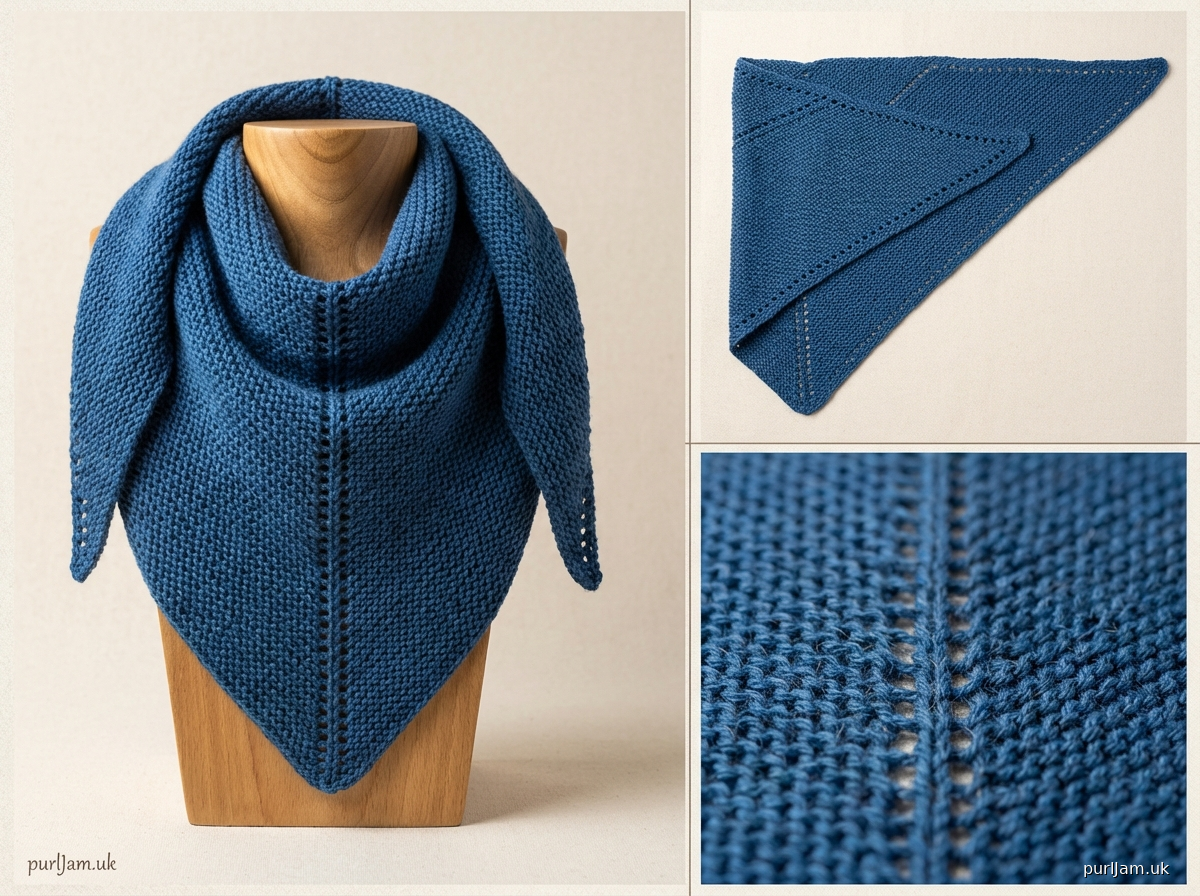
A simple triangular bandana perfect for beginners! This versatile accessory can be worn around your neck, as a headband, or even as a small pet neckerchief. Worked entirely in garter stitch from the top point down, this project teaches basic increasing techniques while creating a fun, wearable piece.

---

## **MATERIALS**

**Yarn**: Worsted weight (#4 Medium) yarn
- Approximately 300-350 yards
- Sample shown uses a solid or semi-solid color for best stitch definition

**Suggested yarns**: Lion Brand Wool-Ease, Red Heart Super Saver, Cascade 220, or any worsted weight yarn

**Needles**: US 8 (5 mm) straight or circular needles (24" or longer for holding many stitches), or size needed to obtain gauge

**Notions**:
- Stitch markers (optional, but helpful)
- Tapestry needle for weaving in ends
- Scissors

---

## **GAUGE**

18 stitches and 36 rows = 4" (10 cm) in garter stitch (knit every row), after blocking

**Gauge is important!** If you have more stitches per 4", use larger needles. If you have fewer stitches per 4", use smaller needles.

To check gauge: Cast on 24 sts, knit every row for 5", bind off. Measure the center 4" square.

---

## **FINISHED MEASUREMENTS**

Width (along top edge): approximately 50" (127 cm)
Depth (from top point to center of bottom edge): approximately 25" (63.5 cm)

---

## **ABBREVIATIONS**

- k = knit
- yo = yarn over (wrap yarn around right needle to create a new stitch and decorative eyelet)
- RS = right side
- WS = wrong side
- st(s) = stitch(es)

---

## **PATTERN NOTES**

- This bandana is worked flat from the top point down in garter stitch (knit every row).
- Increases are made using yarn overs (yo), which create small decorative eyelets along the center spine and edges.
- Stitch count is provided at the end of key rows in parentheses.
- Right side (RS) rows are odd-numbered rows; wrong side (WS) rows are even-numbered rows.
- In garter stitch, both sides look the same, so your bandana is reversible!
- A circular needle is recommended to hold the large number of stitches comfortably, but you'll still work back and forth in rows (not in the round).

---

## **INSTRUCTIONS**

### Setup

**Cast on 3 sts** using your preferred cast-on method (long-tail cast-on recommended).

### Increase Section

**Row 1 (RS)**: K1, yo, k1, yo, k1. **(5 sts)**

**Row 2 (WS)**: Knit all sts. **(5 sts)**

**Row 3 (RS)**: K2, yo, k1, yo, k2. **(7 sts)**

**Row 4 (WS)**: Knit all sts. **(7 sts)**

**Row 5 (RS)**: K3, yo, k1, yo, k3. **(9 sts)**

**Row 6 (WS)**: Knit all sts. **(9 sts)**

**Pattern established!** You are now increasing 2 stitches on each side of the center stitch, adding 4 stitches total every RS row.

**Continue in pattern as established:**

**RS rows**: K to 1 st before center st, yo, k1 (center st), yo, k to end. **(4 sts increased)**

**WS rows**: Knit all sts.

**Tip**: Place a removable stitch marker in the center stitch on Row 1 and move it up every few rows to help you find the center easily!

### Working to Final Size

Continue working RS and WS rows as established until you have **225 sts** total.

This will take approximately **111 increase rows** (RS rows) plus **111 WS rows** = **222 rows total** from cast-on.

**Stitch count checkpoints** (after completing the RS row):
- After Row 21: 45 sts
- After Row 41: 85 sts
- After Row 61: 125 sts
- After Row 81: 165 sts
- After Row 101: 205 sts
- After Row 111: 225 sts ✓

**Math verification**: 3 beginning sts + (4 sts increased per RS row × 111 RS rows) = 3 + 444 = 447...

**CORRECTION**: Let me recalculate: Starting with 3 sts, after Row 1 (first increase row) = 5 sts. Pattern increases 4 sts every RS row.
- Row 1: 5 sts (increased 2)
- Row 3: 7 sts
- Row 5: 9 sts
- Formula: Sts = 3 + (2 × row number) for RS rows
- To reach 225 sts: 225 = 3 + (2 × number of RS rows completed after setup)
- 222 = 2 × RS rows; 111 = number of RS increase rows

After **Row 221 (RS)**: you should have **225 sts**.

**Row 222 (WS)**: Knit all sts. **(225 sts)**

---

## **FINISHING**

### Bind Off

**Bind off all sts loosely** on the next row.

**Tip**: Use a larger needle (one or two sizes up) for binding off to ensure the edge has enough stretch to match the rest of the fabric.

### Weaving in Ends

Using your tapestry needle, weave in all yarn ends on the wrong side of the work. Since garter stitch is reversible, choose which side you prefer as the "wrong" side.

### Blocking

For best results, wet block your bandana:
1. Soak in cool water with a little wool wash for 15-20 minutes
2. Gently squeeze out excess water (don't wring)
3. Roll in a towel to remove more moisture
4. Lay flat on a blocking mat or towels
5. Pin into a triangle shape, stretching gently to even out stitches
6. Allow to dry completely (24-48 hours)

### Wearing Your Bandana

**As a neck scarf**: Fold in half along the center spine, wrap around neck with point at front, and tie ends at back.

**As a headscarf**: Fold along center spine, place wide edge along forehead, and tie ends at nape of neck.

**As a kerchief**: Wear with point at back and tie at front of neck.

---

## **PATTERN SUPPORT**

If your stitch count doesn't match the checkpoints:
- Count carefully, including the yarn overs
- Make sure you're knitting every stitch on WS rows (easy to miss the yarn overs)
- Check that you're placing yarn overs on both sides of center stitch each RS row

**Congratulations on completing your bandana!**

---

*Pattern © 2024. For personal use only.*
Disclaimer: This pattern was generated by AI and should be reviewed for accuracy before use. While we strive for quality, AI-generated content may contain errors. Please verify measurements, stitch counts, and instructions before beginning your project. Generated by purlJam.uk
Access your pattern anytime
Bookmark this page to access your pattern anytime