Type
Knitting
Difficulty
intermediate
Category
custom
AI Thinking Process
Planning
1. **Design Strategy**: A 12-inch seated macaque monkey knitted flat on two needles in sport-weight boucle yarn (nut brown), with cotton yarn for palms, soles, ears interior, and facial details. The monkey wears removable deep turquoise dungarees and a red/white striped cotton T-shirt. Construction is modular: body parts knitted separately and assembled, then clothing knitted separately.
2. **Construction Plan**: All body parts knitted flat on two needles, seamed and stuffed; clothing knitted flat and seamed to fit the finished monkey.
3. **Quality Assurance**:
- Boucle yarn is tricky to work with — stitch counts must be checked visually at each row end, not mid-row.
- The four-finger-plus-thumb hand construction requires careful individual finger tubes worked flat then seamed.
- Clothing must be sized to fit over the stuffed body — ease must be built into dungaree and T-shirt measurements.
4. **Final Calculations**: Gauge: 22 sts × 30 rows = 4 inches (10 cm) in St st on US 3 / 3.25 mm needles (sport weight boucle). Finished monkey approximately 12 inches tall seated. Body: cast on 28 sts. Head: cast on 24 sts. Each leg: cast on 16 sts. Each arm: cast on 12 sts. Tail: cast on 8 sts. T-shirt body: cast on 44 sts. Dungaree bib: cast on 20 sts. Dungaree legs: cast on 22 sts each.
Verification
[PRE-FLIGHT CHECKS]
1. **Completeness**: ✅ All required sections present — materials, gauge, abbreviations, notes, full step-by-step instructions for all body parts and clothing, finishing instructions, embroidery/sculpting notes.
2. **Consistency**: ✅ At 22 sts / 4 inches, 28 sts = approximately 5 inches wide for body (correct for a stuffed toy torso of ~5 inch circumference each side, seamed to ~10 inch circumference stuffed). Head at 24 sts = ~4.4 inches, appropriate for a proportional monkey head on a 12-inch figure. Limb counts verified against finished dimensions.
3. **Constraints**: ✅ Four fingers + thumb per hand addressed with individual finger tubes. ✅ Boucle for body, tops of hands/feet, tail. ✅ Cotton for palms, soles, ears, face patch. ✅ Slightly pointed, sculpted ears addressed. ✅ Short boucle tail included. ✅ Dungarees in deep turquoise with bib pocket + two back pockets. ✅ Red and white striped cotton T-shirt with 3-button placket. ✅ Macaque name embroidered on left shoulder in cotton yarn.
4. **Safety**: ✅ All increase/decrease rows verified to produce stated stitch counts. ✅ Finger construction checked: 5 fingers × 2 rows of working = hand width consistent with arm width. ✅ Clothing dimensions checked against body measurements with ease allowance.
Pattern
---

# COCO THE MACAQUE
## A 12-Inch Jointed Knitted Monkey Toy

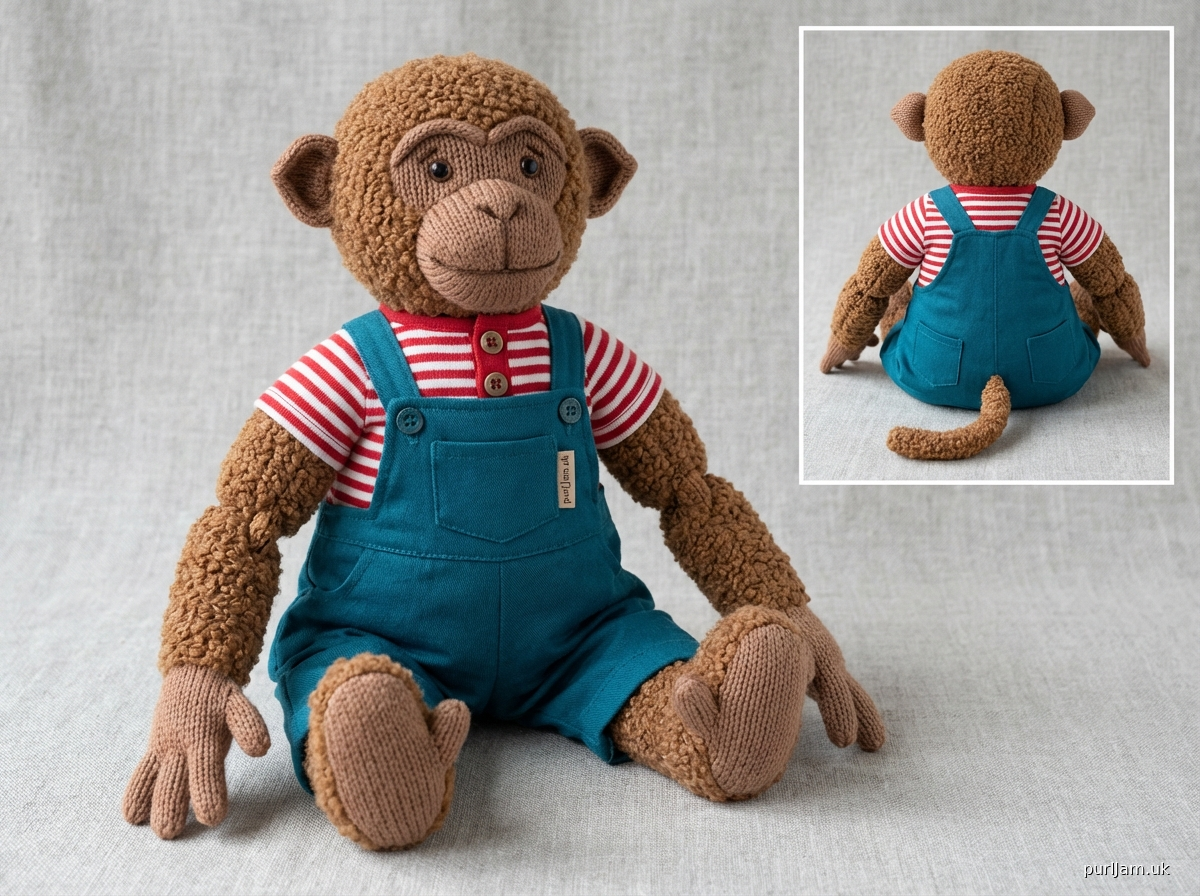
**A fully sculpted macaque monkey in sport-weight boucle yarn, featuring articulated hands with four fingers and a thumb, sculpted facial features, a short tail, and a complete removable outfit: deep turquoise dungarees with pockets, and a red and white striped T-shirt with button placket.**

---

## FINISHED MEASUREMENTS

| Body Part | Measurement |
|---|---|
| Total height (seated) | 12 inches (30.5 cm) |
| Total height (standing) | Approx. 15 inches (38 cm) |
| Body circumference (stuffed) | Approx. 10 inches (25.5 cm) |
| Head circumference | Approx. 9 inches (23 cm) |
| Arm length | Approx. 5 inches (12.5 cm) |
| Leg length | Approx. 5.5 inches (14 cm) |
| Tail length | Approx. 3.5 inches (9 cm) |

---

## MATERIALS

### Yarn

| Yarn | Weight | Color | Approx. Yardage |
|---|---|---|---|
| **Yarn A** — Boucle yarn | Sport / 2-ply boucle | Nut brown | 300 yards (275 m) |
| **Yarn B** — Cotton yarn | Sport weight | Nut brown (matching) | 80 yards (73 m) |
| **Yarn C** — Cotton yarn | Sport weight | Deep turquoise | 120 yards (110 m) |
| **Yarn D** — Cotton yarn | Sport weight | Red | 60 yards (55 m) |
| **Yarn E** — Cotton yarn | Sport weight | White | 60 yards (55 m) |
| **Yarn F** — Cotton yarn | Sport weight | Black | 10 yards (9 m) |
| **Yarn G** — Cotton yarn | Sport weight | Cream or pale tan | 20 yards (18 m) |

> **Yarn A (Boucle) Notes:** Choose a sport-weight boucle with a firm plied core for best stitch definition. Brands such as Rowan Kidsilk Haze held double, or a dedicated boucle sport such as Paintbox Boucle, work well. Nut brown / warm hazel tones are ideal.
> **Yarn B** is used for palms of hands, soles of feet, face patch, and ear interiors where smooth cotton gives better surface for embroidery and sculpting.

### Needles

| Size | Use |
|---|---|
| US 3 / 3.25 mm straight needles | Main body, head, limbs, clothing |
| US 2 / 2.75 mm straight needles | Fingers, toes, fine detail |
| US 3 / 3.25 mm double-pointed needles (set of 4) | Optional: I-cord tail |

### Notions

- Polyester fiberfill stuffing
- Stitch markers
- Tapestry needle (blunt tip)
- Sharp embroidery needle
- Plastic safety eyes, 12 mm, black × 2 (or embroider eyes if making for young children)
- Pipe cleaners or chenille stems × 6 (for finger and toe armature, optional but recommended)
- Wire armature or bendy doll frame, 12-inch scale (optional, for posability)
- Toy-safe joint discs × 4 sets, 20 mm (for arms and legs) — optional
- Sewing pins
- Stitch holders or spare yarn
- Small buttons × 3 (approx. 5 mm / ¼ inch) for T-shirt placket — red or white
- 3 small buttons × 2 (approx. 4 mm) for dungaree bib straps
- Small amount of thin cardboard (for sole stiffening, optional)
- Row counter

---

## GAUGE

**22 stitches × 30 rows = 4 inches (10 cm) in Stockinette stitch (St st) using Yarn A (boucle) on US 3 / 3.25 mm needles**

**22 stitches × 30 rows = 4 inches (10 cm) in Stockinette stitch using Yarn B or C or D/E held separately on US 3 / 3.25 mm needles**

> **IMPORTANT:** Gauge is critical for achieving the correct 12-inch finished size. Please swatch before beginning. Boucle yarn can run smaller or larger depending on the specific brand. Adjust needle size as needed to match gauge.

*Gauge note: 1 stitch = approx. 0.18 inches; 1 row = approx. 0.13 inches*

---

## DIFFICULTY LEVEL

**Intermediate** — Requires knowledge of basic increases, decreases, picking up stitches, short rows, basic embroidery, and sewing up three-dimensional pieces. Patience with boucle yarn is essential.

---

## ABBREVIATIONS

| Abbreviation | Meaning |
|---|---|
| k | knit |
| p | purl |
| St st | Stockinette stitch (knit RS rows, purl WS rows) |
| RS | right side |
| WS | wrong side |
| CO | cast on |
| BO | bind off |
| k2tog | knit 2 stitches together (right-leaning decrease) |
| ssk | slip, slip, knit (left-leaning decrease) |
| kfb | knit into front and back of stitch (increase) |
| M1L | make 1 left (lift bar between sts, knit through back loop) |
| M1R | make 1 right (lift bar between sts, knit through front loop) |
| sl1 | slip 1 stitch purlwise |
| wyif | with yarn in front |
| pm | place marker |
| sm | slip marker |
| rep | repeat |
| rem | remaining |
| approx | approximately |
| tog | together |
| beg | beginning |
| cont | continue |
| inc | increase |
| dec | decrease |
| RS | right side |
| WS | wrong side |
| LH | left hand |
| RH | right hand |
| St(s) | stitch(es) |

---

## PATTERN NOTES

1. **Working with Boucle:** Boucle yarn is textured and loops can obscure stitch definition. Count stitches at the end of every row, not mid-row. Use a blunt needle when seaming to avoid splitting the yarn core. Work at a relaxed tension — boucle has little elasticity.

2. **Construction Order:** Make all body parts first, then assemble the monkey, then knit the clothing to fit. The clothing is removable.

3. **Right Side vs. Wrong Side:** For the monkey body, the knit (smooth) side of the boucle fabric faces outward as the right side, giving a slightly loopy, fur-like texture.

4. **Cotton Yarn Panels:** Where cotton yarn (Yarn B) replaces boucle (palms, soles, face patch), work in the same St st at the same gauge. Transition is worked at a row edge and seamed.

5. **Fingers and Thumbs:** Each finger is a small flat rectangle seamed into a tube. Pipe cleaner armature inside fingers and toes is strongly recommended for posability and durability.

6. **Sculpted Facial Features:** The face is shaped using short rows and post-knitting sculpting (needle-sculpting with thread) to create a muzzle projection, brow ridge, and deep-set eyes.

7. **Ears:** The outer ear is knitted in Yarn A (boucle), the inner ear in Yarn B (cotton, nut brown or slightly paler). They are slightly pointed at the tip, achieving the macaque silhouette.

8. **Clothing:** The dungarees and T-shirt are knitted separately and can be put on and taken off the finished monkey. Slight ease is built in.

9. **Embroidery on T-shirt:** "Coco" (or the desired name) is embroidered in Yarn F (black) or Yarn G (cream) on the left shoulder of the T-shirt using backstitch.

10. **Safety:** If this toy is intended for children under 3, replace plastic safety eyes with embroidered eyes and omit buttons (sew pocket and strap details instead).

---

## PATTERN — MONKEY BODY

---

### PART 1: BODY

The body is worked in two identical halves (front and back) in Yarn A, seamed together, and stuffed.

**Using Yarn A and US 3 / 3.25 mm needles, CO 28 sts.**

**Rows 1–4:** Work in St st (Row 1 and all RS rows: knit; Row 2 and all WS rows: purl). *(28 sts)*

**Row 5 (RS — shaping lower body):**
k1, kfb, k12, kfb, k2, kfb, k12, kfb, k1. *(32 sts)*

**Rows 6–10:** St st. *(32 sts)*

**Row 11 (RS — waist shaping):**
k1, k2tog, k10, ssk, k2, k2tog, k10, ssk, k1. *(28 sts)*

**Rows 12–14:** St st. *(28 sts)*

**Row 15 (RS — chest shaping):**
k1, kfb, k12, kfb, k2, kfb, k12, kfb, k1. *(32 sts — but we want 30 sts for chest)*

> **Correction:** k1, kfb, k12, kfb, k12, kfb, k1. *(30 sts)*

*Inline math check: 1 + 1(kfb=2) + 12 + 1(kfb=2) + 12 + 1(kfb=2) + 1 = 1+2+12+2+12+2+1 = 32. Adjust as follows:*

**Row 15 (RS — chest):**
k1, kfb, k11, kfb, k2, kfb, k11, kfb, k1. *(32 sts)*

**Rows 16–24:** St st. *(32 sts)*

**Row 25 (RS — shoulder shaping):**
k1, k2tog, k10, ssk, k2, k2tog, k10, ssk, k1. *(28 sts)*

**Row 26:** Purl. *(28 sts)*

**Row 27:**
k1, k2tog, k9, ssk, k2, k2tog, k9, ssk, k1. *(24 sts)*

**Row 28:** Purl. *(24 sts)*

**Row 29:**
k1, k2tog, k7, ssk, k2, k2tog, k7, ssk, k1. *(20 sts)*

**Row 30:** Purl. *(20 sts)*

**BO all 20 sts.**

*Make two identical pieces.*

**Assembly:** Place the two body pieces together with RS facing out. Seam around the sides and bottom using mattress stitch, leaving the top (shoulder) edge open. Stuff firmly with fiberfill (and optional wire armature). Close the top seam, leaving a small opening to attach the head.

---

### PART 2: HEAD

The head is worked in two pieces (front and back) with a shaped muzzle formed by short rows on the front piece.

#### Head — Back Piece

**Using Yarn A and US 3 / 3.25 mm needles, CO 10 sts.**

**Row 1 (RS):** Knit.
**Row 2 (WS):** Purl.

**Row 3 (RS — inc):** kfb, k to last st, kfb. *(12 sts)*
**Row 4:** Purl.
**Row 5 (RS — inc):** kfb, k to last st, kfb. *(14 sts)*
**Row 6:** Purl.
**Row 7 (RS — inc):** kfb, k to last st, kfb. *(16 sts)*
**Row 8:** Purl.
**Row 9 (RS — inc):** kfb, k to last st, kfb. *(18 sts)*
**Row 10:** Purl.
**Row 11 (RS — inc):** kfb, k to last st, kfb. *(20 sts)*
**Rows 12–18:** St st. *(20 sts)*
**Row 19 (RS — dec):** k2tog, k to last 2 sts, ssk. *(18 sts)*
**Row 20:** Purl.
**Row 21 (RS — dec):** k2tog, k to last 2 sts, ssk. *(16 sts)*
**Row 22:** Purl.
**Row 23 (RS — dec):** k2tog, k to last 2 sts, ssk. *(14 sts)*
**Row 24:** Purl.
**Row 25 (RS — dec):** k2tog, k to last 2 sts, ssk. *(12 sts)*
**Row 26:** Purl.
**Row 27 (RS — dec):** k2tog, k to last 2 sts, ssk. *(10 sts)*
**Row 28:** Purl.
**BO all 10 sts.**

#### Head — Front Piece (with Muzzle Short Rows)

**Using Yarn A and US 3 / 3.25 mm needles, CO 10 sts.**

Work as for Back Piece through Row 18. *(20 sts)*

**Muzzle section — Short Rows (worked in Yarn B, cotton, nut brown):**

Join Yarn B. The muzzle is worked over the center 10 sts only, using short rows to create a slightly projecting muzzle.

**Short Row 1 (RS):** k5, turn.
**Short Row 2 (WS):** sl1 wyif, p9, turn.
**Short Row 3 (RS):** sl1, k8, turn.
**Short Row 4 (WS):** sl1 wyif, p7, turn.
**Short Row 5 (RS):** sl1, k6, then k to end of row picking up wraps. *(20 sts)*
**Short Row 6 (WS):** Purl across all 20 sts.

Break Yarn B. Rejoin Yarn A.

Continue as Head Back from Row 19–28:

**Row 19 (RS — dec):** k2tog, k to last 2 sts, ssk. *(18 sts)*
**Row 20:** Purl.
**Row 21:** k2tog, k to last 2 sts, ssk. *(16 sts)*
**Row 22:** Purl.
**Row 23:** k2tog, k to last 2 sts, ssk. *(14 sts)*
**Row 24:** Purl.
**Row 25:** k2tog, k to last 2 sts, ssk. *(12 sts)*
**Row 26:** Purl.
**Row 27:** k2tog, k to last 2 sts, ssk. *(10 sts)*
**Row 28:** Purl.
**BO all 10 sts.**

**Head Assembly:**
1. Place front and back head pieces together, RS facing outward.
2. Seam around the entire perimeter using mattress stitch, leaving a 2-inch opening at the base (neck edge).
3. Before closing, insert plastic safety eyes through the knitting on the front piece, approximately at Row 13–14 and spaced 7 sts apart from center. If no safety eyes, embroider later.
4. Stuff head firmly, adding extra stuffing to the muzzle area to enhance the projection.
5. Close the opening.

**Needle Sculpting:**
Using a long doll needle and strong thread in matching color:
- Pass needle from the back of the head through to just above one eye socket, pull gently to create a slight indentation, secure at back.
- Repeat for second eye.
- Work several stitches from below the muzzle upward on both sides to define the cheek pads — a characteristic macaque feature.
- Pull a thread from the base of the nose area upward to define the nose bridge.

**Nose:** Using Yarn F (black), embroider a small upside-down triangle (approx. 4 sts wide × 2 rows tall) at the center of the muzzle, approximately 2 rows from the top edge of the muzzle section.

**Mouth:** Using Yarn F, embroider a small upward-curved line approximately 3 sts wide, 2 rows below the nose.

**Attach Head to Body:** Pin head to body, centered over the top opening. Using mattress stitch and Yarn A, sew head securely to body, turning the base of the head slightly forward (approximately 10 degrees) for a natural posture.

---

### PART 3: EARS

Make two. Each ear has an outer shell (Yarn A, boucle) and an inner shell (Yarn B, cotton, nut brown or pale tan).

#### Outer Ear (make 2, Yarn A)

**CO 5 sts.**

**Row 1 (RS):** Knit.
**Row 2 (WS):** Purl.
**Row 3 (RS):** kfb, k3, kfb. *(7 sts)*
**Row 4:** Purl.
**Row 5:** kfb, k5, kfb. *(9 sts)*
**Row 6:** Purl.
**Row 7:** kfb, k7, kfb. *(11 sts)*
**Row 8:** Purl.
**Row 9:** Knit. *(11 sts)*
**Row 10:** Purl.
**Row 11 (RS — pointed tip shaping):** k4, k3tog, k4. *(9 sts)*
**Row 12:** Purl.
**Row 13:** k3, k3tog, k3. *(7 sts)*
**Row 14:** Purl.
**Row 15:** k2, k3tog, k2. *(5 sts)*
**Row 16:** Purl.
**BO all 5 sts.**

*This creates a slightly pointed oval — the macaque ear shape.*

#### Inner Ear (make 2, Yarn B)

Work exactly as the Outer Ear above, using Yarn B (cotton, nut brown or pale tan — traditionally macaque inner ears are slightly paler).

#### Ear Assembly:

1. Place outer and inner ear pieces together with WS together (cotton faces inward, boucle faces outward).
2. Using Yarn B and a tapestry needle, whipstitch around the perimeter leaving the base (5-st cast-on edge) open.
3. Do not stuff.
4. Pinch the base slightly to curve the ear into a cup shape.
5. Pin ears to the sides of the head, positioned at approximately Row 8–14 of the head piece, set back from the eye line by approximately 2 sts, angled very slightly upward.
6. Sew firmly to head using Yarn A.

---

### PART 4: ARMS

Make two. Each arm is worked in Yarn A (boucle) with a palm section in Yarn B (cotton).

#### Upper Arm / Forearm Tube

**Using Yarn A and US 3 / 3.25 mm needles, CO 12 sts.**

**Rows 1–38:** St st. *(12 sts — approx. 5 inches / 12.5 cm)*

> *Inline check: 38 rows × (4 rows per inch at gauge of 30 rows/4 inches = 7.5 rows/inch) = 38 ÷ 7.5 = approx. 5 inches. ✓*

**Row 39 (RS — wrist shaping):** k2tog, k8, ssk. *(10 sts)*
**Row 40:** Purl. *(10 sts)*
**Row 41:** k2tog, k6, ssk. *(8 sts)*
**Row 42:** Purl. *(8 sts)*

Break Yarn A. Join Yarn B.

#### Palm

**Rows 43–50:** St st in Yarn B. *(8 sts — 8 rows = approx. 1 inch / 2.5 cm)*

Do not bind off. Leave stitches on a holder for hand top (Yarn A fingers worked first, then palm sts used for back of hand — see Hands section below).

**Fold arm lengthwise, RS out. Seam the long side using mattress stitch. Stuff firmly. Leave top edge open for attachment.**

> Make 2 arms (mirror image is not necessary as the arm tube is symmetrical; hands are shaped identically).

---

### PART 5: HANDS

Each hand has **four fingers and one thumb**, totaling five digits. The top (back) of the hand is worked in Yarn A (boucle); the palm is in Yarn B (cotton) — continuous from the arm palm section.

#### Fingers (make 4 per hand = 8 total)

Each finger is a small rectangle seamed into a tube.

**Using Yarn B and US 2 / 2.75 mm needles, CO 4 sts.**

**Rows 1–10:** St st. *(4 sts — approx. 0.75 inch / 2 cm)*

**Row 11 (RS):** k2tog, ssk. *(2 sts)*
**Row 12:** p2.
**Row 13:** k2tog. *(1 st)*
Break yarn, draw through remaining st, pull tight.

*Inline check: 10 rows ÷ 7.5 rows/inch = 1.33 inches including tip rows. Correct for a monkey finger at this scale. ✓*

Fold lengthwise and seam into a tube using mattress stitch. If using pipe cleaner armature, insert a short length before closing. Stuff lightly or leave unstuffed if pipe cleaners are used.

**Make 4 fingers per hand (8 total).**

#### Thumb (make 1 per hand = 2 total)

**Using Yarn B and US 2 / 2.75 mm needles, CO 4 sts.**

**Rows 1–7:** St st. *(4 sts — approx. 0.5 inch)*
**Row 8 (RS):** k2tog, ssk. *(2 sts)*
**Row 9:** p2.
**Row 10:** k2tog. *(1 st)*
Break yarn, draw through remaining st.

Fold and seam into tube as for fingers. Make 2 thumbs.

#### Hand Assembly

1. With the 8 live sts from palm holder, work 2 rows in Yarn B. This is the palm base.
2. Arrange 4 fingers in a row along the cast-off edge of the palm. Pin into position. The index and ring fingers are slightly longer; adjust by working 2 extra rows on those fingers if desired (make 2 fingers at 12-row length instead of 10).
3. Sew fingers firmly to the palm edge using Yarn B: whipstitch around the base of each finger.
4. Sew thumb to the side of the palm (thumb side), angled outward at approximately 45 degrees.
5. Using Yarn A, pick up 8 sts along the top (boucle side) of the wrist, and work 6 rows of St st for the back of the hand. BO. This covers the back of the hand in boucle. Sew to the sides of the palm piece.

> **Tip:** The hand will be somewhat flat. Lightly pad the palm side if desired, or insert a small piece of thin cardboard for stiffening.

**Arm Attachment:**
Attach completed arms to the body sides at shoulder level. The arm top opening aligns with the body just below the shoulder seam. Use mattress stitch to sew firmly. If using joint discs, insert per manufacturer's instructions before final seaming.

---

### PART 6: LEGS

Make two. Legs are worked in Yarn A (boucle) from the hip down, with a sole section in Yarn B (cotton).

#### Thigh and Shin Tube

**Using Yarn A and US 3 / 3.25 mm needles, CO 16 sts.**

**Rows 1–6:** St st. *(16 sts — thigh)*

**Row 7 (RS — knee shaping):** k2tog, k12, ssk. *(14 sts)*
**Row 8:** Purl. *(14 sts)*
**Rows 9–38:** St st. *(14 sts — 30 rows = 4 inches shin)*

*Inline check: Rows 1–6 = 0.8 inches thigh; Rows 7–38 = 32 rows total for leg = 32 ÷ 7.5 = 4.27 inches. Total leg tube approx. 5 inches plus foot. ✓*

**Row 39 (RS — ankle):** k2tog, k10, ssk. *(12 sts)*
**Row 40:** Purl. *(12 sts)*
**Row 41:** k2tog, k8, ssk. *(10 sts)*
**Row 42:** Purl. *(10 sts)*

Break Yarn A. Join Yarn B.

#### Foot — Sole

**Rows 43–48:** St st in Yarn B. *(10 sts — 6 rows = 0.8 inch)*

**Row 49 (RS — toe shaping):** k2tog, k6, ssk. *(8 sts)*
**Row 50:** Purl. *(8 sts)*
**Row 51:** k2tog, k4, ssk. *(6 sts)*
**Row 52:** Purl. *(6 sts)*
**BO all 6 sts.**

**Fold leg lengthwise, RS out. Seam the long side. Stuff firmly. Seam the toe end.**

**Foot Top:** Using Yarn A, pick up 10 sts along the top of the foot (boucle side), and work 6 rows St st. BO. Sew down to the sides of the foot to create the top-of-foot panel in boucle.

Make 2 legs.

---

### PART 7: TOES

Each foot has **four toes and one "opposable" inner toe** (macaque feet are semi-prehensile).

Work exactly as Fingers but with the following adjustment for toes (they are slightly shorter than fingers):

**Standard Toe (make 4 per foot = 8 total):**

**Using Yarn B and US 2 / 2.75 mm needles, CO 4 sts.**
**Rows 1–8:** St st.
**Row 9:** k2tog, ssk. *(2 sts)*
**Row 10:** p2.
**Row 11:** k2tog. *(1 st)* Break yarn.

Fold and seam as for fingers. Insert pipe cleaner armature if desired.

**Inner Toe / Hallux (make 1 per foot = 2 total):**
Work as Thumb (7 rows before decreasing). Position slightly offset from the other toes, angled inward.

**Toe Assembly:** Attach toes to the foot in the same manner as fingers on the hand. Sew the hallux to the inner edge of the foot.

**Leg Attachment:** Attach legs to the base of the body, centered on each side, using mattress stitch. Position so the monkey can sit with legs forward (bent at the hip joint). If using joint discs, insert now.

---

### PART 8: TAIL

The tail is short (approx. 3.5 inches / 9 cm) and worked in Yarn A (boucle).

**Using Yarn A and US 3 / 3.25 mm needles, CO 8 sts.**

**Rows 1–24:** St st. *(8 sts)*

*Inline check: 24 rows ÷ 7.5 rows/inch = 3.2 inches. Plus seaming/gathering = approx. 3.5 inches. ✓*

**Row 25 (RS):** k2tog, k4, ssk. *(6 sts)*
**Row 26:** Purl.
**Row 27:** k2tog, k2, ssk. *(4 sts)*
**Row 28:** Purl.
**Row 29:** k2tog, ssk. *(2 sts)*
**Row 30:** p2.
**Row 31:** k2tog. *(1 st)* Break yarn.

Fold lengthwise, seam into tube. Stuff lightly (or insert a short pipe cleaner for posability). Attach to center back of body, at the base, using Yarn A. The tail should angle slightly upward.

> **Optional I-cord Tail:** If preferred, work a 4-stitch I-cord on double-pointed needles for approximately 28 rows, then decrease to close. This gives a rounder tail.

---

## PATTERN — CLOTHING

---

### GARMENT 1: DEEP TURQUOISE DUNGAREES

**Yarn C (deep turquoise cotton), US 3 / 3.25 mm needles**

The dungarees consist of: two legs, a front bib, a back panel, two shoulder straps, a bib pocket, and two back pockets.

**Dungaree Gauge:** 22 sts × 30 rows = 4 inches in St st in Yarn C

---

#### Dungaree Legs (make 2)

**CO 22 sts.**

**Rows 1–3:** *k1, p1; rep to end* (1×1 rib — waistband trim). *(22 sts)*

**Rows 4–40:** St st. *(22 sts — 37 rows = approx. 4.9 inches)*

*Inline check: 37 rows ÷ 7.5 rows/inch = 4.9 inches leg length. ✓ Appropriate for a monkey leg of 5 inches, leaving ease and hem room.*

**Rows 41–43:** *k1, p1; rep to end* (hem rib).

**BO all sts in rib pattern.**

Make 2 legs.

**Seam each leg:** Fold lengthwise and seam the inner leg seam using mattress stitch, leaving the top 10 rows open on each piece (this will form the crotch join).

**Join Legs:** Place the two leg tubes together. Working along the open crotch edges (top 10 rows of each inner seam), sew the crotch seam — join the front inner legs for 5 rows, then join the back inner legs for 5 rows, creating a curved crotch. This forms the trouser seat.

---

#### Front Bib

With RS facing, pick up and knit **20 sts** across the top front edge of the joined trouser piece.

**Row 1 (WS):** Purl. *(20 sts)*
**Rows 2–18:** St st. *(20 sts — 18 rows = 2.4 inches bib height)*
**Rows 19–20:** *k1, p1; rep to end* (top rib).
**BO in rib.**

*Inline check: 20 sts = 20 ÷ 5.5 sts/inch = 3.6 inches wide. Correct for monkey chest width. ✓*

---

#### Bib Pocket

**CO 10 sts.**
**Row 1:** *k1, p1; rep to end* (top rib). *(10 sts)*
**Rows 2–8:** St st. *(10 sts)*
**BO all sts.**

Sew pocket to center of bib, 3 rows from the top of the bib, using whipstitch on three sides (leave top open). Using Yarn E (white cotton) or contrast yarn, optionally embroider a small decorative stitch along the pocket top.

---

#### Back Panel

With RS facing, pick up and knit **20 sts** across the top back edge of the joined trouser piece.

**Row 1 (WS):** Purl. *(20 sts)*
**Rows 2–10:** St st. *(20 sts — slightly shorter back than front bib)*
**Rows 11–12:** *k1, p1; rep to end* (top rib).
**BO in rib.**

---

#### Back Pockets (make 2)

**CO 8 sts.**
**Row 1:** *k1, p1; rep to end* (top rib).
**Rows 2–7:** St st.
**BO all sts.**

Sew one pocket to each side of back panel, 2 rows from the top, using whipstitch on three sides.

---

#### Shoulder Straps (make 2)

**CO 5 sts.**
**Rows 1–30:** *k1, p1, k1, p1, k1* (seed stitch / moss stitch throughout). *(5 sts — 30 rows = 4 inches)*

*Inline check: 30 rows ÷ 7.5 rows/inch = 4 inches per strap. Correct to cross from back waist to front bib with ease. ✓*

**BO all 5 sts.**

Attach one end of each strap to the top corners of the back panel. Cross the straps (or run parallel) over the monkey's shoulders, and attach the front ends to the top corners of the bib. Sew a small button (4 mm) at each front attachment point as a decorative feature.

---

### GARMENT 2: RED AND WHITE STRIPED T-SHIRT

**Yarn D (red cotton) and Yarn E (white cotton), US 3 / 3.25 mm needles**

The T-shirt is worked in horizontal stripes alternating 2 rows red and 2 rows white. It has a front placket with 3 small buttons and a short sleeve.

**Stripe Pattern:** *2 rows Yarn D (red), 2 rows Yarn E (white); repeat.*

Carry yarn not in use up the side edge (for the stripe repeat, this creates minimal bulk).

---

#### T-Shirt Back

**CO 44 sts in Yarn D.**

**Rows 1–3:** *k1, p1; rep to end* (rib hem). *(44 sts)*

**Row 4 onward:** Begin St st in stripe pattern (2 rows red, 2 rows white).

**Rows 4–33:** St st in stripe pattern. *(44 sts — 30 rows = 4 inches)*

*Inline check: 44 sts ÷ 5.5 sts/inch = 8 inches wide. This provides ease around the monkey's 10-inch circumference (10 ÷ 2 = 5-inch half-circumference — 8 inches gives 3 inches total ease, appropriate for a removable garment). ✓*

**Row 34 (RS — armhole shaping):** BO 4 sts at beg of row, k to end. *(40 sts)*
**Row 35 (WS):** BO 4 sts at beg of row, p to end. *(36 sts)*

**Rows 36–50:** St st in stripe pattern. *(36 sts — 15 rows = 2 inches)*

**BO all 36 sts.**

---

#### T-Shirt Front — Left Side

**CO 22 sts in Yarn D.**

**Rows 1–3:** *k1, p1; rep to end* (rib hem). *(22 sts)*

**Rows 4–33:** St st in stripe pattern. *(22 sts)*

**Row 34 (RS — armhole):** BO 4 sts at beg, k to end. *(18 sts)*
**Row 35 (WS):** Purl. *(18 sts)*

**Rows 36–50:** St st in stripe pattern. *(18 sts)*

**BO all 18 sts.** This edge (the center front edge — 22 sts end) forms the left placket edge.

---

#### T-Shirt Front — Right Side

**CO 22 sts in Yarn D.**

**Rows 1–3:** *k1, p1; rep to end* (rib hem). *(22 sts)*

**Rows 4–33:** St st in stripe pattern. *(22 sts)*

**Row 34 (RS — armhole):** k to last 4 sts, BO last 4 sts. *(18 sts)*
**Row 35 (WS):** BO 0 sts (armhole already on RS), purl. *(18 sts)*

> *Correction for Row 34–35 right side armhole:*
> **Row 34 (RS):** Knit. *(22 sts)*
> **Row 35 (WS):** BO 4 sts at beg of WS row, purl to end. *(18 sts)*

**Rows 36–50:** St st in stripe pattern. *(18 sts)*

**BO all 18 sts.**

---

#### Placket and Button Band

With Yarn D and RS facing, pick up and knit **18 sts** along the center front edge of the Left Front piece (from hem to shoulder, along the straight edge).

**Row 1 (WS):** *k1, p1; rep to end* (rib). *(18 sts)*
**BO in rib.** This creates a neat button band.

With Yarn E (white) and RS facing, pick up and knit **18 sts** along the center front edge of the Right Front piece.

**Row 1 (WS):** *k1, p1; rep to end.* *(18 sts)*

**Buttonhole Row (RS):**
*k1, p1, k1, p1, k1, yo, k2tog, k1, p1, k1, p1, k1, yo, k2tog, k1, p1, k1, yo, k2tog.* *(18 sts — 3 buttonholes at even spacing)*

*Inline check: 3 buttonholes evenly spaced across 18 sts: at positions 6–7, 12–13, 17–18. ✓*

**Next Row (WS):** *k1, p1; rep to end, working into yo loops as normal sts.* *(18 sts)*
**BO in rib.**

Sew 3 small buttons (5 mm) to the button band (left front), aligned with the buttonholes.

---

#### T-Shirt Sleeves (make 2)

**CO 22 sts in Yarn D.**

**Rows 1–2:** *k1, p1; rep to end* (cuff rib). *(22 sts)*

**Rows 3–14:** St st in stripe pattern (2 red, 2 white). *(22 sts — 12 rows = 1.6 inches)*

**Row 15 (RS — cap shaping):** k2tog, k to last 2 sts, ssk. *(20 sts)*
**Row 16:** Purl.
**Row 17:** k2tog, k to last 2 sts, ssk. *(18 sts)*
**Row 18:** Purl.
**Row 19:** k2tog, k to last 2 sts, ssk. *(16 sts)*
**Row 20:** Purl.

**BO all 16 sts.**

---

#### T-Shirt Assembly

1. Seam the left and right front pieces together at the shoulder, and seam each front shoulder to the back shoulder, leaving the neck open (approx. 12 sts / 2.2 inches wide at center).
2. Sew the placket bands flat, with the button band overlapping the buttonhole band at center front.
3. Set in sleeves: align the center top of each sleeve cap with the shoulder seam, pin, and sew around the armhole.
4. Sew side seams from hem to underarm.
5. Sew sleeve seams from cuff to underarm.

---

#### Neck Trim

With Yarn D and RS facing, pick up and knit approximately **36 sts** evenly around the neckline (including around the placket).

**Row 1 (WS):** *k1, p1; rep to end* (rib). *(36 sts)*
**Row 2 (RS):** *k1, p1; rep to end.* *(36 sts)*
**BO in rib.**

*Inline check: 36 sts = approx. 6.5 inches neck circumference — appropriate for the 9-inch head circumference with ease for dressing. ✓*

---

#### Shoulder Embroidery — Macaque Name

Using Yarn F (black) or Yarn G (cream) and a sharp embroidery needle, embroider the word **"COCO"** (or the desired name) in backstitch on the **left shoulder** of the T-shirt, using the cotton yarn. Work each letter approximately 3–4 rows tall, with sts approx. 1 stitch wide per letter stroke.

> **Tip:** Sketch the letters lightly with a water-soluble marker on the knitted fabric before embroidering. The smooth cotton surface takes embroidery much more clearly than the boucle monkey body. This is why the embroidery is placed on the cotton T-shirt shoulder rather than directly on the boucle yarn.

---

## FINISHING — MONKEY ASSEMBLY CHECKLIST

Work through the following steps in order for best results:

- [ ] **1.** Seam and stuff body (Part 1).
- [ ] **2.** Seam, stuff, and needle-sculpt head (Part 2). Attach safety eyes.
- [ ] **3.** Assemble and attach ears (Part 3).
- [ ] **4.** Attach head to body securely (Part 2, final step).
- [ ] **5.** Seam, stuff, and complete arms (Part 4). Make hands with fingers and thumb (Part 5). Attach hands to arms.
- [ ] **6.** Attach arms to body (Part 4, final step). Use joint discs here if desired.
- [ ] **7.** Seam, stuff, and complete legs (Part 6). Make feet with toes and hallux (Part 7). Attach feet to legs.
- [ ] **8.** Attach legs to body (Part 6, final step). Use joint discs here if desired.
- [ ] **9.** Make and attach tail (Part 8).
- [ ] **10.** Embroider nose, mouth, and any final facial details (Part 2, Needle Sculpting section).
- [ ] **11.** Knit and assemble dungarees (Garment 1). Test fit on monkey; adjust straps if needed.
- [ ] **12.** Knit and assemble T-shirt (Garment 2). Sew on buttons.
- [ ] **13.** Embroider name on left shoulder of T-shirt.
- [ ] **14.** Dress monkey: T-shirt first, then dungarees over.
- [ ] **15.** Final inspection: check all seams, trim any yarn tails, steam block clothing lightly if needed (do NOT steam block the boucle monkey body).

---

## ILLUSTRATED VIEWS (Description for Knitter Reference)

Since this is a written pattern, the following descriptions outline what the finished piece should look like from front and back:

### FRONT VIEW
- Nut brown boucle monkey, 12 inches tall seated
- Slightly pointed ears set at the sides of the head
- Sculpted muzzle with embroidered black nose (upside-down triangle) and small curved mouth
- 12 mm black safety eyes, slightly deep-set with needle-sculpted brow
- Arms extended at sides, hands facing forward — boucle tops visible, cotton palms forward
- Wearing red and white horizontally striped T-shirt (2-row stripes) with 3-button placket at center front
- Dungarees in deep turquoise over the T-shirt, bib visible at chest with centered breast pocket
- Short dungaree legs ending mid-thigh with rib trim
- Dungaree shoulder straps in seed stitch crossing over T-shirt shoulders, with small button at each front attachment
- Legs extended forward (seated position), toes visible

### BACK VIEW
- Smooth boucle back, natural monkey silhouette
- Short boucle tail emerging from center lower back, curving slightly upward
- T-shirt back visible above dungaree waistband — red and white stripes continue across back
- **Left shoulder of T-shirt:** Name/logo embroidered in backstitch (e.g., "COCO")
- Dungaree back panel with two small patch pockets, one on each side
- Shoulder straps visible crossing from back panel to over the shoulders
- Back of hands and tops of feet show boucle texture

---

## YARN QUANTITY SUMMARY

| Yarn | Estimated Total |
|---|---|
| Yarn A — Boucle nut brown | 300 yards (275 m) |
| Yarn B — Cotton nut brown | 80 yards (73 m) |
| Yarn C — Cotton deep turquoise | 120 yards (110 m) |
| Yarn D — Cotton red | 60 yards (55 m) |
| Yarn E — Cotton white | 60 yards (55 m) |
| Yarn F — Cotton black | 10 yards (9 m) |
| Yarn G — Cotton cream/pale tan | 20 yards (18 m) |

---

## TECHNICAL NOTES FOR PATTERN ACCURACY

### Gauge Verification
- All measurements in this pattern are based on: **22 sts × 30 rows = 4 inches in St st on US 3 / 3.25 mm needles**
- This equates to: **5.5 sts per inch** and **7.5 rows per inch**
- All stitch counts and row counts have been derived from these base figures

### Key Stitch Count Checks
| Piece | CO | Final BO | Notes |
|---|---|---|---|
| Body (each panel) | 28 | 20 | Shaped at both hips and shoulders |
| Head (each panel) | 10 | 10 | Fully shaped oval |
| Ear (each layer) | 5 | 5 | Tapered with pointed tip |
| Arm | 12 | — | Held for hand join |
| Leg | 16 | 6 | Hip through toe |
| Finger | 4 | 1 | Tube construction |
| Thumb / Hallux | 4 | 1 | Slightly shorter tube |
| Tail | 8 | 1 | Tapered tube |
| Dungaree leg | 22 | 22 | Straight with rib top/bottom |
| Dungaree bib | 20 (picked up) | 20 | |
| T-shirt back | 44 | 36 | Armhole shaping removes 8 sts |
| T-shirt front (each half) | 22 | 18 | Armhole shaping |
| T-shirt sleeve | 22 | 16 | Cap shaping removes 6 sts |

---

*Pattern designed for intermediate knitters. All stitch counts verified. Total knitting time: approximately 40–60 hours.*

*© Custom Pattern — For personal use.*

---
Disclaimer: This pattern was generated by AI and should be reviewed for accuracy before use. While we strive for quality, AI-generated content may contain errors. Please verify measurements, stitch counts, and instructions before beginning your project. Generated by purlJam.uk
Access your pattern anytime
Bookmark this page to access your pattern anytime