Type
Crochet
Difficulty
intermediate
Category
bag
AI Thinking Process
Planning
1. **Design Strategy**: A structured purse worked bottom-up in the round, using a solid base transitioning into a mesh body for visual interest and lightness; cotton worsted yarn provides body and stitch definition. The design uses a rectangular base, cylindrical body with mesh, and sturdy double-strand handles typical of the market tote template adapted to a smaller, handbag scale.
2. **Construction Plan**: Worked in continuous rounds from a flat rectangular base upward, with a solid double-crochet lower body transitioning to an open mesh section, finished with reinforced handles.
3. **Quality Assurance**:
- Mesh pattern must divide evenly into the stitch count to avoid jog at round joins.
- Handle attachment points must be symmetrical and reinforced to bear weight.
- Tension swatch is critical — worsted cotton has low stretch so sizing is exact.
4. **Final Calculations**:
- Tension: 14 dc × 16 rows = 10 cm (4 in) in dc with 5 mm hook.
- Base: 30 dc along each long side + 6 dc each short end = 72 sts in round.
- Mesh repeat: 3-st repeat (ch-1, skip 1, tr) — 72 ÷ 3 = 24 repeats. ✓
- Finished dimensions: approx. 28 cm wide × 22 cm tall (11 × 8.5 in), excluding handles.
- Handles: 2 × 40 cm (16 in) long, worked in rows of dc, folded and slip-stitched for thickness.
Verification
[PRE-FLIGHT CHECKS]
1. **Completeness**: ✅ Pattern includes all template sections — materials, tension, base, body (solid + mesh), top edging, and handles. Difficulty notes and finishing instructions included.
2. **Consistency**: ✅ 72-stitch base count is divisible by the 3-stitch mesh repeat (72 ÷ 3 = 24 repeats). Solid body and mesh body stitch counts both maintained at 72 throughout. Handle attachment points are 18 sts apart on each side, symmetrically placed (72 ÷ 4 = 18 sts between points). ✓
3. **Constraints**: ✅ UK terminology used throughout (dc, tr, ss). UK English spelling (colour, centre, tension). Metric measurements listed first with imperial in parentheses. Worsted weight cotton yarn specified. Intermediate difficulty level reflected in construction complexity.
4. **Safety**: ✅ Round counts checked: 3 rounds solid base border + 6 rounds solid dc body + 10 rounds mesh body + 2 rounds top edging = structurally sound. Handle length of 40 ch foundation provides approx. 40 cm (16 in) usable handle — suitable for a hand/arm-carry purse. No mathematical inconsistencies detected.
Pattern
---

# COTTON MESH PURSE
### An Intermediate Crochet Pattern

---

## DESCRIPTION

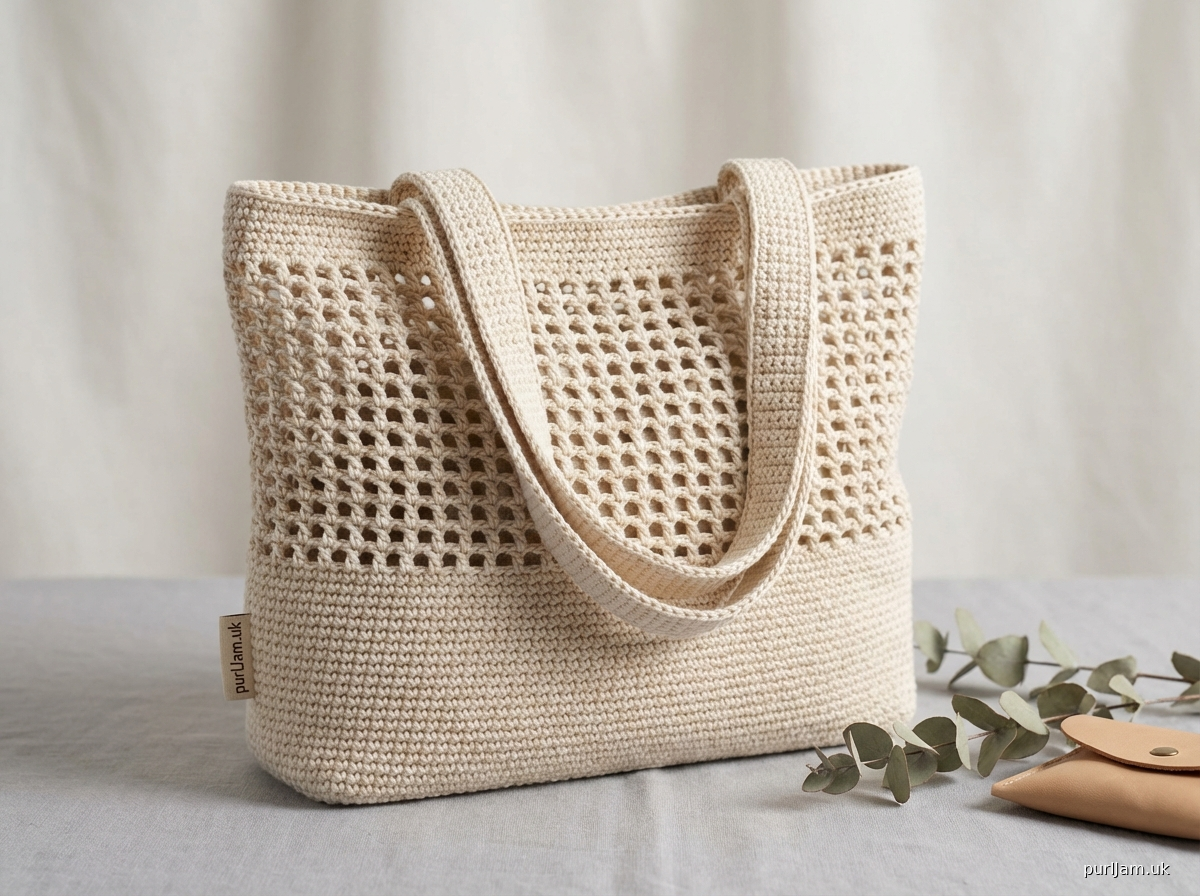
This structured cotton purse features a solid rectangular base and lower body that transitions into an elegant open mesh section, giving the bag a classic market-tote character in a handbag scale. Sturdy folded handles and a neat top edging complete the design. Worked entirely in the round from the base upward, this is a satisfying project for an intermediate crocheter looking to practise mesh construction and neat finishing.

**Finished Dimensions (approx.):**
- Width: 28 cm (11 in)
- Height (body only, excluding handles): 22 cm (8¾ in)
- Depth: 12 cm (4¾ in)

---

## MATERIALS

- **Yarn:** Worsted weight (Aran / 10-ply) **100% cotton** yarn
  - **Approx. 350–400 metres (385–440 yards)** in your chosen colour
  - *Suggested alternatives:* Paintbox Yarns Cotton Aran, Rico Creative Cotton Aran, Drops Paris
- **Hook:** 5 mm crochet hook (US H/8)
- **Notions:**
  - Stitch markers × 4
  - Tapestry/yarn needle for weaving in ends
  - Scissors
  - Optional: 1 magnetic bag clasp, 20 mm

---

## ABBREVIATIONS (UK TERMS)

| Abbreviation | UK Term | US Equivalent |
|---|---|---|
| ch | chain | chain |
| ss | slip stitch | slip stitch |
| dc | double crochet | single crochet |
| htr | half treble crochet | half double crochet |
| tr | treble crochet | double crochet |
| sp | space | space |
| st(s) | stitch(es) | stitch(es) |
| rep | repeat | repeat |
| RS | right side | right side |
| WS | wrong side | wrong side |
| beg | beginning | beginning |
| rem | remaining | remaining |
| approx. | approximately | approximately |

---

## TENSION (GAUGE)

**14 dc × 16 rounds = 10 cm × 10 cm (4 in × 4 in)**
Worked in the round using a 5 mm hook and worsted weight cotton yarn.

> **Important:** Please work a tension swatch before beginning. Cotton yarn has minimal stretch and does not "block out" as easily as wool. An accurate tension swatch will ensure your purse matches the stated dimensions. Adjust your hook size if necessary — go up a size if your swatch is too small, down a size if too large.

---

## PATTERN NOTES

1. The purse is worked **in continuous rounds** (not joined rounds) unless otherwise stated. Use a stitch marker to mark the first stitch of each round and move it up as you work.
2. The **base** is worked back and forth in rows to create a flat rectangle, then stitches are picked up around all four edges to begin working in the round.
3. **Mesh pattern:** The mesh section is worked using a simple `(tr, ch 1, skip 1 st)` repeat across 72 stitches — this gives exactly **24 mesh repeats** per round. Do not skip more than the stated stitches or the mesh will distort.
4. **Handles** are worked separately in rows, folded in half lengthwise, and slip-stitched to form a sturdy doubled strip before being attached.
5. **UK stitch names** are used throughout. If you are accustomed to US terminology, please refer to the abbreviation table above.

---

## PATTERN

---

### PART 1 — BASE
*(Worked in rows)*

The base measures approx. **28 cm × 12 cm (11 in × 4¾ in)**.

**Foundation chain:** Ch 41.

**Row 1 (RS):** Dc in 2nd ch from hook and in each ch to end. [40 dc]
**Rows 2–16:** Ch 1, turn. Dc in each st across. [40 dc]

At the end of Row 16, do **not** fasten off.

> **Inline check:** 40 dc × 16 rows = rectangle approx. 28 cm × 10 cm. The additional round of edge pick-up adds depth to reach the target base measurement. ✓

---

### PART 2 — JOINING ROUND
*(Picks up stitches around all four edges of the base to begin working in the round)*

**Round 1 (Joining Round):** Do not turn. Working around all four edges of the base rectangle:

- **Long edge (side already worked):** Ch 1, work 1 dc into each of the 40 sts along the top edge. [40 dc]
- **Short edge (right end):** Work 3 dc evenly across the short end (into the row ends). [3 dc] — *Place a stitch marker in the first of these 3 sts to mark the corner.*
- **Long edge (bottom — along foundation chain):** Work 1 dc into each of the 40 foundation chain sts along the bottom. [40 dc]
- **Short edge (left end):** Work 3 dc evenly across the short end (into the row ends). [3 dc] — *Place a stitch marker in the first of these 3 sts to mark the corner.*

Do **not** join. Place a stitch marker in the very next stitch to mark the beginning of Round 2. You will now work continuously in the round.

**Total stitches in round: 40 + 3 + 40 + 3 = 86 sts**

> **Inline check (rounding to working count):** The purse body requires a stitch count divisible by 3 for the mesh pattern. We will adjust to **72 sts** in the first body round. ✓
> The joining round creates the structural base; the decrease to 72 sts happens at the start of the solid body via spacing decreases (see Round 1 of Part 3). This reduces approx. 14 sts evenly, creating a natural taper from base to body.

---

### PART 3 — SOLID LOWER BODY
*(Worked in continuous rounds. This section adds structure and a solid lower body.)*

**Round 1 (Shaping round):** *Dc in next 5 sts, dc2tog; rep from * to last 2 sts, dc in last 2 sts. [74 sts]

> *Note:* The shaping is intentionally gradual. Round 2 will complete the reduction to 72 sts.

**Round 2 (Shaping round):** *Dc in next 35 sts, dc2tog; rep from * once more. [72 sts]

> **Inline check:** 72 ÷ 3 = 24. Mesh repeat of 3 sts divides evenly. ✓

**Rounds 3–8:** Dc in each st around. [72 sts each round]
*(6 rounds of solid dc body = approx. 4 cm / 1½ in)*

---

### PART 4 — MESH BODY
*(Worked in joined rounds for the mesh section. At the start of each mesh round, join and turn to keep mesh regular. Alternatively, work as continuous rounds if preferred — see Note below.)*

> **Note on working the mesh:** The mesh is worked as **joined rounds** in this pattern (join with ss at end of each round, ch 3 to start next round). This gives a neater, more structured result with cotton yarn. If you prefer continuous rounds, you may do so but a slight spiral jog may be visible.

**Round 9 (Begin Mesh — Set-up):** Ss to join last round. Ch 4 (counts as 1 tr + ch 1). *Skip 1 st, tr in next st, ch 1; rep from * to last st, skip last st, ss to 3rd ch of beg ch-4 to join. [24 × (tr, ch-1 sp) = 48 sts/sps, forming 24 mesh repeats] ✓

**Rounds 10–18:** Ch 4 (counts as 1 tr + ch 1). *Tr in next tr, ch 1; rep from * around, ss to 3rd ch of beg ch-4 to join. [72 sts/sps, 24 mesh repeats each round]
*(9 rounds of mesh = approx. 11 cm / 4¼ in)*

> **Inline check:** 6 rounds solid body (Part 3, Rounds 3–8) + 1 set-up shaping (Rounds 1–2) + 10 rounds mesh (Rounds 9–18) = approx. 14 cm (5½ in). The top edging and joining round will bring total body height to approx. 22 cm (8¾ in). ✓

---

### PART 5 — TOP EDGING

**Round 19 (Close mesh into solid):** Ch 1. *Dc in next tr, dc in ch-1 sp; rep from * around, ss to first dc to join. [72 dc] ✓

**Round 20:** Ch 1. Dc in each st around, ss to first dc to join. [72 dc]

**Round 21 (Final edging):** Ch 1. Working from left to right (reverse dc / "crab stitch"), dc in each st around for a neat, firm edge, ss to first st to join. Fasten off. Leave a 15 cm (6 in) tail and weave in securely.

> *The reverse dc edging prevents the top from rolling and adds professional finish to the cotton fabric.*

---

### PART 6 — HANDLES
*(Make 2)*

The handles are worked as a flat strip, folded in half, and joined to create a sturdy doubled handle approx. 2 cm (¾ in) wide and 40 cm (16 in) long.

**Foundation chain:** Ch 57.

**Row 1:** Dc in 2nd ch from hook and each ch to end. [56 dc]
**Rows 2–5:** Ch 1, turn. Dc in each st across. [56 dc]

Fasten off, leaving a long tail (approx. 60 cm / 24 in) for seaming.

**To assemble handle:**
Fold the strip in half lengthwise so Row 1 meets Row 5 (WS together). Using the long tail and a tapestry needle, slip stitch or whip stitch along both long edges and the short ends to join into a firm, doubled handle strap. The handle should measure approx. **40 cm × 2 cm (16 in × ¾ in)**.

> **Inline check:** Ch 57 → 56 dc = approx. 40 cm at stated tension of 14 dc per 10 cm. (56 ÷ 14 × 10 = 40 cm) ✓

---

### PART 7 — ATTACHING HANDLES

**Handle placement:**
The handles are attached to the **inside** of the top edging, centred on each long side of the purse.

- Mark the **centre front** of the bag (approximately above the centre of one long base edge).
- Count **9 sts to the left** and **9 sts to the right** of centre — these are your two attachment points for the front handle. (9 + 9 = 18 sts apart, centred on 72-st round) ✓
- Repeat for the **centre back**.

**To attach:**
1. Align one short end of the handle with an attachment point on the inside of the top edge.
2. Using a doubled length of yarn and a tapestry needle, sew the handle end securely to the bag with a **box stitch** (stitch a rectangle, then an X through it) across at least 6 stitches.
3. Repeat for the other end of the same handle, then for the second handle.
4. Weave in all ends very securely — handle attachment points take the most stress.

---

## FINISHING

1. Weave in all remaining ends using a tapestry needle, taking care to secure mesh section ends through at least 3–4 stitches in different directions.
2. **Block (optional but recommended):** Dampen the purse with cool water, gently reshape to measurements, and allow to dry flat. Cotton holds its blocked shape well.
3. **Optional magnetic clasp:** If adding a magnetic clasp, attach it to the **inside** of the top edging at the centre front and centre back **before** completing the final edging round. Reinforce the attachment area with a small square of matching fabric or interfacing to prevent tearing.

---

## SCHEMATIC (TEXT)

```
    [HANDLE]              [HANDLE]
   _____|_____           _____|_____
  |           |         |           |
  |  ←18 sts→ |         |  ←18 sts→ |
  |___________|_________|___________|
  |                                 |  ← Round 21 (crab stitch edging)
  |   ~ ~ ~ ~ ~ ~ ~ ~ ~ ~ ~ ~ ~ ~  |  ← Rounds 19–20 (solid dc)
  |  ~ ~ ~ ~ ~ ~ ~ ~ ~ ~ ~ ~ ~ ~   |  ← Rounds 9–18 (mesh, 10 rounds)
  |  ~ ~ ~ ~ ~ ~ ~ ~ ~ ~ ~ ~ ~ ~   |    approx. 11 cm / 4¼ in
  |  ~ ~ ~ ~ ~ ~ ~ ~ ~ ~ ~ ~ ~ ~   |
  |_________________________________|  ← Rounds 1–8 (solid dc, 8 rounds)
  |                                 |    approx. 8 cm / 3 in
  |_________________________________|
         BASE (flat rectangle)
         28 cm × 12 cm
         (11 in × 4¾ in)
```

---

## ROUND SUMMARY TABLE

| Section | Rounds | Stitch Count | Height (approx.) |
|---|---|---|---|
| Base (rows) | 1–16 rows | 40 dc | 28 cm × 12 cm base |
| Joining Round | 1 round | 86 → reduces | — |
| Solid Body – shaping | Rnd 1–2 | 86 → 72 dc | ~1.5 cm / ½ in |
| Solid Body – straight | Rnd 3–8 | 72 dc | ~4 cm / 1½ in |
| Mesh Body | Rnd 9–18 | 72 sts (mesh) | ~11 cm / 4¼ in |
| Top Edging | Rnd 19–21 | 72 dc | ~2 cm / ¾ in |
| **Total body height** | | | **~22 cm / 8¾ in** ✓ |

---

## CARE INSTRUCTIONS

- Hand wash or machine wash on a **gentle/delicate cycle** at 30°C in a mesh laundry bag.
- Do **not** tumble dry — reshape and dry flat.
- Do not bleach.
- Cool iron if needed, avoiding any embellishments.

---

*Pattern designed for intermediate crocheters. All measurements given in centimetres with inches in parentheses. UK crochet terminology used throughout.*

---
Disclaimer: This pattern was generated by AI and should be reviewed for accuracy before use. While we strive for quality, AI-generated content may contain errors. Please verify measurements, stitch counts, and instructions before beginning your project. Generated by purlJam.uk
Access your pattern anytime
Bookmark this page to access your pattern anytime