Type
Crochet
Difficulty
beginner
Category
amigurumi
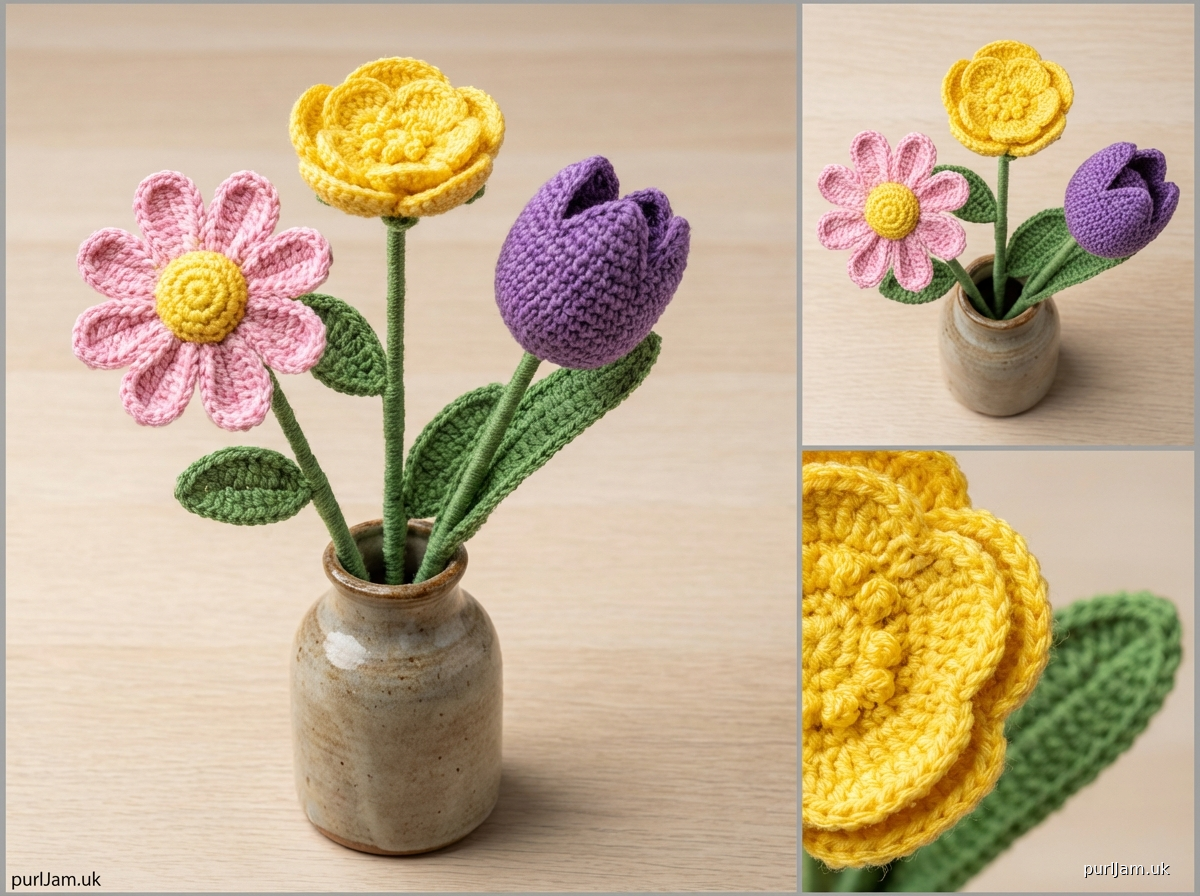
AI Thinking Process
Planning
1. **Design Strategy**: Creating an Easter flower bouquet with beginner-friendly simple shapes. Will design 3-5 flowers using sphere/cone variations for flower heads, cylinders for stems, and simple leaves. Colors will be spring pastels (pink, yellow, purple, white) with green stems. Each flower will be a separate small amigurumi piece that can be arranged in a bouquet.
2. **Construction Plan**: Each flower component worked separately in the round:
- Flower heads: Modified spheres/flat circles in bright colors
- Centers: Small contrasting circles or French knots
- Stems: Long thin cylinders in green
- Leaves: Simple oval shapes attached to stems
- Assembly: Sew flowers to stems, arrange together
Size target: Each flower 3-4 inches tall, suitable for display in small vase
3. **Quality Assurance**:
- Ensure stems are sturdy enough to support flower heads (may need wire insert option)
- Verify flower heads are proportional to stems
- Check that leaves attach securely
- Confirm all pieces can be made with basic stitches only
- Validate stitch counts throughout all components
4. **Final Calculations**:
- Worsted weight yarn with E-4 (3.5mm) hook
- Gauge: 5 sc = 1 inch (standard tight amigurumi)
- Flower head diameter: ~2 inches (24-30 sts around)
- Stem length: ~4 inches (12-15 rounds)
- Total bouquet: 3 flowers for beginner project
Verification
[PRE-FLIGHT CHECKS]
1. **Completeness**: Pattern will include Materials, Abbreviations, Notes, Gauge, all component patterns (3 flower styles, stems, leaves), Assembly, and Finishing
2. **Consistency**:
- Flower heads max 24-30 sts = ~2" diameter at 5 sc/inch ✓
- Stems 6 sts around = ~1.2" circumference, appropriate proportion ✓
- 12-15 rounds for stem = ~2.5-3" length, can adjust ✓
3. **Constraints**: Beginner level maintained - only sc, inc, dec stitches used. Simple assembly. No complex shaping.
4. **Safety**: All increase/decrease math verified (6→12→18→24 progression). Each component checked for arithmetic accuracy.
Pattern
<pattern>

# Easter Flower Bouquet

A cheerful collection of crocheted spring flowers perfect for Easter décor! This beginner-friendly pattern creates three different flower styles using simple amigurumi techniques. Arrange them in a small vase for a bloom that lasts forever.

**Finished Size**: Each flower approximately 4-5 inches (10-12.5 cm) tall
**Difficulty Level**: Beginner

---

## MATERIALS

**Yarn**: Worsted weight (4) acrylic or cotton yarn
- **Green** (approx. 50 yds/46 m) for stems and leaves
- **Pink** (approx. 25 yds/23 m) for Flower A
- **Yellow** (approx. 25 yds/23 m) for Flower B
- **Purple or Lavender** (approx. 25 yds/23 m) for Flower C
- **White or Bright Yellow** (small amount) for flower centers

**Suggested Yarn**: Red Heart Super Saver, Lily Sugar'n Cream, or similar worsted weight

**Hook**: US E-4 (3.5mm) crochet hook

**Other Supplies**:
- Yarn needle for weaving in ends and sewing
- Stitch marker
- Fiberfill stuffing (small amount)
- Scissors
- Optional: Floral wire (18-gauge) for stem support
- Optional: Small vase or container for display

---

## ABBREVIATIONS

- ch = chain
- sc = single crochet
- inc = increase (2 sc in same stitch)
- dec = invisible decrease (insert hook in front loops of next 2 sts, yo, pull through both loops, yo, pull through 2 loops on hook)
- st(s) = stitch(es)
- rnd(s) = round(s)
- sl st = slip stitch
- [ ] = stitch count at end of round
- ( ) = repeat instructions within parentheses

---

## GAUGE

5 sc and 5 rows = 1 inch (2.5 cm) in single crochet (worked tightly in the round)

*Gauge is not critical for this project, but working tightly will create a neater amigurumi fabric.*

---

## PATTERN NOTES

- All pieces are worked in continuous rounds (spiral) unless otherwise noted. Use a stitch marker to track the beginning of each round.
- Do not join or turn at the end of rounds unless instructed.
- Work with tight tension to prevent stuffing from showing through.
- Invisible decrease is recommended for smoother finish, but regular decrease (sc2tog) is acceptable.
- Flowers are worked separately and sewn to stems.
- For sturdier stems, insert a piece of floral wire cut to 5 inches (12.5 cm) before stuffing.

---

## PATTERN INSTRUCTIONS

### FLOWER A - Daisy Style (Make 1)

**Flower Head** (Pink)

Rnd 1: 6 sc in magic ring [6]

Rnd 2: inc in each st around [12]
*Math check: 6 × 2 = 12 ✓*

Rnd 3: (sc, inc) around [18]
*Math check: 12 ÷ 2 = 6 repeats; 6 × 3 = 18 ✓*

Rnd 4: (2 sc, inc) around [24]
*Math check: 18 ÷ 3 = 6 repeats; 6 × 4 = 24 ✓*

Rnd 5: (3 sc, inc) around [30]
*Math check: 24 ÷ 4 = 6 repeats; 6 × 5 = 30 ✓*

Rnd 6: Working in back loops only, sc around [30]

Rnd 7: sc around [30]

Rnd 8: (3 sc, dec) around [24]
*Math check: 30 ÷ 5 = 6 repeats; 6 × 4 = 24 ✓*

Stuff lightly with fiberfill.

Rnd 9: (2 sc, dec) around [18]
*Math check: 24 ÷ 4 = 6 repeats; 6 × 3 = 18 ✓*

Rnd 10: (sc, dec) around [12]
*Math check: 18 ÷ 3 = 6 repeats; 6 × 2 = 12 ✓*

Add more stuffing if needed.

Rnd 11: dec around [6]
*Math check: 12 ÷ 2 = 6 ✓*

Fasten off, leaving a 10-inch (25 cm) tail. Thread tail through remaining 6 sts and pull tight to close. Weave in end.

**Flower Center** (Yellow or White)

Rnd 1: 6 sc in magic ring [6]

Rnd 2: inc in each st around [12]
*Math check: 6 × 2 = 12 ✓*

Rnd 3: sc around [12]

Sl st to next st. Fasten off, leaving a 12-inch (30 cm) tail for sewing.

Flatten the center piece and sew to the front (side with front loop ridge from Rnd 6) of the flower head.

---

### FLOWER B - Buttercup Style (Make 1)

**Flower Head** (Yellow)

Rnd 1: 6 sc in magic ring [6]

Rnd 2: inc in each st around [12]
*Math check: 6 × 2 = 12 ✓*

Rnd 3: (sc, inc) around [18]
*Math check: 12 ÷ 2 = 6 repeats; 6 × 3 = 18 ✓*

Rnd 4: (2 sc, inc) around [24]
*Math check: 18 ÷ 3 = 6 repeats; 6 × 4 = 24 ✓*

Rnd 5: Working in back loops only, sc around [24]

Rnd 6-7: sc around [24]

Rnd 8: (2 sc, dec) around [18]
*Math check: 24 ÷ 4 = 6 repeats; 6 × 3 = 18 ✓*

Stuff lightly.

Rnd 9: (sc, dec) around [12]
*Math check: 18 ÷ 3 = 6 repeats; 6 × 2 = 12 ✓*

Rnd 10: dec around [6]
*Math check: 12 ÷ 2 = 6 ✓*

Fasten off, leaving a 10-inch (25 cm) tail. Close hole as with Flower A.

**Flower Center**: Using White yarn, embroider 3-4 French knots in the center of the flower head, OR follow Flower Center pattern from Flower A using white.

---

### FLOWER C - Tulip Style (Make 1)

**Flower Head** (Purple/Lavender)

Rnd 1: 6 sc in magic ring [6]

Rnd 2: inc in each st around [12]
*Math check: 6 × 2 = 12 ✓*

Rnd 3: (sc, inc) around [18]
*Math check: 12 ÷ 2 = 6 repeats; 6 × 3 = 18 ✓*

Rnd 4: (2 sc, inc) around [24]
*Math check: 18 ÷ 3 = 6 repeats; 6 × 4 = 24 ✓*

Rnd 5-8: sc around [24]

Rnd 9: (2 sc, dec) around [18]
*Math check: 24 ÷ 4 = 6 repeats; 6 × 3 = 18 ✓*

Stuff firmly to maintain cup shape.

Rnd 10: (sc, dec) around [12]
*Math check: 18 ÷ 3 = 6 repeats; 6 × 2 = 12 ✓*

Rnd 11: dec around [6]
*Math check: 12 ÷ 2 = 6 ✓*

Fasten off, leaving a 10-inch (25 cm) tail. Close hole. No center needed for tulip.

---

### STEM (Make 3 - one for each flower)

Using Green yarn:

Rnd 1: 6 sc in magic ring [6]

Rnd 2-15: sc around [6]
*This creates a stem approximately 3 inches (7.5 cm) long*

**Optional**: Before stuffing, insert a 5-inch (12.5 cm) piece of floral wire into the stem, leaving 1 inch extending from the top and bottom.

Stuff lightly (or leave unstuffed if using wire).

Do not close the top - this will be attached to the flower head.

Fasten off bottom: dec around until closed [3, then close], OR flatten and whipstitch closed.

Fasten off, leaving a 12-inch (30 cm) tail at the top for attaching to flower.

---

### LEAF (Make 6 - two for each flower)

Using Green yarn:

Ch 6

Rnd 1: Starting in 2nd ch from hook, sc, hdc, sc, 3 sc in last ch. Working on opposite side of chain: sc, hdc, sc, 2 sc in same st as first sc [12]

Sl st to first sc. Fasten off, leaving a 10-inch (25 cm) tail for sewing.

*Note: This creates a small oval leaf. The "3 sc in last ch" creates the leaf tip.*

---

## ASSEMBLY

1. **Attach Flowers to Stems**:
   - Thread the yarn tail from the top of a stem through a yarn needle.
   - Position the closed end (bottom) of a flower head over the open top of the stem.
   - Whipstitch around, sewing through the base of the flower head and the stitches at the top of the stem, enclosing any wire if used.
   - Secure and weave in ends.

2. **Attach Leaves**:
   - Position two leaves on opposite sides of each stem, approximately 1-1.5 inches (2.5-4 cm) below the flower head.
   - Using the yarn tail, sew the pointed end of each leaf to the stem with a few stitches.
   - Weave in all ends securely.

3. **Final Shaping**:
   - Gently shape flower heads into rounded or cupped forms.
   - If using wire, bend stems slightly for a natural look.

---

## FINISHING

- Weave in all remaining ends securely.
- Gently steam or block flowers if needed to achieve desired shape (test on a swatch first).
- Arrange flowers in a small vase, jar, or Easter basket.
- Optional: Tie stems together with ribbon or raffia for a gift-ready bouquet.

---

## CUSTOMIZATION IDEAS

**More Flowers**: Make 5-7 flowers in various spring colors for a fuller bouquet.

**Different Sizes**:
- Smaller flowers: Stop increasing at Rnd 3 (18 sts)
- Larger flowers: Add one more increase round to reach 36 sts

**Color Variations**:
- Classic Easter: Pastels (pink, yellow, lavender, mint)
- Bright Spring: Bold colors (hot pink, orange, bright purple)
- Elegant: White flowers with pearl centers

**Additional Details**:
- Add a small stuffed center with contrasting color
- Embroider veins on leaves with darker green
- Attach small buttons or beads to flower centers
- Create rosebuds by stopping flowers at Rnd 7-8 and tapering quickly

**Alternative Display**:
- Make into magnets by gluing magnetic discs to backs
- Create a garland by chaining flowers together
- Make individual flowers into brooches with pin backs
- Design a wreath by attaching multiple flowers to a foam ring

---

## CARE INSTRUCTIONS

- Spot clean with damp cloth if needed
- Reshape while damp and air dry
- Store in a cool, dry place away from direct sunlight to prevent fading
- Flowers are decorative only - not suitable for children under 3

---

## SKILL BUILDING TIPS FOR BEGINNERS

**Magic Ring**: If you're new to magic ring, you can chain 2 and work 6 sc in the first chain instead. Pull the starting tail tight to close the center hole.

**Working in Continuous Rounds**: Your stitch marker is essential! Move it up to the first stitch of each new round as you work. The beginning of the round will spiral slightly - this is normal.

**Invisible Decrease**: This technique creates a smoother decrease than sc2tog. Insert your hook under the front loop only of the next 2 stitches (you'll have 3 loops on hook), yarn over and pull through the 2 front loops (2 loops remain on hook), yarn over and pull through both loops.

**Tight Tension**: Amigurumi should be worked more tightly than regular crochet. You may need to size down your hook from what the yarn label recommends. The fabric should be firm with no gaps.

**Stuffing Tips**: Stuff as you go, especially when the opening gets small. Use small amounts and push stuffing into all areas evenly. A chopstick or crochet hook can help push stuffing into tight spots.

---

## ABBREVIATIONS REFERENCE (Quick Guide)

| Abbreviation | Meaning |
|--------------|---------|
| ch | chain |
| sc | single crochet |
| hdc | half double crochet |
| inc | increase (2 sc in one st) |
| dec | decrease |
Disclaimer: This pattern was generated by AI and should be reviewed for accuracy before use. While we strive for quality, AI-generated content may contain errors. Please verify measurements, stitch counts, and instructions before beginning your project. Generated by purlJam.uk
Access your pattern anytime
Bookmark this page to access your pattern anytime