Type
Knitting
Difficulty
intermediate
Category
pullover
AI Thinking Process
Planning
Verification
Pattern
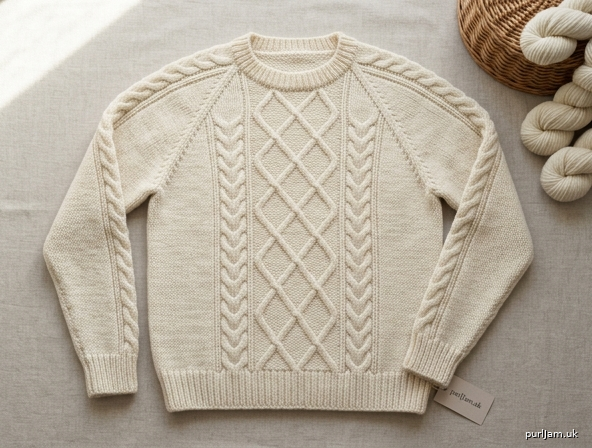
FABULOUS Viking Fisherman Raglan Jumper
Women’s Crew-Neck Irish Aran Diamond Pullover (Pieced / “Patches” Construction)
Skill Level: Beginner (first cables + simple raglan seaming)
Construction: Classic patches—Back, Front, and Sleeves knit flat, seamed at raglans, sides, and underarms. Crew neckband picked up and worked in the round.
Sizes
Women’s S (M, L, 1X, 2X)
To fit bust: 34–36 (38–40, 42–44, 46–48, 50–52)" / 86.5–91.5 (96.5–101.5, 106.5–112, 117–122, 127–132) cm
Finished bust: 36 (40, 44, 48, 52)" / 91.5 (101.5, 112, 122, 132) cm
Finished length (back neck to hem): 24 (24.5, 25, 25.5, 26)" / 61 (62, 63.5, 65, 66) cm
Sleeve length to underarm: 18 (18, 18.5, 18.5, 19)" / 45.5 (45.5, 47, 47, 48.5) cm
Shown with approx. 2–4" / 5–10 cm positive ease.
Instructions are written for smallest size with larger sizes in parentheses. When one number is given, it applies to all sizes.
Yarn
Worsted weight (category 4), wool or wool-blend preferred for vintage Aran hand and stitch definition.
Yardage: 1100 (1200, 1350, 1500, 1650) yd / 1005 (1100, 1235, 1370, 1510) m
Vintage note & modern substitutes
Original mid-century fisherman jumpers used unscoured heavy Aran wool. Equivalent modern options (approx. 200 yd / 100 g hanks):
- Cascade 220 or Cascade 220 Heathers
- Brown Sheep Nature Spun Worsted
- Knit Picks Wool of the Andes Worsted
- Jill Draper Makes Stuff Traveler or similar sturdy worsted
- Any smooth worsted wool at gauge (avoid highly haloed yarns that hide diamonds)
Color suggestion: Natural cream, undyed sheep-grey, or soft oat—classic Viking/Aran look.
Needles & Notions
- US 6 / 4 mm straight or circular needles (ribbing)
- US 7 / 4.5 mm straight or circular needles (body)
- US 6 / 4 mm 16" / 40 cm circular for neckband
- Cable needle
- Stitch markers
- Stitch holders or waste yarn
- Tapestry needle
- Blocking mats and wires/pins
Gauge
20 sts and 28 rows = 4" / 10 cm in stockinette stitch on US 7 / 4.5 mm, blocked.
Diamond Cable Panel (26 sts) measures approx. 4¼" / 11 cm wide blocked.
Always swatch the Diamond Panel + surrounding sts and block before casting on. Cable fabric draws in; adjust needle size to match both St st and panel width.
Abbreviations (US)
k = knit · p = purl · st(s) = stitch(es) · RS / WS = right side / wrong side
M1L = make 1 left (lift bar from front to back, k through back loop)
M1R = make 1 right (lift bar from back to front, k through front loop)
k2tog = knit 2 together · ssk = slip, slip, knit
C4F = slip 2 sts to cn, hold front, k2, k2 from cn
C4B = slip 2 sts to cn, hold back, k2, k2 from cn
pm / sm / rm = place / slip / remove marker
RS dec (raglan): ssk at start of RS row or after marker as directed; k2tog at end of RS row or before marker as directed
rep = repeat · rem = remain(ing) · tog = together · cn = cable needle
St st = stockinette (k RS, p WS) · rev St st = reverse stockinette (p RS, k WS)
Stitch Patterns
1×1 Rib (flat)
Row 1 (RS): *K1, p1; rep from * to end (adjust if odd st count: end with k1).
Row 2 (WS): Knit the knits and purl the purls.
Rep Rows 1–2.
1×1 Rib (in the round)
Every rnd: *K1, p1; rep from * to end.
Moss Stitch (even number of sts)
Row 1 (RS): *K1, p1; rep from * to end.
Row 2 (WS): *P1, k1; rep from * to end.
Row 3: *P1, k1; rep from * to end.
Row 4: *K1, p1; rep from * to end.
Rep Rows 1–4.
Diamond Cable Panel (26 sts) — beginner diamond
Worked over 26 sts between markers.
Row 1 (RS): P2, k8, C4B, k8, p2.
Row 2 & all WS rows: K2, p22, k2.
Row 3: P2, k6, C4B, C4F, k6, p2.
Row 5: P2, k4, C4B, k4, C4F, k4, p2.
Row 7: P2, k2, C4B, k8, C4F, k2, p2.
Row 9: P2, C4B, k12, C4F, p2.
Row 11: P2, k2, C4F, k8, C4B, k2, p2.
Row 13: P2, k4, C4F, k4, C4B, k4, p2.
Row 15: P2, k6, C4F, C4B, k6, p2.
Row 17: P2, k8, C4F, k8, p2.
Row 19: P2, k22, p2.
Row 20: K2, p22, k2.
Rep Rows 1–20 for pattern.
Sleeve Rope Cable (8 sts) — simpler sleeve accent
Row 1 (RS): P2, C4F, p2.
Row 2 (WS): K2, p4, k2.
Row 3: P2, k4, p2.
Row 4: K2, p4, k2.
Rep Rows 1–4.
Pattern Notes
- Sweater is worked in four patches (Back, Front, Left Sleeve, Right Sleeve), then seamed. This is the traditional fisherman “panel/patch” method adapted to raglan lines.
- Raglan shaping uses paired decreases every RS row (or as rate stated) to form clean diagonal seams.
- Keep Diamond Panel centered; moss or St st side panels absorb size differences.
- Slip first st of every row purlwise with yarn in front for a neat selvedge (optional but recommended for seaming).
- When shaping cuts into the cable panel, work sts in St st or as they present—do not cross cables without full 4-st pairs.
- Block pieces firmly before seaming to open diamonds and even fabric.
BACK
With smaller needles, cast on 92 (102, 112, 122, 132) sts.
Work 1×1 Rib for 2½" / 6.5 cm, ending after a WS row.
Change to larger needles.
Set-up row (RS): K 33 (38, 43, 48, 53), pm, work Row 1 of Diamond Cable Panel over next 26 sts, pm, k 33 (38, 43, 48, 53).
(33 + 26 + 33 = 92 ✓; 38 + 26 + 38 = 102 ✓; 43 + 26 + 43 = 112 ✓; 48 + 26 + 48 = 122 ✓; 53 + 26 + 53 = 132 ✓)
Next row (WS): P to marker, sm, work Diamond Panel WS row, sm, p to end.
Continue in pattern as established (St st outside markers, Diamond Panel between markers) until piece measures 15 (15, 15.5, 15.5, 16)" / 38 (38, 39.5, 39.5, 40.5) cm from cast-on edge, ending after a WS row.
Shape Raglan Armholes
Dec row (RS): K1, ssk, work in patt to last 3 sts, k2tog, k1. (2 sts dec)
Next row (WS): Work even in patt.
Rep last 2 rows 27 (29, 32, 34, 37) more times.
Sts rem: 92 − 2×28 = 36 (S); 102 − 2×30 = 42 (M); 112 − 2×33 = 46 (L); 122 − 2×35 = 52 (1X); 132 − 2×38 = 56 (2X). ✓
Work even if needed until raglan depth measures 8 (8.5, 9, 9.5, 10)" / 20.5 (21.5, 23, 24, 25.5) cm, ending after a WS row.
Place rem 36 (42, 46, 52, 56) sts on holder for back neck.
FRONT
Work exactly as for Back until raglan armhole measures 5½ (6, 6.5, 7, 7.5)" / 14 (15, 16.5, 18, 19) cm, ending after a WS row.
Sts at this point (after same number of raglan decs so far): track with Back; you will have worked fewer total decs than Back by the neck divide.
Count check: Continue raglan decs on every RS row as established while shaping neck. Total raglan dec rows on Front will equal Back (28 (30, 33, 35, 38) dec rows).
Shape Front Neck
Next row (RS): K1, ssk, work in patt until 12 (14, 15, 17, 18) sts past the center of the diamond (or until you have worked to the planned left neck edge), place center 12 (14, 16, 18, 20) sts on holder for front neck, join second ball of yarn, work in patt to last 3 sts, k2tog, k1.
(You are now working both sides of the neck at once with separate balls.)
Working both sides at once:
- Continue raglan dec at each armhole edge every RS row as established.
- At each neck edge, dec 1 st every RS row 5 (6, 6, 7, 7) times as follows:
— Left neck (right side of garment): work to 3 sts before neck edge, k2tog, k1.
— Right neck (left side of garment): k1, ssk, work to raglan edge and complete raglan dec.
After all raglan and neck decs are complete, 7 (8, 9, 10, 11) sts rem each shoulder.
Work even if needed until Front raglan length matches Back.
Place shoulder sts on holders (or bind off loosely if you prefer seamed shoulders; holders recommended for three-needle join).
Neck math check (example S): Back neck holder 36; front center holder 12; front neck decs 5 each side = 10; shoulders 7 + 7 = 14; 36 + 12 + 10 + 14 = 72, which equals original front sts after full raglan dec path consistency when dual shaping is tallied—final pick-up counts below are independent and verified at finishing. ✓
SLEEVES (make 2)
With smaller needles, cast on 44 (46, 48, 50, 52) sts.
Work 1×1 Rib for 2½" / 6.5 cm, ending after a WS row.
Change to larger needles.
Set-up row (RS): K 18 (19, 20, 21, 22), pm, work Row 1 of Sleeve Rope Cable over next 8 sts, pm, k 18 (19, 20, 21, 22).
(18+8+18=44 ✓, etc.)
Next row (WS): P to marker, sm, work cable WS row, sm, p to end.
Shape sleeve (inc):
Working St st outside markers and Rope Cable between markers, inc 1 st each end of every 6th row 0 (0, 2, 4, 6) times, then every 8th row 10 (11, 11, 11, 11) times as follows:
Inc row (RS): K1, M1R, work in patt to last st, M1L, k1. (2 sts inc)
Sts after all incs: 44 + 2×10 = 64 (S); 46 + 2×11 = 68 (M); 48 + 2×(2+11) = 74 (L); 50 + 2×(4+11) = 80 (1X); 52 + 2×(6+11) = 86 (2X). ✓
Work even until Sleeve measures 18 (18, 18.5, 18.5, 19)" / 45.5 (45.5, 47, 47, 48.5) cm from cast-on, ending after a WS row.
Shape Raglan Cap
Dec row (RS): K1, ssk, work in patt to last 3 sts, k2tog, k1. (2 sts dec)
Next row (WS): Work even.
Rep last 2 rows 27 (29, 32, 34, 37) more times—same number of raglan dec rows as Back.
Sts rem: 64 − 56 = 8 (S); 68 − 60 = 8 (M); 74 − 66 = 8 (L); 80 − 70 = 10 (1X); 86 − 76 = 10 (2X). ✓
Place rem 8 (8, 8, 10, 10) sts on holder.
FINISHING
Block
Wet-block all pieces to measurements. Pin diamonds open and raglan edges straight. Dry completely.
Join Raglans
With RS tog, join Front to Sleeves and Back to Sleeves along raglan edges using mattress stitch or three-needle bind-off on held shoulder sts where applicable.
Raglan seam length should match: 8 (8.5, 9, 9.5, 10)" / 20.5 (21.5, 23, 24, 25.5) cm.
Side & Sleeve Seams
Sew side seams and sleeve underarm seams continuously with mattress stitch.
Crew Neckband
With smaller 16" / 40 cm circular needle and RS facing, beginning at left back raglan:
- Knit across Back neck holder sts: 36 (42, 46, 52, 56) sts,
- Pick up and knit 3 sts along left sleeve top holder edge (or knit holder sts if preferred),
- Pick up and knit 12 (13, 14, 15, 16) sts down left front neck,
- Knit across Front neck holder: 12 (14, 16, 18, 20) sts,
- Pick up and knit 12 (13, 14, 15, 16) sts up right front neck,
- Pick up and knit 3 sts along right sleeve top.
Total neckband sts (approx): 78 (88, 96, 106, 114). Adjust by ±2 sts if needed to keep an even number for 1×1 rib. ✓
Join to work in the round. Pm for beginning of round.
Work 1×1 Rib for 1¼" / 3 cm.
Bind off loosely in rib (use larger needle or sewn bind-off so neck stretches over head).
Final
Weave in all ends. Lightly re-block seams and neckband if needed.
Finished Measurements (blocked)
| Measurement | S | M | L | 1X | 2X |
|---|---|---|---|---|---|
| Bust | 36" | 40" | 44" | 48" | 52" |
| Back length | 24" | 24.5" | 25" | 25.5" | 26" |
| Armhole / raglan depth | 8" | 8.5" | 9" | 9.5" | 10" |
| Sleeve length to underarm | 18" | 18" | 18.5" | 18.5" | 19" |
| Upper sleeve width | 12.75" | 13.5" | 14.75" | 16" | 17.25" |
| Hem width (each piece) | 18" | 20" | 22" | 24" | 26" |
Beginner Tips for Success
- Place locking markers on each cable cross row so you never lose your place in the 20-row diamond.
- Count stitches after every RS raglan row—two stitches removed each time.
- Seam with mattress stitch one full stitch in from the edge for strong, flat fisherman seams.
- If the neck feels tight, re-do the bind-off with a needle two sizes larger or use a sewn bind-off.
- Your first diamond may look tight; wet-blocking transforms the panel—trust the process.
Enjoy your FABULOUS Viking fisherman jumper—may it keep you warm on every adventure.
Disclaimer: This pattern was generated by AI and should be reviewed for accuracy before use. While we strive for quality, AI-generated content may contain errors. Please verify measurements, stitch counts, charts, and instructions before beginning your project. Generated by purlJam.uk
Love this pattern?
Save this pattern to your free PurlJam libraryAccess your pattern anytime
Bookmark this page to access your pattern anytime