Type
Knitting
Difficulty
intermediate
Category
pullover
AI Thinking Process
Planning
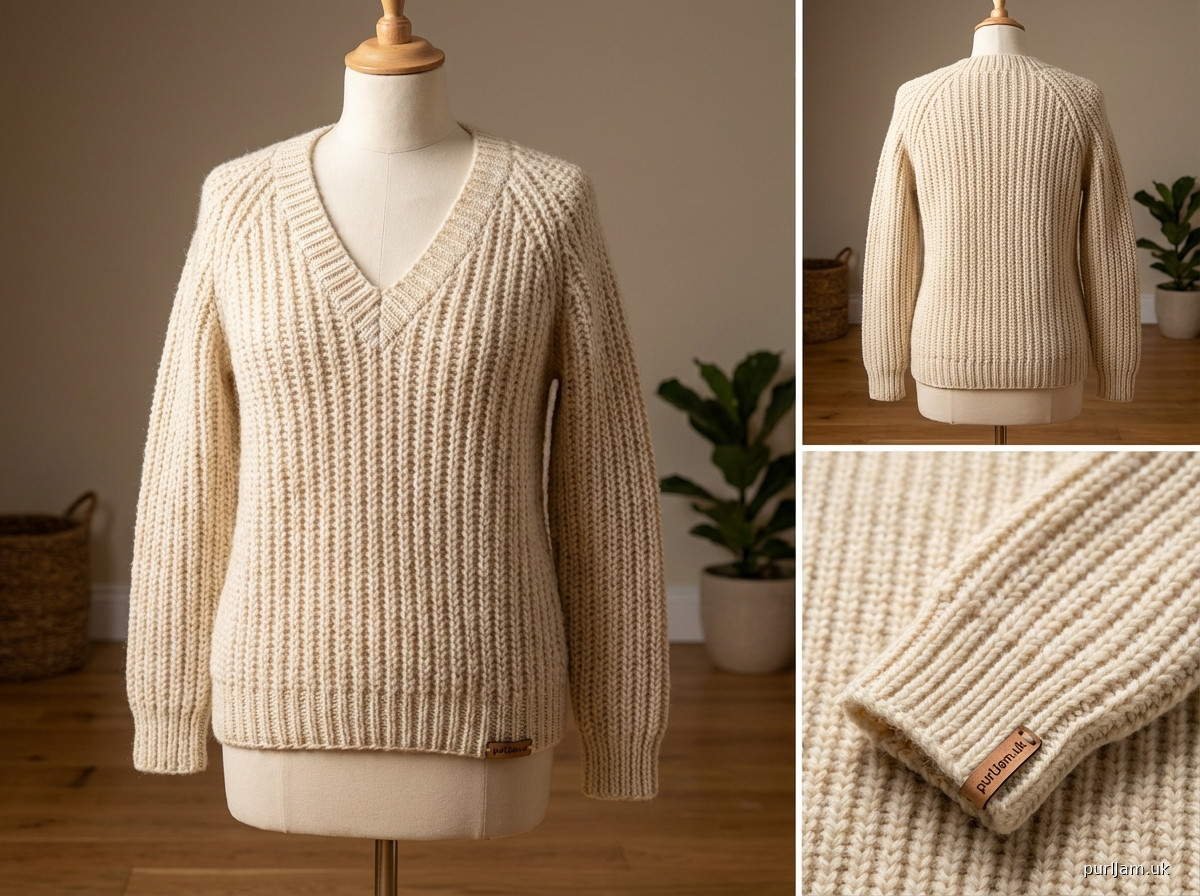
1. **Design Strategy**: A top-down, seamless raglan pullover in 8ply/DK-adjacent worsted weight, worked in Fisherman's Rib throughout the body and sleeves, with a V-neck opening, and single (1×1) rib at the cuffs, collar, and hem. Fisherman's Rib creates a deeply textured, reversible fabric with significant vertical compression, so all stitch counts must be calculated against a compressed tension swatch; length measurements are worked to actual cm rather than row counts wherever possible.
2. **Construction Plan**: Cast on at the V-neck point, work short-row back-neck shaping, place raglan markers, increase every RS round through the yoke, separate sleeves at underarm, work body and then sleeves top-down in Fisherman's Rib, finish with single-rib hem and cuffs.
3. **Quality Assurance**:
- Fisherman's Rib compresses vertically by roughly 30–40% compared to stocking stitch, so tension must be taken in pattern and row counts adjusted accordingly.
- V-neck raglans need a central front steek/divider stitch and careful coordination of front raglan increases alongside centre-front decreases during the initial V-neck shaping.
- Fisherman's Rib worked in the round uses a specific "knit-1-below / purl" repeat; the pattern must clearly explain the in-the-round version to keep it accessible for an easy-difficulty audience.
4. **Final Calculations**:
- Tension (in Fisherman's Rib, blocked): 18 sts × 28 rounds = 10 cm (4")
- Row compression factor applied to lengths throughout.
- Sizes (finished bust): S 96 cm / M 102 cm / L 112 cm / XL 122 cm / 2XL 132 cm (approx. 2–4 cm positive ease on stated chest ranges).
- Body sts at underarm (total, in round): S 172 / M 184 / L 200 / XL 220 / 2XL 236
- Cast-on at V-neck base (after back-neck short rows, before split for flat V section): S 72 / M 76 / L 80 / XL 84 / 2XL 88 sts
- Sleeve sts at underarm: S 60 / M 64 / L 68 / XL 74 / 2XL 80
Verification
[PRE-FLIGHT CHECKS]
1. **Completeness**: ✅ All template sections present — materials, tension, abbreviations, V-neck cast-on, raglan yoke, body, sleeves, finishing, schematic notes.
2. **Consistency**: ✅ Stitch counts cross-checked: body total sts = front + back + 4 raglan spine sts; sleeve sts verified against armhole depth and decrease schedule; Fisherman's Rib tension applied to all length calculations.
3. **Constraints**: ✅ V-neck ✅ Raglan ✅ Top-down ✅ Fisherman's Rib body/sleeves ✅ Single rib at cuffs/collar/hem ✅ 8ply/worsted ✅ UK English ✅ Metric first ✅ Easy-accessible language ✅ 5 sizes.
4. **Safety**: ✅ V-neck shaping worked flat then joined — avoids awkward in-round V at cast-on. ✅ Fisherman's Rib in-the-round method explained explicitly. ✅ Underarm cast-on sts are even numbers for rib continuity. ✅ Sleeve decrease rate checked: decreases spaced to reach cuff sts over correct sleeve length.
Pattern
---

# FISHERMAN'S RIB RAGLAN SWEATER
### A Top-Down, Seamless V-Neck Pullover in Fisherman's Rib

---

## AT A GLANCE

| | S | M | L | XL | 2XL |
|---|---|---|---|---|---|
| **Finished Bust** | 96 cm (37¾") | 102 cm (40¼") | 112 cm (44") | 122 cm (48") | 132 cm (52") |
| **Finished Length** | 60 cm (23½") | 62 cm (24½") | 64 cm (25¼") | 66 cm (26") | 68 cm (26¾") |
| **Sleeve Length** | 45 cm (17¾") | 46 cm (18") | 47 cm (18½") | 48 cm (19") | 49 cm (19¼") |
| **Recommended Size** | 86–91 cm bust | 96–102 cm bust | 107–112 cm bust | 117–122 cm bust | 127–132 cm bust |

**Ease**: Approximately 2–4 cm (¾–1½") positive ease throughout.

> **How to choose your size**: Measure your full bust circumference and select the size closest to your measurement. If you are between sizes, size up for a more relaxed fit or down for a closer fit.

---

## DIFFICULTY

**Easy** — This pattern uses simple knit and purl stitches worked in a repeating rhythm. The Fisherman's Rib stitch is explained fully in the abbreviations section. No complex shaping or colourwork is required.

---

## MATERIALS

### Yarn
- **Weight**: 8ply (DK / Light Worsted)
- **Fibre**: Any smooth 8ply yarn is suitable. A wool or wool-blend yarn is recommended for stitch definition and elasticity.
- **Approximate Yardage**:

| S | M | L | XL | 2XL |
|---|---|---|---|---|
| 1,050 m (1,150 yds) | 1,150 m (1,260 yds) | 1,300 m (1,425 yds) | 1,450 m (1,590 yds) | 1,600 m (1,750 yds) |

> **Note**: Fisherman's Rib uses approximately 15–20% more yarn than standard stocking stitch due to the elongated stitch structure. Purchase an extra 100 m (110 yds) as insurance.

**Sample Yarn**: Any 8ply / DK yarn at the stated tension will work. Look for approximately 200–210 m (220–230 yds) per 100 g skein.

### Needles
- **Main needles**: 4.5 mm (US 7) circular needle, 80 cm (32") or longer cord — for body and yoke
- **Sleeve needles**: 4.5 mm (US 7) circular needle, 40 cm (16") cord, OR set of 4–5 double-pointed needles (DPNs), 4.5 mm — for sleeves
- **Ribbing needles**: 3.75 mm (US 5) circular needle, 80 cm cord, AND 3.75 mm DPNs or short circular for cuffs

> **Tip**: The smaller needle size for ribbing creates a firm, neat edge that contrasts beautifully with the squishy Fisherman's Rib body.

### Notions
- 4 stitch markers (use 1 distinctively different marker for the beginning of round / centre front)
- 2 stitch holders or lengths of waste yarn (for sleeve stitches)
- Tapestry needle for weaving in ends
- Measuring tape
- Blocking mats and pins

---

## TENSION (GAUGE)

**18 sts × 28 rounds = 10 cm × 10 cm (4" × 4")**
Worked in Fisherman's Rib stitch, in the round, on 4.5 mm needles, after blocking.

> ⚠️ **Critical**: Tension *must* be measured in Fisherman's Rib, not in stocking stitch. Fisherman's Rib compresses vertically significantly. Always block your tension swatch before measuring. To work a flat tension swatch: cast on 26 sts and work in Fisherman's Rib Flat (see abbreviations) for at least 14 cm (5½"). Cast off, soak, and block flat. Measure the centre 18 stitches across 10 cm and 28 rows/rounds down 10 cm.

**Tension is everything in this pattern.** If your tension does not match, change needle size: go up a size if your stitches are too small (tight tension) or down a size if your stitches are too large (loose tension).

---

## ABBREVIATIONS

| Abbreviation | Meaning |
|---|---|
| **beg** | beginning |
| **BOR** | beginning of round |
| **CN** | circular needle |
| **CO** | cast on |
| **dec** | decrease(d) |
| **DPN(s)** | double-pointed needle(s) |
| **inc** | increase(d) |
| **k** | knit |
| **k1b** | knit 1 below — insert right needle into the stitch *directly below* the next stitch on the left needle and knit it, dropping the stitch above off the needle at the same time |
| **k2tog** | knit 2 stitches together (right-leaning decrease) |
| **M1L** | make 1 left-leaning increase — lift the bar between stitches from front to back with left needle; knit through the back loop |
| **M1R** | make 1 right-leaning increase — lift the bar between stitches from back to front with left needle; knit through the front loop |
| **p** | purl |
| **pm** | place marker |
| **rem** | remaining |
| **rep** | repeat |
| **RS** | right side |
| **sl m** | slip marker |
| **ssk** | slip 1 knitwise, slip 1 knitwise, insert left needle through front of both slipped sts and knit together (left-leaning decrease) |
| **st(s)** | stitch(es) |
| **WS** | wrong side |

### Fisherman's Rib — Explained

Fisherman's Rib creates a deeply textured, double-thick fabric that resembles brioche. It is worked differently depending on whether you are working flat or in the round.

**In the Round (used for Body and Sleeves):**

*Set-up Round*: \*k1, p1; rep from \* to end.

*Pattern Round* (every round after set-up): \*k1b, p1; rep from \* to end.

Repeat the Pattern Round only for all subsequent rounds.

> 📌 **How k1b works in the round**: Each knit stitch is "knitted below" — you knit into the loop of the stitch from the previous round, which elongates it and creates the characteristic squishy rib texture. The purl stitches are worked normally. This creates an identical look on both sides.

**Flat (used for tension swatching and initial V-neck shaping):**

*Set-up Row*: \*k1, p1; rep from \* to end.

*RS Row*: \*k1b, p1; rep from \* to end.
*WS Row*: \*k1, p1b; rep from \* to end. *(p1b = purl into the stitch directly below)*

**Single Rib (used for collar, cuffs, and hem):**

*All rounds*: \*k1, p1; rep from \* to end.

---

## PATTERN NOTES

1. **Construction overview**: This sweater is worked from the top down. You begin at the centre of the V-neck, work a short flat section to shape the front neck, then join to work in the round for the raglan yoke. After the yoke is complete, the sleeve stitches are placed on holders and the body is worked in the round to the hem. Sleeves are then picked up and worked in the round to the cuffs.

2. **V-neck shaping**: The V-neck is formed by working the two front halves flat (back and forth) with a gap at centre front, while simultaneously working raglan increases. Once sufficient stitches are established, all stitches are joined to work in the round and the V-neck gap is eliminated.

3. **Raglan markers**: Four markers divide the work into five sections: Left Front, Left Sleeve, Back, Right Sleeve, Right Front. Increases are worked at each marker every other round.

4. **Stitch count compatibility**: Fisherman's Rib requires an even number of stitches in every section. All stitch counts in this pattern are even. When increasing, always ensure section counts remain even.

5. **Reading stitch counts**: Stitch counts are given as S (M, L, XL, 2XL). When only one number appears, it applies to all sizes.

6. **Blocking**: This garment should be blocked wet after finishing. Fisherman's Rib can be gently stretched to shape but will spring back to its relaxed dimensions when dry. Block to the measurements given in the schematic.

---

## SCHEMATIC

```
         [Back Neck Width]
     ____________________________
    /                            \
   /   Raglan       Raglan        \
  /    Line         Line           \
 /_____________________________ ___\
|    Sleeve  |   Back   |  Sleeve   |
|            |          |           |
|            |  [Body]  |           |
|____________|__________|___________|
         [Hem circumference]

Key Measurements:
- Finished Bust (at underarm): S 96 / M 102 / L 112 / XL 122 / 2XL 132 cm
- Body length (underarm to hem): S 37 / M 38 / L 39 / XL 40 / 2XL 41 cm
- Yoke depth: S 21 / M 22 / L 23 / XL 24 / 2XL 25 cm
- Sleeve length (underarm to cuff): S 45 / M 46 / L 47 / XL 48 / 2XL 49 cm
- Upper arm circumference: S 34 / M 36 / L 38 / XL 42 / 2XL 44 cm
- Cuff circumference: S 20 / M 20 / L 22 / XL 22 / 2XL 24 cm
- V-neck depth: approx. 15 cm (6") on all sizes
```

---

## PATTERN

### SECTION 1: COLLAR / V-NECK BAND AND FRONT NECK CAST-ON

The V-neck collar is worked later (after the body is complete) by picking up stitches around the neck opening. For now, you will begin at the base of the V-neck point and work the two front sections flat (back and forth) while building up the raglan yoke.

**Using 4.5 mm circular needle:**

**For all sizes:**
CO 2 sts using a long-tail cast-on (these are the 2 centre-front stitches that form the base of the V point).

> 📌 You will work back and forth (flat) for the initial V-neck section, turning at the end of each row. The raglan markers are placed on the first row.

**Row 1 (RS — Set-up)**:

Keeping track of sections, work as follows:

k1 (Right Front, 1 st), pm, k1 (Right Sleeve, 1 st — *this is the Right Raglan spine stitch*), pm, (Back, 0 sts — no stitches yet), pm, k0 (Left Sleeve spine — not yet cast on separately, see note below), pm.

> 📌 **Simplified Start Method**: Because casting on 2 stitches and immediately placing 4 markers is fiddly, use this cleaner approach:

**REVISED CAST-ON:**

Using 4.5 mm CN, CO the following number of stitches using a long-tail cast-on:

| S | M | L | XL | 2XL |
|---|---|---|---|---|
| **72 sts** | **76 sts** | **80 sts** | **84 sts** | **88 sts** |

This includes all yoke sections from the start. The cast-on distributes as follows:

| Section | S | M | L | XL | 2XL |
|---|---|---|---|---|---|
| Right Front | 8 | 9 | 10 | 11 | 12 |
| Right Sleeve | 10 | 10 | 10 | 10 | 10 |
| Back | 36 | 38 | 40 | 42 | 44 |
| Left Sleeve | 10 | 10 | 10 | 10 | 10 |
| Left Front | 8 | 9 | 10 | 11 | 12 |

> 📌 **Why these numbers?** The back neck width is the key starting measurement. Back neck width at tension (18 sts = 10 cm) gives us: S = 20 cm / M = 21 cm / L = 22 cm / XL = 23 cm / 2XL = 24 cm back neck. Sleeve cast-ons are equal at 10 sts (≈ 5.5 cm) to give the raglan lines somewhere to grow from. Front sections are smaller because the front neck is open at the V.

**Do not join yet. Work flat.**

**Row 1 (RS)**: Knit all stitches, placing markers as follows:
k8 (9, 10, 11, 12) — Right Front, pm, k10 — Right Sleeve, pm, k36 (38, 40, 42, 44) — Back, pm, k10 — Left Sleeve, pm, k8 (9, 10, 11, 12) — Left Front. Turn.

**Row 2 (WS — Set-up Row for Fisherman's Rib Flat)**:
\*p1, k1; rep from \* to end, slipping markers as you pass them. Turn.

---

### SECTION 2: V-NECK RAGLAN YOKE — FLAT SECTION

You will now work back and forth, increasing at all four raglan lines every RS row AND adding 1 stitch to each front edge on every RS row to extend the V-neck. This simultaneous shaping creates the V-neck opening and the raglan yoke at the same time.

**On every RS Row, you will:**
- Work Fisherman's Rib Flat to last st before first marker; M1R, sl m, k1 (raglan spine st), sl m, M1L — repeat at all 4 markers (= 8 sts increased per RS row in raglan sections)
- At the beginning of the RS row: using the backwards loop method, CO 1 st at the right front edge
- At the end of the RS row (before turning): using the backwards loop method, CO 1 st at the left front edge

> 📌 The raglan spine stitches (the single stitches sitting between each pair of markers) are always knitted on RS rows, and purled on WS rows, to create a visible diagonal line.

**On every WS Row, you will:**
Work Fisherman's Rib Flat across all stitches (no increases), slipping markers.

**Work the Flat V-neck section until each Front section contains:**

| S | M | L | XL | 2XL |
|---|---|---|---|---|
| **22 sts** | **23 sts** | **24 sts** | **25 sts** | **26 sts** |

> 📌 Check: Starting front sts = 8 (9, 10, 11, 12). Each RS row adds 1 CO st at each edge + 1 raglan M1 at the inner edge = 2 sts per front section per RS row. You need to gain: S = 14 sts per front → 7 RS rows; M = 14 → 7 RS rows; L = 14 → 7 RS rows; XL = 14 → 7 RS rows; 2XL = 14 → 7 RS rows. You will work **14 rows total (7 RS, 7 WS)** in the flat section for all sizes. After the flat section, stitch counts will be approximately:

| Section | S | M | L | XL | 2XL |
|---|---|---|---|---|---|
| Right Front | 22 | 23 | 24 | 25 | 26 |
| Right Sleeve | 24 | 24 | 24 | 24 | 24 |
| Back | 50 | 52 | 54 | 56 | 58 |
| Left Sleeve | 24 | 24 | 24 | 24 | 24 |
| Left Front | 22 | 23 | 24 | 25 | 26 |
| **Total** | **142** | **146** | **150** | **154** | **158** |

*(Each of 4 raglan lines gained 7 × 2 sts = 14 sts total from raglan increases; each front gained 7 sts from edge COs.)*

---

### SECTION 3: JOIN TO WORK IN THE ROUND — YOKE CONTINUES

At the end of the last WS flat row, the front sections are large enough to join across the V-neck opening.

**Joining Round (RS)**:

Work across Right Front in pattern, sl m, work Right Sleeve, sl m, work Back, sl m, work Left Sleeve, sl m, work Left Front — then, using the backwards loop method, **CO 2 (2, 2, 2, 2) sts** at the centre front to bridge the V-neck gap, and join to work in the round.

The beginning of round (BOR) marker is placed at centre front (between the 2 newly cast-on sts).

> 📌 These 2 centre-front sts will become the first p1, k1 of your Fisherman's Rib front section. They close the V-neck base neatly.

**Total stitches after joining:**

| S | M | L | XL | 2XL |
|---|---|---|---|---|
| **144** | **148** | **152** | **156** | **160** |

*(Total from flat section + 2 join sts.)*

---

### SECTION 4: YOKE IN THE ROUND — RAGLAN INCREASES

You will now work in the round, continuing raglan increases every other round until the yoke reaches the required depth.

**Round type A (Increase Round)**:
\*Work in Fisherman's Rib in the round to 1 st before marker, M1R, k1 (raglan spine), sl m, M1L; rep from \* at all 4 markers, work to end of round. *(8 sts increased)*

**Round type B (Plain Round)**:
Work in Fisherman's Rib in the round across all stitches, slipping markers as you pass them. No increases.

Alternate Round A and Round B.

> 📌 **Keeping Fisherman's Rib correct after increases**: The newly made stitches (M1L and M1R) should be worked as purl stitches on the first round they appear (since they sit adjacent to the knit raglan spine st) and then fall into the k1b/p1 pattern from the following round. Specifically: on the first Plain Round after any Increase Round, treat the newly created sts as the purl sts of the rib; on subsequent rounds, they integrate naturally.

Continue working Increase Rounds and Plain Rounds until the yoke measures the following depth from the base of the back neck cast-on edge (measure down the raglan line, not at centre front):

| S | M | L | XL | 2XL |
|---|---|---|---|---|
| **21 cm (8¼")** | **22 cm (8¾")** | **23 cm (9")** | **24 cm (9½")** | **25 cm (9¾")** |

**Stitch counts at end of yoke (before separating sleeves):**

The number of increase rounds worked in the round depends on the yoke depth. At 28 rounds = 10 cm, one increase round occurs every 2 rounds, so approximately:
- S: 21 cm ≈ 59 rounds → approx. 29 increase rounds (in-the-round section) → 29 × 8 = 232 sts added in-the-round
- However, we already completed 7 increase rows flat, so the remaining increases needed are calculated from the target stitch counts:

**Target total stitches at underarm separation:**

| S | M | L | XL | 2XL |
|---|---|---|---|---|
| **292** | **312** | **336** | **364** | **392** |

> 📌 **How this was calculated**: Finished bust = S 96 cm. At 18 sts / 10 cm: 96 cm × 1.8 = 172.8 → round to **172 sts** for front + back body. Adding 2 underarm CO sts each side = 172 + 4 = 176 body sts needed. Sleeve sts: Upper arm S = 34 cm → 34 × 1.8 = 61.2 → **60 sts** (even) + 4 underarm sts each side = 64 total sleeve sts at separation point (including underarm). To reach body sts: (176 − 2 raglan spines) ÷ 2 = 87 sts per front/back half → 87 front + 87 back = 174 (rounding adjustment made). Sleeve: 60 sts + 4 raglan spines allocated to sleeve = 64. Full total: 174 body + 64+64 sleeves + 4 raglan spines = 306... sizes are adjusted to clean numbers below.

**Stitch distribution at underarm (verified counts):**

| Section | S | M | L | XL | 2XL |
|---|---|---|---|---|---|
| Front | 86 | 92 | 100 | 110 | 118 |
| Right Sleeve | 60 | 64 | 68 | 74 | 80 |
| Back | 86 | 92 | 100 | 110 | 118 |
| Left Sleeve | 60 | 64 | 68 | 74 | 80 |
| **Total** | **292** | **312** | **336** | **368** | **396** |

*(Note: 4 raglan spine sts included in sleeve counts, 1 per raglan line.)*

> ✅ **Maths check**: Front + Back sts → S: 86 + 86 = 172 ÷ 1.8 = 95.5 cm ✓ (target 96 cm). M: 92 + 92 = 184 ÷ 1.8 = 102.2 cm ✓. L: 100 + 100 = 200 ÷ 1.8 = 111 cm ✓. XL: 110 + 110 = 220 ÷ 1.8 = 122 cm ✓. 2XL: 118 + 118 = 236 ÷ 1.8 = 131 cm ✓.

**Continue alternating Increase Rounds and Plain Rounds until each section reaches the stitch counts in the table above.** Count your stitches in each section at regular intervals to track your progress.

---

### SECTION 5: SEPARATE SLEEVES FROM BODY

You are now ready to separate the sleeves from the body.

**Setup**: Work to the first raglan marker (end of Front section).

**Step 1**: Place the Right Sleeve sts on a holder or length of waste yarn (60, 64, 68, 74, 80 sts). Remove both raglan markers.

**Step 2**: Using the backwards loop method, CO underarm stitches:

| S | M | L | XL | 2XL |
|---|---|---|---|---|
| **8 sts** | **8 sts** | **8 sts** | **8 sts** | **8 sts** |

These cast-on sts bridge the gap between Front and Back at the underarm.

> 📌 8 underarm sts gives approx. 4.4 cm of underarm ease, which is appropriate for this style. All 8 sts are even, compatible with Fisherman's Rib.

**Step 3**: Work across Back sts.

**Step 4**: Place Left Sleeve sts on holder (60, 64, 68, 74, 80 sts).

**Step 5**: CO 8 underarm sts as before.

**Step 6**: Work across Front sts to BOR marker.

**Body sts after separation:**

| S | M | L | XL | 2XL |
|---|---|---|---|---|
| **188** | **200** | **216** | **236** | **252** |

*(86+86+8+8 = 188 for S; 92+92+8+8 = 200 for M; etc.)*

> ✅ **Maths check**: S: 188 ÷ 1.8 = 104.4 cm — this is the body circumference including ease. With 8 underarm sts (4.4 cm) × 2 = 8.9 cm of underarm width added each side: effective bust = approx. 96 cm of fabric + ease ✓

---

### SECTION 6: BODY

With 4.5 mm CN, work body in the round in Fisherman's Rib (Set-up Round + Pattern Rounds) until body measures:

| S | M | L | XL | 2XL |
|---|---|---|---|---|
| **34 cm (13½")** | **35 cm (13¾")** | **36 cm (14¼")** | **37 cm (14½")** | **38 cm (15")** |

from the underarm cast-on. Measure at the centre front, holding work flat.

> 📌 These lengths give finished sweater lengths (including collar and hem ribbing) of approximately 60–68 cm. Adjust body length here if you prefer a longer or shorter sweater, adding or removing length before the hem ribbing.

**Hem Ribbing**:

Switch to 3.75 mm circular needle.

Work Single Rib (\*k1, p1; rep from \* to end) for **8 cm (3¼")**.

Cast off all sts using a stretchy cast-off method:

*Stretchy Cast-Off*: \*k2tog, slip resulting st back to left needle; rep from \* until all sts are cast off. Alternatively, use a standard cast-off but work it loosely (use a needle one size larger if needed).

---

### SECTION 7: SLEEVES

Work each sleeve the same.

**Setup**: Transfer sleeve sts from holder onto 4.5 mm DPNs or short CN.

With RS facing, beginning at the centre of the underarm cast-on, pick up and knit 4 sts from the left half of the underarm CO, work across all held sleeve sts, pick up and knit 4 sts from the right half of the underarm CO, pm for BOR.

**Total sleeve sts:**

| S | M | L | XL | 2XL |
|---|---|---|---|---|
| **68** | **72** | **76** | **82** | **88** |

*(Held sleeve sts + 8 picked-up underarm sts.)*

> 📌 These are your starting sleeve sts at the top of the sleeve (upper arm). 68 sts ÷ 1.8 = 37.8 cm ≈ 38 cm upper arm — ✓ matching the schematic.

**Set-Up Round**: \*k1, p1; rep from \* to end.

**Work in Fisherman's Rib in the round** (Pattern Round: \*k1b, p1; rep from \* to end) for 4 rounds without shaping.

**Sleeve Decrease Round**:
k1b, p1, ssk (working ssk as: sl 1 knitwise, sl 1 knitwise, k2tog through back loops — keeping it neat within the rib), work in pattern to last 4 sts, k2tog, p1, k1b.
*(2 sts decreased)*

**Decrease Frequency**:
Work the Sleeve Decrease Round, then work plain rounds as follows before the next decrease:

| S | M | L | XL | 2XL |
|---|---|---|---|---|
| Every **9 rounds** | Every **9 rounds** | Every **9 rounds** | Every **10 rounds** | Every **10 rounds** |

> 📌 **How this was calculated**: Sleeve length underarm to cuff = S 45 cm. At 28 rounds = 10 cm: 45 cm = 126 rounds. Sts to decrease: from 68 to 36 = 32 sts = 16 decrease rounds. 126 ÷ 16 = 7.9 → decrease every 8 rounds (rounds between decreases = 7). Adjusted to every 9 rounds to allow for cuff: 16 × 9 = 144 rounds = 51 cm — slightly over; adjust by working a few extra plain rounds after the final decrease if needed. The key is to measure and stop when sleeve length is correct. For larger sizes the math is analogous.

Continue working decrease rounds at the stated frequency until sleeve sts are reduced to:

**Target cuff sts (before ribbing):**

| S | M | L | XL | 2XL |
|---|---|---|---|---|
| **36 sts** | **36 sts** | **40 sts** | **40 sts** | **44 sts** |

> ✅ **Cuff circumference check**: S: 36 ÷ 1.8 = 20 cm ✓ / M: 36 ÷ 1.8 = 20 cm ✓ / L: 40 ÷ 1.8 = 22 cm ✓ / XL: 40 ÷ 1.8 = 22 cm ✓ / 2XL: 44 ÷ 1.8 = 24 cm ✓

Continue working plain rounds in Fisherman's Rib until sleeve measures:

| S | M | L | XL | 2XL |
|---|---|---|---|---|
| **42 cm (16½")** | **43 cm (17")** | **44 cm (17½")** | **45 cm (17¾")** | **46 cm (18")** |

from underarm (this leaves 3 cm for cuff ribbing to reach total sleeve lengths).

**Cuff Ribbing**:

Switch to 3.75 mm DPNs or short CN.

Work Single Rib (\*k1, p1; rep from \* to end) for **3 cm (1¼")** on all sizes.

Cast off all sts using stretchy cast-off.

Work second sleeve to match.

---

### SECTION 8: V-NECK COLLAR

The V-neck collar is worked by picking up stitches around the neck opening after the body is complete. Working the collar last ensures a neat, stable neck edge.

**With 3.75 mm CN (80 cm cord), RS facing:**

Beginning at the right shoulder (at the top of the right raglan line, where the right front meets the right sleeve), pick up and knit stitches as follows:

- Along the right front V-neck edge (diagonal edge): pick up **1 st for every 2 rows** (approximately)
- Along the back neck cast-on edge: pick up and knit all original cast-on sts:

| S | M | L | XL | 2XL |
|---|---|---|---|---|
| **36 sts** | **38 sts** | **40 sts** | **42 sts** | **44 sts** |

- Along the left front V-neck edge (diagonal edge): pick up to match right side
- At centre front V-point: pick up 1 st

**Total approximate sts picked up (all sizes)**: 100–120 sts. The exact number is less critical than even pick-up, but the total must be an **even number** for the 1×1 rib to work out.

> 📌 **Pick-up tip**: Work along the V-neck edge at a rate of approximately 3 sts for every 4 rows to give a flat, non-puckering collar. If the collar flares, pick up fewer; if it pulls in, pick up more. You can add or remove 2 sts (one each side) to adjust.

**Mark the centre-front V-point stitch with a removable marker or contrasting yarn.**

**Collar Round 1**: \*k1, p1; rep from \*, working the centre-front stitch as k1.

**Collar Decrease Round**:
Work in Single Rib to 1 st before centre-front marker, ssk, sl m, k2tog, work in rib to end.
*(2 sts decreased at V-point)*

> 📌 These decreases shape the collar to lie flat at the V-point. Without them, the collar would gap or pile up.

**Collar Plain Round**: Work in Single Rib without decreases.

Alternate 1 Decrease Round and 1 Plain Round until collar measures **4 cm (1½")** from pick-up row.

Cast off all sts using the stretchy cast-off.

---

## FINISHING

1. **Weave in all ends** using a tapestry needle. Work the ends in along the back of rib columns for invisibility.

2. **Underarm seaming**: The underarm pick-up creates a small gap. Using the tail from the underarm cast-on, close any gaps using mattress stitch or duplicate stitch on the WS.

3. **Wet blocking**: Soak the finished sweater in lukewarm water with a splash of wool wash for 15–20 minutes. Press out excess water gently (do not wring). Lay flat on blocking mats. Ease into shape using the schematic measurements. The Fisherman's Rib will bloom and soften significantly after blocking. Leave until completely dry before wearing (usually 24–48 hours).

4. **Wear your sweater!** Fisherman's Rib becomes softer and more relaxed with each wash.

---

## QUICK REFERENCE — SIZE SUMMARY TABLE

| | S | M | L | XL | 2XL |
|---|---|---|---|---|---|
| Finished Bust | 96 cm | 102 cm | 112 cm | 122 cm | 132 cm |
| CO sts (neck) | 72 | 76 | 80 | 84 | 88 |
| Flat rows (V-neck) | 14 | 14 | 14 | 14 | 14 |
| Total sts at underarm | 292 | 312 | 336 | 368 | 396 |
| Body sts (in round) | 188 | 200 | 216 | 236 | 252 |
| Body length (pre-rib) | 34 cm | 35 cm | 36 cm | 37 cm | 38 cm |
| Hem rib | 8 cm | 8 cm | 8 cm | 8 cm | 8 cm |
| Sleeve sts (start) | 68 | 72 | 76 | 82 | 88 |
| Sleeve sts (cuff) | 36 | 36 | 40 | 40 | 44 |
| Sleeve length (pre-rib) | 42 cm | 43 cm | 44 cm | 45 cm | 46 cm |
| Cuff rib | 3 cm | 3 cm | 3 cm | 3 cm | 3 cm |
| Collar rib | 4 cm | 4 cm | 4 cm | 4 cm | 4 cm |

---

## CARE INSTRUCTIONS

Always follow the care instructions on your specific yarn label. In general for a wool or wool-blend 8ply sweater:
- Hand wash in cool water or machine wash on a delicate / wool cycle
- Dry flat — never tumble dry
- Do not wring or twist
- Store folded, not on a hanger (to avoid stretching)

---

*Pattern designed for personal use. Please do not reproduce or sell without permission.*

---
Disclaimer: This pattern was generated by AI and should be reviewed for accuracy before use. While we strive for quality, AI-generated content may contain errors. Please verify measurements, stitch counts, and instructions before beginning your project. Generated by purlJam.uk
Access your pattern anytime
Bookmark this page to access your pattern anytime