Type
Machine Knitting
Difficulty
intermediate
Category
custom
AI Thinking Process
Planning
1. **Design Strategy**: A highland cow pillow requires a decorative image-based approach. I'll create a simple rectangular pillow cover with intarsia or duplicate stitch for the highland cow features (shaggy fringe, horns, face). For a beginner pattern, I'll use stockinette panels with optional duplicate stitch embroidery rather than complex intarsia, plus textured fringe created with loop stitch or cut yarn to simulate the cow's shaggy coat.
2. **Construction Plan**: Two flat rectangular panels (front and back) knit separately on the main bed, then seamed on three sides with the fourth side left open for pillow insert. Front panel will include placement guide for cow features. I'll use a standard 14" x 14" (35.5 cm) finished size to fit a common pillow form. Cast on with waste yarn and ravel cord for clean edges. Tension suitable for worsted weight on standard gauge machine (T6-7).
3. **Quality Assurance**: Key concerns include maintaining consistent tension across large flat pieces, preventing edge curling (consider light steaming/blocking), and ensuring stitch counts are divisible for even shaping. I'll include clear instructions for creating the "shaggy" texture using loop stitch or added fringe, and provide a charted placement guide for the cow face features. Must ensure finishing instructions are clear for mattress stitch seaming.
4. **Final Calculations**:
- Target gauge: T6-7 = approximately 5 sts/inch, 7 rows/inch in stockinette
- For 14" width: 14 × 5 = 70 sts
- For 14" height: 14 × 7 = 98 rows
- Both panels identical dimensions, total yarn approximately 300-350 yards for main color, 50 yards contrast colors for features
Verification
[PRE-FLIGHT CHECKS]
1. **Completeness**: Pattern includes title, materials, gauge, abbreviations, notes, panel instructions with RC checkpoints, cow feature placement, finishing, and assembly.
2. **Consistency**: 70 sts × 98 rows at 5 sts/inch × 7 rows/inch = 14" × 14" ✓
3. **Constraints**: Beginner-friendly with minimal shaping, uses worsted weight, includes machine-specific settings and RC checkpoints throughout.
4. **Safety**: Math verified - stitch counts are whole numbers, row counts are realistic, gauge is appropriate for standard gauge machine with worsted yarn.
Pattern
<pattern>

# HIGHLAND COW PILLOW COVER
## Beginner-Friendly Machine Knitting Pattern

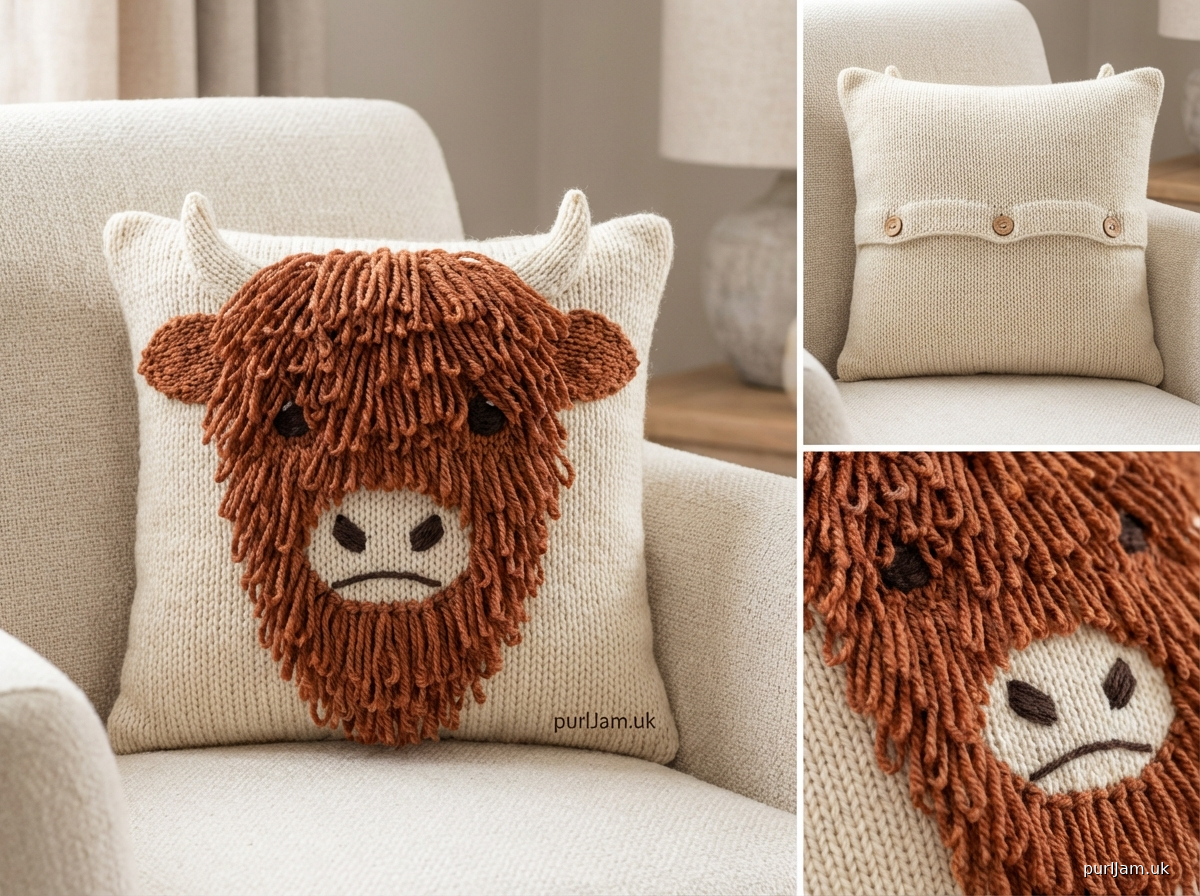
A charming 14" × 14" (35.5 cm) square pillow cover featuring an adorable highland cow design with textured "shaggy" fringe. Perfect for machine knitters ready to try decorative techniques like duplicate stitch embroidery and surface texture additions.

---

## MATERIALS

**Yarn:**
- **Main Color (MC - Cream/Beige)**: Approximately 350 yards (320 m) worsted weight yarn
- **Contrast Color 1 (CC1 - Ginger/Rust Brown)**: Approximately 50 yards (45 m) for shaggy fringe and body details
- **Contrast Color 2 (CC2 - Dark Brown/Black)**: Approximately 20 yards (18 m) for facial features
- **Contrast Color 3 (CC3 - Pale Gray or White)**: Small amount for horns (approximately 10 yards/9 m)

**Suggested Yarn:** Any worsted weight (medium/4) acrylic, wool, or cotton blend suitable for machine knitting. Samples shown used Red Heart Super Saver or Lion Brand Vanna's Choice.

**Machine Requirements:**
- Standard gauge (4.5mm) knitting machine
- No ribber required
- Suitable for punchcard, electronic, or manual machines

**Notions & Tools:**
- Ravel cord (smooth waste yarn)
- Cast-on comb and weights
- Tapestry needle for duplicate stitch and seaming
- Transfer tools (for any dropped stitch rescue)
- Latch tool for bind off
- 14" × 14" (35.5 cm) pillow form insert
- Scissors for fringe cutting
- Cardboard strip (2" × 4") for making even fringe (optional)
- Sewing needle and thread to close pillow opening (optional)
- Steam iron and pressing cloth

---

## GAUGE/TENSION

**Tension Dial Setting:** T6-7 (adjust based on your machine and desired fabric hand)

**Resulting Gauge:** Approximately 5 stitches and 7 rows per inch (2.5 cm) in stockinette stitch, measured after light steaming

**Gauge Swatch:** Cast on 30 sts, knit 40 rows at T6-7, bind off. Measure center 4" × 4" section after steaming. Adjust tension dial if necessary.

---

## FINISHED MEASUREMENTS

- **Width:** 14" (35.5 cm)
- **Height:** 14" (35.5 cm)
- Each panel knit flat creates one side of pillow cover

---

## ABBREVIATIONS & MACHINE TERMS

- **RC:** Row Counter
- **COL:** Carriage on Left
- **COR:** Carriage on Right
- **T:** Tension dial setting
- **MC:** Main Color
- **CC1, CC2, CC3:** Contrast Colors 1, 2, 3
- **WY:** Waste Yarn
- **HP:** Holding Position (needles out of work)
- **WP:** Working Position (needles in work)
- **St(s):** Stitch(es)
- **Duplicate St:** Duplicate stitch embroidery worked with tapestry needle after knitting

---

## PATTERN NOTES

1. **Construction:** This pillow cover is made from two identical rectangular panels knit flat in stockinette stitch. The highland cow design is added to the front panel after knitting using duplicate stitch embroidery and surface fringe.

2. **Beginner-Friendly Approach:** Rather than complex intarsia during knitting, this pattern uses simple stockinette panels with decorative elements added afterward. This keeps the machine knitting straightforward while creating an impressive finished project.

3. **Carriage Settings:** Keep carriage set for normal stockinette throughout (no slip, tuck, or hold settings during main knitting).

4. **Selvedge Edges:** The pattern uses full needle bed width for stable edges. First and last stitches may be slightly looser—this is normal and will be hidden in seams.

5. **Row Counter:** Reset RC to 000 at the beginning of each panel for accuracy.

6. **Tension Consistency:** Use weights throughout knitting to maintain even tension. Add additional weight after every 30-40 rows if fabric begins to pull.

7. **Duplicate Stitch Chart:** A placement guide is provided for the highland cow features. Feel free to adjust placement or add your own creative touches!

---

## INSTRUCTIONS

### MACHINE SETUP

1. Set tension dial to T6-7 (adjust for your machine).
2. Thread carriage with MC yarn.
3. Ensure carriage is set for stockinette (all levers in neutral/normal position).
4. Have cast-on comb, weights, and ravel cord ready.

---

### BACK PANEL (Plain)

**Cast On:**
1. Push 70 needles to WP (working position), centered on needle bed (e.g., needles 35L to 35R).
2. Using WY (waste yarn) and ravel cord, cast on with preferred method (e-wrap or cast-on comb method).
3. Knit 6-8 rows WY at T8-9. End COR.
4. Lay ravel cord across needles.
5. Knit 1 row WY over ravel cord. End COL.
6. Change to MC at T6-7.
7. Reset RC to 000.

**Body:**
1. **RC 000:** COL. Knit 1 row MC. End COR.
2. Continue knitting in stockinette, carriage moving left to right and back.
3. **RC 098:** Complete row. End COR.
   - **MATH CHECK:** 98 rows ÷ 7 rows/inch = 14" ✓

**Bind Off:**
1. **RC 098:** COR. Knit 1 row MC. End COL.
2. Knit 6-8 rows WY at T8-9.
3. Remove fabric from machine using latch tool or release carriage.
4. Set panel aside (do not remove waste yarn yet).

**Stitch Count Verification:** 70 sts across all 98 rows.

---

### FRONT PANEL (With Cow Design Placement)

**Cast On:**
1. Push 70 needles to WP, centered on needle bed (same as back panel).
2. Using WY and ravel cord, cast on with preferred method.
3. Knit 6-8 rows WY at T8-9. End COR.
4. Lay ravel cord across needles.
5. Knit 1 row WY over ravel cord. End COL.
6. Change to MC at T6-7.
7. Reset RC to 000.

**Body:**
1. **RC 000:** COL. Knit 1 row MC. End COR.
2. Continue knitting in stockinette, carriage moving left to right and back.
3. **RC 098:** Complete row. End COR.
   - **MATH CHECK:** 98 rows ÷ 7 rows/inch = 14" ✓

**Bind Off:**
1. **RC 098:** COR. Knit 1 row MC. End COL.
2. Knit 6-8 rows WY at T8-9.
3. Remove fabric from machine.
4. Set panel aside.

**Stitch Count Verification:** 70 sts across all 98 rows (identical to back panel).

---

## HIGHLAND COW DESIGN APPLICATION

After both panels are knit and removed from the machine, you'll add the highland cow features to the front panel. This is done off the machine using duplicate stitch embroidery and surface fringe.

### REMOVING WASTE YARN & FINISHING EDGES

1. For each panel, carefully remove the waste yarn by pulling out the ravel cord first, then unraveling the WY rows.
2. The MC knitting will have clean, stable edges ready for seaming.
3. Lightly steam each panel flat (wrong side up) using a pressing cloth. Do not drag the iron; lift and press gently.
4. Allow panels to cool and dry completely before proceeding.

### HIGHLAND COW PLACEMENT GUIDE

The cow design is centered on the front panel, approximately:
- **Horizontal center:** Around stitch 35 (center of 70-st width)
- **Vertical center:** Around row 50 (center of 98-row height)
- **Cow face height:** Approximately 30 rows (4.25")
- **Cow face width:** Approximately 30 sts (6")

### DUPLICATE STITCH CHART & INSTRUCTIONS

**Duplicate Stitch Technique Reminder:**
Thread a tapestry needle with contrast yarn. Working on the right side of the fabric, bring needle up from back through the base of a knit stitch, pass needle under both legs of the stitch above, then insert needle back down through the base where you started. This covers the original stitch with the new color.

**COW FACE FEATURES (worked in duplicate stitch):**

Use the following as a guide, adjusting placement as desired:

1. **Eyes (CC2 - Dark Brown):**
   - Left eye: Center approximately at st 30, row 60
   - Right eye: Center approximately at st 40, row 60
   - Each eye is 2-3 sts wide, 2 rows tall
   - Add a tiny white highlight dot (1 st) in each eye using MC or CC3

2. **Nose (CC2 - Dark Brown):**
   - Center at st 35, row 52
   - Create an upside-down triangle shape: 5 sts wide at top, tapering to 1 st
   - Approximately 4 rows tall

3. **Mouth (CC2 - Dark Brown):**
   - Simple curved line from nose down to row 48
   - Use backstitch or duplicate stitch for a gentle smile

4. **Ears (CC1 - Ginger Brown):**
   - Left ear: Starting around st 26, row 68, create a small triangular shape 4 sts wide, 5 rows tall
   - Right ear: Mirror on right side, starting around st 44, row 68
   - Optional: Add inner ear detail with lighter MC

5. **Horns (CC3 - Pale Gray/White):**
   - Left horn: Starting around st 24, row 70, create a curved horn shape extending upward and outward, approximately 3-4 sts wide, 8-10 rows tall
   - Right horn: Mirror on right side, starting around st 46, row 70
   - Use duplicate stitch to create curved, slightly tapered horn shape

**SIMPLIFIED CHART (each square = 1 stitch/row):**

```
Row 80  |     H     H     |  (H = Horn, CC3)
Row 75  |     H     H     |
Row 70  |    HH     HH    |
Row 68  |   E         E   |  (E = Ear, CC1)
Row 65  |   E         E   |
Row 62  |                 |
Row 60  |     O     O     |  (O = Eye, CC2)
Row 58  |                 |
Row 55  |                 |
Row 52  |       N         |  (N = Nose, CC2)
Row 50  |      NNN        |
Row 48  |       |         |  (Mouth line)
        +-----------------+
        St 25   35    45
```

This is a simplified guide. Feel free to sketch your own cow face on graph paper and customize!

---

### SHAGGY FRINGE APPLICATION (CC1 - Ginger Brown)

The signature feature of a highland cow is its long, shaggy coat. Create this texture with cut fringe.

**Fringe Method:**

1. **Prepare Fringe Strands:**
   - Cut CC1 yarn into 5" (12.5 cm) lengths (each will create 2" finished fringe after folding).
   - You'll need approximately 60-80 strands for generous coverage.

2. **Fringe Placement:**
   - Add fringe around the cow's face to simulate shaggy hair.
   - Place fringe primarily:
     - Across forehead (rows 70-78, sts 28-42)
     - Down both sides of face (rows 50-75, along edges at sts 24-27 and 43-46)
     - Under chin area (rows 45-52, sts 30-40)

3. **Attaching Fringe:**
   - Fold each 5" strand in half.
   - Using a crochet hook or tapestry needle, pull the folded loop through the knitted fabric from front to back.
   - Thread the two loose ends through the loop and pull tight.
   - Trim all fringe to approximately 2" (5 cm) length for even, shaggy appearance.

4. **Fringe Density:**
   - Place fringe strands every 2-3 stitches and every 2-3 rows for full coverage.
   - Closer spacing = shaggier effect.
   - Step back and assess coverage as you work; add more strands where needed.

5. **Optional Body Texture:**
   - If desired, add sparser fringe to suggest body fur below the face (rows 35-48), using longer strands (3" finished length).

---

## FINISHING & ASSEMBLY

### BLOCKING

1. With both panels completed (front with cow design, back plain), lay flat on blocking surface.
2. Gently steam both panels again if needed to even out any tension irregularities.
3. Do not over-press; you want a soft fabric suitable for a pillow.
4. Allow to cool and dry completely.

### SEAMING

You'll seam three sides completely and leave the fourth side open for pillow insert.

**Setup:**
1. Lay front panel right side up.
2. Lay back panel right side down on top of front panel (right sides together).
3. Pin all four edges, aligning corners carefully.

**Seaming Method (Mattress Stitch or Backstitch):**

1. **Thread tapestry needle** with MC yarn (approximately 60" length).

2. **First Side (Bottom Edge):**
   - Starting at bottom right corner, seam
Disclaimer: This pattern was generated by AI and should be reviewed for accuracy before use. While we strive for quality, AI-generated content may contain errors. Please verify measurements, stitch counts, and instructions before beginning your project. Generated by purlJam.uk
Access your pattern anytime
Bookmark this page to access your pattern anytime