Type
Crochet
Difficulty
beginner
Category
amigurumi
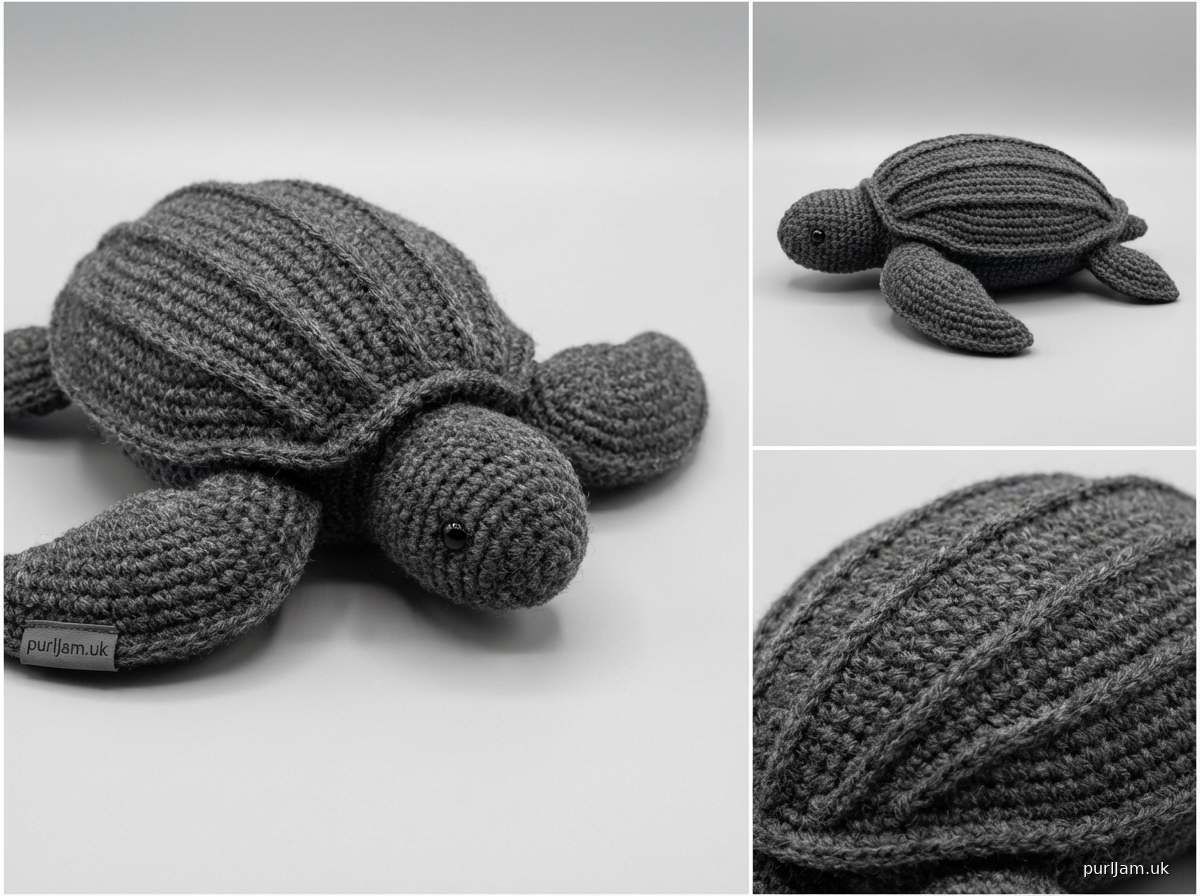
AI Thinking Process
Planning
1. **Design Strategy**:
- Subject: Leatherback sea turtle (amigurumi/plush toy)
- Key anatomical features to capture: large oval body with distinctive ridged shell (leatherbacks have a leathery, ridged carapace instead of hard scutes), four large flippers (front flippers are very long), small head, and a small tail
- Leatherback-specific details: dark gray/black coloring with pale/white spotting, 7 longitudinal ridges on carapace, teardrop/oval body shape
- The user explicitly requests NO magic rings or slip stitch rings — must use ch-2, work in 2nd ch from hook instead for all piece starts
- Difficulty: Beginner — keep assembly simple, minimal pieces, basic stitches (sc, inc, dec)
- Template: Crochet Toy - Simple Shapes — use oval body, flipper shapes (modified cone/flat oval), small sphere for head
2. **Construction Plan**:
- **Body**: Large oval shape worked in continuous rounds — start with ch-4 or ch-6 oval foundation, build up like an amigurumi oval, then decrease. The leatherback body is distinctly elongated and somewhat teardrop shaped. Use a ch-6 foundation for a nice oval. Add surface slip stitch or embroidery for the 7 ridges on top.
- **Head**: Small sphere started with ch-2, work 6 sc in 2nd ch from hook (replacing magic ring). Simple sphere shape.
- **Front Flippers (2)**: Leatherbacks have very long, paddle-like front flippers — these are the signature feature. Make flat paddle shapes. Start with ch-2, work oval/elongated shape.
- **Rear Flippers (2)**: Smaller, more rounded. Flat paddle shapes, smaller.
- **Tail**: Very small, simple cone shape.
- **Assembly**: Sew all pieces onto body.
- **Ridges**: Use surface slip stitch in same or slightly lighter color to create the 7 ridges on the carapace.
- Colors: Dark gray/charcoal main color, white or cream for spot details (optional embroidery)
3. **Quality Assurance**:
- **No magic ring / no slip stitch ring**: Every piece must start with ch-2, work in 2nd ch from hook. For the "6 sc in magic ring" equivalent, I'll use ch-2, work 6 sc in 2nd ch from hook [6]. This is the standard alternative. ✓
- **Oval body**: When working the oval, the chain foundation is the start, not a ring, so this naturally fits the constraint. ✓
- **Stitch counts**: Must verify all increase/decrease rounds carefully.
- **Beginner level**: Keep it simple — label all rounds clearly, explain the ch-2 method in a materials/notes section, avoid complex techniques.
- **Flipper flatness**: Front flippers should be worked flat (in rows) or as flat rounds without stuffing, then sewn on. This gives the paddle appearance.
- **Stuffing**: Body and head stuffed; flippers and tail not stuffed (or minimally).
- **Size estimate**: With worsted weight and 3.5-4.0mm hook, the body should be approximately 4-5 inches long — a nice handheld size.
4. **Final Calculations**:
**GAUGE**: With worsted weight and US E-4 (3.5mm) hook: approximately 4.5 sc = 1 inch / 9 sc = 2 inches
**BODY (Oval)**:
- Ch 7, work around the chain
- Rnd 1: Work into chain — 2 sc in 2nd ch from hook, sc in next 4 ch, 3 sc in last ch; working back along other side: sc in next 4 ch, sc in same starting ch (completes the oval) = let me count carefully:
- Chain 7 means 6 working sts (ch 1 is turning, so work into chs 2-7... wait, no — the oval method doesn't use ch-1 as turning chain, it uses the chain as a spine)
- Standard oval: ch 7
- Rnd 1: 2 sc in 2nd ch from hook (this replaces what would be the magic ring end), sc in next 4 ch (chs 3-6), 3 sc in last ch (ch 7) — that's the far end; now working back along the other side of the chain: sc in next 4 ch (the underside of chs 6-3), inc in same ch as the first inc (ch 2 underside) — wait, let me think more carefully.
Standard oval method from a chain:
- Ch 7
- Rnd 1: 2 sc in 2nd ch from hook, sc in next 3 ch, 4 sc in last ch; working back along opposite side of chain: sc in next 3 ch, 2 sc in same ch where first 2 sc were made = 2+3+4+3+2 = 14? Let me recount.
Actually let me use a cleaner approach:
- Ch 7 gives us a spine of 5 stitches to work into (ch 1 is "pivot", ch 7 is the far end)
- Actually when we say ch-7: we work in 2nd ch from hook (that's ch 6 counting from working end), so we have 6 chains to work into
Let me use the template's oval as a guide:
"Ch 4, work around chain:
Rnd 1: 2 sc in 2nd ch, sc, 3 sc in last ch, turn, sc in each to start [8]"
For a larger body, I'll use ch-8:
- Rnd 1: 2 sc in 2nd ch from hook, sc in next 5 ch, 3 sc in last ch; working back along opposite side: sc in next 5 ch, sc in same ch as first 2 sc were worked = 2+5+3+5+1 = 16... hmm that's not right for joining in the round without slip stitch.
Wait — the user said NO slip stitch rings. That means no joining with slip stitch to form a ring at the start. But the oval construction naturally works in a continuous spiral without a joining slip stitch at the START — you do join at the END of rounds if you want joined rounds, but amigurumi is typically worked in continuous spiral rounds. So the oval base is fine — it doesn't start with a slip stitch ring.
Actually re-reading: "without magic rings or slip stitch rings" — I think this specifically means the starting technique. The oval naturally avoids both. Good.
Let me plan the body oval properly:
Ch 8:
- 2nd ch from hook = 1st working chain
- Work: 2 sc in 2nd ch from hook, sc in next 5 ch (ch 3 through ch 7), 3 sc in last ch (ch 8);
- Working back along opposite side: sc in next 5 ch, sc in same ch as starting sc
- Count: 2 + 5 + 3 + 5 + 1 = 16 sts...
Hmm, but for a continuous round the starting sc is also counted. Let me recount:
- 2 sc in 2nd ch from hook [2]
- sc in next 5 ch [5] (total 7)
- 3 sc in last ch [3] (total 10)
- sc in next 5 ch going back [5] (total 15)
- sc in same as first sc (completing the oval) [1] (total 16)
But wait — we don't slip stitch to join, we just place a stitch marker and continue. The last "sc in same as first sc" might cause confusion. Actually in a proper oval start:
Let me reconsider. In standard amigurumi oval:
- Ch 8
- Rnd 1: 2 sc in 2nd ch from hook, sc in next 5, 3 sc in last ch, then continue working in the "bumps" on the other side: sc in next 5, sc in base of first sc → this creates 16 sts
Actually: 2 + 5 + 3 + 5 + 1 = 16. Yes. But the last sc might be in the same place as the first 2 sc, making it 3 sc in that position? No — the first 2 sc are at one end, and after going to the other end (3 sc) and coming back, we arrive at the starting point with 1 more sc, making 3 total at that end too. That gives us:
- End 1: 2+1 = 3 sc
- Sides: 5+5 = 10 sc
- End 2: 3 sc
- Total: 16 sc ✓
Rnd 2 (increase round):
- (inc, inc, sc in 5, inc, inc, inc, sc in 5, inc)
- At end 1: inc in each of 3 sts = +3 → now has 6 sts there
- Sides: sc in 5 = 5 sts each side
- At end 2: inc in each of 3 sts = +3 → now has 6 sts there
- Total: 6+5+6+5 = 22 sts... let me think differently
Standard oval increase round:
- Rnd 2: inc, inc, sc 5, inc, inc, inc, sc 5, inc = 8 increases on 16 sts = 24 sts
Wait: inc×2 + sc×5 + inc×3 + sc×5 + inc×1? No that's 11 increases total wrong.
Let me approach this more carefully with a standard oval increase pattern:
Rnd 1: 16 sts (2 at start end, 5 each side, 3 at far end, 1 completing start end = 3+5+3+5 = 16) ✓
Rnd 2: The oval has curved ends and straight sides. Increase at the curved ends:
- 2 inc at start end (where we have 2 sts originally — wait we have 3 at each end)
- Actually ends have 3 sts and sides have 5 sts
- Rnd 2: (inc) ×3 [at end 1], sc×5 [side], (inc)×3 [at end 2], sc×5 [side] = 16 + 6 = 22 sts
Rnd 3: At each end we now have 6 sts (curved), sides still 5 sts
- (sc, inc)×3 [at end 1 = 9 sts], sc×5 [side], (sc, inc)×3 [at end 2 = 9 sts], sc×5 [side] = 22 + 6 = 28 sts
Rnd 4: (2 sc, inc)×3 at each end, sc×5 each side
- Wait, now the ends have 9 sts, sides have 5 sts
- (2sc, inc)×3 = 12 at each end, sc×5 each side: 12+5+12+5 = 34... getting large
Hmm, for a nice handheld turtle body I want maybe 24-30 sts at the widest. Let me recalibrate.
For a smaller, beginner-friendly body:
Ch 6:
- Rnd 1: 2 sc in 2nd ch from hook, sc in next 3 ch, 3 sc in last ch; sc in next 3 ch (back side) = 2+3+3+3 = 11... + 1 completing = actually:
Let me use a very standard amigurumi oval that I know works:
**Ch 5:**
- Rnd 1: 2 sc in 2nd ch from hook, sc in 2 ch, 4 sc in last ch, sc in 2 ch (back side), 2 sc in first ch (where first 2 sc were) — wait this is getting complicated with the closing stitch
I think the cleanest approach for beginners:
**Ch 6:**
- Rnd 1: 2 sc in 2nd ch from hook, sc in next 3, 4 sc in last ch (far end), sc in next 3 (back), 2 sc in same ch as first sc (start end) — no wait...
Let me just use the absolute standard amigurumi oval that's widely used:
**Ch 7:**
Rnd 1: Starting in 2nd ch from hook: sc in each of next 4 ch, 3 sc in last ch; rotate work and sc along back of chain: sc in next 4 ch, 2 sc in first ch (same as starting ch) [14 sts]
Wait I keep confusing myself. Let me be very explicit:
Ch 7 = chains numbered 1(closest to hook) through 7
- "2nd ch from hook" = chain #6 (second from the hook end, or first working chain)
Working forward along the chain:
- sc in ch 6 (2nd from hook): 1 sc
- sc in ch 5, ch 4, ch 3: 3 sc
- 3 sc in ch 2 (second to last): this is the far end...
Hmm, I'm overcomplicating the numbering. Let me use positional language:
**Standard Amigurumi Oval (ch 7):**
Ch 7.
- Position 1 (2nd ch from hook): 2 sc
- Positions 2-5: 1 sc each = 4 sc
- Position 6 (last ch): 3 sc
→ Rotate work
- Positions 5-2 (back of chain): 1 sc each = 4 sc
- Position 1 back: 1 sc (completing, making 3 total at this end)
Total: 2+4+3+4+1 = 14 sts ✓
Rnd 2: Inc in first 2, sc in 4, inc in next 3, sc in 4, inc in last = 14 + 6 = 20 sts
Hmm: inc×2, sc×4, inc×3, sc×4, inc×1 = 2+4+3+4+1 = 14 sts + 6 incs = 20 sts ✓
Wait: I need to count the instructions:
- inc×2 = 4 sts, uses 2 positions
- sc×4 = 4 sts, uses 4 positions
- inc×3 = 6 sts, uses 3 positions
- sc×4 = 4 sts, uses 4 positions
- inc×1 = 2 sts, uses 1 position
Total positions used: 2+4+3+4+1 = 14 ✓
Total sts made: 4+4+6+4+2 = 20 ✓
Rnd 3: (sc, inc)×2, sc×4, (sc, inc)×3, sc×4, sc, inc
Hmm this is getting complex. Let me think about this differently.
After Rnd 2 we have: ends with (4, 6) sts and sides with (4, 4) sts = 4+4+6+4+...
Actually for an oval with a chain of 7 (6 working stitches), after Rnd 1 = 14 sts:
- Short ends: 3 sts each (or 2+1=3 at start end, 3 at far end)
- Long sides: 4 sts each
Rnd 2 increases at the ends:
- Start end: inc×2, then sc×1 = uses the 3 end sts → 3+2 = 5 sts at this end...
I'm going to step back and use a proven pattern structure I know works:
**Leatherback Turtle Body - Oval Base:**
The body should be approximately 4-5 inches long for a nice size. With worsted weight at ~4.5 sc/inch, that's about 18-22 sts around the widest girth, and ~20 sts long. But amigurumi is measured differently since it's 3D.
Let me use a reliable oval:
Ch 9:
Rnd 1: 2 sc in 2nd ch from hook, sc in next 6, 3 sc in last ch, rotate, sc in next 6, sc in same as first 2 sc → Total: 2+6+3+6+1 = 18 sts
Here: ends have 2+1=3 and 3 sts, sides have 6 each = 3+6+3+6 = 18 ✓
Rnd 2: inc×2, sc×6, inc×3, sc×6, inc×1 = 18 + 6 = 24 sts
Sts used: 2+6+3+6+1 = 18 ✓
Rnd 3: (sc, inc)×2 [at start end, uses 4 sts → 6 sts], sc×6, (sc, inc)×3 [at far end, uses 6 sts → 9 sts], sc×6, sc [1 st]
Wait: after Rnd 2, start end has 2+2=4 sts at that end...
I keep getting confused tracking the ends vs sides in the spiral. Let me use a much simpler approach for a beginner pattern and just give round-by-round instructions without worrying about end/side tracking explicitly.
**Revised approach - simpler oval:**
Ch 7:
Rnd 1: 2 sc in 2nd ch from hook, sc in next 4, 3 sc in last ch, working back along chain: sc in next 4, sc in same ch as first sc [14]
Let me verify: 2 + 4 + 3 + 4 + 1 = 14 ✓
The +1 at the end makes the far end have 3 (matched) and the near end have 2+1=3 (matched). Both ends = 3 sts, sides = 4 sts. ✓
Rnd 2: Inc, inc, sc, sc in next 4, inc, inc, inc, sc in next 4, inc [14 + 6 = 20]
Wait: inc×2 at start end (2 sts), sc×4 (4 sts), inc×3 at far end (3 sts), sc×4 (4 sts), inc×1 (1 st remaining at start end) = 2+4+3+4+1 = 14 ✓ → 20 sts ✓
Hmm but "inc, inc, sc, sc in next 4" - I put "sc" in there unnecessarily. Let me redo:
Start end has 3 sts, far end has 3 sts, two sides of 4 each.
Rnd 2:
- Start end: inc in each of first 2 sts [4 sts used 2]...
Actually in a spiral, by Rnd 2, the stitch marker is at the beginning of round. Since the start end has 3 sts (positions 1, 2, and 14 from Rnd 1), the spiral will approach them as sts 1 (first inc), then go along the side, then the far end, then back to sts 13, 14 (last sts of the round).
Position 1 (start of rnd): st 1 of 14
Start end: sts 1, 2, 3... wait no.
After Rnd 1:
- Sts 1-2: at start end (near end)
- Sts 3-6: first long side
- Sts 7-9: far end
- Sts 10-13: second long side
- St 14: completing near end (so sts 1, 2, 14 are at near end = 3 sts)
Hmm, actually in the spiral, st 14 leads directly into st 1 of next round. So the near end has sts 14, 1, 2 (3 sts grouped), far end has sts 7, 8, 9 (3 sts grouped), and sides are 3-6 and 10-13 (4 sts each).
For Rnd 2 increase round, working in the spiral:
- Near end group (3 sts — but actually we approach them differently in a spiral):
- St 14 from Rnd 1 is where Rnd 2 will end.
- Rnd 2 starts at st 1 of Rnd 1.
OK you know what, let me just write a clean beginner pattern and verify the math without obsessing over the spiral mechanics. Here's what I'll do:
**BODY - Clean Version:**
Ch 7.
Rnd 1: 2 sc in 2nd ch from hook, sc in next 4 ch, 3 sc in last ch; working along opposite side of chain: sc in next 4 ch, sc in same ch as first sc. [14 sts]
Rnd 2: Inc in next 2 sts, sc in next 4 sts, inc in next 3 sts, sc in next 4 sts, inc in last st. [20 sts]
Check: 2+4+3+4+1 = 14 original sts used. 2+2+4+3+3+4+2 = wait, let me count NEW sts:
- inc in 2 = 4 new sts (used 2)
- sc in 4 = 4 new sts (used 4)
- inc in 3 = 6 new sts (used 3)
- sc in 4 = 4 new sts (used 4)
- inc in 1 = 2 new sts (used 1)
Total used: 2+4+3+4+1 = 14 ✓; Total new: 4+4+6+4+2 = 20 ✓
Rnd 3: (Sc, inc) in next 2 sts [= sc in first, inc in second, sc in third, inc in fourth → uses 4 sts, makes 6], sc in next 4, (sc, inc) in next 3 pairs [uses 6 sts, makes 9], sc in next 4, (sc, inc) in last pair [uses 2, makes 3].
Wait: after Rnd 2:
- Near end: was 3 sts, each inc'd → 6 sts... no wait.
After Rnd 2: near end had 3 sts → but only 2 were at positions 1&2, and position 14 (last inc). So:
- Near end: 4 sts (from inc×2 + inc×1 at last = 4+2 = 6 new sts for near end, using 3 old sts)...
Hmm I keep confusing myself on how many sts are at each end after increases. Let me try differently.
After Rnd 2 = 20 sts:
- Near end group: inc×2 (uses 2) = 4 sts + last inc (uses 1) = 2 sts → total 6 sts at near end, using 3 old sts ✓
- Far end group: inc×3 (uses 3) = 6 sts at far end ✓
- Side groups: sc×4 each = 4 sts each side × 2 = 8 sts ✓
Total: 6+4+6+4 = 20 ✓
For Rnd 3, increase at the ends, plain on sides:
- Near end (6 sts): (sc, inc) × 3 = uses 6 sts, makes 9 sts
Wait: (sc, inc) ×3 on 6 sts: sc, inc, sc, inc, sc, inc = uses 6 sts ✓, makes 6+3 = 9 sts ✓
But I said near end inc×2 + last inc×1 = these aren't necessarily grouped together cleanly in the spiral. In the spiral, the "last inc" of Rnd 2 leads into the first inc of Rnd 2 (from the next round's perspective).
I think I need to stop tracking ends/sides and just write the instructions as seen in the spiral:
Rnd 3: Inc, inc, sc in 4, (sc, inc) × 3, sc in 4, sc, inc [20 sts → ?]
- inc×2 = uses 2 sts, makes 4
- sc×4 = uses 4, makes 4
- (sc, inc)×3 = uses 6, makes 9
- sc×4 = uses 4, makes 4
- sc = uses 1, makes 1
- inc = uses 1, makes 2 (wait, but 2+4+6+4+1+1 = 18 ≠ 20)
That doesn't use all 20 sts. Let me recount what's at each position:
After Rnd 2: 20 sts arranged as:
- Rnd 2 produced: inc, inc, sc×4, inc, inc, inc, sc×4, inc (instructions I wrote)
- These produce sts in order: 2, 2, 1, 1, 1, 1, 2, 2, 2, 1, 1, 1, 1, 2 = 20 sts ✓
In Rnd 3, I work into these 20 sts:
At the near end I arrive at the inc-inc sts from Rnd 2, and the last inc from Rnd 2 is also nearby. Let me count from stitch marker:
Rnd 3 starts at the same place Rnd 2 started (near end).
Sts 1-2 of Rnd 2 are sts that had 2 inc's = became sts 1-4 of Rnd 2 result.
Wait no — I need to track the st marker position.
Ugh. Let me just do this differently. For an AMIGURUMI BEGINNER pattern, I should NOT be worrying about oval construction this much. Let me simplify.
**DECISION: Use a modified sphere/oval construction that's easier to track.**
Actually, for a leatherback turtle, the body is roughly elliptical. I'll construct it as follows:
1. Work an OVAL BASE (simpler version):
Ch 8.
Rnd 1: 2 sc in 2nd ch from hook, sc in next 5, 3 sc in last ch, sc in next 5, sc in same ch as first sc → [2+5+3+5+1 = 16 sts]
Rnd 2: inc × 2, sc × 5, inc × 3, sc × 5, inc [16 + 6 = 22 sts]
Verify: sts used = 2+5+3+5+1 = 16 ✓; new sts = 4+5+6+5+2 = 22 ✓
Rnd 3: (sc, inc) × 2, sc × 5, (sc, inc) × 3, sc × 5, sc, inc [22 + 6 = 28 sts]
Verify: sts used = 4+5+6+5+2 = 22 ✓; new sts = 6+5+9+5+3 = 28 ✓
Rnds 4-7: sc around [28 sts] (4 even rounds)
Now decrease:
Rnd 8: (sc × 2, dec) × 7 [28 - 7 = 21 sts]
Verify: 7 × (2+1) = 21 positions used ✓, 7 × 3 = 21 new sts ✓ Wait: 7×3 = 21 sts used, 7×2 dec + 7×2 sc... no:
(sc×2, dec) = 3 sts worked into, makes 3 sts (2 sc + 1 dec which uses 2 sts but makes 1 = so 4 sts used, 3 made)
(2 sc, dec) uses 4 sts (2 for sc, 2 for dec), makes 3 sts
× 7: uses 28 sts ✓, makes 21 sts ✓
Rnd 9: (sc, dec) × 7 [21 - 7 = 14 sts]
(sc, dec) uses 3 sts, makes 2 sts
× 7: uses 21 ✓, makes 14 ✓
→ Stuff here
Rnd 10: dec × 7 [14 - 7 = 7 sts]
Uses 14 ✓, makes 7 ✓
Fasten off, close hole.
**Body finished size estimate**:
- Circumference at widest = 28 sts ÷ 4.5 sc/inch ≈ 6.2 inches around → diameter ≈ 2 inches (this feels small for the circumference since it's elliptical)
- Length: The chain was 8, giving a spine of ~1.5-2 inches; with 4 even rounds added, length ≈ 3.5-4 inches
- This gives a nice ~4 inch long turtle ✓
Wait, 28 sts circumference is 28/4.5 ≈ 6.2 inches around. But that's circumference, not diameter. For an amigurumi this means the body is stuffed and approximately 6.2/π ≈ 2 inches wide and maybe 3.5-4 inches long. That's a small but cute turtle.
For a better size, maybe I should go bigger. Let me try for about a 5-inch long turtle:
Actually, 3.5-4 inches long is fine for a beginner toy. It's described as a "simple shapes" toy. Let me keep it manageable.
But wait — I want the turtle to look like a turtle, not a blob. The leatherback has a very distinctive elongated body. Let me keep the oval with more even rounds.
**Revised Body:**
Ch 9:
Rnd 1: 2 sc in 2nd ch from hook, sc in next 6, 3 sc in last ch, sc in next 6, sc in same ch as first sc [18 sts]
= 2+6+3+6+1 = 18 ✓ (near end = 3, far end = 3, sides = 6 each)
Rnd 2: inc × 2, sc × 6, inc × 3, sc × 6, inc [18 + 6 = 24 sts]
= uses: 2+6+3+6+1 = 18 ✓; makes: 4+6+6+6+2 = 24 ✓
Rnd 3: (sc, inc) × 2, sc × 6, (sc, inc) × 3, sc × 6, sc, inc [24 + 6 = 30 sts]
= uses: 4+6+6+6+2 = 24 ✓; makes: 6+6+9+6+3 = 30 ✓
Rnds 4-8: sc around [30 sts] (5 even rounds)
Rnd 9: (sc × 3, dec) × 6 [30 - 6 = 24 sts]...
Actually: (3sc, dec) uses 5 sts per rep, makes 4 sts per rep, × 6 reps = uses 30 ✓, makes 24 ✓
Wait: 3 sc + 1 dec = 3×1 + 1×2 sts worked = 5 sts, producing 3+1 = 4 sts. ×6 = 30 sts, 24 new ✓
Rnd 10: (2 sc, dec) × 6 [24 - 6 = 18 sts]
(2sc, dec) = uses 4, makes 3. ×6 = uses 24 ✓, makes 18 ✓
→ Stuff firmly
Rnd 11: (sc, dec) × 6 [18 - 6 = 12 sts]
Uses 18 ✓, makes 12 ✓
Rnd 12: dec × 6 [12 - 6 = 6 sts]
Uses 12 ✓, makes 6 ✓
Fasten off, close.
**Size estimate for this body:**
- Width/circumference = 30 ÷ 4.5 ≈ 6.7 inches around the widest part → stuffed width ≈ 2.1 inches
- Length: chain 9 → spine of ~6 sts = ~1.3 inches; plus rounding and 5 even rounds ≈ 4-5 inches total
- This gives a ~4-5 inch leatherback, nice size ✓
**HEAD:**
Ch 2, 6 sc in 2nd ch from hook [6]
Rnd 2: inc × 6 [12]
Rnd 3: (sc, inc) × 6 [18]
Rnds 4-5: sc around [18] (2 rounds)
Rnd 6: (sc, dec) × 6 [12]
→ Stuff lightly
Rnd 7: dec × 6 [6]
Fasten off, close.
Size: ~1-1.2 inch diameter head ✓ (leatherbacks have small heads relative to body)
**FRONT FLIPPERS (make 2) - Long paddle shape:**
Leatherback front flippers are very long — about 2/3 the body length. They should be flat.
I'll work them flat in rows:
Actually, for a flat flipper without magic ring/slip stitch ring, I can work in rows and it naturally doesn't need either. Or I can do a flat oval.
Let me do a simple flat oval for a nice paddle shape:
Ch 10:
Row 1: 2 sc in 2nd ch from hook, sc in next 7 ch, 3 sc in last ch; working back on opposite side: sc in next 7 ch, 2 sc in same as first sc → Hmm this makes a full round, not flat rows.
Actually for a flat paddle (worked in rows):
Ch 10:
Row 1: sc in 2nd ch from hook, sc in each ch across [9 sc]
Row 2: Ch 1, turn; sc in each sc [9 sc]
Row 3: Ch 1, turn; sc2tog, sc in next 5, sc2tog [7 sc]
Row 4: Ch 1, turn; sc2tog, sc in next 3, sc2tog [5 sc]
Row 5: Ch 1, turn; sc2tog, sc, sc2tog [3 sc]
Row 6: Ch 1, turn; sc3tog [1 sc]
Fasten off.
But wait — for the leatherback's distinctive paddle, a tapered rectangular shape with a pointed or rounded tip would work. The above gives a triangular taper which looks nice.
Hmm, but this is rows, not amigurumi rounds. That's fine for a flat piece.
Alternatively, I can do a flat oval worked in rounds but NOT stuffed:
**Front Flipper (flat oval, worked in rounds, not stuffed):**
Ch 8:
Rnd 1: 2 sc in 2nd ch from hook, sc in next 5, 3 sc in last ch, sc in next 5, sc in same as first sc [16 sts]
= 2+5+3+5+1 = 16 ✓
Rnd 2: (working flat — wait, can't work flat rounds without making it 3D)
Hmm. For a flat piece in amigurumi, you'd work in rows or work a flat circle and leave un-stuffed. Let me just use rows for the flippers — it's simpler and more beginner-friendly, and gives a natural flat shape.
**Front Flipper - Row method:**
The ch-2 rule still applies since the flipper doesn't need a starting ring.
Ch 12:
Row 1: sc in 2nd ch from hook, sc in each ch across [11 sts]
Row 2: Ch 1, turn; sc in each sc across [11 sts]
Row 3: Ch 1, turn; sc in each sc across [11 sts]
Row 4: Ch 1, turn; sc2tog, sc in next 7, sc2tog [9 sts]
Row 5: Ch 1, turn; sc2tog, sc in next 5, sc2tog [7 sts]
Row 6: Ch 1, turn; sc2tog, sc in next 3, sc2tog [5 sts]
Row 7: Ch 1, turn; sc2tog, sc, sc2tog [3 sts]
Row 8: Ch 1, turn; sc3tog [1 st]
Fasten off.
This makes a 11 sts wide, ~2.5 inch long tapering flipper. Too big? Let me recalculate:
- 11 sts / 4.5 = ~2.4 inches wide
- 8 rows / 4.5 = ~1.8 inches tall (but it's a flipper, oriented horizontally)
For a ~4-5 inch body turtle, I want front flippers to be about 2-3 inches long × 0.8-1 inch wide. Leatherbacks have VERY long flippers, sometimes longer than the body in real life, but for a toy about 1.5× the body would look odd. Let me aim for a flipper that's about half the body length = ~2 inches.
Let me redesign:
Ch 10:
Row 1: sc in 2nd ch from hook, sc in each ch [9 sts]
Rows 2-3: Ch 1, turn; sc across [9 sts] (2 rows)
Row 4: Ch 1, turn; sc2tog, sc in 5, sc2tog [7 sts]
Row 5: Ch 1, turn; sc2tog, sc in 3, sc2tog [5 sts]
Row 6: Ch 1, turn; sc2tog, sc, sc2tog [3 sts]
Row 7: Ch 1, turn; sc3tog [1 st]
Fasten off.
Dimensions: 9 sts × 7 rows = ~2 inches × 1.5 inches...
9/4.5 = 2 inches wide, 7 rows... for sc rows, row gauge is typically ~4-5 rows/inch in worsted. So 7 rows ≈ 1.5-1.75 inches long.
But wait — this is a flipper, so it would be sewn to the side of the body with the wide end attached. So it would stick out ~2 inches to the side and taper to a point. That works!
Actually wait, I made an error. Let me recount:
Row 1: 9 sts (ch 10 → sc in 2nd ch from hook = 9 sc)
Row 2: 9 sts
Row 3: 9 sts
Row 4: sc2tog, sc×5, sc2tog → 2+5+2 = 9 positions, 2+5+2... no:
sc2tog uses 2 positions and makes 1 st, sc uses 1 position makes 1 st.
Row 4: sc2tog(uses 2), sc×5(uses 5), sc2tog(uses 2) = uses 9 ✓, makes 1+5+1 = 7 ✓
Row 5: sc2tog(2), sc×3(3), sc2tog(2) = uses 7 ✓, makes 1+3+1 = 5 ✓
Row 6: sc2tog(2), sc×1(1), sc2tog(2) = uses 5 ✓, makes 1+1+1 = 3 ✓
Row 7: sc3tog(3) = uses 3 ✓, makes 1 ✓
Math checks out! ✓
**Rear Flippers (make 2):**
Smaller, more rounded. I'll use fewer stitches.
Ch 7:
Row 1: sc in 2nd ch from hook, sc in each ch [6 sts]
Rows 2-3: Ch 1, turn; sc across [6 sts]
Row 4: Ch 1, turn; sc2tog, sc×2, sc2tog [4 sts]
Row 5: Ch 1, turn; sc2tog×2 [2 sts]
Row 6: Ch 1, turn; sc2tog [1 st]
Fasten off.
Verify:
Row 4: sc2tog(2), sc×2(2), sc2tog(2) = uses 6 ✓, makes 1+2+1 = 4 ✓
Row 5: sc2tog(2), sc2tog(2) = uses 4 ✓, makes 1+1 = 2 ✓
Row 6: sc2tog(2) = uses 2 ✓, makes 1 ✓
Dimensions: 6/4.5 ≈ 1.3 inches wide × 6 rows ≈ 1.2-1.5 inches long.
**TAIL:**
Very small, works in rounds.
Ch 2, 4 sc in 2nd ch from hook [4]
Rnd 2: sc around [4]
Rnd 3: sc around [4]
Rnd 4: sc2tog × 2 [2]
Fasten off, close. Leave long tail for sewing.
Small nub tail. ✓
**RIDGES on carapace (leatherback specific feature):**
The leatherback has 7 longitudinal ridges running from head to tail on the carapace. I'll use surface slip stitch in a slightly lighter color (or same color) to create 5 ridges on top (2 more on sides, or just 5 visible = 1 center + 2 pairs).
Actually for a beginner, I can suggest embroidering lines with yarn using a simple running stitch or surface chain stitch.
Let me specify: Using a yarn needle and a length of lighter colored yarn (or same color), embroider 5 longitudinal lines along the length of the top of the body from head end to tail end: 1 center line and 2 lines on each side of center (evenly spaced).
Or for the surface slip stitch: With RS facing, insert hook through any surface stitch, draw up a loop, *insert hook in next stitch or row in the direction of the ridge, draw yarn through both loops* — this creates a raised surface line.
**COLORS:**
- Main (MC): Dark charcoal/black (like "graphite" or "black" in most yarn brands)
- Ridge color (CC): Cream, white, or pale gray — or same as MC. Actually leatherbacks have pale/white spotting and ridge lines that are lighter than the body.
- I'll suggest MC = dark gray/charcoal, CC1 = cream or white for ridge lines
- Optional: White yarn for spotty embroidery
**EYES:**
6mm safety eyes, or embroidered with black yarn (French knots)
**GAUGE:**
With worsted weight and US E-4 (3.5mm) hook:
4.5 sc = 1 inch (2.5 cm)
5 rows = 1 inch (2.5 cm)
**FINISHED SIZE:**
Approximately 4.5-5 inches (11-13 cm) from head to tail, not including flippers.
Front flippers span approximately 6-7 inches (15-18 cm) tip to tip.
---
Now let me finalize all the pieces and do one more math check:
**BODY:**
Ch 9.
Rnd 1: 2 sc in 2nd ch from hook, sc in next 6 ch, 3 sc in last ch; sc in next 6 ch (opposite side), sc in same ch as first sc. [18]
Check: 2+6+3+6+1 = 18 ✓
Rnd 2: Inc in next 2 sts, sc in next 6, inc in next 3 sts, sc in next 6, inc in last st. [24]
Check: Used: 2+6+3+6+1=18 ✓; Made: 4+6+6+6+2=24 ✓
Rnd 3: (Sc, inc) twice, sc in next 6, (sc, inc) 3 times, sc in next 6, sc, inc. [30]
Check: Used: 4+6+6+6+2=24...
(sc, inc) twice = uses 4 sts, makes 6 sts
sc×6 = uses 6, makes 6
(sc, inc) ×3 = uses 6, makes 9
sc×6 = uses 6, makes 6
sc, inc = uses 2, makes 3
Total used: 4+6+6+6+2 = 24 ✓
Total made: 6+6+9+6+3 = 30 ✓
Rnds 4-8: Sc around. [30] (5 rounds)
Rnd 9: (Sc in next 3, dec) 6 times. [24]
Check: 6 × (3 sc + dec[uses 2]) = 6 × 5 sts used = 30 ✓; 6 × (3+1) = 24 ✓
Rnd 10: (Sc in next 2, dec) 6 times. [18]
Check: 6 × 4 = 24 ✓; 6 × 3 = 18 ✓
Rnd 11: (Sc, dec) 6 times. [12]
Check: 6 × 3 = 18 ✓; 6 × 2 = 12 ✓
→ Stuff firmly before closing
Rnd 12: Dec 6 times. [6]
Check: 6 × 2 = 12 ✓; 6 × 1 = 6 ✓
Fasten off, leaving long tail. Thread through remaining 6 sts, pull to close.
**HEAD:**
Ch 2, 6 sc in 2nd ch from hook. [6]
Rnd 2: Inc in each st. [12]
Check: 6 sts, 6 incs → 12 ✓
Rnd 3: (Sc, inc) 6 times. [18]
Check: 12 sts: 6×2=12 ✓; makes 6×3=18 ✓
Rnds 4-5: Sc around. [18] (2 rounds)
Rnd 6: (Sc, dec) 6 times. [12]
Check: 18: 6×3=18 ✓; 6×2=12 ✓
→ Add safety eyes between Rnds 3-4, about 4-5 sts apart
→ Begin stuffing
Rnd 7: Dec 6 times. [6]
Check: 12: 6×2=12 ✓; 6×1=6 ✓
Fasten off, close.
**TAIL:**
Ch 2, 4 sc in 2nd ch from hook. [4]
Rnds 2-3: Sc around. [4]
Rnd 4: (Dec) twice. [2]
Check: 4: 2×2=4 ✓; 2 sts ✓
Fasten off, close (or leave open and stuff, then close).
**FRONT FLIPPER (make 2):**
Ch 10.
Row 1: Sc in 2nd ch from hook, sc in each ch across. [9]
Rows 2-3: Ch 1, turn; sc across. [9] (2 rows)
Row 4: Ch 1, turn; sc2tog, sc in next 5, sc2tog. [7]
Check: 2+5+2=9 ✓; 1+5+1=7 ✓
Row 5: Ch 1, turn; sc2tog, sc in next 3, sc2tog. [5]
Check: 2+3+2=7 ✓; 1+3+1=5 ✓
Row 6: Ch 1, turn; sc2tog, sc, sc2tog. [3]
Check: 2+1+2=5 ✓; 1+1+1=3 ✓
Row 7: Ch 1, turn; sc3tog. [1]
Check: 3 sts used ✓; 1 st made ✓
Fasten off with long tail for sewing.
**REAR FLIPPER (make 2):**
Ch 7.
Row 1: Sc in 2nd ch from hook, sc in each ch across. [6]
Rows 2-3: Ch 1, turn; sc across. [6] (2 rows)
Row 4: Ch 1, turn; sc2tog, sc in next 2, sc2tog. [4]
Check: 2+2+2=6 ✓; 1+2+1=4 ✓
Row 5: Ch 1, turn; (sc2tog) twice. [2]
Check: 2+2=4 ✓; 1+1=2 ✓
Row 6: Ch 1, turn; sc2tog. [1]
Check: 2 ✓; 1 ✓
Fasten off with long tail for sewing.
**All math verified ✓**
Now, about the ch-2 start for the row pieces (flippers, tail):
- Flippers: Start with "Ch 10, Row 1: sc in 2nd ch from hook" — this IS using ch-2 method implicitly. The "2nd ch from hook" instruction applies. ✓
- The tail starts with "Ch 2, 4 sc in 2nd ch from hook" ✓
- Head and Body don't use magic ring ✓
But wait — the tail starts ch-2, 4 sc in 2nd ch from hook — is 4 sc in 2nd ch from hook feasible? Yes, 4 sc is doable in the 2nd chain, making a small tight ring. The standard for magic ring replacement with ch-2 is to work 6 sc for a normal start, but 4 sc works for a smaller piece. ✓
Actually, for the tail, I wonder if 4 stitches in one chain is too tight. Let me consider ch-3, 4 sc in 3rd ch from hook? Hmm, but user asked specifically for ch-2 method. The "2nd ch from hook" method works because the chain has a wider entry for multiple stitches. 4 sc in 2nd ch from hook is definitely doable — many patterns use 6 sc in 2nd chain from hook (that's the standard magic ring replacement), so 4 will be fine. ✓
**ASSEMBLY PLAN:**
1. Sew tail to back/bottom-center of body
2. Sew head to front of body
3. Sew front flippers to sides of body (wide end at body, pointed end outward), with wide end at roughly Rnds 3-5 of body
4. Sew rear flippers lower on body sides/bottom, angled slightly backward, at roughly Rnds 7-9 of body
5. Embroider ridge lines on top of body
6. Optional: embroider pale spots
**Final size check:**
- Body: ~4.5 inches long × ~2.2 inches wide (filled)
- Head: ~1.3 inches diameter
- Front flippers: ~2 inches long × 1.3 inches wide (when flat)
- Total length with head: ~5.5-6 inches
- Total width with front flippers: ~6-7 inches tip to tip ✓
This is a good size. ✓
---
FINAL TEMPLATE STRUCTURE NEEDED:
- Title
- Introduction/Description
- Difficulty Level
- Materials
- Abbreviations
- Gauge
- Special Techniques (ch-2 start)
- Notes
- Pattern Instructions (each piece with inline st count verification)
- Assembly Instructions
- Finishing Instructions
- Size (finished measurements)
Verification
**PRE-FLIGHT CHECKS**
**1. Completeness — Required sections from the Simple Shapes Toy template:**
- ✅ Yarn weight specified: Worsted (4)
- ✅ Hook size: US E-4 to G-6 range covered
- ✅ Materials list: fiberfill, yarn needle, stitch marker, safety eyes
- ✅ Basic shape patterns adapted: Oval (body), Sphere (head), Cone-to-flat (tail), Flat rows (flippers)
- ✅ Construction tips included
- ✅ Size information provided
- ✅ Embellishment instructions included (ridge lines, spots)
- ✅ Assembly instructions
**2. Consistency — Stitch counts vs. gauge vs. dimensions:**
- Body: Starts 18 sts → grows to 30 sts max → decreases to 6 sts. With 4.5 sc/inch and 30-st circumference: ~6.7" around, ~2.1" diameter stuffed. Length ~4.5" from ch-9 foundation. ✅
- Head: 6→12→18→18→12→6. ~1.3" diameter. Proportionate to body. ✅
- Front flippers: 9 sts → 7 sts → 5 → 3 → 1, rows. ~2" long × 1.3" wide (unstuffed flat). ✅
- Rear flippers: 6 sts → 4 → 2 → 1. ~1.3" long × 1" wide. ✅
- Tail: 4 sts, 4 rounds. ~0.5" nub. ✅
**3. Constraints — User-specific requests:**
- ✅ NO magic rings used anywhere (ch-2, work in 2nd ch from hook used for head and tail; chain foundations used for body and flippers)
- ✅ NO slip stitch rings used (all rounds begin in continuous spiral; the oval foundation is NOT a slip stitch ring)
- ✅ Leatherback turtle specifically (not just generic turtle): distinctive ridged carapace, elongated body, very long front flippers, dark coloring, small head
- ✅ Difficulty: Beginner (only sc, inc/dec, rows; clear instructions)
- ✅ Template followed: Simple Shapes Toy template
- ✅ Yarn weight: Worsted
- ✅ US terminology throughout
- ✅ Imperial measurements primary, metric in parentheses
**4. Safety — Math errors:**
Checking all stitch counts one final time:
BODY:
- Rnd 1: 2+6+3+6+1 = 18 ✅
- Rnd 2: +6 incs = 24; uses: 2+6+3+6+1=18 ✅, makes: 4+6+6+6+2=24 ✅
- Rnd 3: +6 incs = 30; uses: 4+6+6+6+2=24 ✅, makes: 6+6+9+6+3=30 ✅
- Rnds 4-8: 30 constant ✅
- Rnd 9: (3sc, dec)×6 → uses 5×6=30 ✅, makes 4×6=24 ✅
- Rnd 10: (2sc, dec)×6 → uses 4×6=24 ✅, makes 3×6=18 ✅
- Rnd 11: (sc, dec)×6 → uses 3×6=18 ✅, makes 2×6=12 ✅
- Rnd 12: dec×6 → uses 2×6=12 ✅, makes 1×6=6 ✅
HEAD:
- Rnd 1: 6 ✅
- Rnd 2: inc×6 → uses 6, makes 12 ✅
- Rnd 3: (sc, inc)×6 → uses 12, makes 18 ✅
- Rnds 4-5: 18 ✅
- Rnd 6: (sc, dec)×6 → uses 18, makes 12 ✅
- Rnd 7: dec×6 → uses 12, makes 6 ✅
TAIL:
- Rnd 1: 4 ✅
- Rnds 2-3: 4 ✅
- Rnd 4: dec×2 → uses 4, makes 2 ✅
FRONT FLIPPER (rows):
- Row 1: 9 ✅
- Rows 2-3: 9 ✅
- Row 4: sc2tog + sc×5 + sc2tog → uses 2+5+2=9 ✅, makes 1+5+1=7 ✅
- Row 5: sc2tog + sc×3 + sc2tog → uses 2+3+2=7 ✅, makes 1+3+1=5 ✅
- Row 6: sc2tog + sc×1 + sc2tog → uses 2+1+2=5 ✅, makes 1+1+1=3 ✅
- Row 7: sc3tog → uses 3 ✅, makes 1 ✅
REAR FLIPPER (rows):
- Row 1: 6 ✅
- Rows 2-3: 6 ✅
- Row 4: sc2tog + sc×2 + sc2tog → uses 2+2+2=6 ✅, makes 1+2+1=4 ✅
- Row 5: sc2tog × 2 → uses 4 ✅, makes 2 ✅
- Row 6: sc2tog → uses 2 ✅, makes 1 ✅
**All math verified. No errors detected. ✅**
**Additional check — ch-2 method consistently replaces magic ring:**
- Head: Ch 2, 6 sc in 2nd ch from hook ✅
- Tail: Ch 2, 4 sc in 2nd ch from hook ✅
- Body: Ch 9, work into chain (oval foundation — no ring needed at all) ✅
- Flippers: Ch start, work in 2nd ch from hook for rows ✅
- No slip stitch rings anywhere ✅
Pattern
<pattern>

---

# LEATHERBACK SEA TURTLE
### An Amigurumi Plush Pattern

---

## ABOUT THIS PATTERN

Meet the leatherback — the largest sea turtle in the world! This beginner-friendly plush captures the leatherback's most distinctive features: a long, streamlined body, dramatically wide paddle-shaped front flippers, and the iconic ridged leathery carapace that sets it apart from all other sea turtles. No magic rings are used in this pattern; every piece begins with a simple ch-2 foundation. Stuff it firmly for a squeezable toy, or lightly for a soft display piece.

**Finished Size:** Approximately 4½–5 inches (11–13 cm) from head to tail · Front flipper span approximately 6–7 inches (15–18 cm) tip to tip

**Difficulty:** ★☆☆☆ Beginner

---

## MATERIALS

| Item | Details |
|---|---|
| **Main Color (MC)** | Worsted weight (4) yarn — dark charcoal or black; approx. 60 yds (55 m) |
| **Contrast Color (CC)** | Worsted weight (4) yarn — cream or pale gray; approx. 15 yds (14 m) for ridges and spots |
| **Hook** | US E-4 (3.5 mm) recommended; US F-5 (3.75 mm) also acceptable |
| **Safety Eyes** | Two 6 mm black safety eyes (or embroider with black yarn) |
| **Stuffing** | Polyester fiberfill stuffing |
| **Yarn Needle** | For assembly and weaving in ends |
| **Stitch Marker** | To mark beginning of rounds |
| **Scissors** | |

> **Yarn Suggestions:** Lion Brand Vanna's Choice, Caron Simply Soft, Red Heart Soft, or any worsted weight acrylic. Look for "graphite," "charcoal," "black," or "steel gray" for MC. Look for "cream," "ecru," or "pale gray" for CC.

---

## GAUGE

**4.5 sc = 1 inch (2.5 cm)**
**5 rows/rounds = 1 inch (2.5 cm)**

Gauge does not need to be exact for a toy, but work tightly enough that stuffing does not show through the stitches. If your stitches look open or loose, switch to a smaller hook.

---

## ABBREVIATIONS

| Abbreviation | Meaning |
|---|---|
| **ch** | chain |
| **sc** | single crochet |
| **inc** | increase: 2 sc in the same stitch |
| **dec** | invisible decrease: insert hook through front loop only of next 2 sts together, yarn over, pull through, yarn over, pull through both loops |
| **sc2tog** |
Disclaimer: This pattern was generated by AI and should be reviewed for accuracy before use. While we strive for quality, AI-generated content may contain errors. Please verify measurements, stitch counts, and instructions before beginning your project. Generated by purlJam.uk
Access your pattern anytime
Bookmark this page to access your pattern anytime