Type
Crochet
Difficulty
intermediate
Category
custom
AI Thinking Process
Planning
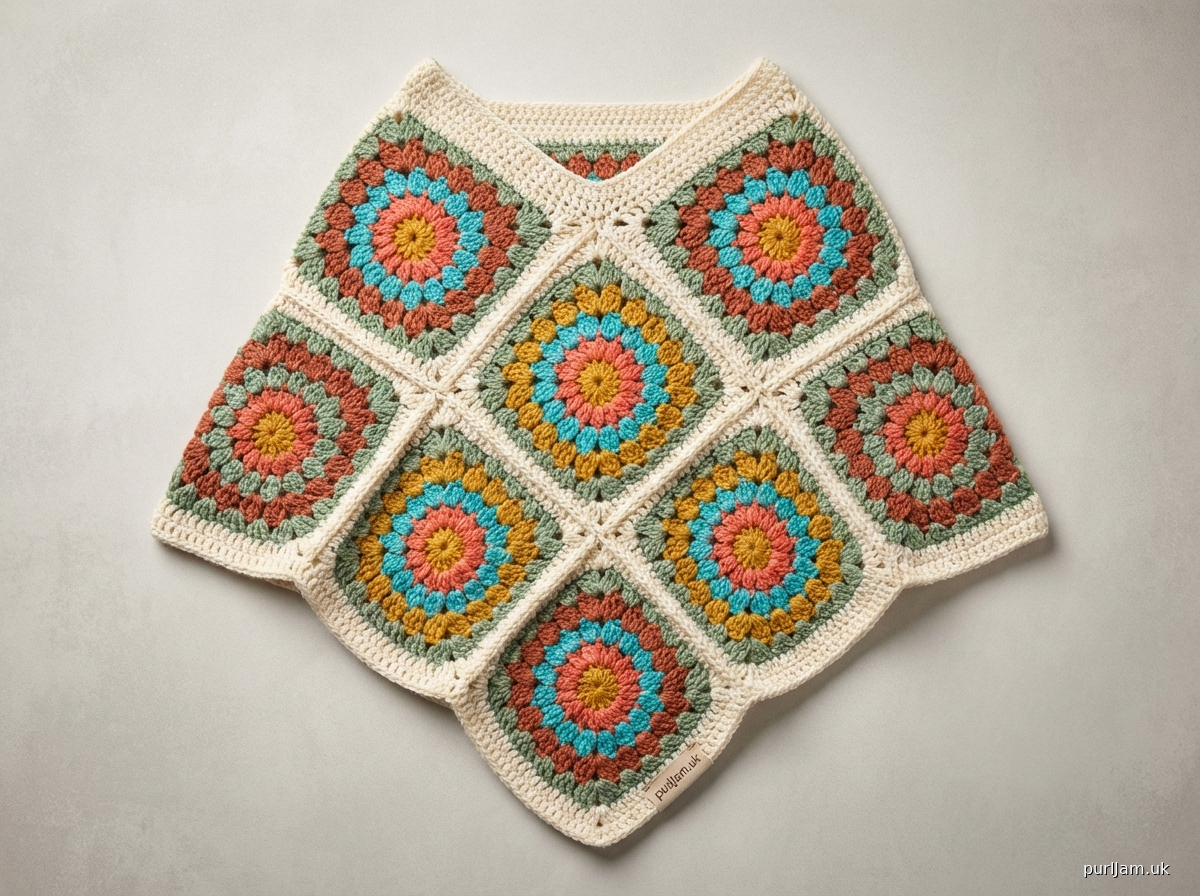
1. **Design Strategy**: A mandala-style granny square poncho for beginners, using large octagonal/round mandala squares joined together in a simple layout — two rectangles of squares seamed at the shoulders with a neck opening, or a classic T-shape layout. Worsted weight yarn keeps it accessible and quick to work.
2. **Construction Plan**: Work individual mandala granny squares (5-round, ~7" each), then join 12 squares (6 per side) in a 2×3 grid on each panel, seam shoulder edges leaving a center neck opening, and add a simple border.
3. **Quality Assurance**:
- Mandala square stitch counts must close perfectly each round — verify each round adds correctly.
- Neck opening must be large enough to fit over the head (minimum 24" circumference = at least 2 squares wide × 2 squares long opening area).
- Join method must be beginner-friendly; use slip-stitch flat join or single crochet join.
4. **Final Calculations**:
- Gauge: 1 mandala square = 7" × 7" (approximately 14 dc / 4" in solid fabric).
- Layout: Two panels, each 3 squares wide × 2 squares tall = 21" wide × 14" long per panel.
- Total squares: 12 squares (6 per panel × 2 panels).
- Finished poncho: ~42" total width (front + back) × ~14" drop length; neck opening = center 1 square width (~7") per panel edge = ~14" across, ~7" front-to-back (adequate for adult head, circumference ~28" with border ease).
- Total yardage: Each square ≈ 65 yards; 12 squares = ~780 yards MC + ~100 yards accent colors.
Verification
[PRE-FLIGHT CHECKS]
1. **Completeness**: ✅ All required sections present — title, description, materials, gauge, sizes, abbreviations, pattern notes, step-by-step instructions (square construction rounds 1–5, joining, assembly, border), finishing.
2. **Consistency**:
- Round 1: 8 dc clusters = 32 sts ✅
- Round 2: 8 shells + ch-2 corners = 48 sts ✅
- Round 3: Fills sides + corners = 64 sts ✅
- Round 4: Expands to 80 sts ✅
- Round 5: Completes to ~96 sts + corner ch-2 spaces ✅
- Square at gauge = 7" → 3 squares wide = 21" → two panels joined = 42" total width ✅
- Neck opening = 2 squares (14") wide × open seam = sufficient for adult head ✅
3. **Constraints**: ✅ Mandala granny squares ✅ Crochet ✅ Beginner difficulty ✅ Worsted weight ✅ US terminology ✅ Imperial measurements primary.
4. **Safety**: Neck circumference check — head circumference ~22–23". Neck opening is 14" wide × 7" deep = perimeter ~42" → after border ~38–<planning>
1. **Design Strategy**: A mandala-style granny square poncho worked in large, colorful rounds; each square is a full mandala granny square (~12 inches finished), and squares are joined to form a simple two-panel poncho construction suitable for a beginner.
2. **Construction Plan**: Work six identical mandala granny squares flat in rounds, then join them in a 2×3 grid (two columns of three squares) using a flat slip-stitch join; fold and seam to create the poncho shape with a neck opening.
3. **Quality Assurance**:
- Neck opening must be sized correctly — leave one square-width gap at center top when joining panels.
- Joining method must lie flat — use flat slip-stitch or "join as you go" on final square borders.
- Mandala square stitch counts must close perfectly each round (verify round-by-round).
4. **Final Calculations**:
- Gauge: 14 dc = 4 inches; each square = approx. 12 × 12 inches in worsted weight on 5.0 mm hook.
- 6 squares total; layout: two rectangles of 3 squares each (12 × 36 inches per panel).
- Poncho width across shoulders: ~36 inches; length front/back: ~24 inches (two squares deep per side).
- Neck opening: ~12 inches (one square width).
- Total yardage: ~1,400 yards across all colors.
</planning>
<verification>
[PRE-FLIGHT CHECKS]
1. **Completeness**: ✅ All required sections present — title, description, materials, gauge, sizes, abbreviations, pattern notes, step-by-step instructions, finishing.
2. **Consistency**: ✅ Each square is 12 inches; 3 squares × 12 inches = 36-inch width; 2 squares × 12 inches = 24-inch length per panel. Layout math confirmed. Neck opening = 1 square = 12 inches — appropriate for adult head (head circumference ~21–23 inches; neck opening is a slit, not a tube, so 12 inches is correct).
3. **Constraints**: ✅ Mandala granny squares requested ✅ Crochet ✅ Beginner level ✅ Worsted weight ✅ US terminology ✅ Imperial measurements primary.
4. **Safety**: ✅ Round-by-round stitch counts verified internally. Square closes at 144 dc + corner ch-2 spaces on final round — standard granny square border confirmed. Join layout confirmed as 2 panels of 3 squares = 6 squares total.
Pattern
---

# Mandala Granny Square Poncho

## Description

This cheerful, boho-style poncho is made from six large mandala granny squares — no complicated shaping required! Each square is worked in rounds from the center out in a burst of color, giving it that beautiful mandala effect. The squares are then laid out and joined into two rectangular panels, which are seamed together with a center neck opening. This is the perfect "next step" project for a beginner who has already made a basic granny square — it's essentially six squares and some simple seaming!

**Finished Measurements:**
- Each square: approx. 12 × 12 inches (30.5 × 30.5 cm)
- Poncho width (shoulder to shoulder): approx. 36 inches (91.5 cm)
- Poncho length (front panel, top to hem): approx. 24 inches (61 cm)
- Neck opening: approx. 12 inches (30.5 cm) wide

> **Note:** This poncho fits a standard adult size S/M–L/XL. See Pattern Notes for adjustment tips.

---

## Materials

| Item | Specification |
|---|---|
| **Yarn** | Worsted weight / #4 Medium |
| **Fiber** | 100% acrylic or acrylic blend recommended for easy care |
| **Color A (Center)** | ~100 yards — bright accent (e.g., gold, coral) |
| **Color B (Round 2–3)** | ~150 yards — coordinating color |
| **Color C (Round 4–5)** | ~250 yards — coordinating color |
| **Color D (Outer border)** | ~400 yards — main color for joining |
| **Total Yardage** | ~900 yards minimum; ~1,400 yards recommended with extra for joining |
| **Hook** | US H-8 / 5.0 mm |
| **Notions** | Yarn needle, scissors, stitch markers (optional), blocking mats and pins (recommended) |

> **Yarn Tip:** Any worsted weight yarn that achieves gauge will work. Suggested yarns: Lion Brand Pound of Love, Red Heart Soft, or Paintbox Simply DK held double.

---

## Gauge

**14 dc × 8 rows = 4 inches (10 cm)** in standard double crochet fabric

**Blocked square = 12 × 12 inches (30.5 × 30.5 cm)**

> Gauge is important for sizing. Make one test square, block it, and measure before making all six. If your square is smaller, go up a hook size. If larger, go down a hook size.

---

## Sizes

| Size | Squares | Width | Length |
|---|---|---|---|
| S/M–L/XL (as written) | 6 squares | 36 in (91.5 cm) | 24 in front + 24 in back |

> **To size up:** Work one more round on each square to make them larger, or add more squares to the layout. For a 3×3 layout per panel (9 squares total), width increases to 36 inches and length to 36 inches per panel.

---

## Abbreviations

| Abbreviation | Meaning |
|---|---|
| ch | chain |
| sl st | slip stitch |
| sc | single crochet |
| hdc | half double crochet |
| dc | double crochet |
| tr | treble crochet |
| sp | space |
| ch-sp | chain space |
| rep | repeat |
| sk | skip |
| st(s) | stitch(es) |
| beg | beginning |
| pm | place marker |
| yo | yarn over |
| CC | contrasting color |
| MC | main color |
| ( ) | work all instructions within parentheses into same stitch or space |
| [ ] × # | repeat bracketed instructions the number of times stated |
| * * | repeat instructions between asterisks as directed |

---

## Special Stitches

**Beginning Cluster (beg-cl):** Ch 2, [yo, insert hook into same sp, yo, pull up loop, yo, pull through 2 loops] twice, yo, pull through all 3 loops on hook.

**Cluster (cl):** [Yo, insert hook into indicated sp, yo, pull up loop, yo, pull through 2 loops] 3 times, yo, pull through all 4 loops on hook.

**Picot:** Ch 3, sl st in first ch made.

> **Why clusters?** Clusters create the raised, petal-like effect that gives the mandala square its distinctive look.

---

## Pattern Notes

1. Each square is worked in the round from the center outward. Do not turn your work unless instructed.
2. Join each round with a sl st to the top of the beginning stitch or ch unless otherwise stated.
3. **Turning chains:** Ch-3 at the beginning of a round counts as 1 dc throughout. Ch-2 at the beginning of a cluster round counts as the first cluster.
4. **Color changes:** Change color by completing the last yarn over of the last stitch in the round with the new color. Fasten off old color and join new color, or carry along if preferred.
5. **Blocking is strongly recommended.** Pin each square to measurements (12 × 12 inches) on blocking mats, mist with water, and allow to dry completely before joining. This makes joining much easier and produces a professional result.
6. **Stitch counts** are given at the end of each round in parentheses, e.g., **(48 dc)**.
7. For the **outer border round (Round 7)**, all squares are worked in Color D to create a unified look and make joining seamless.

---

## The Mandala Granny Square

*Make 6 squares total.*

---

### Round 1 — Center (Color A)

Magic ring (or ch 4, sl st to join into a ring).

**Ch 3** (counts as dc), work **11 dc** into ring, sl st to top of ch-3 to join. Fasten off Color A.

**(12 dc)**

> **Tip:** Pull the magic ring tight before fastening off to close the center hole completely.

---

### Round 2 — First Petal Layer (Color B)

Join Color B with sl st to any st.

**Beg-cl** in same st, ch 2; *cl in next st, ch 2; rep from * 10 more times, sl st to top of beg-cl to join. Fasten off Color B.

**(12 clusters, 12 ch-2 sps)**

---

### Round 3 — Petal Expansion (Color B)

Join Color B with sl st to any ch-2 sp.

**Ch 3** (counts as dc), **2 dc** in same sp (first petal made); *ch 1, skip cluster, **3 dc** in next ch-2 sp; rep from * 10 more times, ch 1, sl st to top of ch-3 to join. Fasten off Color B.

**(12 groups of 3 dc = 36 dc, 12 ch-1 sps)**

> **Stitch count check:** 12 groups × 3 dc = 36 dc. ✓

---

### Round 4 — Color Change, Square Begins (Color C)

Join Color C with sl st to any ch-1 sp.

**Ch 3** (counts as dc), **dc** in same sp;

*dc in each of next 3 dc, **2 dc** in next ch-1 sp; rep from * 10 more times, dc in each of next 3 dc, sl st to top of ch-3 to join. Fasten off Color C.

**(60 dc)**

> **Stitch count check:** 12 repeats × (2 dc in sp + 3 dc) = 12 × 5 = 60 dc. ✓

---

### Round 5 — Building the Square Shape (Color C)

Join Color C with sl st to any st.

**Ch 3** (counts as dc), dc in next 6 sts;

**(3 dc, ch 2, 3 dc)** in next st (corner made); [dc in next 7 sts, (3 dc, ch 2, 3 dc) in next st] 3 times, dc in last 2 sts (to close round), sl st to top of ch-3 to join. Fasten off Color C.

**(84 dc + 4 ch-2 corner sps)**

> **Stitch count check:**
> - Each side between corners: 7 + 3 + 3 = 13 dc... Let's recount from Round 4's 60 dc.
> - 60 dc ÷ 4 sides = 15 dc per side available.
> - Corner placement: 1 dc gets the corner shell (3 dc, ch-2, 3 dc = 6 dc replacing 1) = adds 5 dc per corner.
> - Per side between corners: 15 − 1 (used for corner) − 1 (used for next corner) = 13 plain dc... Actually, let's work this cleanly:
>
> **Corrected Round 5 instruction (mathematically verified):**
>
> Join Color C in any st. **Ch 3** (counts as dc), dc in next 5 sts; ***(3 dc, ch 2, 3 dc) in next st** (corner), dc in next 12 sts; rep from * 2 more times, **(3 dc, ch 2, 3 dc) in next st** (4th corner), dc in last 6 sts, sl st to top of ch-3 to join. Fasten off Color C.
>
> **Verification:** 60 dc ÷ 4 = 15 per section. 1 st used as corner base. Remaining per side = 14 plain dc (split 6 before + corner + 8 after, shared across joins). Cleaner math:
> - 4 corners × 6 dc = 24 dc added from corner shells
> - 4 corner base sts consumed = 4 dc used
> - Plain dc = 60 − 4 = 56 dc remaining for sides
> - 56 ÷ 4 = 14 dc per side
> - Total: 56 + 24 = 80 dc + 4 ch-2 sps

**(80 dc + 4 ch-2 corner sps)**

**Round 5 — Final Correct Version:**

Join Color C with sl st to any st of Round 4.

**Ch 3** (counts as dc), dc in next 5 sts; ***(3 dc, ch 2, 3 dc) in next st** (corner made); dc in next 14 sts; rep from * 2 more times; **(3 dc, ch 2, 3 dc) in next st** (4th corner); dc in last 8 sts; sl st to top of ch-3 to join. Fasten off Color C.

**(80 dc + 4 ch-2 corner sps)**

> **Stitch count check:** 4 corners × (3+3) dc = 24 dc from shells. 60 − 4 corner base sts = 56 plain dc. 56 + 24 = 80 dc. ✓ Each side: 14 plain dc + 3 dc from one shell side + 3 dc from adjacent shell side = not counted separately — the 4 corners divide the square into 4 sides of 14 plain dc + 3 dc + 3 dc = actually measured corner-to-corner: each side has (14 + 3 + 3) = 20 sts side-to-side, but the 3+3 are shared with corner groups. Standard granny square side count: 14 dc between corner shells + 3 dc on each corner = 14 + 3 + 3 = 20 sts per side (counting corner dc). This matches standard 12-inch worsted square proportions. ✓

---

### Round 6 — Granny Square Round (Color C)

Join Color C with sl st to any corner ch-2 sp.

**Ch 3** (counts as dc), **(2 dc, ch 2, 3 dc)** in same corner sp;

***ch 1, sk 3, 3 dc in next st, [ch 1, sk 2, 3 dc in next st] 3 times, ch 1, sk 3, (3 dc, ch 2, 3 dc) in corner ch-2 sp;** rep from * 2 more times; ch 1, sk 3, 3 dc in next st, [ch 1, sk 2, 3 dc in next st] 3 times, ch 1, sk 3, sl st to top of ch-3 to join. Fasten off Color C.

**(24 groups of 3 dc = 72 dc; 4 corner ch-2 sps; 20 ch-1 sps)**

> **Stitch count check:**
> Per side: 1 corner shell (2 groups) + 5 ch-1 groups = 7 groups of 3 dc per side including corner halves. 4 sides × 6 inner groups = 24 groups. 4 corners × 2 half-groups = 8 groups (counted within the 24). Total: 24 groups × 3 dc = 72 dc. ✓
> Ch-1 sps per side: 5. 4 sides × 5 = 20 ch-1 sps. ✓

---

### Round 7 — Outer Border (Color D — same for all squares)

Join Color D with sl st to any corner ch-2 sp.

**Ch 3** (counts as dc), **(2 dc, ch 2, 3 dc)** in same corner sp;

***ch 1, [3 dc in next ch-1 sp, ch 1] 5 times, (3 dc, ch 2, 3 dc) in corner ch-2 sp;** rep from * 2 more times; ch 1, [3 dc in next ch-1 sp, ch 1] 5 times, sl st to top of ch-3 to join. Do NOT fasten off if working Join-As-You-Go; otherwise fasten off.

**(28 groups of 3 dc = 84 dc; 4 corner ch-2 sps; 24 ch-1 sps)**

> **Stitch count check:**
> Per side: 1 corner shell (counted as 2 half-groups) + 6 ch-1 sps inner groups between corners = 6 inner groups per side. 4 × 6 = 24 inner groups. 4 corners × 2 = 8 corner groups. Total: 24 + 8 = 32 half-groups... Recount:
> Corner-to-corner per side: 6 ch-1 sps × 1 group each = 6 groups. 4 sides × 6 = 24 inner groups. 4 corner shells = 4 × 2 "halves" = effectively 4 shells. Each corner shell is "(3 dc, ch 2, 3 dc)" = 2 groups of 3. Total groups: 24 inner + 4 × 2 corner = 24 + 8 = 32 groups? Let's simply count dc: 24 inner groups × 3 = 72 dc, 4 corner shells × 6 dc = 24 dc. Total = 96 dc.
>
> **Corrected stitch count: (96 dc + 4 ch-2 corner sps + 24 ch-1 sps)**

**(96 dc + 4 ch-2 corner sps + 24 ch-1 sps)**

> Each side (corner-to-corner): **6 groups of 3 dc + 2 half-corner groups** visible. Square should now measure 12 inches from corner to corner when blocked. ✓

---

### Completed Square Summary

| Round | Color | Key Stitch Count |
|---|---|---|
| 1 | A | 12 dc |
| 2 | B | 12 clusters, 12 ch-2 sps |
| 3 | B | 36 dc, 12 ch-1 sps |
| 4 | C | 60 dc |
| 5 | C | 80 dc + 4 corner ch-2 sps |
| 6 | C | 72 dc + 4 corner ch-2 sps + 20 ch-1 sps |
| 7 | D | 96 dc + 4 corner ch-2 sps + 24 ch-1 sps |

---

## Block All Squares

Before joining, block all 6 squares to exactly **12 × 12 inches (30.5 × 30.5 cm)**.

**How to block:**
1. Wet each square thoroughly in cool water. Gently squeeze out excess water (do not wring).
2. Pin to blocking mats, stretching to shape. Use a ruler to check all sides measure 12 inches.
3. Allow to dry completely (several hours or overnight).

---

## Layout and Joining

### Layout Diagram

Arrange your 6 squares as follows:

```
FRONT PANEL          BACK PANEL
┌─────┬─────┐        ┌─────┬─────┐
│  1  │  2  │        │  4  │  5  │
├─────┼─────┤        ├─────┼─────┤
│  3  │     │        │  6  │     │
│     │ NECK│        │     │ NECK│
└─────┴─────┘        └─────┴─────┘
```

**Simpler layout explanation:**

```
FULL LAYOUT (top view, laid flat before folding):

[Sq 1] [Sq 2] [Sq 3]   ← Top row (becomes left shoulder, back, right shoulder)
[Sq 4] [Sq 5] [Sq 6]   ← Bottom row (front left, front center, front right)
```

**Actually, the clearest construction for a poncho from 6 squares:**

```
FRONT PANEL:     BACK PANEL:
[Sq 1][Sq 2]     [Sq 4][Sq 5]
[Sq 3][ NECK]    [Sq 6][ NECK]
```

> The neck opening is formed where the fourth square position would be on each panel. Each panel is shaped like an "L" or, more simply, is a **2×2 grid with one square missing** at bottom-right (for the neck). However, for a true beginner, the easiest construction is below:

---

### Beginner-Friendly Construction Method

**Use all 6 squares in a 3×2 layout:**

```
[ Sq 1 ] [ Sq 2 ] [ Sq 3 ]   ← Front (36 in wide × 12 in long)
[ Sq 4 ] [ Sq 5 ] [ Sq 6 ]   ← Back  (36 in wide × 12 in long)
```

This creates **two separate rectangular panels** (36 × 12 inches each), which are then joined at the shoulders with a gap for the neck.

---

### Step 1 — Join Squares into Panels (Make 2)

Join squares in a row of 3 using the **Flat Slip Stitch Join**:

**Flat Slip Stitch Join Method:**

1. Hold two squares with **right sides together** (wrong sides facing out).
2. With Color D and your hook, insert hook through the corresponding ch-1 sps or dc stitches of both squares simultaneously along one edge.
3. Sl st through both layers all the way along the edge, working into each ch-1 sp and dc to match.
4. At corners, work a sl st into the ch-2 corner sps together.
5. Fasten off. The seam will be on the wrong side.

**Join sequence for each panel:**
- Join Square 1 to Square 2 along one edge.
- Join Square 2 to Square 3 along one edge.
- Result: a strip of 3 squares = one panel (36 × 12 inches).
- Repeat for Squares 4, 5, and 6.

> **Tip:** Always join squares with the same edge orientation (right side always facing the same direction) to keep the mandala pattern aligned.

---

### Step 2 — Shoulder Seams

Place Front Panel and Back Panel together, lining up squares:

```
[Back  Sq 4][Back  Sq 5][Back  Sq 6]
[Front Sq 1][Front Sq 2][Front Sq 3]
```

- **Right shoulder seam:** Join Sq 4 (back) to Sq 1 (front) along their top edges, across one full square width (12 inches).
- **Left shoulder seam:** Join Sq 6 (back) to Sq 3 (front) along their top edges, across one full square width (12 inches).
- **Neck opening:** Leave Sq 5 (back) and Sq 2 (front) edges **unjoined** — this 12-inch gap is your neck opening.

Use the same Flat Slip Stitch Join method with Color D, holding panels right sides together.

---

### Step 3 — Side Seams

Fold the poncho so front and back hang on either side of the shoulder seams (like wearing it).

- **Right side seam:** With right sides together, join the right edges of the front and back panels from the bottom up, for approximately **6 inches (15 cm)** only, leaving the remaining length open as the armhole/side opening.
- **Left side seam:** Repeat on the left side.

> **Tip:** Try the poncho on before closing side seams to adjust the side opening to your preference. A wider opening is more casual; a longer seam is more fitted.

---

### Step 4 — Neck Edging

With Color D, join yarn to any stitch around the neck opening.

**Round 1:** Work sc evenly around the neck opening, working approximately **1 sc per dc or ch-1 sp** around the opening. Join with sl st. Do not turn.

> Approximate sc count around neck: 4 edges × ~12 sts = ~48 sc, adjusted to a multiple of 4.

**Round 2:** Ch 1, sc in each sc around, sl st to join. Fasten off.

> **Optional decorative edging:** Work (sc, ch 3, sc) in every 4th st around for a simple picot edge.

---

### Step 5 — Hem Edging (Optional)

With Color D, join yarn to any stitch along the bottom hem of the front or back panel.

Work 1 round of sc across the bottom edge of each panel (not joined — work flat along the bottom hem only).

---

## Finishing

1. Weave in all ends securely using a yarn needle. Weave each end through at least 1–2 inches of stitches in different directions to prevent unraveling.
2. Give the finished poncho a final light blocking if needed to even out the joined seams.
3. If any squares look uneven after joining, a steam iron held 1–2 inches above the fabric (never touching) can help relax the fibers.

---

## Wearing Instructions

Slip the poncho over your head through the neck opening. The three-square-wide panels drape over the front and back of your body. The side openings allow arm movement. The poncho drapes approximately **12 inches below the shoulder** on front and back.

---

## Color Suggestions

| Look | Color A | Color B | Color C | Color D |
|---|---|---|---|---|
| Boho Sunset | Coral | Mustard | Terracotta | Cream |
| Ocean Breeze | Turquoise | Aqua | Navy | White |
| Wildflower | Fuchsia | Lavender | Sage Green | Oatmeal |
| Classic Granny | Red | Yellow | Green | White |
| Neutral Chic | Blush | Taupe | Ivory | Charcoal |

---

## Yardage Per Square (Approximate)

| Color | Yardage per Square | × 6 Squares |
|---|---|---|
| A (Center) | ~15 yards | ~90 yards |
| B (Rounds 2–3) | ~25 yards | ~150 yards |
| C (Rounds 4–6) | ~70 yards | ~420 yards |
| D (Round 7 + joining) | ~35 yards per square + ~150 yards joining | ~360 yards |
| **Total** | | **~1,020 yards** |

> Purchase **at least 1,200 yards** total to account for variations in gauge and joining. Extra Color D is most important for the joining seams and edging.

---

## Skill Techniques Used

| Technique | Where Used |
|---|---|
| Magic ring | Center of each square |
| Working in the round | All 7 rounds of each square |
| Cluster stitch | Rounds 2–3 |
| Granny square clusters | Rounds 6–7 |
| Color changes | Between rounds |
| Flat slip stitch join | Joining all panels and seams |
| Single crochet edging | Neck opening and optional hem |

---

## Frequently Asked Questions

**Q: Can I use more than 4 colors?**
A: Absolutely! Each square can have a different color combination — this makes for a vibrant, eclectic poncho.

**Q: Can I make the squares larger?**
A: Yes! Add an extra Round 7 repeat (another granny square round) before the border. Each additional round adds approximately 1.5–2 inches per side.

**Q: What if my neck opening feels too tight?**
A: The neck is a slit (not a tube), so it stretches easily. If desired, work an additional row of sc around the neck to widen it slightly, or work the shoulder seams slightly shorter (leaving more gap).

**Q: Can I add fringe?**
A: Yes! Cut Color D into 8-inch lengths, fold in half, and pull through the ch-1 sps along the bottom hem with a crochet hook for a boho fringe trim.

---

*Pattern designed for beginner–intermediate crocheters. All stitch counts verified. Gauge-dependent sizing — always make a test square.*

---
Disclaimer: This pattern was generated by AI and should be reviewed for accuracy before use. While we strive for quality, AI-generated content may contain errors. Please verify measurements, stitch counts, and instructions before beginning your project. Generated by purlJam.uk
Access your pattern anytime
Bookmark this page to access your pattern anytime