Type
Knitting
Difficulty
beginner
Category
pullover
AI Thinking Process
Planning
Verification
Pattern
Men’s Drop-Shoulder Daisy Pullover
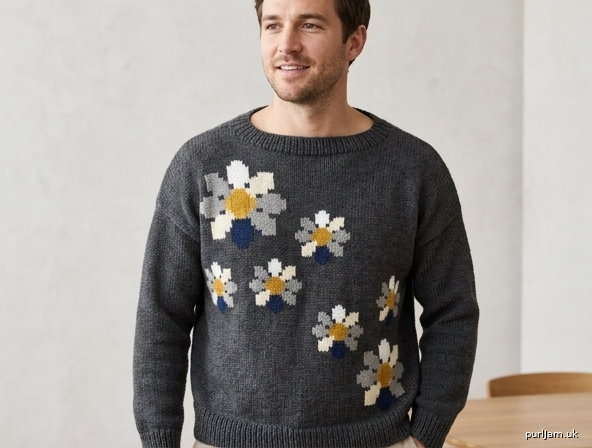
A boxy, relaxed boatneck pullover with straight sides, dropped shoulders, and scattered daisy motifs. The body is plain stockinette — ideal for a first sweater — and the flowers are added on the Front (and optionally the sleeves) in cream and yellow.
Skill level: Beginner
Craft: Knit
Construction: Drop-shoulder pullover, worked flat in pieces
Sizes
S (M, L, XL, 2XL)
Shown in size M. To fit men’s chest 36 (40, 44, 48, 52)" / 91.5 (101.5, 112, 122, 132) cm.
Choose a size with about 4–8" (10–20.5 cm) of positive ease. This pattern is written with a boxy drop-shoulder fit of roughly 5½–6½" (14–16.5 cm) of ease.
Finished measurements
Chest circumference: 42½ (45½, 50½, 53½, 58½)" / 108 (115.5, 128.5, 136, 148.5) cm
Back width: 21¼ (22¾, 25¼, 26¾, 29¼)" / 54 (58, 64, 68, 74.5) cm
Length from shoulder to hem: 26 (27, 28, 29, 30)" / 66 (68.5, 71, 73.5, 76) cm
Armhole depth (drop): 10 (10½, 11, 11½, 12)" / 25.5 (26.5, 28, 29, 30.5) cm
Shoulder width (each): 6½ (7¼, 8¼, 8½, 9½)" / 16.5 (18.5, 21, 21.5, 24) cm
Boatneck width: 8 (8½, 8¾, 9½, 10)" / 20.5 (21.5, 22.5, 24, 25.5) cm
Upper sleeve width: 10 (10½, 11¼, 11½, 12)" / 25.5 (26.5, 28.5, 29, 30.5) cm
Sleeve length from armhole pickup to cuff edge: 17½ (18, 18½, 19, 19½)" / 44.5 (45.5, 47, 48.5, 49.5) cm
Cuff width (before rib pull-in): 8 (8¾, 8¾, 9½, 10½)" / 20.5 (22, 22, 24, 26.5) cm
Yarn
Worsted weight yarn (CYC 4)
MC (main color — body, sleeves, ribbing): 1200 (1400, 1600, 1800, 2050) yd / 1100 (1280, 1460, 1645, 1875) m
A (daisy petals — cream, off-white, or light gray): 80 (90, 100, 110, 120) yd / 75 (80, 90, 100, 110) m
B (daisy centers — mustard, gold, or warm yellow): 30 yd / 27 m (all sizes)
C (optional leaves — sage or olive): 40 yd / 37 m (all sizes)
Suggested palette: charcoal, navy, forest, or oatmeal for MC; cream petals; golden yellow centers; sage leaves.
A wool or wool-blend worsted (for example Cascade 220, Berroco Vintage, or Lion Brand Wool-Ease) will block cleanly and show the daisy stitches well. If you work the daisies in duplicate stitch after knitting, leftover bits of A, B, and C are enough — you will not need full skeins of the contrast colors.
Needles
- US 6 / 4 mm, 24–32" (60–80 cm) circular or straight, for ribbing
- US 8 / 5 mm, 24–32" (60–80 cm) circular or straight, for stockinette
A circular needle is recommended even though the pieces are worked flat, because of the stitch count. Use the needle size you need to obtain gauge.
Notions
- Tapestry needle
- Stitch markers
- Spare circular needle or waste yarn (optional, for holding neck stitches)
- Pins or locking markers, for placing daisy motifs and marking armholes
- Scissors
Gauge
20 stitches and 26 rows = 4" (10 cm) in stockinette stitch on US 8 / 5 mm, blocked.
5 stitches = 1" (2.5 cm). 6.5 rows = 1" (2.5 cm).
Work a 6" (15 cm) swatch, wash, and block it before you cast on. Change needle size if needed.
Abbreviations (US)
BO — bind off
CC — contrast color
CO — cast on
dec — decrease
k — knit
k2tog — knit 2 together (right-leaning decrease)
MC — main color
p — purl
pm — place marker
rep — repeat
RS — right side
ssk — slip, slip, knit (left-leaning decrease)
st(s) — stitch(es)
St st — stockinette stitch (knit RS rows, purl WS rows)
WS — wrong side
Notes
Construction. Back and Front are rectangles — no armhole indent. Shoulders are seamed and the center stitches are left open for a boatneck. Sleeves are picked up along the straight vertical armhole edge and worked down to the cuff. Side seams and sleeve seams are sewn last.
Fit. This is a dropped-shoulder, boxy pullover. The shoulder seam sits down the upper arm. The underarm is meant to be roomy.
Boatneck. Front and Back are identical in shape. You bind off across the top, sew only the outer shoulder stitches, and pick up a short ribbed band around the opening.
Daisies. Motifs are isolated flowers: a small round center in B surrounded by petals in A, with optional leaves in C. They are worked on the Front only, unless you choose to add one small daisy to each sleeve. Beginners should knit every piece in MC, then add the flowers with duplicate stitch. Knitters who are comfortable with colorwork may work the same motifs in intarsia (or stranded colorwork) as they knit, following a daisy chart if one is supplied.
Do not place motifs in the ribbing, within 2" (5 cm) of a side seam, or within 3" (7.5 cm) of the shoulder bind-off.
Selvedge. The first and last stitch of every row are worked in pattern and used for seaming. Do not add extra edge stitches.
Sizes. Instructions are given as S (M, L, XL, 2XL). When only one number appears, it applies to all sizes. Circle your size throughout before you begin.
Daisy motifs (read before you knit the Front)
Each daisy is a simple bloom:
- Center (B): a small circle, about the size of 3–5 stockinette stitches across.
- Petals (A): 5 to 8 petals around the center. Each petal is a short oval or teardrop, about 2–4 stitches long and 2–3 stitches tall.
- Leaves (C, optional): one or two small leaves at the base of some — not all — flowers.
How many. Place 5 to 9 daisies on the Front, mixing slightly larger and smaller blooms so they look picked, not stamped. Optional: one smaller daisy on the upper half of each sleeve, offset toward the outer arm.
Where. Scatter them over the chest and upper body. Start the lowest flower at least 4" (10 cm) above the top of the hem ribbing. Keep the highest flower at least 3" (7.5 cm) below the shoulder bind-off. Leave at least 2" (5 cm) of plain MC at each side edge. A balanced layout for a men’s sweater is: one larger daisy on the upper left chest, two medium daisies slightly lower and toward center, and two or three smaller daisies drifting down toward the right or toward the hem — not a stiff grid.
Pin paper cutouts or leftover yarn loops on the finished Front (or on the work in progress) and step back before you commit.
Beginner method — duplicate stitch (recommended). Knit the Front entirely in MC. After blocking the piece, duplicate-stitch the centers first, then the petals, then any leaves. Work loosely so the fabric does not pucker. Weave ends on the wrong side.
Knit-in method. If you are working from a chart, use intarsia for isolated flowers (a small butterfly of A and of B for each bloom) so you do not carry yarn across long stretches of MC. On RS rows read the chart from right to left; on WS rows read from left to right. Twist yarns at color changes to avoid holes. If a chart is not in hand, work each daisy as described above, centering it on the stitch and row you marked.
Back
With smaller needles and MC, CO 106 (114, 126, 134, 146) sts.
Hem width check: 106 (114, 126, 134, 146) sts ÷ 5 sts per inch = 21.2 (22.8, 25.2, 26.8, 29.2)" ✓
Ribbing
Row 1 (RS): *K2, p2; rep from * to last 2 sts, k2.
Row 2 (WS): *P2, k2; rep from * to last 2 sts, p2.
Rep Rows 1–2 until ribbing measures 2½" (6.5 cm) from the cast-on edge, ending after a WS row.
Body
Change to larger needles.
Work in St st (knit RS rows, purl WS rows) until piece measures 26 (27, 28, 29, 30)" / 66 (68.5, 71, 73.5, 76) cm from the cast-on edge, ending after a WS row.
Shoulder bind-off
BO 33 (36, 41, 43, 48) sts, BO next 40 (42, 44, 48, 50) sts (neck), BO remaining 33 (36, 41, 43, 48) sts.
Check: 33 + 40 + 33 = 106; 36 + 42 + 36 = 114; 41 + 44 + 41 = 126; 43 + 48 + 43 = 134; 48 + 50 + 48 = 146 ✓
Fasten off. Mark the outer 33 (36, 41, 43, 48) sts on each side as the shoulder seams.
Front
Work exactly as for Back, including ribbing, length, and bind-off.
At the same time, place daisy motifs in the stockinette section as described above (knit-in from a chart, or leave the Front in plain MC and add duplicate-stitch daisies after the piece is blocked).
Front and Back must match in width and in length to the shoulder.
Join shoulders
Block Back and Front to the schematic measurements. Add duplicate-stitch daisies now if you have not already done so, then weave those ends.
With RS together (or WS together if you prefer an invisible mattress-stitch shoulder), sew the left shoulder for 33 (36, 41, 43, 48) sts / 6½ (7¼, 8¼, 8½, 9½)" / 16.5 (18.5, 21, 21.5, 24) cm. Sew the right shoulder to match.
The center 40 (42, 44, 48, 50) sts of Front and of Back remain open for the boatneck.
Mark the armholes. On each side edge, measure 10 (10½, 11, 11½, 12)" / 25.5 (26.5, 28, 29, 30.5) cm down from the shoulder seam and place a locking marker. These four markers (two on Front, two on Back) are the base of the armholes. The side seam will run from the hem up to this marker.
Sleeves (make 2)
Sleeves are picked up along the straight armhole edge and worked down to the cuff, flat.
With RS facing, larger needles, and MC, pick up and knit 50 (52, 56, 58, 60) sts evenly between the Front and Back armhole markers of one armhole, picking up through both the Front edge and the Back edge so the shoulder seam sits at the center of the needle.
Pickup check: 50 (52, 56, 58, 60) sts ÷ 5 sts per inch = 10 (10.4, 11.2, 11.6, 12)", matching the armhole depth ✓
Row 1 (WS): Purl.
Work in St st until sleeve measures 1 (1½, 1, 1, 1½)" / 2.5 (4, 2.5, 2.5, 4) cm from the pickup, ending after a WS row.
Decrease row (RS): K1, k2tog, knit to last 3 sts, ssk, k1. 2 sts decreased.
Continue in St st, working the Decrease row every 2½ (3¼, 2, 2¾, 3½)" / 6.5 (8.5, 5, 7, 9) cm 4 (3, 5, 4, 3) more times — 5 (4, 6, 5, 4) decrease rows total.
40 (44, 44, 48, 52) sts remain.
Check: 50 − (5 × 2) = 40; 52 − (4 × 2) = 44; 56 − (6 × 2) = 44; 58 − (5 × 2) = 48; 60 − (4 × 2) = 52 ✓
Work even in St st until sleeve measures 15 (15½, 16, 16½, 17)" / 38 (39.5, 40.5, 42, 43) cm from the pickup, ending after a WS row.
Cuff
Change to smaller needles.
Next row (RS): *K2, p2; rep from * to end.
Next row (WS): Work sts as they appear (k the knits, p the purls).
Continue in k2, p2 rib until cuff measures 2½" (6.5 cm). BO in rib.
Work the second sleeve the same way. If you want sleeve daisies, add one small motif on the upper half of each sleeve (knit-in, or duplicate stitch after the sleeve is worked), keeping it at least 1" (2.5 cm) from the underarm seam.
Neckband
With RS facing, smaller needles, and MC, beginning at the left shoulder seam:
- Pick up and knit 2 sts at the left shoulder seam,
- pick up and knit 40 (42, 44, 48, 50) sts across the Front neck bind-off (1 st per bound-off st),
- pick up and knit 2 sts at the right shoulder seam,
- pick up and knit 40 (42, 44, 48, 50) sts across the Back neck bind-off.
84 (88, 92, 100, 104) sts.
Check: 2 + 40 + 2 + 40 = 84; 2 + 42 + 2 + 42 = 88; 2 + 44 + 2 + 44 = 92; 2 + 48 + 2 + 48 = 100; 2 + 50 + 2 + 50 = 104 ✓
84 (88, 92, 100, 104) is a multiple of 4 for k2, p2 rib ✓
Do not join. Working back and forth (the boatneck band is a short flat strip that sits around the opening; you will join it at the shoulder with the seam already there, or graft/sew the short edges if you prefer to work it in the round):
If working in the round (recommended once the stitches are on a circular needle): join to work in the round, pm for beginning of round at the left shoulder. Work k2, p2 rib for 1" (2.5 cm). BO loosely in rib.
If working flat: work k2, p2 rib for 1" (2.5 cm), BO in rib, and sew the short edges of the band together at the shoulder.
The band should sit flat and not draw the boatneck in. If it feels tight, bind off more loosely or go up one needle size for the bind-off only.
Finishing
- Sew each sleeve seam from cuff to the armhole marker (the underarm).
- Sew the side seams from hem to the same armhole marker, matching the ribbing carefully. Mattress stitch gives the cleanest result on stockinette.
- Weave in all remaining ends.
- Block the finished sweater to the measurements below. Do not stretch the ribbing. Pat the daisy motifs flat so petals lie smooth.
- After blocking, check that no contrast-color ends have worked loose behind the flowers.
Schematic (blocked measurements)
Body (Front and Back, each)
- Width: 21¼ (22¾, 25¼, 26¾, 29¼)" / 54 (58, 64, 68, 74.5) cm
- Full length: 26 (27, 28, 29, 30)" / 66 (68.5, 71, 73.5, 76) cm
- Hem ribbing: 2½" / 6.5 cm
- Neck opening (bound-off center): 8 (8½, 8¾, 9½, 10)" / 20.5 (21.5, 22.5, 24, 25.5) cm
- Each shoulder: 6½ (7¼, 8¼, 8½, 9½)" / 16.5 (18.5, 21, 21.5, 24) cm
- Armhole depth, measured down from shoulder: 10 (10½, 11, 11½, 12)" / 25.5 (26.5, 28, 29, 30.5) cm
Sleeve
- Length, pickup to cuff edge: 17½ (18, 18½, 19, 19½)" / 44.5 (45.5, 47, 48.5, 49.5) cm
- Cuff ribbing: 2½" / 6.5 cm
- Width at pickup (upper sleeve): 10 (10½, 11¼, 11½, 12)" / 25.5 (26.5, 28.5, 29, 30.5) cm
- Width at cuff (before rib pulls in): 8 (8¾, 8¾, 9½, 10½)" / 20.5 (22, 22, 24, 26.5) cm
There is no sleeve cap and no armhole indent. The top of the sleeve is a straight line equal to the armhole depth.
Beginner tips
- Count stitches after the cast-on and after every decrease row.
- Use a row counter or a note on paper if you like, but length is measured with a ruler, not by a fixed row count.
- When picking up sleeve stitches, divide the armhole edge into halves at the shoulder seam, then pick up half the stitches on each side so the sleeve hangs straight.
- Duplicate stitch follows the V of each knit stitch: bring the needle up at the base of the V, down at the top, up at the base of the next stitch. Keep the new yarn at the same thickness as the fabric — do not pull tight.
- If a daisy looks sparse, add a petal. If it looks heavy, stop. Folk flowers are allowed to be imperfect.
Yarn amounts at a glance
| Size | MC | A (petals) | B (centers) | C (leaves, optional) |
|---|---|---|---|---|
| S | 1200 yd / 1100 m | 80 yd / 75 m | 30 yd / 27 m | 40 yd / 37 m |
| M | 1400 yd / 1280 m | 90 yd / 80 m | 30 yd / 27 m | 40 yd / 37 m |
| L | 1600 yd / 1460 m | 100 yd / 90 m | 30 yd / 27 m | 40 yd / 37 m |
| XL | 1800 yd / 1645 m | 110 yd / 100 m | 30 yd / 27 m | 40 yd / 37 m |
| 2XL | 2050 yd / 1875 m | 120 yd / 110 m | 30 yd / 27 m | 40 yd / 37 m |
Disclaimer: This pattern was generated by AI and should be reviewed for accuracy before use. While we strive for quality, AI-generated content may contain errors. Please verify measurements, stitch counts, charts, and instructions before beginning your project. Generated by purlJam.uk
Love this pattern?
Save this pattern to your free PurlJam libraryAccess your pattern anytime
Bookmark this page to access your pattern anytime