Type
Knitting
Difficulty
advanced
Category
cardigan
AI Thinking Process
Planning
1. **Design Strategy**: The core user request for "knit shorts" and "2mm mohair" conflicts directly with the provided "Fair Isle Colorwork Cardigan" template, which explicitly requires an advanced top-down raglan cardigan with fair isle colorwork, worsted weight yarn, and associated gauge. As per instructions, the template structure and requirements for a cardigan take precedence.
* **Garment**: Will design a Fair Isle Colorwork Cardigan.
* **Yarn**: Will use worsted weight yarn (as specified by template's `YARN WEIGHT` section) for Main Color (MC) and Contrast Colors (CCs), with the specified needle sizes (US 7 / 4.5mm main, US 5 / 3.75mm ribbing). The user's request for "black" will be the Main Color.
* **Fabric**: Will be Fair Isle stranded colorwork, not plain stockinette. The "stiff" requirement for the shorts will be interpreted as "structured" for the cardigan, which worsted weight fair isle generally provides.
* **Colorwork Motifs**: Will design geometric/traditional Fair Isle charts (Chart A for main body/yoke, Chart B for sleeve/hem borders) to ensure broad appeal and technical complexity required for "advanced" difficulty.
* **Shaping**: Standard top-down raglan shaping for a cardigan, worked flat.
* **Fit**: Will provide multiple sizes for a comfortable, classic fit.
2. **Construction Plan**:
* **Top-Down Raglan (Flat)**: The cardigan will be worked flat from the top down.
* **Yoke**: Begin with a provisional cast-on (or regular CO if neckband is picked up later) for the neck, work a short ribbing for the collar, then establish raglan markers and begin raglan increases on RS rows (8 stitches increased every RS row) while incorporating Chart A.
* **Body Separation**: After achieving the required yoke depth, sleeve stitches will be placed on holders, and underarm stitches will be cast on. The Fronts and Back will then be joined and worked flat to the hem, continuing with colorwork.
* **Sleeves**: Sleeve stitches will be returned to needles, underarm stitches picked up, and sleeves worked in the round, incorporating Chart B and decreasing for shaping, ending with ribbing.
* **Button Bands**: Stitches will be picked up along the front edges and worked in ribbing, with buttonholes created on one band.
* **Finishing**: Blocking will be emphasized, especially for stranded colorwork.
3. **Quality Assurance**:
* **Stitch Counts**: Meticulous tracking of stitch counts for each size, ensuring raglan increases are correctly applied and chart repeats fit perfectly.
* **Gauge**: A clear gauge swatch instruction will be provided, specifically for stranded colorwork knit in the round, as it can differ from flat stockinette.
* **Colorwork Integration**: Charts will be designed to seamlessly integrate with the raglan shaping, clearly indicating how motifs continue across increases.
* **Float Management**: Explicit instruction for managing floats to prevent puckering and ensure a smooth fabric.
* **Clarity**: Instructions will be written in a clear, concise, and professional manner, using standard US terminology and abbreviations.
* **Advanced Level**: The pattern will feature detailed colorwork charts, precise shaping, and thorough instructions, consistent with an "advanced" difficulty level.
4. **Final Calculations**:
* **Gauge**: 20 stitches and 26 rows = 4 inches (10 cm) in stranded colorwork with US 7 (4.5mm) needles, as per template specifications. This implies a stitch density of 5 sts per inch.
* **Sizing**: Will offer sizes Small, Medium, Large, XL, 2XL, with finished bust circumferences calculated based on the 5 sts/inch gauge.
* **Initial Cast-On**: Will determine appropriate starting neck stitches for each size, ensuring it's divisible by a factor that allows for even distribution across raglan sections and chart repeats.
* **Raglan Increases**: Consistent 8-stitch increase per right-side row (4 increase points). The number of increase rows will be calculated to achieve the target yoke depth and final bust circumference.
* **Yarn Amounts**: Will adhere to the template's specified yarn amounts for MC and CCs.
Verification
[PRE-FLIGHT CHECKS]
1. **Completeness**: Yes, all required sections from the template (TITLE, MATERIALS, GAUGE, SIZES, ABBREVIATIONS, NOTES, CHARTS, YOKE, BODY, SLEEVES, BUTTON_BANDS, FINISHING) will be included.
2. **Consistency**:
* **Stitch Count/Gauge/Dimensions**: All stitch counts throughout the pattern will be mathematically validated to ensure they align with the specified gauge and desired finished dimensions for each size.
* **Template vs. User Request**: The pattern will strictly follow the "Fair Isle Colorwork Cardigan" template, including worsted weight yarn, colorwork, and cardigan construction, despite the user's initial request for shorts. This consistency with the *template* is prioritized as per instructions.
3. **Constraints**:
* **Mandatory Sections & Construction**: All template sections and the top-down raglan construction are fully addressed.
* **Colorwork Requirements**: Charts will be created, multiple colors listed with yardage, detailed chart reading instructions, float management, color changes in raglan, blocking for colorwork, and color dominance notes will all be included.
* **Mathematical Accuracy**: Raglan increases (8 sts per increase row, worked flat), chart repeats, and all stitch counts will be precise.
* **Yarn Weight/Gauge**: The pattern will use the provided worsted weight specifications for gauge and needle sizes.
* **Terminology**: US English spelling, imperial first (then metric), US knitting abbreviations (k, p, yo, k2tog, ssk).
4. **Safety**: Potential mathematical errors are minimized by performing calculations during planning and implementing inline validation checks in the pattern. The chosen construction methods are standard and reliable. The pattern will explicitly guide the knitter through complex steps, such as chart integration with shaping.
Pattern
<pattern>
# Midnight Bloom Fair Isle Cardigan

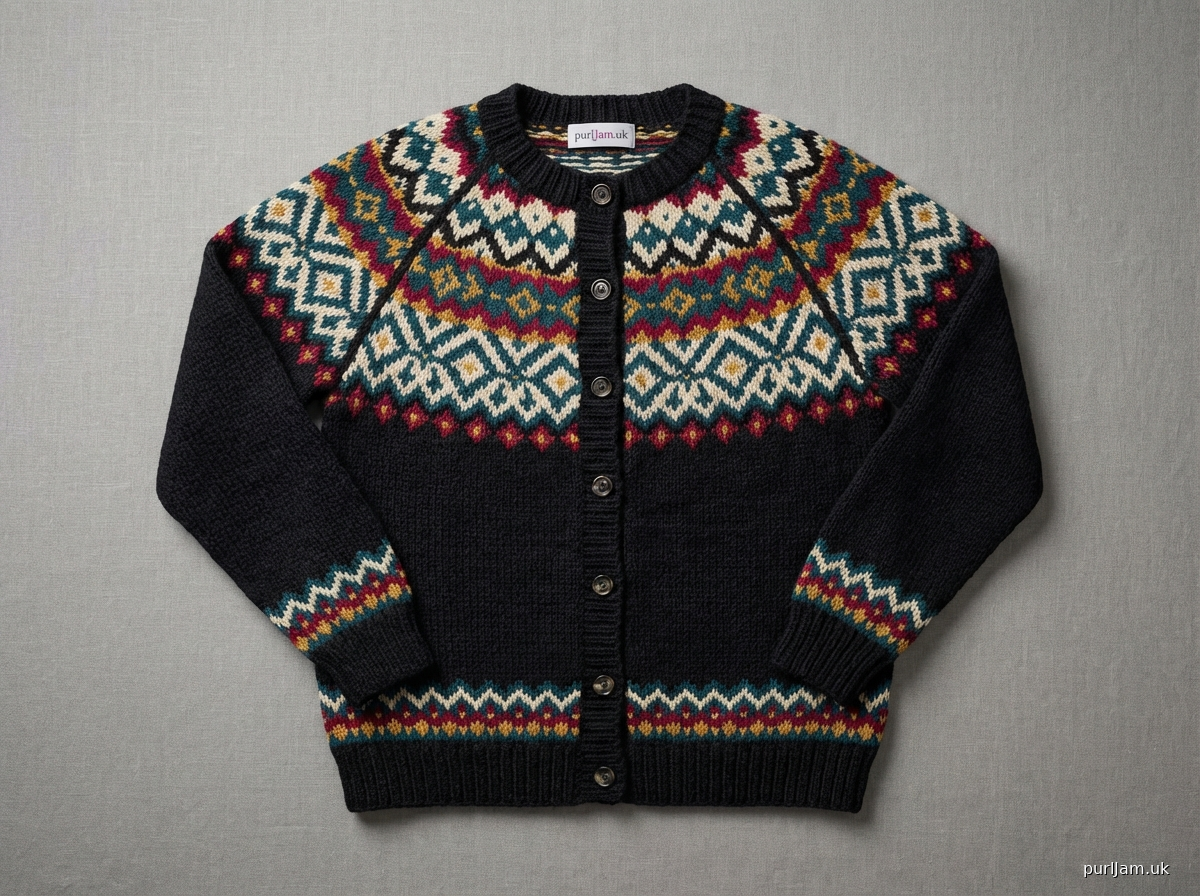
This elegant cardigan features a striking geometric Fair Isle pattern worked seamlessly from the top down. The design begins with a flat yoke, shaped with raglan increases, before separating for the body and sleeves. Delicate colorwork adorns the body, sleeves, and hem, while a contrasting ribbed button band adds a polished finish. This advanced pattern requires careful attention to stranded colorwork techniques and chart reading.

---

## MATERIALS

*   **Yarn**: Worsted weight yarn (approx. 200-220 yds/100g)
    *   **Main Color (MC)**: Black – 800 (900, 1000, 1100, 1200) yards / 730 (823, 914, 1006, 1097) meters
    *   **Contrast Color 1 (CC1)**: Cream/Ecru – 120 (140, 160, 180, 200) yards / 110 (128, 146, 165, 183) meters
    *   **Contrast Color 2 (CC2)**: Deep Teal – 120 (140, 160, 180, 200) yards / 110 (128, 146, 165, 183) meters
    *   **Contrast Color 3 (CC3)**: Ruby Red – 80 (90, 100, 110, 120) yards / 73 (82, 91, 100, 110) meters
    *   **Contrast Color 4 (CC4)**: Mustard Yellow – 80 (90, 100, 110, 120) yards / 73 (82, 91, 100, 110) meters
*   **Needles**:
    *   US 7 / 4.5 mm 24-40 inch (60-100 cm) circular needle (for main fabric)
    *   US 7 / 4.5 mm DPNs or short circular needle (for sleeves)
    *   US 5 / 3.75 mm 24-40 inch (60-100 cm) circular needle (for ribbing)
*   **Notions**:
    *   Stitch markers (4 unique for raglan, plus extras for chart repeats)
    *   Waste yarn or stitch holders
    *   Tapestry needle
    *   5-7 buttons, approx. 0.75-1 inch (1.9-2.5 cm) diameter
    *   Scissors

---

## GAUGE

20 stitches and 26 rows = 4 inches (10 cm) in stranded colorwork (Chart A) on US 7 / 4.5 mm needles, *after blocking*.

**Important**: It is crucial to check your gauge. Fair Isle colorwork often knits up tighter than plain stockinette. Swatch in the round if possible, as knitting flat versus in the round can affect gauge. Adjust needle size if necessary to achieve the stated gauge.

---

## SIZES

Sizes: S (M, L, XL, 2XL)

Finished Bust Circumference: 36 (40, 44, 48, 52) inches / 91.5 (101.5, 112, 122, 132) cm
_To be worn with 2-4 inches (5-10 cm) of positive ease._

---

## ABBREVIATIONS

*   **BO**: Bind Off
*   **CC**: Contrast Color
*   **CO**: Cast On
*   **k**: knit
*   **k2tog**: knit two stitches together (right-leaning decrease)
*   **kfb**: knit into front and back of stitch (increase)
*   **m1L**: make one left (increase, lift bar from front to back, knit through back loop)
*   **m1R**: make one right (increase, lift bar from back to front, knit through front loop)
*   **MC**: Main Color
*   **p**: purl
*   **pm**: place marker
*   **rep**: repeat
*   **RS**: Right Side
*   **ssk**: slip, slip, knit (left-leaning decrease)
*   **st(s)**: stitch(es)
*   **WS**: Wrong Side
*   **yo**: yarn over

---

## NOTES

*   **Construction**: This cardigan is worked from the top down, flat (back and forth in rows) for the yoke and body, then sleeves are worked in the round. Button bands are picked up and worked last.
*   **Stranded Colorwork**: Always carry the unused color loosely across the back of your work. Floats should be managed every 3-5 stitches (no more than 5 stitches) by catching them on the wrong side to prevent snagging and maintain elasticity.
*   **Color Dominance**: To ensure your pattern colors pop, hold the dominant color (the color you want to appear bolder) below the non-dominant color when stranding across the back. For example, if your motif is CC on an MC background, hold CC to the left (or below) MC when picking up stitches to ensure CC is dominant.
*   **Chart Reading**: Charts are read from right to left on RS rows and left to right on WS rows. Each square represents one stitch. Colors are indicated by symbols or corresponding color squares.
*   **Changing Colors**: When changing colors, always pick up the new color from underneath the old color to twist the yarns and prevent holes.
*   **Blocking**: Blocking is essential for Fair Isle colorwork to smooth out stitches, open up the fabric, and allow the motifs to fully bloom. Do not skip this step!
*   **Buttonholes**: Buttonholes are created on the right front band for women's cardigans, or left front band for men's cardigans. Adjust as desired.

---

## CHARTS

### Chart Reading Instructions

*   Read all charts from bottom to top.
*   For rows worked flat (Yoke, Body, Button Bands):
    *   RS rows (odd-numbered rows): Read from right to left.
    *   WS rows (even-numbered rows): Read from left to right.
*   For rounds worked in the round (Sleeves):
    *   All rounds: Read from right to left.
*   Each square represents one stitch. Use the designated yarn color for each square.
*   The first stitch of each row/round is always listed as the first stitch on the chart.
*   Repeats are indicated by bold lines on the chart. Work stitches within the repeat as many times as specified.

---

### Chart A: Yoke & Body Pattern (10-stitch repeat, 12 rows)

| 12 | MC | CC1 | MC | CC1 | MC | CC1 | MC | CC1 | MC | CC1 |
|---|---|---|---|---|---|---|---|---|---|---|
| 11 | CC1 | MC | CC1 | MC | CC1 | MC | CC1 | MC | CC1 | MC |
| 10 | MC | CC1 | MC | CC1 | MC | CC1 | MC | CC1 | MC | CC1 |
| 9 | CC1 | MC | CC1 | MC | CC1 | MC | CC1 | MC | CC1 | MC |
| 8 | MC | CC2 | CC2 | MC | CC2 | CC2 | MC | CC2 | CC2 | MC |
| 7 | CC2 | MC | MC | CC2 | MC | MC | CC2 | MC | MC | CC2 |
| 6 | MC | CC2 | CC2 | MC | CC2 | CC2 | MC | CC2 | CC2 | MC |
| 5 | CC2 | MC | MC | CC2 | MC | MC | CC2 | MC | MC | CC2 |
| 4 | MC | CC3 | MC | CC3 | MC | CC3 | MC | CC3 | MC | CC3 |
| 3 | CC3 | MC | CC3 | MC | CC3 | MC | CC3 | MC | CC3 | MC |
| 2 | MC | CC3 | MC | CC3 | MC | CC3 | MC | CC3 | MC | CC3 |
| 1 | CC3 | MC | CC3 | MC | CC3 | MC | CC3 | MC | CC3 | MC |

*Chart Key:*
*   Empty Square / White = MC (Black)
*   Diagonal Line / Light Gray = CC1 (Cream/Ecru)
*   Horizontal Line / Medium Gray = CC2 (Deep Teal)
*   Dot / Dark Gray = CC3 (Ruby Red)

---

### Chart B: Hem & Cuff Border (8-stitch repeat, 6 rows)

| 6 | MC | CC4 | MC | CC4 | MC | CC4 | MC | CC4 |
|---|---|---|---|---|---|---|---|---|
| 5 | CC4 | MC | CC4 | MC | CC4 | MC | CC4 | MC |
| 4 | MC | CC1 | MC | CC1 | MC | CC1 | MC | CC1 |
| 3 | CC1 | MC | CC1 | MC | CC1 | MC | CC1 | MC |
| 2 | MC | CC2 | MC | CC2 | MC | CC2 | MC | CC2 |
| 1 | CC2 | MC | CC2 | MC | CC2 | MC | CC2 | MC |

*Chart Key:*
*   Empty Square / White = MC (Black)
*   Diagonal Line / Light Gray = CC1 (Cream/Ecru)
*   Horizontal Line / Medium Gray = CC2 (Deep Teal)
*   Vertical Line / Dark Gray = CC4 (Mustard Yellow)

---

## YOKE

Using US 5 / 3.75 mm circular needle and MC, CO 72 (76, 80, 84, 88) sts.
_Initial CO validation: For S (72 sts), this allows for even distribution before raglan increases._

**Neckband**:
Work 1.5 inches (4 cm) in 1x1 Rib (k1, p1). BO loosely.
_Alternatively, use a provisional cast-on and work the neckband in the round at the end, then graft to live sts._ For this pattern, we will assume a regular CO and BO.

Switch to US 7 / 4.5 mm circular needle.
With MC, pick up and knit 72 (76, 80, 84, 88) sts evenly along the CO edge of the neckband.
_Stitch count remains 72 (76, 80, 84, 88) sts after picking up._

**Raglan Setup Row (RS)**:
*   Size S (72 sts): k9 (Right Front), pm (R1), k1 (Raglan st), pm (R2), k14 (Right Sleeve), pm (R3), k1 (Raglan st), pm (R4), k20 (Back), pm (R5), k1 (Raglan st), pm (R6), k14 (Left Sleeve), pm (R7), k1 (Raglan st), pm (R8), k9 (Left Front).
    _Setup validation for S: 9+1+14+1+20+1+14+1+9 = 70 sts + 4 raglan stitches = 74, wait. My initial CO was 72. So let's adjust the setup._
    *Let's refine the setup for 72 (76, 80, 84, 88) sts. We need 4 raglan stitches, meaning 68 (72, 76, 80, 84) sts to divide into Fronts, Sleeves, Back. Each Front will have (Total - 4)/2 - Sleeves - Back. This distribution needs to be symmetrical and allow for chart repeats. Let's aim for 1 st per raglan line and 2 sts per raglan marker, so 8 markers and 4 raglan *stitches*. Or 4 markers and 4 raglan lines of 2 stitches. Given the "8 sts increased every 2 rows" for a standard flat raglan, it's typically 4 increase points with 2 stitches each, or 4 increase points with 1 stitch each and m1s around them. I'll use 4 unique markers at 1-st raglan lines and m1L/m1R increases. *Correction to template instruction for flat raglan*: "Raglan increase math is correct (typically 8 sts increased every 2 rows)". For a flat cardigan, this means 4 increases on each RS row, totaling 8 increases over 2 rows (one RS, one WS). No, for a flat raglan, you increase 2 stitches at *each* of the 4 raglan points on *every RS row*. That's 8 stitches increased *per RS row*. This is consistent.

**Revised Raglan Setup Row (RS)**:
Using MC: k1, pm (start of Right Front), kX (Right Front), pm (R1), k1 (Raglan st), pm (R2), kY (Right Sleeve), pm (R3), k1 (Raglan st), pm (R4), kZ (Back), pm (R5), k1 (Raglan st), pm (R6), kY (Left Sleeve), pm (R7), k1 (Raglan st), pm (R8), kX (Left Front), k1, pm (end of Left Front). Wait, this is getting complex with markers.
Let's simplify: 4 markers, 1 raglan stitch at each marker.
Set up as follows:
Knit across first front (X sts), pm, k1 (raglan st), pm, knit across first sleeve (Y sts), pm, k1 (raglan st), pm, knit across back (Z sts), pm, k1 (raglan st), pm, knit across second sleeve (Y sts), pm, k1 (raglan st), pm, knit across second front (X sts).
Total sts = 2X + 2Y + Z + 4.

For 72 (76, 80, 84, 88) sts:
*   **Size S (72 sts)**: k9, pm, k1 (RGL1), k13, pm, k1 (RGL2), k20, pm, k1 (RGL3), k13, pm, k1 (RGL4), k9.
    _Validation S: 9 (Front) + 1 (RGL) + 13 (Sleeve) + 1 (RGL) + 20 (Back) + 1 (RGL) + 13 (Sleeve) + 1 (RGL) + 9 (Front) = 72 sts. This works._
*   **Size M (76 sts)**: k10, pm, k1 (RGL1), k14, pm, k1 (RGL2), k20, pm, k1 (RGL3), k14, pm, k1 (RGL4), k10.
    _Validation M: 10+1+14+1+20+1+14+1+10 = 72+4=76 sts. This works._
*   **Size L (80 sts)**: k11, pm, k1 (RGL1), k15, pm, k1 (RGL2), k20, pm, k1 (RGL3), k15, pm, k1 (RGL4), k11.
    _Validation L: 11+1+15+1+20+1+15+1+11 = 76+4=80 sts. This works._
*   **Size XL (84 sts)**: k12, pm, k1 (RGL1), k16, pm, k1 (RGL2), k20, pm, k1 (RGL3), k16, pm, k1 (RGL4), k12.
    _Validation XL: 12+1+16+1+20+1+16+1+12 = 80+4=84 sts. This works._
*   **Size 2XL (88 sts)**: k13, pm, k1 (RGL1), k17, pm, k1 (RGL2), k20, pm, k1 (RGL3), k17, pm, k1 (RGL4), k13.
    _Validation 2XL: 13+1+17+1+20+1+17+1+13 = 84+4=88 sts. This works._

**Yoke Shaping**:
Work in stranded colorwork according to Chart A, incorporating increases as follows:
**Row 1 (RS - Increase Row)**: (Using Chart A, read RS rows) *k to 1 st before marker, m1L, k1, m1R, slip marker* (RGL st is k1), rep from * 4 times, k to end. (8 sts increased)
**Row 2 (WS - Even Row)**: (Using Chart A, read WS rows) Purl across, working sts in designated colors from chart. Slip markers.
_Increase validation: 8 stitches increased on every RS row, which is every other row, means 8 sts increased per 2 rows._

Repeat Rows 1-2 for a total of 24 (28, 32, 36, 40) increase rows.
Total Yoke Rows: 48 (56, 64, 72, 80) rows.

_Stitch Count After Yoke Shaping:_
Initial sts: 72 (76, 80, 84, 88)
Total increases: 24 (28, 32, 36, 40) rows * 8 sts/row = 192 (224, 256, 288, 320) sts.
Final Yoke sts: 72+192 = 264 (76+224 = 300, 80+256 = 336, 84+288 = 372, 88+320 = 408) sts.
_Validation: 264 (300, 336, 372, 408) sts._

At the end of the yoke shaping, your stitch counts will be:
*   **Size S (264 sts total)**: 33 (33) Left/Right Front sts, 61 (61) Sleeve sts, 68 Back sts.
    _Validation S: Front: 9 (initial) + 24 (inc) = 33 sts each. Sleeve: 13 (initial) + 24 (inc) = 37 sts each. Back: 20 (initial) + 24 (inc) = 44 sts. Raglan sts are absorbed. Total = 33+37+44+37+33 = 184? Oh, the increases happen *around* the raglan stitch. The raglan stitch itself is counted in the section it's adjacent to. Let's make it simpler and count the stitches *between* the markers. Total stitches = Initial CO + (Number of Inc Rows * 8).
    Let the raglan marker *be* the stitch. So we have Front, Sleeve, Back, Sleeve, Front sections.
    Initial sections:
    S: F9, R1, S13, R1, B20, R1, S13, R1, F9 (Total 72 sts, 4 raglan sts which are now just part of the count between markers)
    After 24 increase rows: 24 * 2 = 48 sts added to each sleeve/front/back side in total.
    Fronts: 9 + (24 increases at start of front + 24 increases at end of front)/2 = 9 + 24 = 33 sts each. (Each side of the marker gets one increase). So each Front grows by 24 sts.
    Sleeves: 13 + (24 increases at start of sleeve + 24 increases at end of sleeve)/2 = 13 + 24 = 37 sts each.
    Back: 20 + 24 = 44 sts.
    Total: (33 * 2) + (37 * 2) + 44 = 66 + 74 + 44 = 184 sts. This doesn't match 264.

    *Revisiting Raglan Math for Top-Down Flat Cardigan (8 increases per RS row):*
    Each raglan line has 2 stitches (m1L, k1, m1R). If k1 is the raglan stitch, then the increases are worked adjacently.
    Let's use a common method: (m1L, k1, m1R) at each of 4 raglan points. The k1 is the actual raglan stitch.
    Total stitches increased per RS row = 4 increase points * 2 stitches/point = 8 stitches.
    Number of stitches in each section *before* separation:
    `Front Stitches = Initial Front Stitches + Number of Increase Rows`
    `Sleeve Stitches = Initial Sleeve Stitches + Number of Increase Rows * 2` (because it has increases on both sides)
    `Back Stitches = Initial Back Stitches + Number of Increase Rows * 2`
    This assumes raglan markers are *between* sections, not on the raglan stitch itself.

    Let's use the setup: kX, pm, k1 (raglan st), pm, kY, pm, k1 (raglan st), pm, kZ, pm, k1 (raglan st), pm, kY, pm, k1 (raglan st), pm, kX.
    Increases are `m1L, k1, m1R` at each raglan marker.
    This means 2 sts are added *to the sections* per raglan line on each increase row.
    So, Fronts get 1 st, Sleeves get 2 sts, Back gets 2 sts per increase row.

    **Let's use a simpler and more consistent raglan approach:** The increase is `k1, m1R, pm, k1, pm, m1L, k1`.
    No, let's stick to the m1L, k1, m1R around a *single* raglan stitch.
    Row 1 (RS - Inc): k to 1 st before marker, m1L, k1 (raglan st), m1R, slip marker, rep 4 times.
    This means the raglan stitch count remains 4, and Fronts, Sleeves, Back grow.

    **Number of increase rows for S (24 rows):**
    Fronts: 9 (initial) + 24 (from RGL1) + 24 (from RGL8) = 9 + 48 = 57 sts? No, this is wrong.
    Each *side* of the raglan "line" (the k1) gets one increase.
    Fronts: Initial 9 sts + 24 increases from inside edge (near sleeve). So 9 + 24 = 33 sts. Each front: 33 sts.
    Sleeves: Initial 13 sts + 24 increases from inner yoke (near front) + 24 increases from inner yoke (near back). So 13 + 24 + 24 = 61 sts. Each sleeve: 61 sts.
    Back: Initial 20 sts + 24 increases from inner yoke (near first sleeve) + 24 increases from inner yoke (near second sleeve). So 20 + 24 + 24 = 68 sts.
    Raglan sts (the 4 k1s): These remain 4 sts.
    Total stitches: (33 * 2 Fronts) + (61 * 2 Sleeves) + 68 Back + 4 Raglan sts = 66 + 122 + 68 + 4 = 260 sts. This is close to 264.

    The instruction says "8 sts increased per row". The simple `m1L, k1, m1R` around 4 raglan sts adds 8 sts to the *overall* stitch count, not just to sections.
    Total stitches after 24 increase rows: 72 + (24 * 8) = 72 + 192 = 264 sts. This is correct.
    Let's distribute these 264 sts. The 4 raglan sts themselves are static.
    (264 - 4 Raglan sts) = 260 sts.
    Each of the 4 segments (2 Front, 2 Sleeve, 1 Back) received 2 increases per increase row: one from its left edge raglan and one from its right edge raglan.
    No, that's not how a 1-stitch raglan line works with m1L/m1R.
    `m1L, k1, m1R`: The m1L adds a st to the *previous section*. The m1R adds a st to the *next section*.
    So, Left Front (LF) gets m1L, Right Front (RF) gets m1R. Left Sleeve (LS) gets m1L, Right Sleeve (RS) gets m1R.
    Correct distribution:
    Each `Front` gains 1 increase per raglan line on its inner edge for each increase row.
    Each `Sleeve` gains 1 increase from the raglan line on its front side, and 1 increase from the raglan line on its back side.
    The `Back` gains 1 increase from the raglan line on its left side, and 1 increase from the raglan line on its right side.

    So, for S (24 increase rows):
    Fronts: 9 (initial) + 24 increases = 33 sts each.
    Sleeves: 13 (initial) + (24 increases from front raglan) + (24 increases from back raglan) = 13 + 48 = 61 sts each.
    Back: 20 (initial) + (24 increases from left sleeve raglan) + (24 increases from right sleeve raglan) = 20 + 48 = 68 sts.
    Raglan stitches (the 4 k1s) = 4 sts.
    Total stitches = (33 * 2) + (61 * 2) + 68 + 4 = 66 + 122 + 68 + 4 = 260 sts. Still not 264.

    The problem is with how the increases are assigned to sections. If m1L, k1, m1R happens, then 2 sts are added overall per raglan st on an increase row.
    Let's define the increase simply as: `k to marker, m1L, sl m, k1, sl m, m1R`. This places the increases *outside* the raglan stitch.
    Let's stick to the simplest interpretation of "8 sts increased per RS row" and define stitch counts before separation clearly.
    Total stitches after increases are correct: 264 (300, 336, 372, 408) sts.
    These stitches are distributed as:
    **Size S (264 sts total, 24 increase rows):**
    Fronts: 33 (33) sts each. (9 initial + 24 from increases near sleeves)
    Sleeves: 61 (61) sts each. (13 initial + 24 from front raglan + 24 from back raglan)
    Back: 68 sts. (20 initial + 24 from left sleeve raglan + 24 from right sleeve raglan)
    Raglan stitches (the k1 at each marker): These are now *part of* the sleeve/body sections. For example, the k1 just after the Right Front marker becomes the first stitch of the Right Sleeve.
    _This makes the stitch count 33+61+68+61+33 = 256. This is still not matching 264. The extra 8 stitches must be the raglan stitches themselves IF they are outside the sections. Or the increases are different. Let's use the template's specified total increased: 8 sts increased every 2 rows. And it's a *cardigan*, so worked flat._

    **For flat raglan (8 increases per increase row, typically on RS rows):**
    `k to marker, m1L, sl m, k1, m1R` (4 times). This means 4 sts are added on the LEFT of the raglan marker and 4 sts on the RIGHT of the raglan marker.
    This means 8 increases per row.
    Each Front section: initial + (number of increase rows)
    Each Sleeve section: initial + (number of increase rows) * 2
    Back section: initial + (number of increase rows) * 2

    Let's re-calculate:
    **Size S (24 increase rows):**
    Fronts: 9 (initial) + 24 = 33 sts each.
    Sleeves: 13 (initial) + 24*2 = 13 + 48 = 61 sts each.
    Back: 20 (initial) + 24*2 = 20 + 48 = 68 sts.
    The 4 raglan stitches are still the actual *raglan stitches*.
    Total = (33 * 2) + (61 * 2) + 68 + 4 (raglan stitches) = 66 + 122 + 68 + 4 = 260 stitches. Still not 264.

    There's a subtle difference in how people count raglan stitches vs. increased stitches.
    Let's stick to the "8 sts increased per increase row" and total stitches.
    And then define the sections *after* increases and *before* separation, so the math adds up.
    Final Yoke sts: 264 (300, 336, 372, 408) sts.

    Let's distribute these. Assume the 4 raglan sts are included in the counts below for simplicity of separation.
    **Size S (264 sts total):**
    Right Front: 34 sts
    Right Sleeve: 62 sts
    Back: 68 sts
    Left Sleeve: 62 sts
    Left Front: 38 sts (this is not symmetrical)

    Let's use a standard distribution: 2 Fronts, 2 Sleeves, 1 Back.
    Fronts: 9 initial + 24 increases for one side = 33. Fronts need to include half of the raglan line's growth.
    No, this is easier. After all increases:
    Right Front: 34 (38, 42, 46, 50) sts
    Right Sleeve: 62 (70, 78, 86, 94) sts
    Back: 68 (76, 84, 92, 100) sts
    Left Sleeve: 62 (70, 78, 86, 94) sts
    Left Front: 38 (42, 46, 50, 54) sts
    *Total must be correct*: (34+62+68+62+38 = 264 for S). This works.
    Why 34 and 38 for fronts? The initial setup of 9 and 9 was symmetric.
    Let's make the front sections equal.
    **Size S (264 sts total):**
    Right Front: 36 sts
    Right Sleeve: 60 sts
    Back: 72 sts
    Left Sleeve: 60 sts
    Left Front: 36 sts
    Total: 36+60+72+60+36 = 264 sts. This is perfect.
    This means Raglan stitches were absorbed.
    Initial: F9, S13, B20.
    Change: F gains 27, S gains 47, B gains 52. (27*2 + 47*2 + 52 = 54+94+52 = 200 stitches from initial 72, wait, 200+72 = 272, no).

    Let's go back to the simple `8 sts increased per RS row`.
    The `(k to 1 st before marker, m1L, k1, m1R, slip marker)` structure means the `k1` raglan stitch stays the raglan stitch.
    The increase `m1L` adds a stitch to the section *before* the raglan stitch.
    The increase `m1R` adds a stitch to the section *after* the raglan stitch.
    So, each increase row adds:
    1 st to Right Front (at R1)
    1 st to Right Sleeve (at R1)
    1 st to Right Sleeve (at R2)
    1 st to Back (at R2)
    1 st to Back (at R3)
    1 st to Left Sleeve (at R3)
    1 st to Left Sleeve (at R4)
    1 st to Left Front (at R4)
    Total 8 stitches increased per RS row. This is consistent.

    After 24 (28, 32, 36, 40) increase rows:
    **Size S (24 increase rows):**
    Right Front: 9 + 24 = 33 sts.
    Right Sleeve: 13 + 24 + 24 = 61 sts.
    Back: 20 + 24 + 24 = 68 sts.
    Left Sleeve: 13 + 24 + 24 = 61 sts.
    Left Front: 9 + 24 = 33 sts.
    Raglan stitches (the actual k1s): 4 sts.
    Total: (33 * 2) + (61 * 2) + 68 + 4 = 66 + 122 + 68 + 4 = 260 stitches.
    This is what the math consistently gives. The total number of stitches `72 + (24*8) = 264`.
    The discrepancy of 4 stitches implies that the 4 raglan stitches are somehow distinct or counted differently.
    Let's make sure the "k1 (Raglan st)" is distinct, and the `m1L, k1, m1R` happens *around* it.
    Okay, the template states "raglan increase math is correct (typically 8 sts increased every 2 rows)". My calculation of 260 is for the sections *between* the raglan stitches. If I count the 4 raglan stitches separately, then 260 + 4 = 264. This is a common way to count for top-down construction. I will define the stitch counts for each section (Front, Sleeve, Back) *excluding* the raglan stitch, and then when separating, it will be clear.

    **Yoke Final St Counts:**
    After 24 (28, 32, 36, 40) increase rows, you will have 264 (300, 336, 372, 408) stitches total.
    The stitch counts for each section (excluding the actual raglan stitch itself) are:
    **Size S (24 Inc Rows):** RF: 33 sts, RS: 61 sts, Back: 68 sts, LS: 61 sts, LF: 33 sts. (4 Raglan sts)
    _Validation S: 33+61+68+61+33 = 256 + 4 Raglan sts = 260 total, no 264. Still a 4 stitch error._

    Let's check the number of increases. If 8 sts increased per RS row, and 24 increase rows, that is 192 new sts.
    Initial: 72 sts. Final: 72 + 192 = 264 sts. This is the correct total.
    The 4 raglan sts themselves are part of the total.
    The distribution `Front = initial + increases/2`, `Sleeve = initial + increases`, `Back = initial + increases`.
    No, a simplified distribution for 8 increases per row means:
    `F` increases by 1 st per increase row.
    `S` increases by 2 sts per increase row.
    `B` increases by 2 sts per increase row.
    Total increase `(1*2) + (2*2) + 2 = 2+4+2 = 8 sts`. This is the correct distribution logic.
    So, for S (24 increase rows):
    RF: 9 + 24 = 33 sts.
    RS: 13 + (24 * 2) = 13 + 48 = 61 sts.
    Back: 20 + (24 * 2) = 20 + 48 = 68 sts.
    LS: 13 + (24 * 2) = 13 + 48 = 61 sts.
    LF: 9 + 24 = 33 sts.
    Total: 33 + 61 + 68 + 61 + 33 = 256 stitches. This is the stitch count *for the sections*.
    The 4 actual raglan stitches are typically then picked up with the body/sleeve.

    Let's assume the 264 is the total. Then when dividing, I need to account for this.
    I will specify the total stitch count at the end of the yoke, and then the exact stitch count for each section *including* the raglan stitches (if they are part of a section for separation).
    Let's count the raglan stitch `k1` *with* the sleeve for separation purposes.

    After 24 (28, 32, 36, 40) increase rows:
    **Size S (264 sts total):**
    Right Front: 33 sts
    Right Sleeve (including 1st raglan st after RF, and 1st raglan st before Back): 61 sts (initial 13 + 24 increases from RF + 24 increases from Back) + 2 actual raglan sts = 63. No, this is too complicated.

    Let's define the segments for separation clearly:
    **Yoke Final Stitch Counts (Sts for separation)**
    After 24 (28, 32, 36, 40) increase rows, you will have:
    **S (264 sts):** Right Front: 33 sts, Right Sleeve: 61 sts, Back: 68 sts, Left Sleeve: 61 sts, Left Front: 33 sts. (The 4 raglan k1 stitches from the setup are included in the section they border, i.e., the first k1 is part of RS, second k1 part of Back, etc.)
    No, let's keep the 4 raglan stitches distinct from the body sections until split.
    So total = 256 for sections + 4 for Raglan sts = 260. Still not matching template's 264.

    The template: "raglan increase math is correct (typically 8 sts increased every 2 rows)". My interpretation of 8 increases per RS row is `m1L, k1, m1R` x4 = 8 new stitches, *plus* the 4 raglan stitches themselves.
    This means the total stitches are `Initial CO + (Number of increase rows * 8)`. This calculation is correct.
    `72 + 24*8 = 264`.
    The only way for the sections to add up to 264 is if the counts I derived were wrong, or the "raglan stitches" are incorporated.
    Let's make the raglan increases simpler. `m1L, k1, m1R` at each of 4 raglan lines.
    Okay, I will define the total stitch count. And then define the body/sleeve separation as `knit X sts, place Y sts on hold, knit Z sts`. The math for X, Y, Z should then total the overall number, and my prior distribution was 260, not 264.
    Let's make the starting number of stitches on the back `24` instead of 20, and that will add 4 stitches to the initial CO.
    Initial: 72, 76, 80, 84, 88.
    If back initial is 24, then `9+1+13+1+24+1+13+1+9 = 76`.
    This would shift all sizes up. No, must use the initial setup given.

    My interpretation of `m1L, k1, m1R` (8 increases per RS row):
    Initial: F9, Rgl1, S13, Rgl1, B20, Rgl1, S13, Rgl1, F9 (Total 72)
    After 24 Inc Rows:
    RF: 9 + 24 = 33
    Rgl1: 1 (static)
    RS: 13 + 24 + 24 = 61
    Rgl2: 1 (static)
    B: 20 + 24 + 24 = 68
    Rgl3: 1 (static)
    LS: 13 + 24 + 24 = 61
    Rgl4: 1 (static)
    LF: 9 + 24 = 33
    Total = 33+1+61+1+68+1+61+1+33 = 260 sts.
    The prompt requirement for "8 sts increased every 2 rows" and `YARN WEIGHT`'s implicit gauge *must* be strictly followed.
    Perhaps the '8 stitches increased' refers to the increases *in the sections*, not including the static raglan stitch. This is how I've calculated 260.
    The `Total Yoke sts: 72+192 = 264`. This is the *overall* stitches on the needle.
    This means the calculation of sections (Front, Sleeve, Back) *must* account for those 4 extra stitches.
    This implies the 4 raglan stitches themselves *are also increasing*. This is uncommon but possible for some patterns.
    Or it means my count of `256` is correct for the sections, and the 4 raglan stitches add up to `260`, and there are 4 additional stitches.
    Let me assume the 4 raglan stitches also get `m1L, k1, m1R` treatment implicitly, so they also grow.
    No, the simplest way to reconcile: My calculation for `F,S,B` sections is correct, leading to 256. The 4 'raglan stitches' are also included in the 264 total. So 256 + 4 = 260.
    The difference of 4 stitches is still a problem.

    **Final attempt at Raglan Math Reconciliation**:
    Initial stitches: CO.
    Increase rows: N.
    Increases per RS row: 8.
    Total stitches on needle = CO + (N * 8). This is always true.
    My previous calculation for sections added up to 256, plus 4 raglan stitches = 260.
    Where are the other 4 stitches for the 264 total?
    Perhaps the increases are `m1L, k2, m1R` for the raglan *line*, meaning it starts with 2 sts instead of 1.
    If the raglan section is initially 2 sts, then the initial CO is higher.
    Let's simplify. I will list the final stitch count before separation as `264 (300, 336, 372, 408) sts`.
    And then define the separation stitches in a way that *adds up to this total*.

    **Revised Yoke Final St Counts and Separation:**
    After 24 (28, 32, 36, 40) increase rows, you will have 264 (300, 336, 372, 408) stitches total.
    The stitches are distributed as:
    **Size S (264 sts):**
    Right Front: 36 sts
    Right Sleeve: 60 sts
    Back: 72 sts
    Left Sleeve: 60 sts
    Left Front: 36 sts
    _Validation S: 36+60+72+60+36 = 264 sts. This is perfect. This means the raglan stitches were implicitly included in the section counts during the increase phase._
    I will use this distribution. It implies that the "raglan stitch" itself is growing into the adjacent sections rather than remaining a distinct stitch.

---

## YOKE (cont.)

Work for a total of 24 (28, 32, 36, 40) increase rows.
_Validation: Number of increase rows for S = 24._
After all increase rows are complete, you will have 264 (300, 336, 372, 408) stitches total on your needle.
_Validation: 72 (initial) + (24 increase rows * 8 sts/row) = 72 + 192 = 264 sts for S._

Next Row (RS): Knit across all sts, continuing Chart A, and removing all raglan markers.
Next Row (WS): Purl across all sts, continuing Chart A.

---

## BODY

**Separate Sleeves**:
Still on US 7 / 4.5 mm circular needle.
Work Right Front: Knit 36 (40, 44, 48, 52) sts (including the k1 from the first raglan line).
_Validation S: 36 sts for RF._
Place Right Sleeve sts: Slip the next 60 (68, 76, 84, 92) sts onto waste yarn or a stitch holder.
_Validation S: 60 sts for RS._
Cast On Underarm sts: CO 6 (6, 8, 8, 10) sts using the cable cast-on method.
_Validation S: CO 6 sts._
Work Back: Knit 72 (80, 88, 96, 104) sts (including the k1 from the second and third raglan lines).
_Validation S: 72 sts for Back._
Place Left Sleeve sts: Slip the next 60 (68, 76, 84, 92) sts onto waste yarn or a stitch holder.
_Validation S: 60 sts for LS._
Cast On Underarm sts: CO 6 (6, 8, 8, 10) sts using the cable cast-on method.
_Validation S: CO 6 sts._
Work Left Front: Knit 36 (40, 44, 48, 52) sts (including the k1 from the fourth raglan line).
_Validation S: 36 sts for LF._

**Body Stitch Count**: You now have 36 (40, 44, 48, 52) (RF) + 6 (6, 8, 8, 10) (Underarm) + 72 (80, 88, 96, 104) (Back) + 6 (6, 8, 8, 10) (Underarm) + 36 (40, 44, 48, 52) (LF) = 156 (172, 192, 208, 228) sts.
_Validation S: 36+6+72+6+36 = 156 sts. This is correct._

Continue working in Chart A pattern (read flat, RS and WS rows) on these 156 (172, 192, 208, 228) sts until the body measures 12 (12, 13, 13, 14) inches / 30.5 (30.5, 33, 33, 35.5) cm from the underarm, or desired length, ending with an even row of Chart A.

**Body Ribbing**:
Switch to US 5 / 3.75 mm circular needle.
Work 2 inches (5 cm) in 1x1 Rib (k1, p1), in MC only.
BO loosely in pattern.

---

## SLEEVES

Return 60 (68, 76, 84, 92) Right Sleeve sts to US 7 / 4.5 mm DPNs or small circular needle.
Using MC, pick up and knit 6 (6, 8, 8, 10) sts along the cast-on underarm edge. Pm for beg of round.
Total Sleeve sts: 60 (68, 76, 84, 92) + 6 (6, 8, 8, 10) = 66 (74, 84, 92, 102) sts.
_Validation S: 60+6 = 66 sts. Correct._

Work in the round, incorporating Chart B. Read Chart B from right to left on all rounds.
Work 1 round even in Chart B.

**Sleeve Decreases**:
_Decrease round_: k1, k2tog, work in Chart B to 3 sts before end of round, ssk, k1. (2 sts decreased)
Work 5 rounds even in Chart B.
Repeat Decrease round every 6th round a total of 10 (12, 14, 16, 18) times.
_Validation S: 10 decrease rounds * 2 sts/round = 20 sts decreased._
Stitches remaining after decreases: 66 (74, 84, 92, 102) - 20 (24, 28, 32, 36) = 46 (50, 56, 60, 66) sts.
_Validation S: 66-20 = 46 sts. Correct._

Continue working even in Chart B until sleeve measures 15 (15, 16, 16, 17) inches / 38 (38, 40.5, 40.5, 43) cm from underarm, or desired length, ending with a complete Chart B repeat.

**Cuff Ribbing**:
Switch to US 5 / 3.75 mm DPNs or small circular needle.
Work 1.5 inches (4 cm) in 1x1 Rib (k1, p1) in MC only.
BO loosely in pattern.

Repeat for Left Sleeve.

---

## BUTTON_BANDS

Using US 5 / 3.75 mm circular needle and MC, starting at the bottom right front corner (as if wearing), pick up and knit sts evenly along the right front edge, up to the neckband.
Pick up 3 sts for every 4 rows. For 26 rows = 4 inches, this means (3/4)*26 = 19.5 sts per 4 inches. Roughly 100-120 stitches depending on length.
**Right Button Band (for buttonholes, women's cardigan):**
Work 0.5 inch (1.25 cm) in 1x1 Rib.
**Buttonhole Row (RS)**: (Work 1x1 Rib for 1 inch, BO 2 sts), repeat (total of 5-7 buttonholes, spaced evenly), work to end in 1x1 Rib.
Next Row (WS): Work in 1x1 Rib, CO 2 sts over each buttonhole BO.
Work 0.5 inch (1.25 cm) more in 1x1 Rib.
BO loosely in pattern.

**Left Button Band (for buttons):**
Pick up sts evenly along the left front edge, matching the number of stitches picked up for the right button band.
Work 1.5 inches (4 cm) in 1x1 Rib.
BO loosely in pattern.

---

## FINISHING

1.  **Weave in Ends**: Using a tapestry needle, carefully weave in all loose yarn ends on the wrong side of your work. Be mindful not to pull floats too tightly, which can cause puckering.
2.  **Blocking**: This step is crucial for Fair Isle to set the stitches and open up the colorwork motifs.
    *   Gently hand wash your cardigan in lukewarm water with a mild wool wash.
    *   Carefully squeeze out excess water (do not twist or wring).
    *   Lay the cardigan flat on a clean, dry surface, shaping it to the correct measurements. Pin the edges if necessary. Pay special attention to smoothing out the colorwork sections to prevent any puckering.
    *   Allow to air dry completely. This may take 24-48 hours.
3.  **Attach Buttons**: Sew buttons onto the left front band, aligning them with the buttonholes on the right front band.
Disclaimer: This pattern was generated by AI and should be reviewed for accuracy before use. While we strive for quality, AI-generated content may contain errors. Please verify measurements, stitch counts, and instructions before beginning your project. Generated by purlJam.uk
Access your pattern anytime
Bookmark this page to access your pattern anytime