Type
Knitting
Difficulty
intermediate
Category
shawl
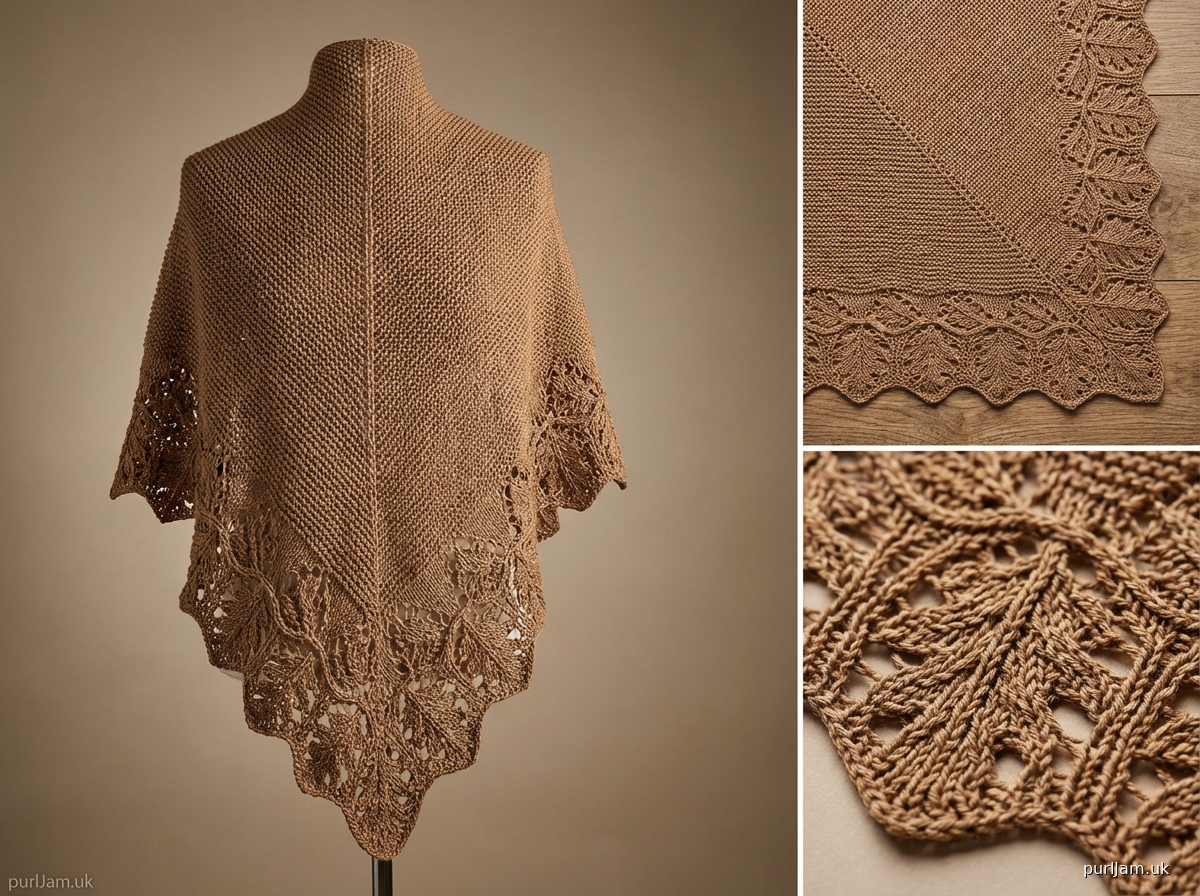
Pattern
---

# OAK LEAF LACE SHAWL

*An advanced triangular shawl worked from the center top-down in garter stitch, finished with a graceful sideways-worked oak leaf lace border.*

---

## FINISHED MEASUREMENTS

| Measurement | Blocked |
|---|---|
| Wingspan (tip to tip) | approx. 65 inches (165 cm) |
| Depth (center back) | approx. 22 inches (56 cm) |

*Finished measurements are after blocking. Lace opens significantly with wet blocking.*

---

## MATERIALS

- **Yarn:** Worsted weight, approx. 800–900 yards (730–823 m)
  - *Sample shown in a smooth, plant-fiber-blend or superwash wool worsted for best stitch definition and blocking.*
  - *Suggested yarn: 4 skeins of a 200-yard / 100g worsted, or equivalent.*
- **Needles:** US 8 / 5 mm, 32-inch (80 cm) or longer circular needle (for body and border)
- **Notions:**
  - Stitch markers (6 total: 1 unique center marker, 4 standard markers)
  - Tapestry needle
  - Blocking mats, rust-proof pins
  - Blocking wires (strongly recommended for lace border)
  - Waste yarn or spare circular needle for holding stitches (optional)

---

## GAUGE

**18 stitches × 36 rows = 4 inches (10 cm) in garter stitch**
*(worked flat, on US 8 / 5 mm needles)*

*Gauge is important for finished dimensions. A slightly looser gauge is intentional for drape and lace openness. Take time to swatch and block your swatch before beginning.*

---

## DIFFICULTY

**Advanced** — This pattern requires comfort with lace knitting, yarn overs, multiple decrease types (k2tog, ssk, sk2p), reading lace charts, and joining a sideways-worked border to live edge stitches.

---

## ABBREVIATIONS

| Abbreviation | Meaning |
|---|---|
| k | knit |
| p | purl |
| yo | yarn over |
| k2tog | knit 2 stitches together (right-leaning decrease) |
| ssk | slip, slip, knit slipped stitches together (left-leaning decrease) |
| sk2p | slip 1 knitwise, k2tog, pass slipped stitch over (double center decrease) |
| k3tog | knit 3 stitches together (right-leaning double decrease) |
| sl1 | slip 1 stitch purlwise with yarn in back |
| pm | place marker |
| sm | slip marker |
| rm | remove marker |
| RS | right side |
| WS | wrong side |
| rep | repeat |
| st(s) | stitch(es) |
| CO | cast on |
| BO | bind off |
| [ ] | work instructions within brackets the number of times indicated |

---

## PATTERN NOTES

1. **Construction Overview:** The shawl body is worked from the top center down, increasing 4 stitches every right-side row to build a triangular shape. The lace border is worked separately as a sideways strip and joined to the live edge stitches of the shawl body as you go.

2. **Selvedge Stitches:** The first stitch of every row is slipped purlwise with yarn in back (sl1) to create a neat chain selvedge, which aids in picking up stitches for the border. Do not slip the first stitch if using a different method — simply be consistent throughout.

3. **Markers:** Place a unique center marker (a different color or style) on either side of the center spine stitch. Four additional markers indicate the increase zones. See setup row instructions below.

4. **Lace Chart Reading:** Read RS rows from right to left and WS rows from left to right. The lace border is worked flat.

5. **Yarn Overs at Increases:** The increase yarn overs in the body create deliberate eyelets flanking the center spine. Work them snugly to keep the center line tidy.

6. **Border Joining:** The border is joined to the shawl's live stitches at the end of every WS border row. The final stitch of each WS border row is worked together (ssk) with one live stitch from the shawl needle. This joins 1 shawl stitch every 2 border rows.

---

## CONSTRUCTION SCHEMATIC

```
        [CO 3 sts at top center]
               /\
              /  \
    increase /    \ increase
    each RS /      \ each RS
           /        \
          /  garter  \
         /    body    \
        /________________\
        |  oak leaf lace  |
        |_________________|
```

---

## SHAWL BODY

### Setup

**Cast on:** Using a long-tail cast-on (or your preferred stretchy cast-on), CO **3 stitches**.

**Setup Row (WS):** Sl1, k1, sl1 purlwise wyif (this slipped stitch will be your center spine stitch on subsequent rows). *Note: On the very first WS row, simply: sl1, k1, p1.*

> **Stitch Count after Setup:** 3 sts

---

### Increase Section

The shawl is worked as follows. Each RS row gains 4 stitches. Each WS row is worked plain in garter stitch (knit all stitches, slipping the first stitch).

**Marker Placement on Row 1 (RS):**

**Row 1 (RS — Increase Row):** Sl1, yo, k1, pm (right marker), yo, k1 (center spine st), yo, pm (left marker), k1, yo, k1. *(4 sts increased; 7 sts total)*

**Row 2 (WS):** Sl1, knit to end.

**Row 3 (RS — Increase Row):** Sl1, yo, knit to 1 st before right marker, k1, sm, yo, k1 (center spine st), yo, sm, k1, yo, knit to last st, k1. *(4 sts increased)*

**Row 4 (WS):** Sl1, knit to end.

> **General RS Increase Row (all subsequent RS rows):**
> Sl1, yo, knit to marker, sm, yo, k1 (center spine st), yo, sm, knit to last st, yo, k1.
> *(+4 sts per RS row)*

> **General WS Row (all WS rows):**
> Sl1, knit to end.

**Continue** working RS Increase Rows and WS plain rows until you have worked **72 RS increase rows total** (144 rows total from cast-on, counting the setup row as row 0).

> **Stitch Count Verification after 72 RS rows:**
> Start: 3 sts
> Increases: 4 sts × 72 RS rows = 288 sts added
> **Total: 3 + 288 = 291 stitches** ✓

**Do not bind off.** Leave all 291 stitches on the needle. You will work the border next, joining it to these live stitches.

> **Body Dimensions (before border, before blocking):**
> Wingspan: 291 sts ÷ 4.5 sts per inch = approx. 64.7 inches (unblocked)
> Depth: 144 rows ÷ 9 rows per inch = approx. 16 inches (unblocked)
> *(18 sts = 4 in → 4.5 sts per inch; 36 rows = 4 in → 9 rows per inch)*

---

## OAK LEAF LACE BORDER

The border is worked as a separate strip, perpendicular to the body, and joined row by row to the live body stitches. The border begins at one lower corner of the shawl (right tip as worn), travels across the bottom edge, and ends at the other lower corner (left tip as worn).

The oak leaf lace pattern is worked over **24 stitches** (the border strip width) plus **1 selvedge join stitch** = 25 border stitches at the start of each WS join row.

### Oak Leaf Lace Pattern — Written Instructions

The oak leaf motif is worked over **24 stitches and a 16-row repeat.** Each motif represents a single oak leaf with a central stem and lobed edges.

> **Stitch Count Stability:** Each row within the 16-row repeat is self-balancing — the number of yarn overs equals the number of decreases within each row. The total stitch count of the border strip remains constant at 24 sts throughout (excluding the join stitch).

---

**BORDER SETUP:**

Using a separate ball of yarn and the same needle (or a second needle), CO **24 stitches** using a long-tail cast-on. These 24 stitches form the border panel.

*Place the shawl needle with 291 live stitches to your left (or in your lap) so you can access them at the end of WS rows.*

---

### Oak Leaf Lace — 16-Row Repeat

*(Read RS rows right to left; WS rows left to right)*

**Notation key for this section:**
- Rows labeled **RS** are worked on the right side of the border panel.
- Rows labeled **WS** are worked on the wrong side and **join** 1 shawl stitch.
- At the end of each WS row, the last border stitch is worked together with the next live shawl stitch as an ssk (joining ssk), consuming 1 live stitch from the shawl needle.

---

**Row 1 (RS):** Sl1, k3, yo, k3, ssk, k1, k2tog, k3, yo, k1, yo, k3, ssk, k1, k2tog, k1. *(24 sts)*

**Row 2 (WS):** Sl1, k2, p18, k2, ssk-join. *(24 border sts + 1 shawl st joined = 1 shawl st consumed)* ✓

**Row 3 (RS):** Sl1, k2, yo, k1, yo, k2, ssk, k1, k2tog, k2, [yo, k1] twice, k2, ssk, k1, k2tog, k2. *(24 sts)* ✓

**Row 4 (WS):** Sl1, k2, p18, k2, ssk-join. *(1 shawl st consumed)*

**Row 5 (RS):** Sl1, k1, yo, k3, yo, k1, ssk, k1, k2tog, k1, yo, k3, yo, k1, ssk, k1, k2tog, k3. *(24 sts)* ✓

**Row 6 (WS):** Sl1, k2, p18, k2, ssk-join. *(1 shawl st consumed)*

**Row 7 (RS):** Sl1, yo, k5, yo, ssk, k1, k2tog, yo, k5, yo, ssk, k1, k2tog, yo, k1. *(24 sts)* ✓

**Row 8 (WS):** Sl1, k2, p18, k2, ssk-join. *(1 shawl st consumed)*

**Row 9 (RS):** Sl1, k1, k2tog, k3, yo, k1, yo, k3, ssk, k1, k2tog, k3, yo, k1, yo, k2, sl1. *(24 sts)* ✓

**Row 10 (WS):** Sl1, k2, p18, k2, ssk-join. *(1 shawl st consumed)*

**Row 11 (RS):** Sl1, k2, k2tog, k2, [yo, k1] twice, k2, ssk, k1, k2tog, k2, yo, k1, yo, k3. *(24 sts)* ✓

**Row 12 (WS):** Sl1, k2, p18, k2, ssk-join. *(1 shawl st consumed)*

**Row 13 (RS):** Sl1, k3, k2tog, k1, yo, k3, yo, k1, ssk, k1, k2tog, k1, yo, k3, yo, k1, k2. *(24 sts)* ✓

**Row 14 (WS):** Sl1, k2, p18, k2, ssk-join. *(1 shawl st consumed)*

**Row 15 (RS):** Sl1, k4, k2tog, yo, k5, yo, ssk, k1, k2tog, yo, k5, yo, ssk. *(24 sts)* ✓

**Row 16 (WS):** Sl1, k2, p18, k2, ssk-join. *(1 shawl st consumed)*

> **Repeat Rows 1–16** for the oak leaf lace pattern.
>
> **Join Rate Verification:**
> Each 16-row repeat consumes 8 shawl stitches (1 per WS row, 8 WS rows per repeat). ✓
> Total shawl stitches to join: 291 sts.
> 291 ÷ 8 = 36.375 repeats needed.
>
> **Important — Stitch Count Adjustment:**
> Work the body to produce **288 joinable stitches** along the lower two edges plus the **3 center spine stitches**, for 291 total. The two sloped edges each have **144 edge stitches** (one per RS body row = 72 RS rows × 2 selvedge edges). 288 ÷ 8 = **36 complete repeats** per side. The 3 center spine stitches are addressed in the Corner Transition (see below). ✓

---

### Working the Border

**Step 1 — Right Edge:**
Beginning at the right lower tip of the shawl (as worn), pick up the first live stitch onto the border needle. *The 291 live stitches remain on the shawl needle as a holding needle; they are joined one at a time, not transferred.*

Work **36 complete repeats of Rows 1–16** of the Oak Leaf Lace, joining 1 shawl stitch at the end of every WS row (8 sts consumed per repeat × 36 repeats = 288 sts consumed — the full right edge). ✓

**Step 2 — Corner Transition (Center Spine):**
At the center spine, 3 stitches remain. Work a short corner as follows:

**Corner Row 1 (RS):** Work Row 1 of Oak Leaf Lace across 24 border sts.
**Corner Row 2 (WS):** Work WS border row, joining the center spine stitch (ssk-join). *(1 st consumed)*
**Corner Rows 3–4:** Work Rows 3–4, joining 1 stitch at end of Row 4. *(1 st consumed)*
**Corner Rows 5–6:** Work Rows 5–6, joining final center spine stitch at end of Row 6. *(1 st consumed)*

*All 3 center spine stitches are now joined. 291 total stitches consumed.* ✓

**Step 3 — Left Edge:**
Continue working the Oak Leaf Lace, now joining the **left edge stitches** (the remaining 144 left-edge sts, now live on the shawl needle having been worked into by the shawl body rows in mirror). Wait — the left edge stitches are also live on the main needle, worked in the same manner.

Work **36 complete repeats of Rows 1–16**, joining 1 stitch per WS row (288 sts consumed for the left edge). ✓

> **Total join verification:**
> Right edge: 144 sts (36 repeats × 8 WS rows)
> Center spine: 3 sts
> Left edge: 144 sts (36 repeats × 8 WS rows)
> **Grand total: 144 + 3 + 144 = 291 sts consumed = 291 shawl sts** ✓

---

### Bind Off the Border

When all 291 shawl stitches have been consumed and joined, the border strip ends.

**Bind off the 24 border stitches** using a stretchy bind-off:

*Recommended: Jeny's Surprisingly Stretchy Bind-Off or a standard lace bind-off.*

**Lace Bind-Off:** [K2tog-tbl, slip resulting st back to left needle] repeat until all sts are bound off. Break yarn, draw through last stitch.

---

### Grafting the Border Ends

The cast-on edge and the final bind-off edge of the border strip meet at the top corner of the shawl. Using a tapestry needle and a length of yarn, seam or graft these two ends together invisibly using Kitchener stitch or mattress stitch, depending on your preference.

---

## FINISHING

### Weave In Ends
Weave in all ends securely using a tapestry needle, weaving in at least 2 inches (5 cm) through the fabric in multiple directions for security.

---

### Blocking Instructions

Blocking is **essential** for this pattern. Lace knitting is intended to be blocked to open the stitch pattern and set the finished dimensions.

**You will need:**
- Blocking mats (at least 24 × 70 inches / 61 × 178 cm of mat surface)
- Rust-proof T-pins (at least 50)
- Blocking wires (for the lace border and straight edges)
- Basin, lukewarm water, and wool wash or gentle soap

**Wet Blocking Method:**

1. **Soak:** Fill a basin with lukewarm water and a small amount of wool wash. Submerge the shawl and gently press it under until fully saturated. Do not agitate. Allow to soak for 15–20 minutes.

2. **Remove excess water:** Gently lift the shawl and support its weight. Press (do not wring) against the side of the basin. Roll the shawl in a clean dry towel and press firmly to remove as much water as possible. Unroll.

3. **Thread blocking wires:** Thread blocking wires through the top edge of the shawl (the cast-on spine edge) and along both diagonal body edges. Thread a blocking wire through the picot or points of the lace border along the outer edge.

4. **Pin to mats:** Lay the shawl flat on blocking mats. Pin the top center point. Stretch the shawl gently to the desired wingspan (approximately 65 inches / 165 cm from tip to tip). Pin the two lower corners. Pin the top edge taut along the wire.

5. **Block the border:** Gently stretch the lace border outward and pin each oak leaf point individually. The lace should open noticeably. Pin generously to ensure the motifs lie flat and even.

6. **Dry completely:** Allow the shawl to dry thoroughly before removing pins — at least 24–48 hours depending on your climate and humidity. Do not dry in direct sunlight (this can weaken and discolor fiber).

7. **Remove pins and wires:** Once completely dry, carefully remove all pins and wires. The shawl will hold its blocked shape.

---

## SCHEMATIC (Finished, Blocked)

```
        ●  ←— top center (CO point)
       /|\
      / | \
     /  |  \
    / garter\
   /  body   \
  /____________\
  ‹—oak leaf lace border—›
  ←——— 65 inches ———→
  depth: 22 inches
  (center back, tip to border hem)
```

---

## YARN SUBSTITUTION NOTES

For best results, choose a yarn with the following properties:
- **Smooth and tightly plied** (will show lace stitch definition clearly)
- **Good elasticity** (wool or wool blend recommended; superwash wool or wool/silk works beautifully)
- **Reliable blocking behavior** (avoid 100% acrylic, which will not block to open lace)
- **Gauge:** 18 sts × 36 rows per 4 inches in garter stitch on US 8 / 5 mm needles

If substituting, swatch and block your gauge swatch before beginning. Adjust needle size as needed to achieve gauge.

---

## QUICK REFERENCE SUMMARY

| Section | Key Numbers |
|---|---|
| Cast on | 3 sts |
| RS body rows worked | 72 |
| Sts at end of body | 291 |
| Border strip width | 24 sts |
| Border lace repeat | 16 rows |
| Border repeats per side | 36 |
| Total shawl sts joined | 291 |
| Finished wingspan (blocked) | approx. 65 in (165 cm) |
| Finished depth (blocked) | approx. 22 in (56 cm) |
| Yarn needed | approx. 850 yards (778 m) |

---

*Happy knitting! Block boldly — lace is made for the water.*
Disclaimer: This pattern was generated by AI and should be reviewed for accuracy before use. While we strive for quality, AI-generated content may contain errors. Please verify measurements, stitch counts, and instructions before beginning your project. Generated by purlJam.uk
Access your pattern anytime
Bookmark this page to access your pattern anytime