Type
Knitting
Difficulty
intermediate
Category
custom
AI Thinking Process
Planning
Verification
Pattern
Pilsens
Worsted house socks
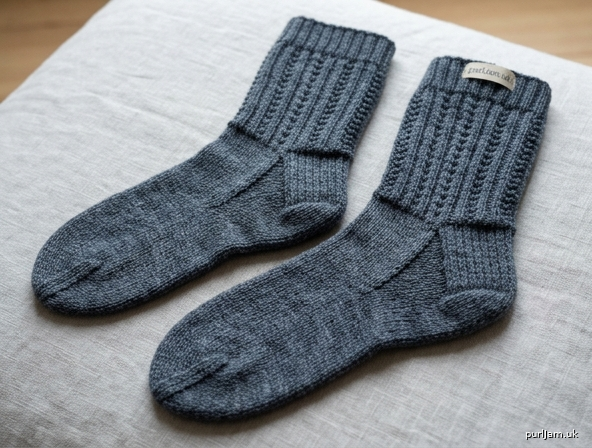
Sturdy cuff-down house socks in worsted-weight yarn, made for indoor wear. A snug 2×2 rib cuff leads into a softly textured broken-rib leg; the foot is smooth stocking stitch. A slipped-stitch heel flap, gusset and grafted wedge toe give a classic, reliable fit. Intermediate: knitting in the round, heel flap and turn, picking up stitches, Kitchener graft.
Materials
Yarn: Worsted weight (10-ply), wool or wool/nylon blend (nylon improves durability at heel and toe).
- Metreage: 200 (240, 280, 320) m / 220 (260, 305, 350) yd
- Weight (approx.): 100 (120, 140, 160) g, based on 200 m per 100 g
- Allow extra if lengthening the leg.
Needles:
- 3.5 mm (UK 9 / US 4) — cuff, or size 0.5 mm smaller than main needle
- 4 mm (UK 8 / US 6) — leg, heel, foot and toe — DPNs, or an 80–100 cm circular for magic loop, or two circulars
- Adjust needle size to obtain tension.
Notions: 3 stitch markers (one distinct for beginning of round); stitch holder or waste yarn; tapestry needle.
Tension (gauge)
20 sts and 28 rounds = 10 cm (4 in) over stocking stitch in the round on 4 mm needles, after blocking.
Work a circular swatch. If you have more than 20 sts to 10 cm, use a larger needle; if fewer, use a smaller needle. Tension is critical for fit.
Sizes
S (M, L, XL)
To fit foot circumference: 20 (22.5, 24.5, 26.5) cm [8 (8¾, 9¾, 10½) in] Finished circumference (unstretched): 18 (20, 22, 24) cm [7 (8, 8¾, 9½) in] — about 10% negative ease To fit UK shoe (approx.): 3–5 (5–7, 7–9, 9–11); EU 35–38 (38–40, 40–43, 43–45)
Foot length is adjustable; see Foot.
Shown numbers are written S (M, L, XL) throughout. Choose by foot circumference, not shoe size.
Abbreviations
| Abbr. | Meaning |
|---|---|
| BOR | beginning of round |
| cm | centimetre(s) |
| CO | cast on |
| dec | decrease(s)/decreasing |
| k | knit |
| k2tog | knit 2 together (right-leaning dec) |
| m | metre(s) |
| p | purl |
| p2tog | purl 2 together |
| pm | place marker |
| rem | remain(s)/remaining |
| rep | repeat |
| rnd(s) | round(s) |
| RS | right side |
| sl | slip stitch purlwise unless stated |
| sm | slip marker |
| ssk | slip 1 knitwise, slip 1 knitwise, knit the 2 slipped sts together through the back loop (left-leaning dec) |
| st(s) | stitch(es) |
| St st | stocking stitch (knit every rnd in the round; k RS, p WS when flat) |
| tbl | through the back loop |
| WS | wrong side |
| wyib | with yarn in back |
| wyif | with yarn in front |
| yd | yard(s) |
Pattern notes
- Worked cuff down, in the round to the heel, then the heel flap is worked flat on half the stitches. Gusset, foot and toe return to the round.
- Use magic loop, two circulars or DPNs — whichever you prefer. On DPNs, divide stitches as evenly as possible.
- The sock is designed with negative ease so the fabric clings. If you prefer a looser house sock, go up one size.
- When picking up gusset stitches, pick up into the outer half of each slipped edge chain and knit those stitches tbl on the following round to keep the join tidy.
- At each corner between flap and instep, pick up an extra stitch to close the gap (included in the pick-up numbers).
- Broken rib is a 2-round repeat on a multiple of 2 sts; the cast-on is a multiple of 4 so the 2×2 cuff sits evenly.
- Both socks are identical.
Broken rib (in the round)
- Rnd 1: *k1, p1; rep from * to end.
- Rnd 2: knit. Rep Rnds 1–2.
Instructions
Make two.
Cuff
With 3.5 mm needles and a stretchy method (long-tail, German twisted, or tubular), CO 36 (40, 44, 48) sts. Join to work in the round, being careful not to twist. Pm for BOR.
Work 2×2 rib: *k2, p2; rep from * to end. Continue until cuff measures 5 cm (2 in) from the cast-on edge.
Leg
Change to 4 mm needles.
Work Broken rib until leg measures 10 (11, 12, 13) cm [4 (4¼, 4¾, 5) in] from the top of the cuff (total length from cast-on 15 (16, 17, 18) cm [6 (6¼, 6¾, 7) in]), ending after a Rnd 2 (knit round). For a taller boot sock, work extra broken-rib rounds here; keep notes so the second sock matches.
Stitch count remains 36 (40, 44, 48).
Heel flap
The flap is worked flat on the first 18 (20, 22, 24) sts. Slip the remaining 18 (20, 22, 24) instep sts onto a holder or waste yarn (or leave them on the cable).
Row 1 (RS): *Sl 1 wyib, k1; rep from * to end of heel sts. Row 2 (WS): Sl 1 wyif, purl to end.
Rep Rows 1–2 until 18 (20, 22, 24) rows have been worked, ending after a WS row. You will have 9 (10, 11, 12) slipped chain stitches along each selvedge. Heel still has 18 (20, 22, 24) sts.
Heel turn
Work short-row shaping as follows. “Gap” means the hole between the last worked stitch and the unworked stitches.
Set-up Row 1 (RS): Sl 1 wyib, k10 (11, 12, 13), ssk, k1, turn. Set-up Row 2 (WS): Sl 1 wyif, p5, p2tog, p1, turn.
Row 3: Sl 1 wyib, knit to 1 st before the gap, ssk, k1, turn. Row 4: Sl 1 wyif, purl to 1 st before the gap, p2tog, p1, turn.
Rep Rows 3–4 until all heel stitches have been worked. When only 1 stitch remains unworked on a side, omit the final k1 or p1 after the decrease and turn.
Stitches remaining on heel: 12 (12, 14, 14). [18 − 6 = 12; 20 − 8 = 12; 22 − 8 = 14; 24 − 10 = 14 ✓]
Do not turn after the last WS row; resume working in the round.
Gusset
With RS facing, using 4 mm needles:
- Knit across the 12 (12, 14, 14) heel sts.
- Pick up and knit 10 (11, 12, 13) sts down the left side of the flap (9 (10, 11, 12) in the slipped chains + 1 extra in the corner). Pm (left instep).
- Knit across the 18 (20, 22, 24) held instep sts. Pm (right instep).
- Pick up and knit 10 (11, 12, 13) sts up the right side of the flap (corner first, then chains).
Total: 50 (54, 60, 64) sts. [12+10+18+10 = 50; 12+11+20+11 = 54; 14+12+22+12 = 60; 14+13+24+13 = 64 ✓]
Place BOR at the centre of the heel (after 6 (6, 7, 7) of the heel sts) if you like a centre-back start; otherwise leave BOR at the start of the next round as you have it. The two instep markers define the sole/instep split.
Next rnd (set-up): Knit, working each picked-up st tbl to tighten the join. Slip markers as you meet them.
Decrease rnd: Knit to 3 sts before the left instep marker, k2tog, k1, sm, knit instep to next marker, sm, k1, ssk, knit to end of rnd. [4 sts decreased: 50 (54, 60, 64) → 46 (50, 56, 60) on the first decrease rnd ✓]
Plain rnd: Knit.
Rep Decrease rnd then Plain rnd 6 (6, 7, 7) more times — 7 (7, 8, 8) decrease rnds in total. [7 × 2 = 14 sts decreased from 50 → 36; 14 from 54 → 40; 8 × 2 = 16 from 60 → 44; 16 from 64 → 48 ✓]
36 (40, 44, 48) sts remain. Instep still holds 18 (20, 22, 24) sts; sole holds 18 (20, 22, 24) sts.
Foot
Knit every round (stocking stitch) until the foot measures 5 (5.5, 6, 6.5) cm [2 (2¼, 2¼, 2½) in] less than the desired finished foot length, measuring from the back of the heel.
Finished foot-length guide (back of heel to tip of toe):
- S: 22–23 cm (8¾–9 in)
- M: 24–25 cm (9½–9¾ in)
- L: 26–27 cm (10¼–10¾ in)
- XL: 28–29 cm (11–11½ in)
The remaining 5 (5.5, 6, 6.5) cm will be taken up by the toe. Try the sock on if you can: the fabric should reach the base of the little toe before you start the toe.
Keep the two instep markers in place for the toe, with 18 (20, 22, 24) sts between them on each half.
Toe
Rnd 1 (decrease): *K1, ssk, knit to 3 sts before marker, k2tog, k1, sm; rep from * once more. [4 sts decreased ✓]
Rnd 2: Knit.
Rep Rnds 1–2 until 16 (20, 20, 24) sts remain. [S: 36 − 4×5 = 16; M: 40 − 4×5 = 20; L: 44 − 4×6 = 20; XL: 48 − 4×6 = 24 ✓]
Now work Rnd 1 only (decrease every round) until 8 sts remain (4 on instep, 4 on sole). [16 → 12 → 8; 20 → 16 → 12 → 8; 24 → 20 → 16 → 12 → 8 ✓]
Cut yarn, leaving a 30 cm (12 in) tail. Arrange 4 instep sts on one needle and 4 sole sts on another.
Finishing
Kitchener stitch (graft the toe)
Hold the two needles parallel, WS together, yarn coming from the back needle. Set-up: through first front st as if to purl, leave on; through first back st as if to knit, leave on.
Then repeat:
- Front: as if to knit, slip off; as if to purl, leave on.
- Back: as if to purl, slip off; as if to knit, leave on.
Until 1 st remains on each needle, then: front knitwise and slip off; back purlwise and slip off. Snug the line so it matches the surrounding fabric; do not pull tight.
Weave in ends on the WS, tracing along a column of stitches so they do not show on the RS.
Blocking: Soak in lukewarm water with a little wool wash for 15–20 minutes. Roll in a towel to remove excess water. Shape to the finished measurements (or slip over sock blockers / a well-fitting shoe last). Dry flat, away from heat. Blocking evens the broken rib and sets the foot length.
Optional: For extra hard-wearing house socks, duplicate-stitch a reinforcement over the heel flap and toe after blocking, using the same or a stronger yarn.
Schematic measurements (after blocking)
| S | M | L | XL | |
|---|---|---|---|---|
| Cuff/leg circumference | 18 cm (7 in) | 20 cm (8 in) | 22 cm (8¾ in) | 24 cm (9½ in) |
| Cuff depth | 5 cm (2 in) | 5 cm (2 in) | 5 cm (2 in) | 5 cm (2 in) |
| Leg (below cuff) | 10 cm (4 in) | 11 cm (4¼ in) | 12 cm (4¾ in) | 13 cm (5 in) |
| Foot length (adjustable) | 22–23 cm | 24–25 cm | 26–27 cm | 28–29 cm |
Wear as slipper socks around the house. If knitting a denser, more slipper-like fabric, go down 0.5 mm on the foot only and re-check the length, as row tension will change.
Disclaimer: This pattern was generated by AI and should be reviewed for accuracy before use. While we strive for quality, AI-generated content may contain errors. Please verify measurements, stitch counts, charts, and instructions before beginning your project. Generated by purlJam.uk
Love this pattern?
Save this pattern to your free PurlJam libraryAccess your pattern anytime
Bookmark this page to access your pattern anytime