Type
Crochet
Difficulty
intermediate
Category
custom
AI Thinking Process
Planning
Verification
Pattern
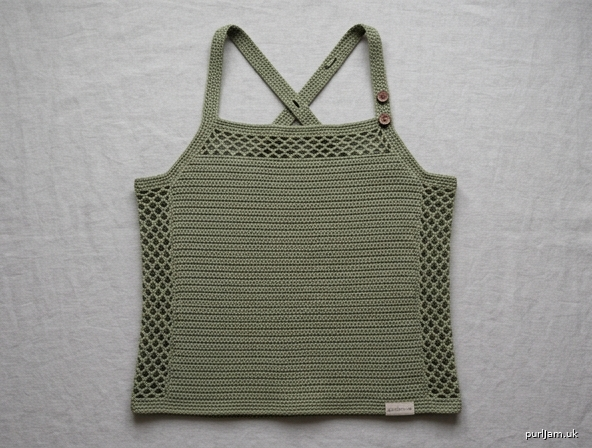
Sage Diamond Camisole
A minimalist fitted tank with square neckline, diamond mesh side panels & openwork front band
A modern, close-fitting camisole worked in dense single crochet for a smooth, structured fabric. Delicate diamond mesh lace runs up both side seams, and a matching diamond openwork band crosses the upper front neckline. Thin double-crochet straps button at the back for adjustable length. Beginner-to-intermediate friendly with clear stitch counts throughout.
Materials
- Yarn: Sport/DK weight, 100% cotton, in sage green (dusty olive).
- Approx. yardage by size:
- XS: 650 yd (595 m)
- S: 720 yd (660 m)
- M: 800 yd (730 m)
- L: 900 yd (825 m)
- XL: 1000 yd (915 m)
- XXL: 1100 yd (1005 m)
- Approx. yardage by size:
- Hook: US C-2/D-3 (3.0 mm) for body; US E-4 (3.5 mm) for straps/edging if you crochet tightly. Use whichever hook achieves gauge.
- Notions: Tapestry needle, 4 small buttons (⅜"/10 mm) for adjustable straps, stitch markers, blocking mat + pins, scissors.
Gauge
- 22 sc × 24 rows = 4" (10 cm) in single crochet, blocked.
- Take time to check gauge; cotton has little give, so gauge directly determines fit.
Gauge math check: 22 sts ÷ 4" = 5.5 sts/inch. A 16" front = 16 × 5.5 = 88 sts. ✓
Sizes
Pattern is written for XS (S, M, L, XL, XXL). Garment is designed with ~2" (5 cm) negative ease for a fitted look.
| Size | To Fit Bust | Garment Bust | Front sts | Length (hem→shoulder) |
|---|---|---|---|---|
| XS | 30–32" | 28" | 78 | 19" |
| S | 32–34" | 30" | 82 | 19.5" |
| M | 34–36" | 32" | 88 | 20" |
| L | 38–40" | 36" | 98 | 20.5" |
| XL | 42–44" | 40" | 110 | 21" |
| XXL | 46–48" | 44" | 120 | 21.5" |
Garment bust = front width + back width (front and back are equal). Check (M): 88 sts ÷ 5.5 sts/inch = 16" front → 32" garment bust. ✓
Abbreviations (US Terms)
- beg – beginning
- ch – chain
- ch-sp – chain space
- dc – double crochet
- rep – repeat
- RS / WS – right side / wrong side
- sc – single crochet
- sc2tog – single crochet 2 together (decrease)
- sk – skip
- sl st – slip stitch
- sp – space
- st(s) – stitch(es)
Special Stitches
Diamond Mesh (side panels) — worked over 8 sts, multiple based on ch-1 mesh:
- Mesh row (RS or WS): (sc, ch 1, sk 1 st) across the panel, ending with sc. Working sc into ch-1 sps of the previous row and ch-1 over the sc's creates the offset diamond openwork.
Diamond Openwork Band (upper front) — worked over full front width:
- Band Row A: ch 1, sc in first st, ch 1, sk 1 st, sc in next st rep across.
- Band Row B: ch 1, sc in first sc, ch 1, sc in next ch-1 sp rep across, ending sc in last sc.
- Alternating A/B forms staggered diamonds.
Pattern Notes
- Front and back are worked flat, bottom-up, then seamed at sides. Straps are added last.
- Turning ch-1 does NOT count as a stitch throughout the sc sections.
- Each piece has an 8-st diamond mesh panel at each side edge and a solid sc field in the center.
- Stitch counts are given at the end of each row in parentheses. Counts include mesh sc's + ch-1s counted as their base stitch positions.
- Instructions are written for size M; other sizes appear in brackets (XS, S, M, L, XL, XXL) where they differ. Where only one number is given, it applies to all sizes.
- Panel layout per piece: [8 mesh] + [center sc field] + [8 mesh].
- Center field sts: XS 62, S 66, M 72, L 82, XL 94, XXL 104.
- Total = 8 + field + 8. Check M: 8 + 72 + 8 = 88. ✓
FRONT
Foundation & Lower Body
Row 1 (RS): Ch 78 (82, 88, 98, 110, 120) + ch 1 to turn is not needed—foundation as follows: Ch 79 (83, 89, 99, 111, 121). Sc in 2nd ch from hook and in each ch across. (78, 82, 88, 98, 110, 120 sc)
Place markers: first 8 sts = right mesh panel; last 8 sts = left mesh panel; center = sc field.
Row 2 (WS): Ch 1, turn.
- Mesh panel (first 8 sts): sc in first st, ch 1, sk 1, sc in next st — over 8 sts this = sc, (ch1, sk1, sc) ×3, sc → uses all 8 st positions.
- Center field: sc in each st across.
- Mesh panel (last 8 sts): work mesh as first panel. (88 st positions maintained; M)
Row 3 (RS): Ch 1, turn.
- Mesh panel: sc in first sc, ch 1, sc in next ch-1 sp across panel, ending sc in last sc.
- Center: sc in each st.
- Mesh panel: rep mesh. (88)
Rows 4–[length to underarm]: Rep Rows 2–3, keeping mesh panels at each edge and sc across center, until piece measures 13 (13, 13, 13.5, 13.5, 14)" from foundation, ending with a WS row.
Underarm marker check: at 24 rows/4", 13" ≈ 78 rows. End on a WS row so armhole shaping begins on RS.
Armhole Shaping (Front)
Maintain mesh panels at edges throughout; work decreases within the sc field just inside the mesh so the panels stay intact.
Row 1 (RS): Ch 1, turn. Work mesh panel (8), sc2tog, sc across center to last st before mesh, sc2tog, work mesh panel (8). (86, M) — decreased 2
Row 2 (WS): Ch 1, turn. Work in pattern (mesh, sc field, mesh) with no shaping. (86)
Rep Rows 1–2 a total of 3 (3, 4, 5, 6, 7) times.
- M: 4 decrease rows × 2 sts = 8 sts removed → 88 − 8 = 80 sts. ✓
Work even in pattern (mesh + sc field + mesh) until armhole measures 3 (3, 3.5, 3.5, 4, 4)", ending with a WS row.
Diamond Openwork Neckline Band (Front)
The band spans the full front width and forms the straight square neckline top edge.
Band Row 1 (RS): Ch 1, turn. Sc in first st, ch 1, sk 1, sc in next st rep across. (band established over 80 sts, M)
Band Rows 2–5: Ch 1, turn. Sc in first sc, ch 1, sc in next ch-1 sp across, ending sc in last sc. This alternation forms 2 full diamond rows.
Work band for 1.5 (1.5, 2, 2, 2, 2)" total (about 4–5 band rows).
Stabilizing Row (RS): Ch 1, turn. Sc in each sc and each ch-1 sp across — restoring solid count. (80, M)
Square Neckline Setup Row (WS): Ch 1, turn. Sc across the following to define straps and neckline:
- Work strap-base width sts, then fasten off center neckline sts, then work the second strap-base.
- Strap-base sts each side: 12 (13, 14, 16, 18, 20).
- Center neckline sts fastened off (bound): total − (2 × strap base).
- M: 80 − (2 × 14) = 80 − 28 = 24 center sts left unworked/finished as the straight square neckline. ✓
Right strap base: Ch 1, sc across first 14 sts. Turn, work 2 more rows even in sc (14 sts) to create a small shoulder tab. Fasten off. Left strap base: Rejoin yarn to last 14 sts, sc across, work 2 rows even. Fasten off.
The 24 unworked center stitches form the clean, straight square neckline edge. Reinforce later in finishing.
BACK
Work exactly as Front, including foundation, lower body, and armhole shaping — BUT omit the diamond openwork neckline band. Instead:
- After armhole shaping, work even in pattern (mesh + sc field + mesh) until armhole measures same as front to the stabilizing row point.
- Back neckline: the back is a straight edge. Work the Square Neckline Setup Row identically: two 14 (as size)-st strap bases at each shoulder, with the same center sts left as a straight square back neckline.
- M: 24 center sts unworked. Strap bases 14 sts each. ✓
Fasten off.
ASSEMBLY
- Block front and back pieces to size (see Blocking).
- Side seams: With RS together, align the mesh panels of front and back at each side. Whip stitch or sc-seam from hem up to the underarm. The two 8-st mesh panels meet to form a continuous diamond lace column along each side seam. Repeat on the other side.
- Reinforce neckline & armholes: With RS facing, join yarn and work 1 row of sc evenly around each armhole opening and along each straight square neckline edge (front and back). This firms the square neckline and prevents stretching. Work sc at a rate of ~3 sc per 4 rows along vertical edges.
Reinforcement math: even sc edging keeps the square corners crisp — do not skip.
STRAPS (Thin Double Crochet, Adjustable)
Straps are worked from the front shoulder tabs, crossed to the back, and buttoned for adjustable length.
Make 2 straps.
Strap: With 3.5 mm hook, join yarn to the outer edge of a front shoulder tab (14-st base).
- Row 1: Ch 1, sc 5 (5, 6, 6, 7, 7) sts across the narrow tab edge. Turn.
- Row 2: Ch 3 (counts as first dc), dc in each st across. (5, 5, 6, 6, 7, 7 dc)
- Rep Row 2 until strap measures 9 (9, 9.5, 10, 10, 10.5)" or desired length to reach the back shoulder tab.
- Buttonhole end: Final row — ch 3 (as dc), dc 1, ch 2, sk 2, dc to end. The ch-2 forms a buttonhole. Fasten off.
Second strap: identical, from the other front tab.
Buttons: Sew 2 buttons onto each back shoulder tab, spaced ½" apart, so the buttonhole strap end can be fastened at two positions → adjustable strap length. Cross straps at the back for a stylish look, or keep them straight — your choice.
FINISHING
- Weave in all ends securely with a tapestry needle; cotton can slip, so weave in both directions.
- Hem: The foundation-chain edge is already a clean straight hem. Optionally work 1 row of sc along the hem for extra structure — keep it non-restrictive.
- Try on and adjust strap buttoning for correct fit.
- Give a final light steam if needed.
BLOCKING
- Soak finished pieces (or whole garment) in cool water with a little wool wash.
- Gently squeeze out water — do not wring.
- Lay flat on a blocking mat, shape to schematic measurements, and pin. Open up the diamond mesh panels and neckline band gently to reveal the openwork.
- Pin the square neckline corners at true 90° angles for a crisp finish.
- Allow to dry completely before wearing. Cotton benefits from firm blocking.
CUSTOMIZATION TIPS
- Length: Add or remove rows evenly in the lower body before armhole shaping. Every 6 rows ≈ 1" (2.5 cm). Keep an even row count to end on a WS row before shaping.
- Bust fit: For more coverage/ease, go up one size or add a 6-st repeat to the center sc field (keeps mesh panels intact). Each added 6 sts ≈ 1.1" more width.
- Cropped version: Work lower body to only 9–10" before armhole shaping.
- Wider straps: Increase strap Row 1 sc count to 8–10 sts for a supportive strap.
- More lace: Widen side mesh panels from 8 to 14 sts (add 6). Remember to reduce the center sc field by the same amount to keep total unchanged.
- Neckline height: Add more band rows for a higher square neckline, or fewer for a lower cut.
Final Stitch-Count Summary (Size M)
- Foundation front/back: 88 sts (8 mesh + 72 field + 8 mesh). ✓
- After armhole shaping: 80 sts (8 + 64 + 8). ✓
- Neckline: 2 × 14-st strap bases + 24-st square center = 52 worked/held from 80; remaining armhole-edge sts absorbed in edging. ✓
- Straps: 6 dc wide, adjustable via 2 buttons per back tab. ✓
Enjoy your Sage Diamond Camisole!
Disclaimer: This pattern was generated by AI and should be reviewed for accuracy before use. While we strive for quality, AI-generated content may contain errors. Please verify measurements, stitch counts, and instructions before beginning your project. Generated by purlJam.uk
Access your pattern anytime
Bookmark this page to access your pattern anytime