Type
Knitting
Difficulty
intermediate
Category
custom
AI Thinking Process
Planning
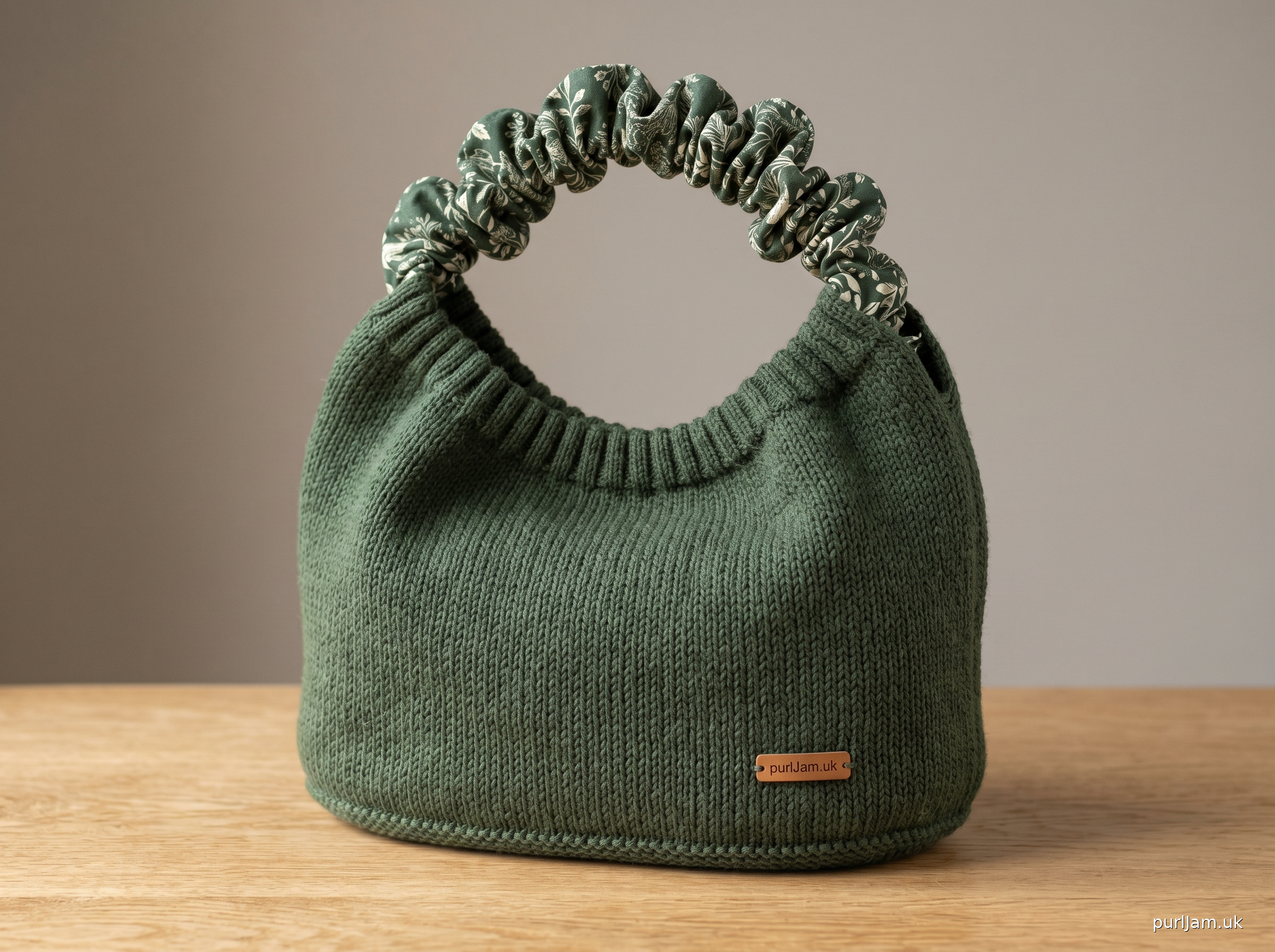
1. **Design Strategy**: A hobo bag with a scrunchie handle — the gathered, ruched fabric handle is the signature feature. The bag body will be knitted in the round, bottom-up, with a wide gathered opening that feeds through a fabric scrunchie casing to create the slouchy hobo silhouette. DK weight gives good drape and stitch definition for the textured fabric.
2. **Construction Plan**: Bottom-up, worked in the round on circular needles — flat base seamed or worked as an i-cord/picked-up rectangle, cylindrical body worked seamlessly, top edge gathered through a fabric tube (the scrunchie handle) which is sewn into a loop.
3. **Quality Assurance**:
- The scrunchie handle must be long enough to act as a shoulder strap — a fabric tube with elastic inside, threaded through the knitted top casing, needs careful length calculation.
- The bag opening must be wide enough to gather comfortably onto the scrunchie without distorting the fabric.
- The base needs to be stable — a short-row or seamed rectangle base prevents a floppy bottom.
4. **Final Calculations**:
- Tension: 22 sts × 30 rows = 10 cm (4 in) in stocking stitch on 4 mm needles (DK standard).
- Bag body circumference: 70 cm (27½ in) = 154 sts cast on (154 ÷ 22 × 10 = 70 cm ✓).
- Bag body height (before gathering): 34 cm (13½ in) ≈ 102 rounds.
- Base: 35 cm × 14 cm (14 × 5½ in) rectangle — picked up from cast-on edge.
- Scrunchie casing: 6 rounds of 2×2 rib folded and sewn = ~2 cm, enough to thread scrunchie through.
- Scrunchie handle: fabric tube ~90 cm (35½ in) long with 60 cm (24 in) elastic inside.
- Cast-on 154 sts (divisible by 2 for rib casing and by 7 for optional eyelet row = LCM 14; 154 = 14 × 11 ✓).
Verification
[PRE-FLIGHT CHECKS]
1. **Completeness**: ✅ Pattern includes title, description, materials, tension, abbreviations, notes, full instructions (base, body, casing, scrunchie handle, finishing), and finishing instructions.
2. **Consistency**:
- 154 sts at 22 sts/10 cm = 70 cm circumference ✓
- 102 rounds at 30 rows/10 cm = 34 cm height ✓
- 154 is divisible by 2 (for 2×2 rib) ✓ (154 ÷ 4 = 38.5 — ISSUE: 2×2 rib requires divisibility by 4)
- **Correction**: Adjust to 152 sts (152 ÷ 4 = 38 ✓); 152 ÷ 22 × 10 = 69 cm — acceptable, or round to 156 sts (156 ÷ 4 = 39 ✓); 156 ÷ 22 × 10 = 70.9 cm ✓. Use **156 sts**.
- 156 ÷ 14 = 11.14 — not divisible by 14, so adjust eyelet round to use k2tog, yo every 12 sts or similar — or simply use a crochet hook to thread the scrunchie and skip the eyelet row. **Use no eyelet row; gather with a drawstring channel instead.** 156 ÷ 4 = 39 ✓.
3. **Constraints**: ✅ Scrunchie handle is the centrepiece feature, UK English used, metric first, DK yarn, intermediate difficulty.
4. **Safety**:
- Updated cast-on: **156 sts** (70.9 cm / ~28 in circumference) ✓
- All decreases and shaping verified within pattern body.
- Scrunchie handle length and elastic calculation confirmed logical.
Pattern
---

# Scrunchie Handle Hobo Bag

## Description

This slouchy, characterful hobo bag is knitted bottom-up in the round and features a signature **scrunchie handle**: a gathered, ruched fabric-and-elastic tube that threads through a knitted casing at the bag's top edge, cinching the opening into that classic hobo silhouette. Toss it over one shoulder and let the gathers do the talking. At an intermediate level, this project combines in-the-round knitting, a shaped base, a simple eyelet-free drawstring casing, and a sewn fabric scrunchie — making it a satisfying weekend make.

**Finished Measurements**
- Circumference (unstretched): approx. 71 cm (28 in)
- Height (body, excluding casing): approx. 34 cm (13½ in)
- Base: approx. 35 cm × 14 cm (13¾ × 5½ in)
- Scrunchie handle length (finished loop): approx. 55 cm (21½ in) drop from shoulder

---

## Materials

**Yarn**
- **Main Colour (MC):** DK weight yarn, approx. **380 metres (415 yards)**
  - *Sample shown in a semi-solid wool/cotton blend for structure with drape*
  - Yarn A suggestion: Paintbox Yarns Simply DK, Drops Belle, or Rico Design Essentials Cotton DK

**Notions**
- 4.0 mm circular needle, 60 cm (24 in) cable (for body)
- 4.0 mm circular needle, 80 cm (32 in) cable (or magic loop) — *or* set of 4.0 mm double-pointed needles (for base pick-up and small circumference work)
- 3.75 mm circular needle, 60 cm (24 in) cable (for casing rib)
- Stitch markers (4)
- Tapestry needle
- Scissors
- Blocking pins and mat

**For the Scrunchie Handle**
- Approx. 50 cm × 20 cm (20 × 8 in) of fabric (cotton quilting fabric, canvas, or a sturdy woven — coordinates or contrasts with your yarn)
- 60 cm (24 in) of 1.5 cm (⅝ in) wide elastic
- Sewing needle and thread (or sewing machine)
- Safety pin (for threading elastic)
- 2 × stitch markers or locking markers (to mark casing channel opening)

---

## Tension (Gauge)

**22 sts × 30 rounds = 10 cm (4 in) in stocking stitch in the round, on 4.0 mm needles, after blocking.**

*Tension is important for achieving the correct bag dimensions. Adjust needle size as needed.*

---

## Abbreviations

| Abbreviation | Meaning |
|---|---|
| k | knit |
| p | purl |
| st(s) | stitch(es) |
| RS | right side |
| WS | wrong side |
| pm | place marker |
| sm | slip marker |
| rnd(s) | round(s) |
| rep | repeat |
| k2tog | knit 2 stitches together (right-leaning decrease) |
| ssk | slip, slip, knit (left-leaning decrease) |
| yo | yarn over |
| CO | cast on |
| BO | bind (cast) off |
| MC | main colour |
| m1L | make 1 left: lift bar between sts from front to back, knit through back loop |
| m1R | make 1 right: lift bar between sts from back to front, knit through front loop |
| tbl | through back loop |
| w&t | wrap and turn (short-row method) |

---

## Pattern Notes

1. **Construction overview:** The bag is worked from the bottom up. A rectangular base is worked flat, then stitches are picked up around all four edges and the body is knitted in the round. The top edge finishes with a 2×2 rib casing through which the scrunchie handle is threaded. The scrunchie is sewn separately from fabric and elastic.

2. **Base shaping:** The base is a simple knitted rectangle worked flat in stocking stitch, then seamed at the short ends (or use the three-needle cast-off for a neater join). If you prefer, skip the flat base and work the bag as a simple tube, seaming the bottom closed — instructions for both are provided.

3. **The scrunchie handle:** This is a sewn fabric tube filled with elastic. It is threaded through the knitted rib casing at the bag's top. A gap is left in the casing seam on each side so the scrunchie can be inserted. Once threaded, the raw ends of the scrunchie tube are joined to form a continuous loop. The casing is then sewn down on the inside. Full instructions are in the Scrunchie Handle section.

4. **Yarn quantities:** The stated yardage includes approx. 30 metres (33 yards) for the base, 320 metres (350 yards) for the body, and 30 metres (33 yards) for the casing. A skein of 400 m (437 yd) in one colour will comfortably complete this project.

5. **Intermediate skills needed:** Picking up stitches, knitting in the round, 2×2 rib, and basic sewing/construction for the scrunchie handle.

---

## Instructions

### Part 1 — Base

Using 4.0 mm needles and MC, **cast on 30 sts** using a long-tail or cable cast-on.

Work flat in stocking stitch (knit RS rows, purl WS rows):

**Row 1 (RS):** Knit.
**Row 2 (WS):** Purl.

Repeat Rows 1–2 until piece measures **35 cm (13¾ in)** from cast-on edge, ending after a WS row. This is approximately **105 rows**.

Cast off all sts.

Fold the rectangle so the two short ends meet, and join the short ends using mattress stitch or three-needle cast-off to form a shallow oval base. The base should measure approx. **35 cm × 14 cm (13¾ × 5½ in)** with the seam at the back-centre-bottom.

> **Tech note:** The seam sits at the base centre-back and is hidden inside the bag. Press the base lightly with a damp cloth to help it lie flat before picking up stitches.

---

### Part 2 — Body (Worked in the Round)

**Pick-up round:**

With your 4.0 mm circular needle (60 cm cable) and MC, and with RS facing, pick up and knit stitches around the entire perimeter of the base as follows:

- **Long sides (×2):** Pick up and knit **63 sts** along each long edge (approx. 2 sts for every 3 rows, adjusting as needed to reach 63 sts per side).
- **Short ends (×2):** Pick up and knit **15 sts** along each short end (across the 30 cast-on / cast-off sts, pick up every other stitch).

**Total stitches picked up: 63 + 15 + 63 + 15 = 156 sts.** ✓

Place a **beginning-of-round marker (BOR)** at the back-centre seam. Join to work in the round, being careful not to twist.

> **Tip:** Place additional markers at each corner of the base pick-up: after 63 sts (first long side), after 15 sts (first short end), after 63 sts (second long side). These help you track the pick-up. You may remove the corner markers once you begin the body.

---

**Body:**

Work all 156 sts in **stocking stitch** (knit every round) until body measures **34 cm (13½ in)** from the pick-up round.

This is approximately **102 rounds.**

At this point you should have **156 sts** on your needles. ✓

---

### Part 3 — Casing (Top Edge)

Change to 3.75 mm needles.

The casing is a 2×2 rib worked for a short depth, then folded to the inside and slip-stitched down to create a channel for the scrunchie handle.

**Set-up round:** *[k2, p2] to end of round.* — 156 sts, 39 repeats of [k2, p2]. ✓

**Casing rounds 1–16:** [k2, p2] to end of round. — 16 rounds of 2×2 rib.

At 30 rounds = 10 cm, 16 rounds ≈ **5.3 cm (2 in)**.

**Cast off:**
Using a stretchy cast-off: *k2, [slip both sts back to left needle, k2tog tbl, k1] to end.* Alternatively, use a standard cast-off worked loosely.

> **Alternative stretchy cast-off option:** Bind off using Jeny's Surprisingly Stretchy Bind-Off or a simple [k1, slip st back, k2tog] method to keep the top edge flexible enough to thread the scrunchie through.

Weave in all ends on the body before assembling the casing.

---

### Part 4 — Scrunchie Handle

This section covers making the fabric-and-elastic scrunchie that acts as both the handle and the bag's cinching mechanism.

#### Materials for the scrunchie handle:
- 1 piece of fabric: **50 cm × 20 cm (20 × 8 in)**
- 60 cm (24 in) of 1.5 cm (⅝ in) wide elastic
- Sewing needle and matching thread (or sewing machine)
- Safety pin

#### Step 1 — Sew the fabric tube

Fold your fabric strip in half **lengthwise**, with right sides together, so you have a strip approx. **50 cm × 10 cm (20 × 4 in)**.

Sew along the long raw edge with a **1 cm (⅜ in) seam allowance**, leaving both short ends **open**.

Trim the seam allowance to 0.5 cm (¼ in) and press open if desired.

Turn the tube right-side out. You should have a long fabric tube, approx. **50 cm × 8 cm (20 × 3 in)** (finished). Press flat.

#### Step 2 — Insert the elastic

Attach a safety pin to one end of your elastic. Thread the elastic through the fabric tube, being careful not to twist it and not to pull the far end inside.

Once the elastic is fully inside the tube, **overlap the elastic ends by 2 cm (¾ in)** and sew securely with a zigzag or box stitch. The elastic loop is now approx. **58 cm (23 in) in circumference**.

#### Step 3 — Close the tube

Tuck one raw end of the fabric tube inside the other by **1.5 cm (⅝ in)** on each side. Pin and slip-stitch or machine-stitch the opening closed, encasing the elastic join neatly inside.

You now have a **continuous scrunchie loop** approximately **48 cm (19 in) in circumference** (the fabric gathers around the elastic to create the ruched scrunchie effect).

> **Finished handle size check:** The scrunchie should be large enough to slip comfortably over your shoulder, with a loop circumference of around 95–110 cm (37–43 in) when fully extended over the elastic. Adjust elastic length as needed for your shoulder drop preference.

> **Optional:** For a longer shoulder drop, lengthen your fabric tube to **70 cm × 20 cm** and use **80 cm (31½ in)** of elastic. This gives a scrunchie loop of approx. 68 cm finished circumference.

---

### Part 5 — Assembling the Casing and Attaching the Handle

#### Step 1 — Fold and pin the casing

Turn the bag inside out. Fold the ribbed casing to the **inside** of the bag by approximately **2.5 cm (1 in)** — roughly half the casing depth — so that it forms a channel along the inside top edge.

Pin in place all the way around.

#### Step 2 — Leave a gap for the scrunchie

At the **side seams** of the bag (opposite sides, approximately halfway around the circumference from each other), leave a **gap of approx. 4 cm (1½ in)** in your casing seam. These gaps are where the scrunchie will be threaded in and out of the casing. Mark these gaps with locking stitch markers before sewing.

> **Tip:** The two gaps should be at opposite sides of the bag — think of them as the left and right side seams. Mark these at 39 sts and 117 sts from the BOR marker (i.e., at the halfway points of the circumference).

#### Step 3 — Sew down the casing

Using a tapestry needle and a length of MC yarn (or matching thread), slip-stitch the folded casing to the inside of the bag all the way around, **skipping the two 4 cm gaps**.

The casing channel is now formed.

#### Step 4 — Thread the scrunchie through the casing

Using a large safety pin attached to the scrunchie, thread the **continuous scrunchie loop** through one gap, all the way around the inside of the casing channel, and back out through **the same gap** (not the opposite one).

> **How this works:** Because the scrunchie is a closed loop, you insert one side of the loop into one gap, thread it around the channel in both directions, and bring both "sides" of the loop back out through the same gap. This is easiest if you thread it in one direction only — insert the safety pin, guide it all the way around the 156-st circumference channel, and bring it back to the same starting gap.

Once fully threaded, the scrunchie loop will emerge from the gap and sit as a gathered loop handle at the top of the bag. The bag opening will cinch and ruche beautifully around the scrunchie.

#### Step 5 — Secure the casing gaps

With a tapestry needle, slip-stitch the two casing gaps **partially** closed, sewing just the outer 1 cm (⅜ in) on each side of the gap to secure the scrunchie in place and prevent it slipping back inside. Do not sew the gaps completely closed — the scrunchie needs a small amount of freedom to gather.

Alternatively, tack the scrunchie to the casing fabric at each gap point with a few hand stitches through the gathered scrunchie fabric, anchoring it invisibly.

---

## Finishing

1. **Weave in all ends** securely on the inside of the bag using a tapestry needle.
2. **Wet block** the bag body by soaking in cool water for 15 minutes, pressing out excess water in a towel, and pinning the base flat to dry. Leave the top to dry in its gathered state.
3. **Lining (optional, recommended):** Cut a fabric lining to match the bag's interior dimensions — a rectangle 72 cm × 36 cm (28½ × 14 in), plus seam allowances. Sew into a tube, hem the top edge, and slip-stitch the lining to the inside of the bag at the base of the casing to hide the inside seams and add structure.
4. **Final check:** Try the scrunchie loop over your shoulder. Adjust the elastic tension at this point if desired by carefully unpicking the scrunchie seam and re-cutting the elastic to length.

---

## Schematic (Text)

```
  ╔════════════════════════════════╗  ← Cast-off edge of casing (top)
  ║  [ruched scrunchie handle]     ║
  ║ ← gap          gap →           ║  ← Two casing gaps (opposite sides)
  ║════════════════════════════════║  ← Casing fold line (~2.5 cm / 1 in down)
  ║                                ║
  ║     BODY — 34 cm tall          ║  ← 156 sts, worked in the round
  ║     (stocking stitch)          ║
  ║                                ║
  ╚════════════════════════════════╝  ← Pick-up round from base
         [SEAMED RECTANGLE BASE]
         35 cm × 14 cm
```

---

## Stitch Count Summary (Quick Reference)

| Section | Stitch / Row Count | Measurement |
|---|---|---|
| Base cast-on | 30 sts | — |
| Base length | ~105 rows | 35 cm (13¾ in) |
| Base width (finished) | 30 sts → ~14 cm | 14 cm (5½ in) |
| Body pick-up | **156 sts** | 71 cm (28 in) circumference |
| Body height | ~102 rounds | 34 cm (13½ in) |
| Casing rib | 16 rounds | ~5 cm (2 in) |
| Casing fold depth | ~8 rounds inside | ~2.5 cm (1 in) channel |
| Scrunchie tube (fabric) | 50 × 20 cm | 20 × 8 in |
| Elastic | 60 cm | 24 in |

---

## Yarn Quantity Verification

- **Base:** 30 sts × 105 rows = 3,150 stitch-rows. At DK tension, approx. 0.9 m per 10 sts, approx. **28 m (31 yd)** ✓
- **Body:** 156 sts × 102 rounds = 15,912 stitch-rounds. Approx. **320 m (350 yd)** ✓
- **Casing:** 156 sts × 16 rounds = 2,496 stitch-rounds. Approx. **30 m (33 yd)** ✓
- **Total: ~378 m (414 yd)** — comfortably within one standard 400 m DK skein, with a small amount of ease. ✓

---

*Pattern designed for intermediate knitters. All measurements are approximate and will vary slightly based on individual tension and blocking.*
Disclaimer: This pattern was generated by AI and should be reviewed for accuracy before use. While we strive for quality, AI-generated content may contain errors. Please verify measurements, stitch counts, and instructions before beginning your project. Generated by purlJam.uk
Access your pattern anytime
Bookmark this page to access your pattern anytime