Type
Knitting
Difficulty
beginner
Category
blanket
AI Thinking Process
Planning
1. **Design Strategy**: A simple all-garter-stitch baby blanket in worsted-weight yarn, beginner-friendly with a clean knit-every-row fabric. Garter naturally lies flat and forms its own tidy edge, perfect for a first project.
2. **Construction Plan**: Worked flat in one piece, cast on along the width and knit straight to length.
3. **Quality Assurance**:
- Keep edges neat by working the first and last stitch firmly.
- Avoid splitting yarn on the cast-on; count stitches after casting on.
- Check tension swatch to ensure final size is accurate.
4. **Final Calculations**: Tension 18 sts & 36 rows = 10 cm in garter stitch (4.5 mm needles). Target 76 cm (30 in) wide × 91 cm (36 in) long. Cast-on: 76 ÷ 10 × 18 = 136.8 → 137 sts. Rows: 91 ÷ 10 × 36 = 327.6 → 328 rows.
Verification
[PRE-FLIGHT CHECKS]
1. **Completeness**: Includes materials, tension, abbreviations, instructions, finishing, and size — all template sections present. ✓
2. **Consistency**: 137 sts ÷ 18 sts per 10 cm × 10 = 76.1 cm wide ✓; 328 rows ÷ 36 rows per 10 cm × 10 = 91.1 cm long ✓.
3. **Constraints**: Beginner garter stitch, worsted weight, UK English, metric-first — all honoured. No complex stitch requested, so no advanced-pattern note needed. ✓
4. **Safety**: Garter stitch = knit every row, so all 328 rows are knit; no shaping math errors possible. Stitch count constant at 137 throughout. ✓
Pattern
# Simple Garter Stitch Baby Blanket

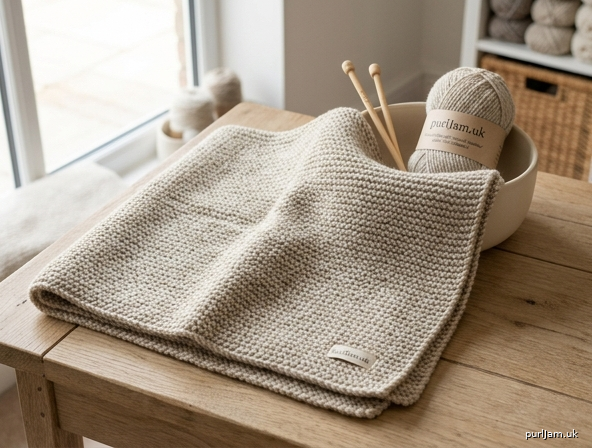
A cosy, squishy baby blanket worked entirely in garter stitch (knit every row). This is an ideal first blanket project — there is nothing to count but rows, and garter stitch lies beautifully flat with naturally tidy edges. Worked in soft worsted-weight yarn, it makes a lovely handmade gift.

**Difficulty:** Beginner

---

## Finished Measurements

- **Width:** approx. 76 cm (30 in)
- **Length:** approx. 91 cm (36 in)

Standard baby blanket size — generous enough for a pram, cot, or playmat.

---

## Materials

- **Yarn:** Worsted-weight (Aran/medium, weight #4) yarn in your favourite colour.
  - Approx. **550–650 m (600–710 yds)** total — roughly **300–350 g**.
  - A soft, machine-washable acrylic, cotton, or wool-blend fibre is ideal for babies.
- **Needles:** 4.5 mm (UK 7 / US 7) straight or circular needles.
  - A long circular needle (60–80 cm) is recommended to comfortably hold all the stitches — you still work back and forth, not in the round.
- **Notions:** Tapestry/yarn needle for weaving in ends, scissors.

---

## Tension (Gauge)

**18 sts and 36 rows = 10 cm (4 in)** in garter stitch on 4.5 mm needles.

*Tension check:* Cast on about 22 stitches and knit roughly 40 rows to make a swatch. Measure the centre 10 cm. If you have too few stitches per 10 cm, try a smaller needle; too many, try a larger needle. Tension on a blanket is forgiving — a slight difference simply makes the blanket a little larger or smaller.

---

## Abbreviations

- **k** – knit
- **st(s)** – stitch(es)
- **RS** – right side
- **WS** – wrong side

*(In garter stitch both sides look the same, so there is no "wrong" side to worry about.)*

---

## Pattern Notes

- The entire blanket is **knit on every row** — this is what creates garter stitch.
- Garter stitch forms its own neat, non-curling border, so no separate edging is required. If you would like a slightly firmer edge, simply work the first and last stitch of every row a touch more snugly.
- Count your stitches occasionally to make sure you still have **137 sts** on the needle.

---

## Instructions

### Cast On

Using 4.5 mm needles, **cast on 137 sts.**

*Maths check: 137 sts ÷ 18 sts per 10 cm × 10 = 76.1 cm wide ✓ (target 76 cm / 30 in).*

### Body

**Every row:** Knit all sts to the end. (137 sts)

Repeat this single row until the blanket measures **91 cm (36 in)** from the cast-on edge, ending after a completed row.

*Maths check: 91 cm requires approx. 328 rows (328 ÷ 36 rows per 10 cm × 10 = 91.1 cm ✓). You do not need to count every row — simply measure with a tape measure as you go and stop when you reach the length you want.*

### Cast Off

Knit-wise, cast off all 137 sts loosely. A loose cast-off keeps the top edge as relaxed and stretchy as the rest of the blanket. If your cast-off tends to be tight, use a needle one size larger (5 mm) for this step only.

---

## Finishing

1. Cut the yarn, leaving a tail of about 15 cm.
2. Using the tapestry needle, weave each end securely into the garter ridges on the back, working over several stitches. Trim neatly.
3. **Optional blocking:** Gently steam or wet-block the blanket to even out the stitches. Lay flat to the finished measurements (76 × 91 cm) and allow to dry fully. For acrylic yarns, use a cool steam held just above the fabric — do not press a hot iron directly onto acrylic.

---

## Optional Simple Border

Garter stitch already gives a tidy edge, but if you'd like a contrast frame, you can pick up and knit stitches around the outer edge in a second colour and work 4–6 rounds/rows of garter stitch, casting off loosely. This is entirely optional and not required for a complete, finished blanket.

---

## Tips for Success

- **Stitch markers** placed every 20 stitches across the cast-on can help you keep count, then be removed after the first few rows.
- **Even tension:** Garter stitch is very forgiving — relax and enjoy the rhythm of knitting every row.
- **Joining a new ball:** Join at the start of a row rather than mid-row for the neatest result, leaving tails to weave in later.

Enjoy making your blanket — happy knitting!
Disclaimer: This pattern was generated by AI and should be reviewed for accuracy before use. While we strive for quality, AI-generated content may contain errors. Please verify measurements, stitch counts, and instructions before beginning your project. Generated by purlJam.uk
Access your pattern anytime
Bookmark this page to access your pattern anytime