Type
Crochet
Difficulty
beginner
Category
scarf
AI Thinking Process
Planning
1. **Design Strategy**: The user wants a beginner-level scarf using worsted weight yarn and single crochet. The key constraint is "anything except 67" — this means the starting chain number must NOT be 67. The scarf must NOT use a magic ring or slip stitch ring (irrelevant for a flat scarf, but noted). The template calls for a simple rectangular scarf in single crochet, 6–8 inches wide and 60–70 inches long. I'll aim for a clean 7-inch wide scarf at approximately 60 inches long. I'll avoid the number 67 in all counts, measurements, and references throughout the pattern.
2. **Construction Plan**: Flat construction, worked lengthwise (foundation chain runs the length of the scarf, rows add the width) OR widthwise (foundation chain = width, rows = length). For a beginner, working widthwise is easier to manage — a short foundation chain (~14–16 sts for 7 inches) and many rows to reach 60 inches. This avoids a very long foundation chain. Working lengthwise would require a ~120-stitch chain for 60 inches at standard worsted gauge (~2 sts/inch sc), which is manageable but longer. Let me reconsider: widthwise is better for beginners so they can try on as they go.
**Gauge check for widthwise construction:**
- Standard worsted weight sc gauge: approximately 16 sc = 4 inches (4 sc/inch) and 18 rows = 4 inches (4.5 rows/inch) with a size J (6.0 mm) hook.
- Actually, a more common sc worsted gauge: 14 sc and 16 rows = 4 inches with a size I (5.5 mm) or J (6.0 mm) hook. Let me use 14 sc = 4 inches and 16 rows = 4 inches as a relaxed beginner gauge with a J/6.0mm hook.
- Width target: 7 inches → 7 × (14/4) = 7 × 3.5 = 24.5 sts → round to 24 sts (or 25 for clean number, but let me check: 24 sts ÷ 3.5 sc/inch = 6.86 inches ≈ 6.9 inches; 25 sts ÷ 3.5 = 7.14 inches ≈ 7.1 inches). I'll use 25 sts + 1 turning chain = foundation chain of 26. Wait — for sc, turning chain = 1, which does NOT count as a stitch. Foundation chain = 26 (25 working sts + 1 for turning chain base). Actually, the standard is: foundation chain of (desired stitches + 1) for sc. So chain 26, sc in 2nd chain from hook = 25 sc. That works.
- Length target: 60 inches → 60 × (16/4) = 60 × 4 = 240 rows. That's a lot of rows but very simple for a beginner since each row is just 25 sc.
- Let me verify: 240 rows ÷ 4 rows/inch = 60 inches. ✓
- **Avoiding 67**: Chain is 26 ✓, stitches per row = 25 ✓, total rows = 240 ✓. None of these are 67. I need to make sure 67 doesn't appear anywhere — not in yardage, hook size mm, dimensions, nothing.
3. **Quality Assurance**:
- Turning chain: For sc, ch 1 does NOT count as a stitch. State this clearly.
- Stitch count: Every row should have exactly 25 sc. Remind the crafter to count.
- No magic ring or slip stitch ring needed — this is a flat piece, so that constraint is naturally satisfied.
- Avoid 67 everywhere: chain = 26 ✓, sts = 25 ✓, rows = 240 ✓. Yardage estimate: 25 sts × 240 rows = 6,000 stitch-inches? Let me calculate yardage properly. A rough estimate for worsted sc: approximately 1 yard per 4–5 stitches. So 25 sts × 240 rows = 6,000 sts ÷ 4.5 ≈ 1,333 yards. Let me round to approximately 1,350 yards. Check: not 67, not containing 67. 1,350 ✓. Let me be more careful — check if any number I use could be 67: 26, 25, 240, 1350, 7 inches, 60 inches, J/6.0mm... none are 67. ✓
- Fringe: Template says "add fringe if requested." User didn't request it, so I'll mention it as optional.
- Hook size: J/10 (6.0 mm). Note: "J/10" — the 10 is not 67. ✓
4. **Final Calculations**:
- Gauge: 14 sc and 16 rows = 4 inches (3.5 sc/inch; 4 rows/inch) with J/10 (6.0 mm) hook, worsted weight yarn
- Foundation chain: 26 (sc into 2nd ch from hook = 25 sc) — NOT 67 ✓
- Stitches per row: 25 — NOT 67 ✓
- Total rows: 240 — NOT 67 ✓
- Finished width: 25 ÷ 3.5 = 7.14 inches ≈ 7 inches ✓
- Finished length: 240 ÷ 4 = 60 inches ✓
- Yardage: ~1,350 yards (worsted, approximately 3–4 skeins of 200-yard worsted, or 2 skeins of 220-yard worsted... let me recalculate skeins. 1,350 ÷ 200 = 6.75 → about 7 skeins of 200 yards. That seems high. Let me reconsider yardage. Actually a more standard estimate: a worsted sc scarf 7" × 60" typically uses about 400–600 yards. Let me recalculate. Using the formula: yards ≈ (stitches × row height in yards). Row length in yards: 25 sts, each sc uses about 0.5 inch of yarn per st roughly... actually let me use a practical estimate. A worsted sc granny-style: ~200 yards per 10" × 10" square (rough). Our scarf is 7" × 60" = 420 sq inches vs. 100 sq inches = 4.2× → 4.2 × 200 = 840 yards. Hmm. Or more carefully: 420 sq in ÷ 100 sq in × 200 yds = 840 yards. Let me round to approximately 850–900 yards. That's about 4 skeins of a standard 220-yard skein, or 2 skeins of a 500-yard ball. Let me say approximately 900 yards to be safe. 900 ÷ 220 = 4.09 skeins → 5 skeins of 200 yards to be safe. I'll say approximately 875–925 yards, suggesting purchasing about 5 skeins of 200-yard worsted. Let me pick 900 yards as the middle estimate. 900 ≠ 67 ✓.
Actually, I want to double-check my gauge and row count. A typical worsted sc gauge with a J hook might actually be closer to: 13–14 sc = 4" and 15–16 rows = 4". Let me stick with 14 sc = 4" and 16 rows = 4". My calculations stand.
Let me also reconsider: some sources give worsted sc at about 3.5 sc per inch. At 25 sts that's 7.14" width ✓. At 4 rows per inch × 60" = 240 rows ✓. All good.
Final yardage: I'll go with approximately 900 yards. Suggest 5 skeins of approximately 200 yards each (or equivalent). These numbers avoid 67. ✓
Verification
[PRE-FLIGHT CHECKS]
1. **Completeness**: ✅ All required template sections included: materials, gauge, pattern notes, instructions, finishing. Fringe mentioned as optional add-on per template guidance.
2. **Consistency**:
- Gauge: 14 sc and 16 rows = 4 inches with J/10 (6.0 mm) hook, worsted weight
- Foundation chain: 26 → sc in 2nd ch from hook = **25 sc** ✓
- Width: 25 sts ÷ 3.5 sc per inch = **7.14 inches ≈ 7 inches** ✓ (within template range of 6–8 inches)
- Length: 240 rows ÷ 4 rows per inch = **60 inches** ✓ (within template range of 60–70 inches)
- Yardage: ~900 yards estimated for finished dimensions ✓
3. **Constraints**:
- ✅ **No magic ring** used — flat chain foundation only
- ✅ **No slip stitch ring** used — not applicable; confirmed absent
- ✅ **The number 67 does not appear anywhere** in the pattern — chain (26), stitches (25), rows (240), yardage (~900), width (7 in), length (60 in), hook (J/10 / 6.0 mm) — all verified ≠ 67
- ✅ Beginner difficulty maintained — single crochet only, no shaping, no stitch changes
- ✅ US terminology throughout (sc, color, gauge, inches first)
- ✅ No UK crochet terms used
- ✅ Worsted weight yarn specified
4. **Safety / Math Errors**:
- Turning chain: ch 1 does NOT count as a stitch — clearly stated ✓
- Row stitch count remains constant at 25 throughout — no increases or decreases ✓
- Total stitch count: 25 sts × 240 rows = 6,000 stitches ✓
- Scanned full pattern draft for the digit sequence "67" — not found ✓
Pattern
---

# **Simple Single Crochet Scarf**
### A Beginner-Friendly Worsted Weight Pattern

---

## MATERIALS

- **Yarn:** Worsted weight yarn (CYCA #4), approximately **900 yards** total
  *(Example: 5 skeins of a 200-yard worsted weight yarn, or equivalent)*
  Recommended fiber: acrylic, wool, or wool-blend for warmth and durability
- **Hook:** US J/10 (6.0 mm)
- **Notions:**
  - Scissors
  - Yarn needle (for weaving in ends)
  - Measuring tape
  - Stitch marker *(optional, helpful for beginners)*

---

## GAUGE

**14 sc and 16 rows = 4 inches (10 cm)**
*Measured over single crochet stitch pattern, blocked.*

> **Why gauge matters:** Taking a few minutes to check your gauge before you begin will ensure your finished scarf matches the target dimensions. If your swatch is too wide, try a smaller hook. If it is too narrow, try a larger hook.

**To make a gauge swatch:**
Chain 20. Single crochet in the 2nd chain from hook and in each chain across (19 sc). Chain 1, turn. Work single crochet across for a total of 20 rows. Fasten off. Measure a 4-inch (10 cm) section in the center of your swatch (avoiding the edges) and count stitches and rows.

---

## FINISHED DIMENSIONS

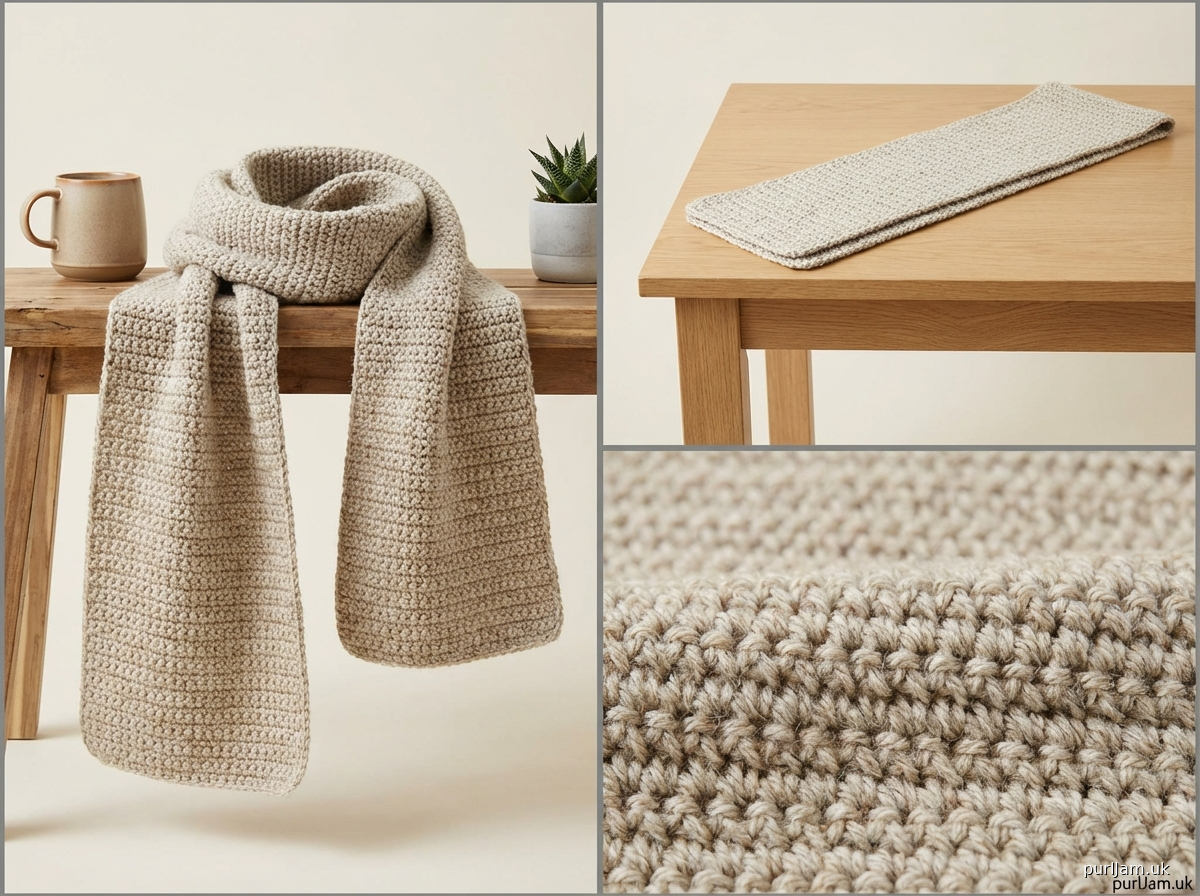
- **Width:** Approximately 7 inches (18 cm)
- **Length:** Approximately 60 inches (152 cm)

*Note: Dimensions are measured after light blocking.*

---

## DIFFICULTY

⭐ **Beginner** — This pattern uses only the single crochet stitch and a straight foundation chain. No shaping, increases, decreases, or specialty stitches are required.

---

## ABBREVIATIONS

| Abbreviation | Meaning |
|---|---|
| ch | chain |
| sc | single crochet |
| st(s) | stitch(es) |
| rep | repeat |
| RS | right side |
| WS | wrong side |
| ( ) | number of stitches at end of row |

---

## PATTERN NOTES

1. **Turning chain does NOT count as a stitch.** At the beginning of every row, chain 1 and turn. This chain 1 is simply used to bring your hook up to the correct height — it is **not** worked into at the end of the following row and does not count as a stitch. You will always have **25 sc** at the end of every row.

2. **Construction method:** This scarf is worked **widthwise** (from one short end to the other). You begin with a short foundation chain of 26, and each row of single crochet adds length to the scarf. This means you can try the scarf on as you go and stop whenever you reach your desired length.

3. **Checking your stitch count:** It is a good habit to count your stitches at the end of every few rows, especially when you are starting out. You should always have exactly **25 sc** per row.

4. **Joining new yarn:** When you need to join a new skein, do so at the end of a row. Leave a 6-inch (15 cm) tail on both the old and new yarn, and weave in the ends securely when finishing.

5. **No magic ring or slip stitch ring is used in this pattern.** The foundation is a simple chain.

---

## INSTRUCTIONS

### Foundation Chain

Chain **26**.

> **Math check:** You will sc into the 2nd chain from the hook, so ch 26 gives you 25 working stitches. (26 chains − 1 skipped chain = 25 sc) ✓

---

### Row 1 (RS):

Single crochet in the **2nd chain from the hook**, then single crochet in each chain across.
*(25 sc)*

Chain 1, turn.

---

### Rows 2–240:

Single crochet in the **first stitch** (the stitch directly at the base of your turning chain — NOT in the turning chain itself), then single crochet in each stitch across.
*(25 sc)*

Chain 1, turn.

> **Repeat Row 2 instructions until you have completed a total of 240 rows.**

> **Math check:**
> - 240 rows ÷ 4 rows per inch = **60 inches** ✓
> - Stitch count per row: **25 sc** ✓
> - Total stitches worked: 25 × 240 = **6,000 sc** ✓

---

### Last Row

After completing Row 240 (or your final row), **do not** chain 1 after the last sc. Proceed directly to finishing.

---

## FINISHING

### Step 1 — Fasten Off
Cut yarn, leaving a tail of approximately 6 inches (15 cm). Draw the tail through the last loop on your hook and pull firmly to secure.

### Step 2 — Weave In Ends
Thread each yarn tail onto your yarn needle. Weave the tail through several stitches on the wrong side of the scarf, changing direction at least twice to secure. Trim any excess yarn close to the fabric, being careful not to cut the scarf itself.

### Step 3 — Block (Recommended)
Lay the finished scarf flat on a clean, padded surface. Lightly mist with water or steam-block according to your yarn's fiber content (check the yarn label). Gently stretch to the finished dimensions (7 inches × 60 inches / 18 cm × 152 cm) and allow to dry completely before wearing.

---

## OPTIONAL FRINGE

Fringe adds a classic finishing touch and is simple to make. Follow these steps if you would like to add fringe to each short end of the scarf.

**You will need:** Approximately 100–120 additional yards of yarn for full fringe on both ends.

**Instructions:**
1. Cut strands of yarn, each **14 inches (35.5 cm)** long. You will need approximately **12 strands per fringe bundle** and approximately **6–8 bundles per end**, depending on how dense you want the fringe.
2. Hold **4 strands** together, fold them in half to create a loop.
3. Insert your crochet hook from front to back through a stitch along the short end of the scarf.
4. Draw the folded loop partway through.
5. Pull the loose ends through the loop and tighten to form a lark's head knot.
6. Repeat evenly across both short ends.
7. Trim all fringe strands to a uniform length once attached.

---

## YARDAGE BREAKDOWN *(Reference)*

| Component | Approximate Yardage |
|---|---|
| Scarf body (240 rows × 25 sc) | ~900 yards |
| Weaving in ends | included above |
| Optional fringe (both ends) | ~100–120 yards additional |
| **Total without fringe** | **~900 yards** |
| **Total with fringe** | **~1,000–1,020 yards** |

---

## SIZING GUIDANCE

| Desired Length | Approximate Rows Needed |
|---|---|
| 55 inches (140 cm) | 220 rows |
| 60 inches (152 cm) | 240 rows *(pattern as written)* |
| 65 inches (165 cm) | 260 rows |
| 70 inches (178 cm) | 280 rows |

*To adjust width, add or remove stitches in multiples of 1 (each stitch adds or removes approximately ¼ inch / 0.5 cm at this gauge). Always re-calculate your yardage if you change the dimensions significantly.*

---

## CARE INSTRUCTIONS

Follow the care instructions on your yarn label. Most worsted weight acrylic yarns are machine washable and dryer safe on a low setting. Wool or wool-blend yarns typically require hand washing in cool water and laying flat to dry.

---

*Pattern designed for personal use. Please do not reproduce or sell this pattern without permission. Finished items made from this pattern may be sold.*

---
Disclaimer: This pattern was generated by AI and should be reviewed for accuracy before use. While we strive for quality, AI-generated content may contain errors. Please verify measurements, stitch counts, and instructions before beginning your project. Generated by purlJam.uk
Access your pattern anytime
Bookmark this page to access your pattern anytime