Type
Knitting
Difficulty
intermediate
Category
custom
Pattern
#SWAG Reversible Panel
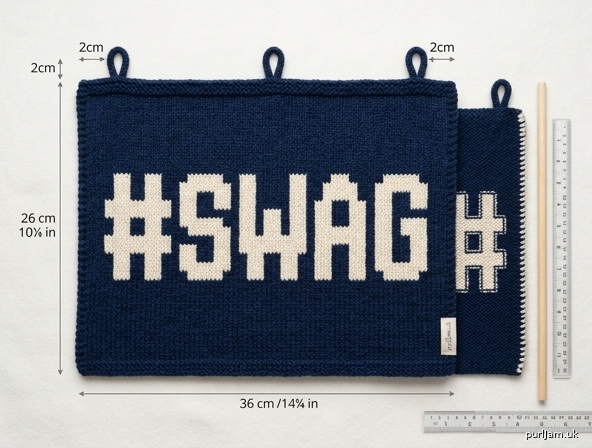
A double-sided knitted hanging. One face reads #SWAG left to right. The other face carries the same word reversed — a true left-to-right mirror — so that it reads #SWAG again when held up to a mirror. Finished size 36 cm × 26 cm (14¼ in × 10¼ in). Intermediate.
The panels are plain stocking stitch. The lettering is worked afterwards in duplicate stitch (Swiss darning), which keeps every stitch count exact and makes the reversed face easy to place.
Finished size
36 cm (14¼ in) wide × 26 cm (10¼ in) tall, after seaming and blocking.
Each panel is blocked to 36 cm × 26 cm before seaming. A mattress-stitch seam sits in the edge stitches and does not move the lettering.
Materials
Yarn: Worsted weight (UK aran-weight equivalent) that knits to the tension below. A wool or wool-blend blocks most reliably; acrylic may be used but will not stretch to length as readily.
- Main colour (MC): 250 m (275 yd), about 4 × 50 g balls at 80 m per 50 g. Background of both panels, seams and loops.
- Contrast colour (CC): 40 m (44 yd), 1 × 50 g ball. Lettering on both faces.
Choose a strong contrast. A deep MC (navy, charcoal, forest) with a light or bright CC reads most clearly. Any two contrasting colours may be used.
Needles: 4.5 mm (UK 7), straight needles, or a circular needle at least 40 cm long used flat. Optional 4 mm and 5 mm needles, used only if needed to match tension.
Notions:
- Tapestry needle (blunt)
- 4 locking stitch markers
- Pins and a blocking surface
- Optional: a 36 cm dowel, if you prefer a rod to i-cord loops
Tension (gauge)
20 stitches and 28 rows = 10 cm (4 in) over stocking stitch on 4.5 mm needles, after blocking.
Work a swatch of at least 30 stitches and 36 rows, block it as you will block the panels, and measure 10 cm in the centre. If you have too many stitches to 10 cm, go up a needle size; if too few, go down. Match stitch tension first. Row tension can be eased in blocking.
At this tension, 72 stitches = 36 cm exactly (72 × 10 ÷ 20 = 36 ✓). 72 rows measure about 25.7 cm and are pinned to 26 cm when blocking.
Abbreviations
- CC — contrast colour
- cm — centimetres
- k — knit
- MC — main colour
- p — purl
- RS — right side
- st(s) — stitch(es)
- st st — stocking stitch (knit on RS rows, purl on WS rows)
- WS — wrong side
Pattern notes
- UK terminology is used throughout. Measurements are metric, with inches in parentheses where the finished size is stated.
- Knit both panels the same. Only the lettering differs.
- Stitch numbers in the lettering are counted from the left-hand edge of the right side, with the cast-on edge at the bottom. They are not counted in the order you knit. On a RS row the first stitch you work is the right-hand edge.
- #, A and W are symmetrical. S and G are not. On the reversed face, S and G must be mirrored, not copied.
- Block before you letter. Duplicate stitch sits evenly only on a blocked grid.
- The wrong side of duplicate stitch is hidden when the two panels are seamed together.
Panels (make 2)
Using 4.5 mm needles and MC, cast on 72 sts with a long-tail cast on. Leave a tail of about 120 cm for seaming.
Row 1 (RS): Knit.
Row 2 (WS): Purl.
These 2 rows form stocking stitch. Work until 72 rows have been completed, ending with a WS row.
On row 29 (WS), purl as set. The lettering window begins on the next row. You may run a scrap of waste yarn along row 29 so the window is easy to find after blocking; pull the scrap out before you letter.
Row 30 (RS): Knit. With the RS facing and the row complete, count from the left and place a locking marker between sts 12 and 13, and another between sts 60 and 61. These mark the lettering window. (Stitch 13 from the left is the 60th stitch worked on this RS row: 72 − 13 + 1 = 60. Do not place the markers by knitting order alone.)
Continue in st st through row 72 (a WS row).
Cast off knitwise on the next RS row. Do not cast off tightly. Leave a tail of about 80 cm.
Blocking
Pin each panel to 36 cm wide × 26 cm tall (14¼ in × 10¼ in). The extra length is about 3 mm over the unblocked 25.7 cm and is normal for wool and wool blends. Leave to dry fully. Do not remove the locking markers until the lettering is finished; replace them after blocking if you pinned through them.
Lettering — shared placement
Both faces use the same window.
- Horizontal: sts 13–60 (48 sts), centred. 12 sts of MC remain outside the window on each side (12 + 48 + 12 = 72 ✓).
- Vertical: rows 30–43 (14 rows), centred. 29 rows of MC lie below the window and 29 rows lie above it (29 + 14 + 29 = 72 ✓).
- Characters: five cells of 8 sts, with a 2-st MC gap between cells (5 × 8 + 4 × 2 = 48 ✓).
Window row 1 is panel row 30 (the bottom of the letters). Window row 14 is panel row 43 (the top of the letters).
Cell positions, Face A, left to right as viewed on the RS:
| Character | Panel stitches |
|---|---|
| # | 13–20 |
| S | 23–30 |
| W | 33–40 |
| A | 43–50 |
| G | 53–60 |
Gaps (sts 21–22, 31–32, 41–42, 51–52) stay MC. Do not cover them.
How to duplicate stitch
Thread a tapestry needle with a comfortable length of CC. Work with the RS facing.
To cover one stitch: bring the needle up at the base of the V, pass it under both legs of the stitch above, and take it back down at the base of the V, following the path of the knitted stitch. Cover each indicated stitch once. Do not pull so tightly that the fabric puckers. Start and finish each length of CC on the WS, and keep those tails inside the seam when you join the panels.
Work one character at a time, from the bottom of the window upwards. Inside a character, “cell stitches” are numbered 1–8 from left to right.
Face A — #SWAG
Reading the finished RS from left to right, the characters are #, S, W, A, G.
Hash (#), panel sts 13–20
- Vertical bars: cell sts 2–3 and 6–7, window rows 1–14.
- Crossbars: all 8 cell sts, window rows 5–6 and 9–10. (These rows are already partly covered by the bars; fill the remaining stitches of the cell.)
S, panel sts 23–30
- Bottom bar: all 8 cell sts, window rows 1–3.
- Lower stem, on the right of the cell: cell sts 6–8, window rows 4–6.
- Middle bar: all 8 cell sts, window rows 7–8.
- Upper stem, on the left of the cell: cell sts 1–3, window rows 9–11.
- Top bar: all 8 cell sts, window rows 12–14.
W, panel sts 33–40
- Outer legs: cell sts 1–2 and 7–8, window rows 1–14.
- Centre foot: cell sts 4–5, window rows 1–5.
- Centre block: cell sts 3–6, window rows 6–9. With the outer legs, the whole cell is covered on these four rows.
- Inner upper legs: cell sts 3 and 6, window rows 10–14.
A, panel sts 43–50
- Legs: cell sts 1–2 and 7–8, window rows 1–5 and 9–11.
- Crossbar: all 8 cell sts, window rows 6–8.
- Top bar: all 8 cell sts, window rows 12–14.
G, panel sts 53–60
- Bottom bar: all 8 cell sts, window rows 1–3.
- Left spine: cell sts 1–3, window rows 4–11.
- Lower right stem: cell sts 6–8, window rows 4–6.
- Middle spur: cell sts 5–8, window rows 7–8. Cell st 4 on these two rows stays MC, so the spur reads as a bar rather than a filled counter.
- Top bar: all 8 cell sts, window rows 12–14.
Check before you continue. From the left, Face A must read #SWAG. If it reads GAWS#, the window was counted from the right; unpick and swap the placement. The lower bowl of S must sit on the right, and the spine of G must sit on the left.
Face B — reversed
Face B is the horizontal mirror of Face A. Reading the finished RS from left to right, the characters are a mirrored G, A, W, a mirrored S, and #. Held up to a mirror, this face reads #SWAG.
You can reach the same result by following the Face A strokes while counting every stitch number from the right-hand edge and swapping the words “left” and “right”. The positions below are that mirror written out, so no conversion is required.
Cell positions, Face B, left to right as viewed on the RS:
| Character | Panel stitches |
|---|---|
| Mirrored G | 13–20 |
| A | 23–30 |
| W | 33–40 |
| Mirrored S | 43–50 |
| # | 53–60 |
A, W and # are symmetrical. Work them from the Face A stroke instructions, in these new cells.
Mirrored G, panel sts 13–20
- Bottom bar: all 8 cell sts, window rows 1–3.
- Lower left stem: cell sts 1–3, window rows 4–6.
- Right spine: cell sts 6–8, window rows 4–11.
- Middle spur: cell sts 1–4, window rows 7–8. Cell st 5 on these two rows stays MC.
- Top bar: all 8 cell sts, window rows 12–14.
Mirrored S, panel sts 43–50
- Bottom bar: all 8 cell sts, window rows 1–3.
- Lower stem, on the left of the cell: cell sts 1–3, window rows 4–6.
- Middle bar: all 8 cell sts, window rows 7–8.
- Upper stem, on the right of the cell: cell sts 6–8, window rows 9–11.
- Top bar: all 8 cell sts, window rows 12–14.
Check before you seam. Face B must not read as a normal #SWAG. S must look backwards (lower bowl on the left), and G must have its spine on the right. In a mirror, both letters should look correct and the word should read #SWAG. If S and G look like the Face A letters, they were copied rather than reversed; unpick those two characters only.
Knitted-in alternative
The same cells and rows may be worked in intarsia instead of duplicate stitch. Use a separate small bobbin of CC for each solid area, and a separate length of MC for each background section between areas. At every colour change, twist the two yarns around each other to close the gap. On RS rows, work the row from right to left as you knit; on WS rows, purl back from left to right, keeping each stitch in the colour already placed. The written cells are still numbered left to right on the RS. Intarsia ends are woven in on the WS and hidden in the seam.
Finishing
Hanging loops (make 3)
Using 4.5 mm needles and MC, cast on 3 sts.
Knit 3. Do not turn. Slide the stitches to the other end of the needle and pull the yarn firmly across the back. Repeat until the i-cord measures 8 cm (3¼ in). Cast off, leaving a tail for sewing.
Seam
Place the panels wrong sides together, so both lettered faces are outward. Match cast-on edges to cast-on edges, so both words are upright when the hanging is viewed from either side.
Mattress-stitch the two side edges and the cast-on edge, taking the seam through the centre of each edge stitch. Draw the seam closed every few centimetres so it does not pucker. Turn the work the right way out through the open cast-off edge. Mattress-stitch the cast-off edges together.
As you close the top, sew one i-cord loop at each end, about 2 cm in from the side, and one at the centre. Fold 1.5 cm at each end of the cord to the inside of the seam and stitch down securely. The visible loop is then about 5 cm.
If you prefer a rod, omit the loops. Fold the top 2 cm of both layers to the inside before closing, stitch through the plain MC rows to form a channel, and insert a 36 cm dowel. The fold falls in the 29 plain rows above the letters, not in the lettering.
Final block
Ease the seamed hanging to 36 cm × 26 cm if the seam has drawn it in. Do not hang it while damp; the length will grow. When dry, the piece may be hung from the three loops.
Care
Hand-wash cool with a wool-safe wash, if the yarn allows. Rinse without wringing. Dry flat, pinned to 36 cm × 26 cm if needed. Do not tumble dry.
Disclaimer: This pattern was generated by AI and should be reviewed for accuracy before use. While we strive for quality, AI-generated content may contain errors. Please verify measurements, stitch counts, charts, and instructions before beginning your project. Generated by purlJam.uk
Love this pattern?
Save this pattern to your free PurlJam libraryAccess your pattern anytime
Bookmark this page to access your pattern anytime