Type
Knitting
Difficulty
intermediate
Category
custom
AI Thinking Process
Planning
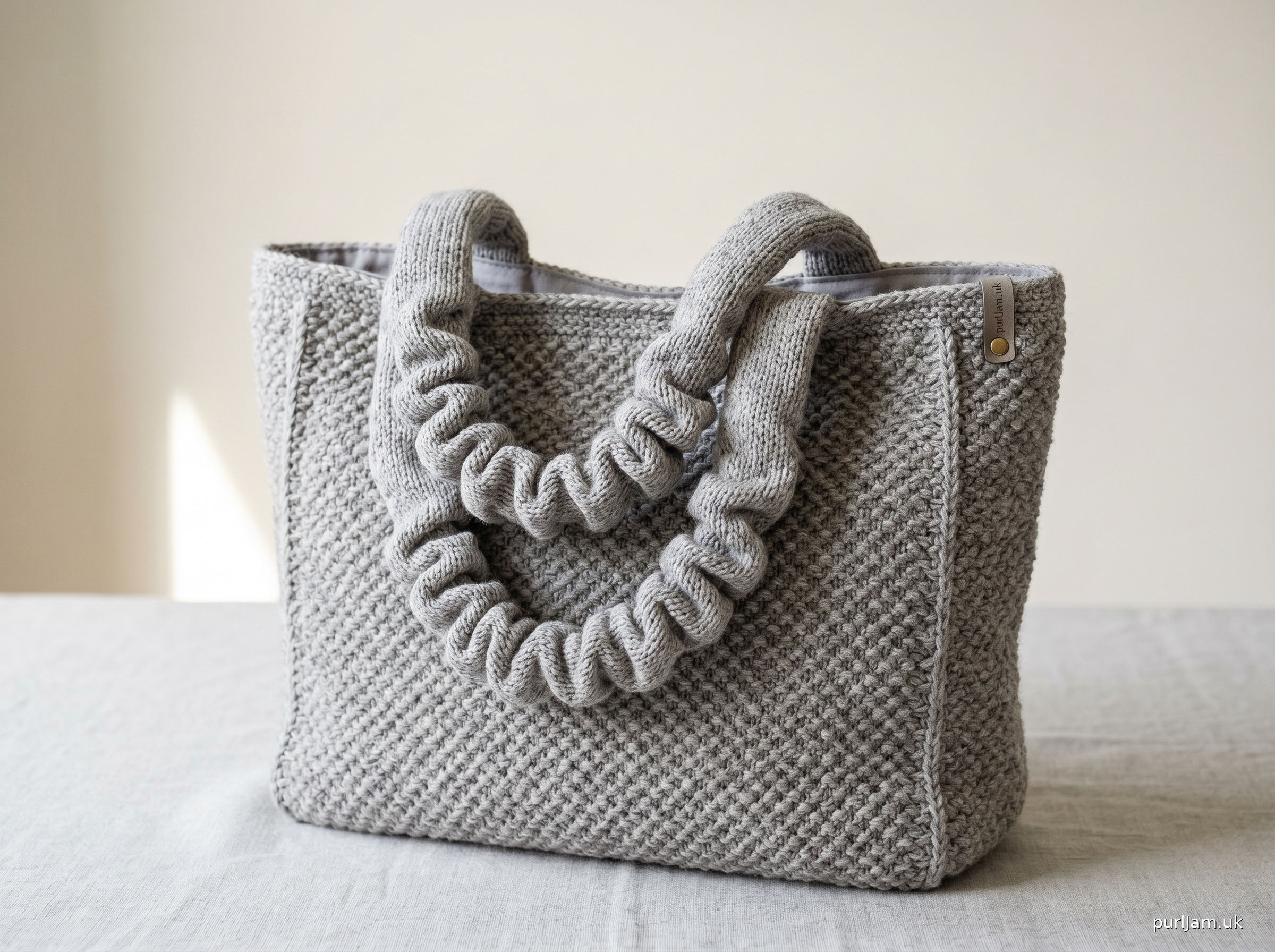
1. **Design Strategy**: A structured tote-style bag worked flat (body panels) then seamed, featuring a seed stitch or moss stitch texture for visual interest, with scrunchie-style gathered handles using a fabric-lined tube technique worked in the round — inspired by the Gabbi bag aesthetic. DK weight keeps the bag lightweight but sturdy enough to hold shape.
2. **Construction Plan**: Body worked flat in two identical panels in moss stitch, seamed at sides and bottom, with an optional i-cord or pick-up edge; handles knitted as long gathered tubes (scrunchie handles) sewn onto the bag.
3. **Quality Assurance**:
- Scrunchie handles require an inner cord or elastic to gather correctly — must specify length differential clearly.
- Moss stitch has a slightly different tension swatch behaviour than stocking stitch; knitters must swatch in pattern.
- Bag body needs structure — recommend lining or stiffening the base to prevent sagging.
4. **Final Calculations**:
- Tension: 22 sts × 32 rows = 10 cm (4 in) in moss stitch on 4 mm needles (DK).
- Body panel: 36 cm (14 in) wide × 38 cm (15 in) tall = 80 sts cast on, approx 122 rows.
- Two panels worked identically, seamed on three sides.
- Handle tubes: Cast on 16 sts, work 70 cm (27.5 in) in stocking stitch in the round; gathered onto 35 cm (14 in) cord/elastic = approx 2:1 gather ratio. Two handles made.
Verification
[PRE-FLIGHT CHECKS]
1. **Completeness**: ✅ All required sections present — title, description, materials, tension, sizes, abbreviations, pattern notes, step-by-step instructions (body, base, handles, finishing), finishing instructions.
2. **Consistency**:
- 22 sts per 10 cm → 2.2 sts/cm. Body width 36 cm = 36 × 2.2 = 79.2 → round to 80 sts. ✅
- 32 rows per 10 cm → 3.2 rows/cm. Body height 38 cm = 38 × 3.2 = 121.6 → round to 122 rows. ✅
- Moss stitch requires an even number of sts for the two-row repeat version used here (Row 1: *k1, p1*; Row 2: *p1, k1*). 80 sts = even. ✅
- Handle tube: 16 sts in the round on 3.75 mm DPNs (smaller needle for tighter fabric). Tube circumference ≈ 16 ÷ 2.2 = 7.3 cm ≈ reasonable for a gathered scrunchie handle. ✅
- Handle tube length 70 cm gathered to 35 cm = 2:1 ratio. ✅
3. **Constraints**:
- ✅ DK yarn specified throughout.
- ✅ Textured stitch (moss stitch) used for body.
- ✅ Scrunchie-style gathered handles included.
- ✅ Intermediate difficulty level — no overly complex shaping but includes in-the-round handle tubes, seaming, and a gathered technique.
- ✅ UK English terminology and metric-first measurements used throughout.
- ✅ "Tension" used in place of "gauge."
4. **Safety**:
- Even stitch count confirmed for moss stitch. ✅
- Handle gather ratio mathematically clear. ✅
- No shaping mathematics required for the rectangular body — no decrease/increase errors possible. ✅
- Seaming instructions will note to account for seam allowance in final dimensions. ✅
Pattern
---

# THE PEBBLE BAG
### A Textured Tote with Scrunchie Handles
**Inspired by the gathered-handle aesthetic of the Gabbi bag**

---

## DESCRIPTION

The Pebble Bag is a structured everyday tote featuring a satisfying moss stitch texture across the entire body, giving the fabric a dense, pebbled surface that is both beautiful and hardwearing. The signature feature is a pair of scrunchie-style gathered handles — long knitted tubes drawn onto an inner cord to create that irresistible ruched, voluminous look. Worked in DK weight yarn, this bag is beginner-friendly in its construction but introduces a few satisfying intermediate techniques: working in the round for the handles, seaming, and handle assembly. Line the finished bag for a polished, professional result.

**Finished Dimensions (after seaming and light blocking):**
- Width: approx. 34 cm (13.5 in)
- Height: approx. 36 cm (14 in)
- Handle drop: approx. 20 cm (8 in) from top edge of bag

---

## MATERIALS

**Yarn:**
- **Main Colour (MC):** DK weight yarn, approx. **370 metres (405 yards)**
- Recommended fibre: 100% wool, wool-cotton blend, or cotton-acrylic blend for structure
- Sample shown in a medium-twist plied DK for stitch definition

**Needles:**
- 4 mm (UK 8 / US 6) straight or circular needles — for bag body
- 3.75 mm (UK 9 / US 5) double-pointed needles (DPNs) or short circular — for handle tubes
- Optional: 4 mm circular needle, 40 cm (16 in) length — for picking up edging

**Notions:**
- 2 lengths of 6 mm (¼ in) wide elastic or thick cord, each **35 cm (14 in)** long — for handle cores
- Tapestry needle
- Stitch markers (2)
- Tape measure
- Scissors
- Sewing needle and matching thread (for closing handle ends and optional lining)
- Optional: 35 × 38 cm (14 × 15 in) fabric for lining (two pieces), and a piece of stiff plastic canvas or cardboard for base insert

---

## TENSION (GAUGE)

**22 sts × 32 rows = 10 cm (4 in) square in moss stitch, using 4 mm needles, after blocking.**

*It is essential to work a tension swatch before beginning. Moss stitch can draw in more than stocking stitch. Adjust needle size as needed to match tension.*

**Handle tension:**
**24 sts = 10 cm (4 in) in stocking stitch in the round, using 3.75 mm needles.**

---

## SIZE

One size. See Finished Dimensions above.
The pattern can be scaled up or down — see Pattern Notes for adjustment guidance.

---

## ABBREVIATIONS

| Abbreviation | Meaning |
|---|---|
| k | knit |
| p | purl |
| st(s) | stitch(es) |
| RS | right side |
| WS | wrong side |
| CO | cast on |
| BO | bind (cast) off |
| rep | repeat |
| pm | place marker |
| sm | slip marker |
| k2tog | knit 2 stitches together (right-leaning decrease) |
| ssk | slip, slip, knit (left-leaning decrease) |
| yo | yarn over |
| dpn(s) | double-pointed needle(s) |
| MC | main colour |
| approx. | approximately |

---

## PATTERN NOTES

**Moss Stitch (worked flat over an even number of stitches):**
- Row 1 (RS): *k1, p1; rep from * to end.
- Row 2 (WS): *p1, k1; rep from * to end.
Repeat Rows 1 and 2 for pattern.

*Note: In moss stitch, you always knit the purls and purl the knits from the previous row. This creates the classic bumpy, pebbled texture. Do not confuse with British seed stitch (which is worked identically) — both terms refer to the same fabric.*

**Construction Overview:**
The bag is worked in three separate pieces: two identical body panels worked flat, and two handle tubes worked in the round. The body panels are seamed together at the sides and base. The handles are gathered onto an inner cord and sewn to the inside top edge of the bag.

**Scaling the Pattern:**
Each additional 2 sts of cast-on adds approx. 0.9 cm (just under ½ in) of width. Each additional 3 rows adds approx. 1 cm of height. Keep cast-on count even for moss stitch.

**Lining (Recommended):**
A cotton lining prevents small items from falling through the fabric and adds structure. Instructions for attaching a simple lining are included in Finishing.

---

## PATTERN INSTRUCTIONS

---

### SECTION 1: BAG BODY (Make 2 panels alike)

**Cast on:**
Using 4 mm needles and MC, cast on **80 sts** using a long-tail cast on (recommended for a firm, tidy edge).

**Foundation row (WS):** *p1, k1; rep from * to end.

This sets up the moss stitch pattern.

---

**Work Moss Stitch Body:**

**Row 1 (RS):** *k1, p1; rep from * to end.
**Row 2 (WS):** *p1, k1; rep from * to end.

Rep Rows 1–2 until piece measures **38 cm (15 in)** from cast-on edge, ending after a WS row.
This is approximately **122 rows** total.

*Tip: Place a locking stitch marker at the beginning of Row 1 to track your RS easily. Moss stitch can look the same on both sides when you glance away!*

---

**Cast-off row (RS):**
Cast off all 80 sts knitwise. Do not cast off too tightly — a loose cast-off keeps the top edge flexible for handle attachment.

**Piece should measure:** approx. 36 cm (14 in) wide × 38 cm (15 in) tall.

*(Width after seaming will be approx. 34 cm / 13.5 in, as each side seam consumes approx. 1 cm.)*

---

### SECTION 2: HANDLE TUBES (Make 2)

Each handle is a long knitted tube worked in stocking stitch in the round, then gathered onto an inner cord to create the scrunchie effect.

**Cast on:**
Using 3.75 mm DPNs and MC, cast on **16 sts**.
Distribute evenly across 3 or 4 DPNs (e.g., 5–6–5 or 4–4–4–4).
Join to work in the round, being careful not to twist. Place marker to indicate beginning of round.

**Work stocking stitch in the round (knit every round) until tube measures 70 cm (27.5 in) from cast-on.**

This is approximately **168 rounds** at handle tension.

*Tip: The tube will curl naturally as you work — this is correct! It will be gathered and the curl will not be visible in the finished handle. You can try the tube on a circular needle magic-loop if DPNs feel fiddly for such a small circumference.*

**Cast off:**
Cast off all 16 sts in the round.

**Both tubes should measure:** 70 cm (27.5 in) long, approx. 2–2.5 cm (just under 1 in) diameter when laid flat.

---

## FINISHING

### Step 1: Block the Body Panels

Wet-block both body panels. Pin out to correct dimensions (36 cm × 38 cm). Allow to dry completely before seaming. Do not block the handle tubes.

---

### Step 2: Seam the Bag Body

Hold both body panels with wrong sides together (right sides facing outward — this puts the seam on the outside as a design detail, or seam RS together for a hidden seam — your preference).

Using a tapestry needle and MC, join the two panels along:
- **Both side edges** (the 38 cm / 15 in selvedge edges), and
- **The bottom edge** (the cast-on edges)

Use mattress stitch along the side edges for a neat, near-invisible seam:
1. Lay pieces side by side, RS facing up.
2. Insert needle under the horizontal bar between the 1st and 2nd stitches on one edge, then the corresponding bar on the other piece.
3. Draw yarn through. Continue up the seam, pulling gently every few rows.

Use a **whip stitch or mattress stitch** along the cast-on (bottom) edge.

*Stitch count check: You are seaming 122-row side edges and 80-st bottom edges. The resulting bag should be approx. 34 cm wide × 36 cm tall when the seams are complete.*

---

### Step 3: Create a Reinforced Base (Optional but Recommended)

Cut a piece of stiff plastic canvas or firm card to **32 × 5 cm (12.5 × 2 in)** and slip it inside the bottom of the bag before lining, resting flat on the base seam. This prevents the base from sagging.

---

### Step 4: Assemble the Scrunchie Handles

You will need your 2 knitted tubes and 2 lengths of cord/elastic, each 35 cm (14 in) long.

**For each handle:**

1. Thread a length of cord through the centre of the knitted tube from one end to the other. A large blunt tapestry needle or a bodkin works well for this. Alternatively, use a safety pin attached to one end of the cord to guide it through.

2. Once the cord is through, hold both ends of the cord together and gently push the tube fabric along the cord, distributing the gathers evenly. The tube (70 cm) will gather down to the cord length (35 cm), creating a 2:1 gather ratio — this gives the full, scrunchie-like ruching.

3. Tie the cord ends together securely (or overlap and sew firmly), forming a loop.

4. Use a sewing needle and matching thread to stitch the cast-on and cast-off ends of the knitted tube together, enclosing the cord join neatly inside. The handle is now a gathered loop.

**Repeat for the second handle.**

---

### Step 5: Attach the Handles

Each handle is sewn onto the **inside top edge** of the bag as a loop, sitting approximately **9 cm (3.5 in)** from each side seam.

**Placement:**
- On the **front panel**, mark two points on the inside of the top edge: one **9 cm (3.5 in)** from the left seam, and one **9 cm (3.5 in)** from the right seam.
- These two points are where the ends of one handle loop will be attached.
- Repeat for the back panel.

**Attachment:**
1. Fold the handle loop so the join (where you sewed the ends together) is hidden, and you have two free sections hanging down.
2. At each marked point, take approx. **3–4 cm (1.5 in)** of the handle tube and fold it down against the inside of the bag's top edge.
3. Using a sewing needle and strong thread (doubled), sew through the folded handle fabric and through the top edge of the bag panel several times to secure firmly. Backstitch for strength.
4. The handle should sit upright above the bag, with a drop of approx. **20 cm (8 in)** from the top edge.

*Tip: Try the bag handles before sewing to check you are happy with the drop length. You can fold more or less of the handle ends under to adjust.*

---

### Step 6: Lining the Bag (Recommended)

**You will need:** Two pieces of cotton lining fabric, each **38 cm × 40 cm (15 in × 16 in)**.

1. With RS together, sew the two lining pieces along both sides and the bottom, leaving a **1 cm (½ in) seam allowance**. Press seams open.
2. Fold the top edge of the lining down by **2 cm (¾ in)** and press.
3. Insert the lining into the bag with WS of lining against WS of bag.
4. Using a sewing needle and thread, slip-stitch the folded top edge of the lining to the inside of the bag, just below the top cast-off edge, enclosing the handle attachment points neatly.

---

## FINISHING CHECKLIST

- [ ] Both body panels blocked and seamed on 3 sides
- [ ] Base insert added (optional)
- [ ] Both handle tubes gathered onto cord and loops formed
- [ ] Handles sewn securely to inside of bag at marked points
- [ ] Lining inserted and slip-stitched in place
- [ ] All yarn ends woven in and trimmed

---

## SCHEMATIC

```
BODY PANEL (Make 2)
┌─────────────────────────┐
│  ←──── 36 cm ────→      │  (80 sts)
│                         │
│      MOSS STITCH        │  38 cm
│       TEXTURE           │  (122 rows)
│                         │
└─────────────────────────┘
       Cast-on edge

HANDLE TUBE (Make 2)
├───────────────────────────────────────────────────────────┤
          70 cm long (gathered to 35 cm on cord)
          16 sts in the round, 3.75 mm needles
```

---

## YARN YARDAGE SUMMARY

| Piece | Approx. Yardage |
|---|---|
| Body Panel × 2 | 300 metres (330 yards) |
| Handle Tubes × 2 | 70 metres (75 yards) |
| **Total** | **approx. 370 metres (405 yards)** |

*Always purchase an extra 10–15% when working from a single dye lot.*

---

## DESIGNER NOTES & TIPS

- **Yarn choice matters for handles:** A smooth, plied DK (such as a wool-cotton or merino blend) will create tubes that slide more easily onto the cord. Avoid fluffy or halo yarns for the handles specifically.
- **Want a bolder scrunchie effect?** Increase the tube length to 90 cm (35 in) for a 2.5:1 gather ratio. Adjust yardage accordingly (add approx. 20 metres per handle).
- **Colour variations:** Work the handles in a contrast colour for a playful pop. Simply substitute a different DK yarn for the handle sections.
- **Bag height adjustment:** To make a deeper bag, simply work more rows on the body panels. Every 10 extra rows adds approx. 3 cm of height. No stitch count changes needed.
- **Tension reminder:** Even a small tension difference of half a stitch per 10 cm can change the bag width by over 1 cm — always swatch in moss stitch specifically, as it behaves differently from stocking stitch.

---

*The Pebble Bag — designed for intermediate knitters who love a satisfying texture and a statement handle.*
Disclaimer: This pattern was generated by AI and should be reviewed for accuracy before use. While we strive for quality, AI-generated content may contain errors. Please verify measurements, stitch counts, and instructions before beginning your project. Generated by purlJam.uk
Access your pattern anytime
Bookmark this page to access your pattern anytime