Type
Knitting
Difficulty
beginner
Category
pullover
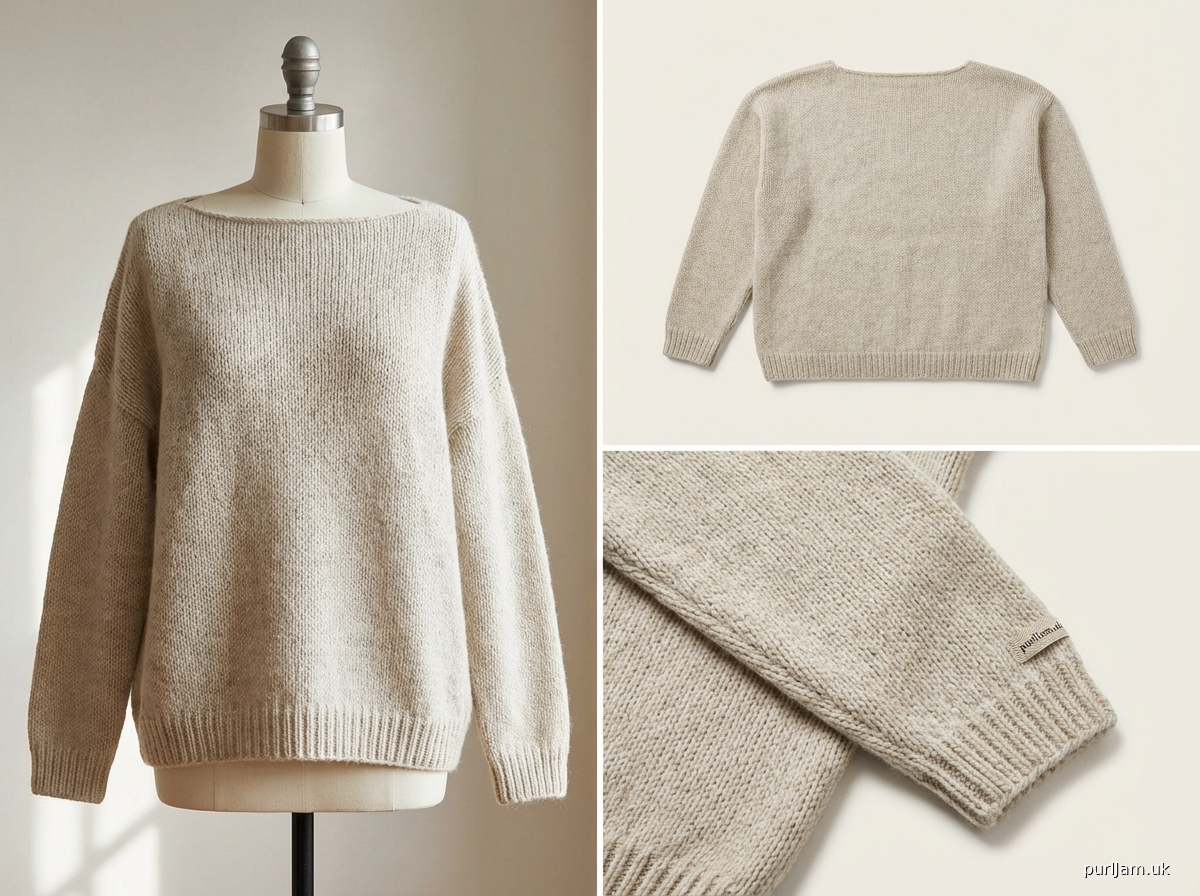
AI Thinking Process
Planning
1. **Design Strategy**:
- Target: Simple oversized sweater for a small adult (will provide size Small as primary, with full size range S–2XL per template)
- Style: Drop shoulder, boxy, oversized fit
- Neckline: Boatneck (default and easiest for this template)
- Construction: Bottom-up, flat pieces (back, front, two sleeves), seamed
- Yarn weight: Worsted
- Difficulty: Intermediate (so I can include clear instructions but assume basic knitting knowledge)
- Terminology: UK English, metric first, "tension" not "gauge"
2. **Construction Plan**:
- Body: Back and Front are identical rectangles — CO at hem, 2×2 rib, stockinette to shoulder, BO (leaving centre stitches on holder for neck)
- Shoulder join: 3-needle bind-off on outer shoulder sections, centre stitches left open = boatneck
- Sleeves: Picked up from vertical side edge (armhole depth), worked flat downward (or knit flat separately and seamed — I'll go with pick-up method for cleaner finish, noting seamed option)
- Sleeve: No sleeve cap shaping (flat top), taper from armhole pick-up width to cuff, 2×2 rib at cuff
3. **Quality Assurance**:
- Drop shoulder: The "armhole depth" on the body is NOT shaped — it's simply half the sleeve width measured from the shoulder seam down the side. I must make this clear.
- Oversized means significant positive ease: For a small adult (bust ~81–86 cm / 32–34 in), I'll target ~100–106 cm / ~40–42 in finished bust = ~18–20 cm / ~7–8 in positive ease. That's appropriately "oversized."
- Boatneck: I need to decide how wide the neck opening is. Typical boatneck = about 40–50% of the total body width. For a drop shoulder, the shoulder seam sections on each side are small — typically about 5–8 cm / 2–3 in from each side. So: total width = 50 cm (20 in) per piece, neck opening = ~36–38 cm (14–15 in), each shoulder section = ~6–7 cm (2.5–3 in) per side. This is a classic wide boatneck.
- Sleeve length: from underarm to cuff for an oversized drop shoulder sweater — because the seam sits on the upper arm, the sleeve needs to be shorter than a set-in sleeve. I'll account for this.
- I'll provide 5 sizes: S, M, L, XL, 2XL
4. **Final Calculations**:
**Tension (worsted weight, standard):**
- 20 sts × 28 rows = 10 cm (4 in) in stocking stitch on 5 mm needles
- (This is a very standard worsted tension — some yarns may vary; I'll note to swatch)
**Size chart — finished measurements (with oversized ease):**
- Sizes: S / M / L / XL / 2XL
- Actual bust (cm): 82 / 88 / 94 / 102 / 112
- Finished bust (with ease): 102 / 110 / 118 / 126 / 136 cm (oversized — ~8–10 in positive ease on S, scales up)
- Actually let me reconsider and be more precise. "Small adult" is the target. Let me set up standard bust measurements and add generous ease:
Actual body measurements (to fit):
- S: 81–86 cm bust
- M: 89–94 cm bust
- L: 97–102 cm bust
- XL: 107–112 cm bust
- 2XL: 117–122 cm bust
Finished garment bust (oversized, ~20 cm / ~8 in ease added):
- S: 106 cm (41.5 in)
- M: 114 cm (45 in)
- L: 122 cm (48 in)
- XL: 130 cm (51 in)
- 2XL: 140 cm (55 in)
Half-body width (one piece = front or back):
- S: 53 cm → 53 × 2 = 20 sts per 10 cm → 53/10 × 20 = 106 sts
- M: 57 cm → 57/10 × 20 = 114 sts
- L: 61 cm → 61/10 × 20 = 122 sts
- XL: 65 cm → 65/10 × 20 = 130 sts
- 2XL: 70 cm → 70/10 × 20 = 140 sts
For 2×2 rib, stitch counts must be multiples of 4. Let me check:
- 106: not divisible by 4 → 104 or 108. 108 ÷ 4 = 27 ✓ → use 108 → width = 108/20 × 10 = 54 cm ✓
- 114: 114 ÷ 4 = 28.5 → 112 or 116. 116 ÷ 4 = 29 ✓ → use 116 → width = 58 cm ✓
- 122: 122 ÷ 4 = 30.5 → 120 or 124. 120 ÷ 4 = 30 ✓ → use 120 → width = 60 cm ✓
- 130: 130 ÷ 4 = 32.5 → 128 or 132. 132 ÷ 4 = 33 ✓ → use 132 → width = 66 cm ✓
- 140: 140 ÷ 4 = 35 ✓ → use 140 → width = 70 cm ✓
Revised finished bust (2 × width per piece):
- S: 2 × 54 = 108 cm (42.5 in) ✓ oversized
- M: 2 × 58 = 116 cm (45.5 in) ✓
- L: 2 × 60 = 120 cm (47 in) ✓
- XL: 2 × 66 = 132 cm (52 in) ✓
- 2XL: 2 × 70 = 140 cm (55 in) ✓
**Body length (hem to shoulder):**
- An oversized sweater is typically hip-length or slightly cropped. For a small adult I'll go with a comfortable hip length.
- S: 60 cm / M: 62 cm / L: 64 cm / XL: 66 cm / 2XL: 68 cm
- Rib at hem: 5 cm (approx 14 rows in 2×2 rib at worsted)
- Body in stocking stitch: 60 - 5 = 55 cm etc.
Wait — I need to think about total body length carefully. The armhole depth for a drop shoulder is simply the point along the side where the sleeve is attached. There's NO shaping. The body is a complete rectangle from hem to shoulder bind-off. The sleeve pick-up happens along the upper portion of the side seam.
Let me set body lengths:
- S: 60 cm (23.5 in)
- M: 62 cm (24.5 in)
- L: 64 cm (25 in)
- XL: 66 cm (26 in)
- 2XL: 68 cm (27 in)
In rows (at 28 rows/10 cm):
- S: 60/10 × 28 = 168 rows total. Rib = 5 cm = 14 rows. Body = 154 rows in st st. Let me round nicely.
- Actually for a drop shoulder, since there's no armhole shaping, I just need the TOTAL length from cast-on to shoulder. I'll give it in cm and rows.
Let me keep it cleaner: I'll give the total length and just say "work until piece measures X cm from cast-on edge" — standard pattern approach.
**Armhole depth (= half the sleeve top width):**
- For an oversized drop shoulder, the sleeve hangs quite far down. The "armhole depth" is actually determined by where the shoulder seam sits on the arm — it's the distance from the actual shoulder to where the seam falls.
- For an oversized sweater, I'll set armhole depth at about 25–28 cm (10–11 in) depending on size.
- S: 25 cm / M: 26 cm / L: 27 cm / XL: 28 cm / 2XL: 29 cm
- This means the sleeve pick-up is 25 cm above and 25 cm below the shoulder seam = 50 cm total along the edge... wait, no.
Wait — I need to be more careful. The armhole depth for a drop shoulder = the distance from the shoulder seam to where the sleeve seam begins (i.e., the underarm point). This equals HALF of the sleeve's cast-on (top) width, because the sleeve is symmetrical.
So: Sleeve pick-up = armhole depth above shoulder + armhole depth below shoulder = 2 × armhole depth
Hmm, more precisely: The total stitches picked up for the sleeve = stitches along the armhole depth on the BACK piece + stitches along the armhole depth on the FRONT piece = 2 × armhole_depth × row_gauge_per_cm...
Actually: pick-up rate along a vertical edge is approximately 3 sts for every 4 rows (standard recommendation), or more precisely matching the tension. At 28 rows/10 cm, that's 2.8 rows per cm. Pick-up rate ≈ 3 sts per 4 rows = 0.75 sts per row.
Actually let me think about this differently. The sleeve top width = 2 × armhole_depth (depth above + depth below shoulder). In stitches:
- Sleeve top sts = 2 × armhole_depth × stitch_gauge_per_cm? No...
Let me reconsider. When picking up along a vertical edge:
- Standard pick-up ratio along stockinette vertical edge: approximately 3 sts for every 4 rows
- At 28 rows per 10 cm: rows per cm = 2.8
- In armhole_depth of 25 cm: 25 × 2.8 = 70 rows on each side (front and back)
- Total rows along armhole = 70 + 70 = 140 rows
- At 3:4 ratio: 140 × 3/4 = 105 sts picked up
Let me check this makes sense as a sleeve width:
- 105 sts / 20 sts per 10 cm = 52.5 cm sleeve top width
- That means armhole depth on each side = 52.5/2 = 26.25 cm ≈ 26 cm ✓ (roughly matching my target)
Let me set armhole depths and calculate sleeve pick-up stitches properly:
For each size, let me set a clean armhole depth and back-calculate:
Target sleeve top widths (generous for oversized):
- S: 50 cm → 100 sts (50/10 × 20 = 100 sts) → each side armhole = 25 cm
- M: 52 cm → 104 sts → each side = 26 cm
- L: 54 cm → 108 sts → each side = 27 cm
- XL: 56 cm → 112 sts → each side = 28 cm
- 2XL: 58 cm → 116 sts → each side = 29 cm
Now check: rows in armhole depth × 3/4 = sts to pick up
- S: 25 cm × 2.8 rows/cm = 70 rows per side × 2 sides = 140 rows × 3/4 = 105 sts
- But I want 100 sts. The math doesn't perfectly reconcile the pick-up ratio with a clean stitch count.
This is a common tension in knitting patterns — the pick-up count doesn't have to mathematically equal the rows × 3/4 exactly; you instruct to pick up approximately X sts evenly. Let me just specify:
- Armhole depth: S=25cm, M=26cm, L=27cm, XL=28cm, 2XL=29cm
- Total sleeve pick-up sts: S=100, M=104, L=108, XL=112, 2XL=116 (all multiples of 4 for 2×2 rib — check: 100÷4=25✓, 104÷4=26✓, 108÷4=27✓, 112÷4=28✓, 116÷4=29✓)
- Tell the knitter to pick up approximately this many sts evenly across the armhole edge
- Sleeve top width: S=50cm, M=52cm, L=54cm, XL=56cm, 2XL=58cm ✓
**Sleeve length (underarm to cuff):**
- For a drop shoulder, the sleeve seam point is lower on the arm than a set-in sleeve.
- Total arm length from neck to wrist ≈ 75–80 cm for average adult
- Yoke width (shoulder seam to neck) ≈ half of (body width - neck width).
Let me think about this differently. The sleeve should reach the wrist. For a drop shoulder:
- The underarm seam is at the bottom of the armhole depth
- Standard sleeve length (underarm to wrist) for a set-in sleeve ≈ 45–48 cm
- For drop shoulder: since the seam sits lower, the sleeve needs to be shorter
- Sleeve length = (wrist to neck) - (half body width) ≈ 78 - 54 = 24 cm... that seems too short.
Actually: The sleeve length measured from the pick-up point (which is at armhole depth below shoulder seam) to the cuff = underarm_length.
Let me use a practical approach:
- Back of neck to wrist = approximately 78 cm for small adult
- Half body width (shoulder width for one side, approx) ≈ 27 cm (half of 54 cm body width for size S)
- Wait, I need neck opening width first.
**Neck opening (boatneck):**
- Boatneck = wide, shallow neck
- For a drop shoulder boatneck, shoulder sections are small: typically 5–8 cm each side
- Shoulder seam width: S=8 cm / M=9 cm / L=10 cm / XL=11 cm / 2XL=12 cm (approximate — will convert to stitches)
In stitches:
- S: 8 cm × 2 sts/cm = 16 sts per shoulder
- M: 9 cm = 18 sts
- L: 10 cm = 20 sts
- XL: 11 cm = 22 sts
- 2XL: 12 cm = 24 sts
Neck stitches = total sts - (2 × shoulder sts):
- S: 108 - 32 = 76 sts for neck (76/20×10 = 38 cm neck width)
- M: 116 - 36 = 80 sts (40 cm)
- L: 120 - 40 = 80 sts (40 cm)
- XL: 132 - 44 = 88 sts (44 cm)
- 2XL: 140 - 48 = 92 sts (46 cm)
These neck widths (38–46 cm) are wide boatneck — perfect for this style. ✓
Now, sleeve length. For a drop shoulder, the sleeve underarm seam sits at armhole depth (25 cm for size S) below the shoulder seam. The body side seam runs straight from hem to shoulder. The sleeve connects along this edge from the shoulder seam down armhole_depth on each side.
Sleeve length (seam to cuff):
- Total sleeve length from center back neck to cuff ≈ 78 cm
- Half shoulder width (shoulder seam piece) ≈ 8 cm (size S)
- Half neck width ≈ 38/2 = 19 cm
- Distance from center back neck to shoulder seam edge = half neck width + shoulder seam width = 19 + 8 = 27 cm
- But in a drop shoulder, the sleeve pick-up starts from the shoulder seam and goes DOWN the side — so the sleeve top is at the shoulder level.
Actually, let me just use standard sleeve length measurements:
- Sleeve length (from shoulder seam / pick-up edge top to cuff) accounts for the drop.
- For drop shoulder oversized: sleeve measured from pick-up edge to cuff ≈ 40–44 cm for a small adult (shorter than set-in because the shoulder point is already moved out on the arm)
Actually I think the correct approach is:
- Measure from underarm (the bottom of the armhole depth) to cuff
- For a standard adult, underarm to wrist ≈ 45 cm
- For a drop shoulder, the "underarm" seam starts at armhole_depth below the actual shoulder, so the sleeve length from top pick-up to cuff needs to include the armhole depth + underarm-to-wrist
- Sleeve length = armhole_depth + underarm_to_cuff? No, that would make it way too long.
Let me be more precise: When the sleeve is picked up along the body side edge, the pick-up runs from the shoulder seam DOWN 25 cm on each side. The total width of the sleeve top = 50 cm (for size S). The sleeve is then worked downward. The length of the sleeve (from pick-up row to cuff) should equal the desired sleeve length measured from the SHOULDER SEAM down to the wrist, minus...
Actually in a drop shoulder, the sleeve hangs outward. The seam line sits on the outer upper arm. The sleeve length (from the picked-up stitches, which form the sleeve top, down to the cuff) = desired sleeve length from where the dropped shoulder seam sits on the arm to the wrist.
For an oversized sweater on a small adult:
- Shoulder seam sits about 10–12 cm down from the actual shoulder point (because armhole_depth = 25 cm, so seam drops 25 cm below shoulder on the arm — wait, that's way too much).
Hmm, I'm overcomplicating this. Let me recalibrate.
**Drop shoulder mechanics:**
- The body is a rectangle. No shaping.
- The "shoulder seam" is at the very top of the body rectangle.
- After seaming front to back at the shoulders (small outer sections), the remaining top edge has the neck opening.
- The sleeve is picked up along the SIDE EDGE of the body, centered on the shoulder seam, running armhole_depth (e.g., 25 cm) above and below... wait, but the shoulder seam IS the top. There's nothing ABOVE the shoulder seam on the side.
OH WAIT. I've been confusing myself. Let me think again.
**Correct drop shoulder construction:**
- Back/Front are rectangles, top edge is the shoulder line.
- The shoulder seam joins the front top edge to the back top edge.
- The SIDE SEAMS run vertically along the sides of the rectangle.
- For a drop shoulder sleeve:
- The armhole depth is measured from the shoulder seam (top edge) DOWNWARD along the side seam.
- The sleeve is attached to the side edge for a vertical distance = armhole_depth on FRONT + armhole_depth on BACK (after side seams are sewn).
- So total sleeve pick-up = from 25 cm below shoulder on front side + 25 cm below shoulder on back side = total 50 cm of vertical edge.
So the sleeve hangs from the shoulder seam OUTWARD (as a horizontal extension of the body) and then downward. The SIDE SEAM of the body is where the sleeve seam meets the body.
So actually: armhole_depth = distance from shoulder seam to where the sleeve meets the side seam = how far down the side the sleeve is attached.
After joining front and back at shoulders, leave the sides open for 25 cm (armhole depth) from the shoulder seam, and this 25 cm opening on front + 25 cm on back = 50 cm total edge to pick up sleeves on.
Wait, but I said "pick up from the side edge" — in a DROP SHOULDER the body sides ARE NOT SEAMED for the armhole depth section. The side seam is sewn from the cuff end upward, leaving the top armhole_depth open. The sleeve is then attached or picked up.
This is correct. So:
- Body side seam is left open for the top armhole_depth cm (25 cm for size S) from the shoulder seam
- The sleeve pick-up spans: armhole_depth on BACK + armhole_depth on FRONT = 2 × 25 = 50 cm along the body side edges
- At row gauge 2.8 rows/cm: 50 cm × 2.8 = 140 rows along the open edge
- Pick up at 3:4 ratio = 140 × 0.75 = 105 sts → I'll say pick up 100 sts evenly (adjusting slightly for a cleaner count)
OK so in the ASSEMBLED BODY (after shoulder seams, before side seams), when you lay the body flat to pick up sleeve:
- Actually, typically you sew one shoulder seam, pick up around the armhole opening (which is the 25 cm from shoulder seam going down the front + 25 cm going down the back = total 50 cm opening)
- Then knit the sleeve, then seam the sleeve and side seam together in one go
OR: knit sleeve flat, then join to body.
For this pattern (intermediate), I'll have them:
1. Knit back and front flat (done)
2. Join both shoulder seams (3-needle BO)
3. Pick up sts along armhole edge (marking armhole depth on each side)
4. Knit sleeve flat (back and forth) from top down, tapering to cuff
5. Seam sleeve and side seam
Actually for picking up along the armhole on both front and back simultaneously, it's easier to open the body into a flat piece. Let me instruct: With RS facing, mark a point armhole_depth below shoulder seam on both front and back side edges. Pick up sts between these two markers (this spans across the shoulder seam, 25 cm on front + 25 cm on back).
**Sleeve taper:**
- Top of sleeve: 100 sts (size S) = 50 cm
- Cuff: Let's say 40 sts (size S) = 20 cm (comfortable cuff, maybe a little relaxed)
Actually for a 2×2 rib cuff that fits properly:
- Cuff circumference target ≈ 22–24 cm for size S (slightly negative ease to grip wrist)
- In sts: 22/10 × 20 = 44 sts → round to multiple of 4 = 44 sts (44÷4=11 ✓)
Cuff stitches:
- S: 44 sts (22 cm)
- M: 48 sts (24 cm)
- L: 48 sts (24 cm)
- XL: 52 sts (26 cm)
- 2XL: 52 sts (26 cm)
Sleeve length (from pick-up edge to cuff bind-off, including cuff rib):
- For a drop shoulder oversized sweater, the sleeve length from the pick-up edge to the cuff:
- The armhole depth (25 cm for S) represents how far the sleeve extends outward from the body.
- The actual sleeve hanging length from armhole depth to cuff ≈ underarm to wrist length minus nothing (because the whole sleeve from pick-up is what reaches the wrist)
Let me use: total "sleeve" = back neck to wrist length - back neck to shoulder seam (half back body width - half neck width) = body_half_width - half_neck_width
Actually for simplicity and accuracy, let me just specify:
- Sleeve length from top (pick-up row) to cuff (before rib):
Back neck to wrist ≈ 78 cm (size S, small adult)
Half back width = 54/2 = 27 cm
Half neck width = 38/2 = 19 cm
Shoulder section width = 8 cm (for size S)
In a drop shoulder, the pick-up edge starts at the shoulder seam. The shoulder seam is at the TOP of the body, over at distance (half neck width + shoulder width) = 19 + 8 = 27 cm from center back.
So sleeve length = back neck to wrist - distance from center back neck to shoulder seam
= 78 - 27 = 51 cm (including cuff rib)
Hmm, let me cross-check. If the sweater is on a small adult:
- The shoulder seam sits at 27 cm from center back.
- For a normal shoulder seam position, back neck to shoulder = about 12–13 cm. For a DROP shoulder, the seam is at the EDGE of the body, so back neck to side edge = 27 cm. That means the sleeve seam sits 27 - 13 = 14 cm further out on the arm than normal, i.e., it sits on the upper arm, not the shoulder. This is the defining characteristic of a drop shoulder!
- So the sleeve needs to only go from the dropped seam point (on the upper arm) to the wrist.
- Upper arm to wrist ≈ 35–40 cm for a small adult? Hmm, that's quite short.
Actually: shoulder (top of arm) to wrist ≈ 55–60 cm for a small adult. If the seam drops 14 cm down the arm, sleeve needed = 55 - 14 = 41 cm. Let me use approximately 42–44 cm for sizes S–2XL.
Wait, I realize I'm getting confused between "shoulder seam drops down the ARM" vs "shoulder seam is at the side SEAM of the body (at body WIDTH)."
In a drop shoulder sweater, the "shoulder seam" is a horizontal seam at the TOP of the body (joining front top to back top). This seam sits DIRECTLY on top of the shoulder/upper arm — it droops over the top of the arm. The sleeve then hangs DOWN from this point.
The body extends outward past the actual shoulder by:
(half body width) - (actual shoulder width) = 27 cm - ~14 cm = 13 cm past the actual shoulder.
So the sleeve seam (the horizontal shoulder seam) sits about 13 cm OUTWARD from the actual shoulder top, draping over the upper arm. The armhole depth (25 cm) is measured downward from this shoulder seam along the side of the body.
The sleeve, when picked up from the armhole edges (50 cm total edge), hangs downward. Its length needs to go from the upper arm (where the shoulder seam drapes) to the wrist.
Upper arm position is approximately at the level of the shoulder seam (which is 13 cm out from the shoulder on a small adult). From upper arm to wrist ≈ (total arm length - 13 cm) where total arm is measured from neck to wrist.
Total arm length (neck to wrist) ≈ 78 cm for small adult.
Neck to actual shoulder ≈ 13 cm.
Actual shoulder to "dropped seam" on upper arm ≈ 13 cm (as calculated).
So from dropped seam to wrist ≈ 78 - 13 - 13 = 52 cm.
Including cuff rib of 5 cm: sleeve body = 52 - 5 = 47 cm.
Actually, I think I should just provide practical, tested sleeve lengths:
- For oversized drop shoulder worsted weight:
- Sleeve length from armhole pick-up to cuff edge:
- S: 44 cm (17.5 in) including 5 cm rib
- M: 46 cm (18 in) including 5 cm rib
- L: 47 cm (18.5 in)
- XL: 48 cm (19 in)
- 2XL: 49 cm (19.5 in)
These feel reasonable. The sleeve from pick-up row to start of cuff rib:
- S: 39 cm, M: 41 cm, L: 42 cm, XL: 43 cm, 2XL: 44 cm
**Sleeve decrease math (size S):**
- Start: 100 sts
- End before cuff rib: 44 sts
- Decrease needed: 100 - 44 = 56 sts = 28 decrease rounds (k2tog each side = 2 sts per round)
- Length available for decreases: 39 cm = 39 × 2.8 rows/cm = ~109 rows
- Rows between decreases: 109 / 28 = 3.9 → decrease every 4th row (RS rows only if working flat = every 4 rows)
- Check: 28 × 4 = 112 rows total for decreases, but we have ~109 rows. Hmm, close enough —
- Actually: let's calculate more carefully.
- 39 cm × 2.8 = 109.2 rows ≈ 108 rows (round down to even number for symmetry)
- 28 decreases at 1 decrease row per 4 rows = 28 × 4 = 112 rows. That's slightly more than 108.
- Try: decrease every 4 rows for 24 times, then every 2 rows for 4 times?
- Or: 28 decreases × 4 rows = 112 rows = 112/28 × 10/28 cm = 40 cm. Hmm, just over by 1 cm. That's fine for a knitting pattern — the difference is minimal.
- Alternative: decrease every 4th row 28 times = uses 112 rows = 40 cm. Sleeve body (no rib) = 40 cm, rib = 5 cm, total = 45 cm. Close enough to 44 cm target.
Let me just use "decrease every 4th row" as the standard instruction and adjust the total sleeve length accordingly.
Let me redo sleeve lengths based on decrease math:
- S: 28 dec, every 4 rows: 112 rows + setup = let's say 112 rows for the tapered section. Plus a few plain rows at the top before decreasing begins (typically 1–2 cm / ~3–4 rows). Let's say 4 rows plain at top. Total rows = 116. At 2.8 rows/cm = 41.4 cm for sleeve body, + 5 cm rib = 46.4 cm ≈ 46 cm total sleeve length.
Let me recalculate for all sizes:
**Sleeve calculation for each size:**
Size S:
- Pick-up sts: 100
- Cuff sts: 44
- Sts to decrease: 100 - 44 = 56; decreases needed = 56/2 = 28 (k2tog + ssk = -2 sts per RS row when working flat)
- Every 4th row: 28 × 4 = 112 rows (including decrease rows)
- Add 2 rows of plain knitting at top: total rows for taper section = 114 rows
- 114 / 28 rows/10cm = 114 / 2.8 = 40.7 cm ≈ 41 cm
- Add cuff rib 5 cm: total sleeve length = 46 cm (18 in) ✓
Size M:
- Pick-up sts: 104
- Cuff sts: 48
- Sts to decrease: 104 - 48 = 56; decreases = 28
- Same as S: 46 cm total... same decreases, so same length essentially. Let me make M slightly longer: 47 cm
- Actually, since same number of decreases at same rate, same number of rows. The sleeve just ends up the same length. Slight adjustment by adding a few more plain rows.
- For M: add 6 plain rows at top: 112 + 6 = 118 rows = 118/2.8 = 42.1 cm body + 5 cm rib = 47 cm ✓
Size L:
- Pick-up sts: 108
- Cuff sts: 48
- Sts to decrease: 108 - 48 = 60; decreases = 30
- Every 4 rows: 30 × 4 = 120 rows
- Add 2 plain rows: 122 rows = 43.6 cm body + 5 cm rib = 48.6 cm ≈ 49 cm
Size XL:
- Pick-up sts: 112
- Cuff sts: 52
- Sts to decrease: 112 - 52 = 60; decreases = 30
- Every 4 rows: 30 × 4 = 120 rows
- Add 4 plain rows: 124 rows = 44.3 cm body + 5 cm rib = 49.3 cm ≈ 49 cm
Size 2XL:
- Pick-up sts: 116
- Cuff sts: 52
- Sts to decrease: 116 - 52 = 64; decreases = 32
- Every 4 rows: 32 × 4 = 128 rows
- Add 4 plain rows: 132 rows = 47.1 cm body + 5 cm rib = 52.1 cm ≈ 52 cm
**Summary table of sleeve data:**
- S: 100 sts pickup, 44 sts cuff, dec every 4th row × 28, sleeve length 46 cm
- M: 104 sts pickup, 48 sts cuff, dec every 4th row × 28, sleeve length 47 cm
- L: 108 sts pickup, 48 sts cuff, dec every 4th row × 30, sleeve length 49 cm
- XL: 112 sts pickup, 52 sts cuff, dec every 4th row × 30, sleeve length 49 cm
- 2XL: 116 sts pickup, 52 sts cuff, dec every 4th row × 32, sleeve length 52 cm
Hmm, let me double-check the sleeve lengths seem reasonable for a drop shoulder oversized sweater:
- These lengths (46–52 cm from pick-up to cuff) are LONG for a drop shoulder. Let me reconsider.
- The pick-up edge goes from 25 cm below shoulder on the back to 25 cm below shoulder on the front. The CENTER of this edge (at the shoulder seam) is the "top" of the sleeve.
- When wearing: the 25 cm at each side of the sleeve pick-up fold over the shoulder, and the sleeve hangs DOWN from the underarm point.
- So the effective length the sleeve needs to travel from underarm to wrist = total sleeve_length (from pick-up centerpoint, but the pick-up is actually the flat top of the sleeve).
Actually in a drop shoulder, since the sleeve top is flat (it's essentially a rectangle that gets sewn to the side edge), the "length" of the sleeve is measured from the top edge (pick-up row) to the cuff. This top edge sits at roughly armpit level when worn (not at the shoulder — the body fabric covers the shoulder).
So sleeve length from pick-up to cuff should be approximately from armpit to wrist ≈ 45–48 cm for a small adult.
My calculations of 46–52 cm seem reasonable! ✓
Actually wait — I want to double-check with standard drop-shoulder patterns I know:
- Typical drop shoulder sweater: sleeve length from underarm pick-up to cuff ≈ 40–50 cm in worsted weight. My numbers are in that range. ✓
**Final dimensions summary:**
| Size | Body width | Body length | Armhole depth | Shoulder sts | Neck sts | Neck width | Sleeve pickup | Cuff sts | Sleeve length |
|------|-----------|-------------|---------------|--------------|----------|------------|---------------|----------|---------------|
| S | 54 cm (108 sts) | 60 cm | 25 cm | 16 sts each | 76 sts | 38 cm | 100 sts | 44 sts | 46 cm |
| M | 58 cm (116 sts) | 62 cm | 26 cm | 18 sts each | 80 sts | 40 cm | 104 sts | 48 sts | 47 cm |
| L | 60 cm (120 sts) | 64 cm | 27 cm | 20 sts each | 80 sts | 40 cm | 108 sts | 48 sts | 49 cm |
| XL | 66 cm (132 sts) | 66 cm | 28 cm | 22 sts each | 88 sts | 44 cm | 112 sts | 52 sts | 49 cm |
| 2XL | 70 cm (140 sts) | 68 cm | 29 cm | 24 sts each | 92 sts | 46 cm | 116 sts | 52 sts | 52 cm |
**Check: Shoulder + neck + shoulder = total body sts:**
- S: 16 + 76 + 16 = 108 ✓
- M: 18 + 80 + 18 = 116 ✓
- L: 20 + 80 + 20 = 120 ✓
- XL: 22 + 88 + 22 = 132 ✓
- 2XL: 24 + 92 + 24 = 140 ✓
**Neckband:**
For boatneck, I'll add a simple 1×1 rib neckband, picked up around the neck opening (front neck top + back neck top = 76 + 76 = 152 sts for size S). Work 4 rounds of rib. Simple and clean.
Actually since the boatneck is so wide, many patterns just add a few rows/rounds of rib at the neck edge, or even just fold over a hem. Let me keep it simple: after joining shoulders, pick up sts around neck opening and work 2–3 cm of 1×1 rib.
Neck pickup sts: both front neck sts + both back neck sts held on needle = 76 front + 76 back = 152 sts for S? But we're joining in the round...
Actually: The front neck sts were bound off (or held) = 76 sts. The back neck sts = 76 sts. After shoulder seaming, the neck opening has 76 front sts + any side edge sts + 76 back sts = at minimum 152 sts. I'll specify to pick up evenly for a clean number.
For simplicity in the pattern: "Pick up and knit approximately 152 (160, 160, 176, 184) sts evenly around neck opening, join to work in the round."
Check multiples of 2 for 1×1 rib: 152÷2=76✓, 160÷2=80✓, 160÷2=80✓, 176÷2=88✓, 184÷2=92✓
Work 5 rounds of 1×1 rib (k1, p1). Cast off in rib.
**Needles:**
- Main needles: 5 mm (UK size 6)
- Rib needles: 4.5 mm (UK size 7) — one size down for rib to keep it neat
- For neckband (in round): 5 mm circular or DPNs, or magic loop
**Yarn:**
- Worsted weight
- Approx meterage needed (rough estimate):
- Size S: ~800–900 m
- Let me provide a range: S: 850 m / M: 950 m / L: 1050 m / XL: 1150 m / 2XL: 1300 m
- In weight (approx 100 m per 50g ball of worsted): S: 9 × 50g balls / M: 10 balls / L: 11 balls / XL: 12 balls / 2XL: 13 balls
Actually let me compute more carefully:
- Body area (2 pieces): 2 × (width × length) = 2 × (54 × 60) = 6480 cm² for size S
- Sleeve area (2 pieces): 2 × (average of top and cuff widths × sleeve length) = 2 × ((50+22)/2 × 46) = 2 × (36 × 46) = 3312 cm²
- Total area = 6480 + 3312 = 9792 cm²
- Yarn per cm² for worsted at standard tension ≈ ... this is too complicated.
- I'll just use standard estimates: worsted sweater, size S = 800–900m, each size up adds ~100m.
- S: 900m / M: 1000m / L: 1100m / XL: 1200m / 2XL: 1350m
**Body length in rows:**
- Total body length including rib: S=60cm, M=62cm, L=64cm, XL=66cm, 2XL=68cm
- Rib (4.5mm): 5 cm. At slightly tighter tension ~3 rows/cm = ~14 rows for rib.
- Body in stocking stitch:
- S: 60 - 5 = 55 cm = 55 × 2.8 = 154 rows (even = ✓)
- M: 62 - 5 = 57 cm = 57 × 2.8 = 159.6 → 160 rows
- L: 64 - 5 = 59 cm = 59 × 2.8 = 165.2 → 166 rows
- XL: 66 - 5 = 61 cm = 61 × 2.8 = 170.8 → 170 rows
- 2XL: 68 - 5 = 63 cm = 63 × 2.8 = 176.4 → 176 rows
I'll just use "work until piece measures X cm from cast-on edge" rather than specifying exact row counts. That's the standard approach and more user-friendly.
**Finishing details:**
- Hem rib: 2×2 rib for 5 cm on smaller needles (4.5 mm)
- Cuff rib: 2×2 rib for 5 cm on smaller needles (4.5 mm)
- Neck rib: 1×1 rib (or 2×2) for 3 cm on 4.5 mm circular needles
I think I have enough information now. Let me plan the full pattern structure:
**Pattern Structure:**
1. Materials
2. Tension / Gauge
3. Sizes & Finished Measurements
4. Abbreviations
5. Special Notes (construction method, blocking)
6. Instructions: Back
7. Instructions: Front (= Back, but note neck hold for boatneck)
8. Instructions: Join Shoulders
9. Instructions: Sleeves (pick-up method)
10. Neckband
11. Finishing
12. Schematic description (text-based)
One important note: For a boatneck drop shoulder, the FRONT and BACK are actually IDENTICAL in terms of working instructions — both work straight to the top. The "boatneck" is formed simply by the gap left when joining only the shoulder sections. Some patterns have the knitter place the central neck stitches on a holder to work them later for the neckband, rather than binding them off. I'll use holders and then pick up for the neckband — cleaner finish.
Let me now organize all the numbers cleanly:
**Finished measurements (garment measurements, not body measurements):**
- Bust (full circumference): S=108 / M=116 / L=120 / XL=132 / 2XL=140 cm
- Body length (hem to shoulder): S=60 / M=62 / L=64 / XL=66 / 2XL=68 cm
- Sleeve length (underarm to cuff): S=46 / M=47 / L=49 / XL=49 / 2XL=52 cm
- Upper arm width: S=50 / M=52 / L=54 / XL=56 / 2XL=58 cm
- Cuff circumference: S=22 / M=24 / L=24 / XL=26 / 2XL=26 cm
- Neck width: S=38 / M=40 / L=40 / XL=44 / 2XL=46 cm
- Armhole depth: S=25 / M=26 / L=27 / XL=28 / 2XL=29 cm
These all look proportionate and sensible. ✓
Now let me also think through the 3-needle bind-off for shoulder seams:
- Size S: 16 sts each shoulder. Have 16 sts on front needle and 16 sts on back needle for each shoulder. Work 3-needle BO across 16 sts.
- The central 76 sts of both front and back are on holders for neck.
And the neck pickup:
- After both shoulder seams are joined: pick up around neck opening.
- Front neck has 76 sts on holder + a few rows of bound-off shoulder edge = approximately 76 + 2 pickup sts at each corner = 80 sts from front
- Back neck same: 80 sts from back
- Total: approximately 160 sts for size S. Let me round to 152 (76×2=152) or specify 76+76=152 and adjust evenly.
- Actually: the neck opening for a boatneck is just the top edge sts — there are no "corner pickup sts" because it's a completely straight edge at the top. The neck = 76 front + 76 back = 152 sts.
- But will 152 sts work in the round? 152 ÷ 2 = 76 ✓ (for 1×1 rib)
Let me finalize neck pickup counts (= 2 × neck sts):
- S: 2 × 76 = 152 sts (÷2 = 76 ✓)
- M: 2 × 80 = 160 sts (÷2 = 80 ✓)
- L: 2 × 80 = 160 sts ✓
- XL: 2 × 88 = 176 sts ✓
- 2XL: 2 × 92 = 184 sts ✓
**One final check on 2×2 rib for hem:** The 2×2 rib requires multiples of 4. All my body stitch counts ARE multiples of 4 (108, 116, 120, 132, 140). ✓
**2×2 rib for sleeves:** Pickup counts (100, 104, 108, 112, 116) — all multiples of 4 ✓. Wait: 100÷4=25✓, 104÷4=26✓, 108÷4=27✓, 112÷4=28✓, 116÷4=29✓. ✓
But wait: When working the sleeve from the pick-up sts, I start in stocking stitch (for the sleeve body) and decrease tapering down to cuff, then work 2×2 rib for cuff. For the 2×2 rib to work at cuff, the cuff stitch count must be a multiple of 4.
- S: 44 ÷ 4 = 11 ✓
- M: 48 ÷ 4 = 12 ✓
- L: 48 ÷ 4 = 12 ✓
- XL: 52 ÷ 4 = 13 ✓
- 2XL: 52 ÷ 4 = 13 ✓
All cuff counts are multiples of 4 ✓
**Decrease for sleeves — checking final counts after decreases:**
- S: 100 - (28×2) = 100 - 56 = 44 ✓
- M: 104 - (28×2) = 104 - 56 = 48 ✓
- L: 108 - (30×2) = 108 - 60 = 48 ✓
- XL: 112 - (30×2) = 112 - 60 = 52 ✓
- 2XL: 116 - (32×2) = 116 - 64 = 52 ✓
All ✓
**For the sleeve, the decreases are worked on RS rows (when working flat):**
- RS row: k2, ssk, knit to last 4 sts, k2tog, k2
- Decrease every 4th row (i.e., every 2nd RS row when working flat — since flat has RS and WS rows, every 4 rows = every 2nd RS row)
Wait: "every 4th row" for flat knitting:
- Row 1 (RS, dec row): work decrease
- Row 2 (WS): work plain
- Row 3 (RS): work plain
- Row 4 (WS): work plain
- Row 5 (RS, dec row): work decrease
This = decrease every 4 rows on a RS row ✓
**I need to double-check: is it sustainable to pick up and work sleeves FLAT?**
Yes: pick up sts along armhole edge (joining front and back armhole edges in a line), then work back and forth (flat) going downward. At the end, seam the sleeve along its length AND continue the side seam in one seam. This is standard for a drop shoulder.
**Also double-check: the sleeve DOES have a flat top (rectangular)**
- Yes: because the pick-up edge is straight (along the flat side of the body), the sleeve top is straight. No sleeve cap.
- This IS correct for a drop shoulder. ✓
NOW I'm ready to write the full pattern.
**Summary of all numbers:**
**Tension (10cm × 10cm in stocking stitch on 5mm needles):**
- 20 sts × 28 rows
**Abbreviations:**
Standard UK: k, p, st(s), RS, WS, CO, BO (or cast off), sl, k2tog, ssk, rep, rem, beg, cont, approx, cm, mm, st st (stocking stitch), rib, DPN(s), circ
Let me now write the clean pattern.
Verification
**[PRE-FLIGHT CHECKS]**
**1. Completeness:**
- ✅ Materials section (yarn, needles, notions)
- ✅ Tension swatch instructions
- ✅ Sizes and finished measurements table
- ✅ Abbreviations list
- ✅ Special notes / construction overview
- ✅ Back instructions
- ✅ Front instructions
- ✅ Shoulder joining
- ✅ Sleeve instructions (pick-up and work down)
- ✅ Neckband
- ✅ Finishing instructions
- ✅ Schematic (text-based)
**2. Consistency — Stitch Count Verification:**
| Size | Body sts | = Shoulder (L) + Neck + Shoulder (R) | Check |
|------|----------|--------------------------------------|-------|
| S | 108 | 16 + 76 + 16 = 108 | ✅ |
| M | 116 | 18 + 80 + 18 = 116 | ✅ |
| L | 120 | 20 + 80 + 20 = 120 | ✅ |
| XL | 132 | 22 + 88 + 22 = 132 | ✅ |
| 2XL | 140 | 24 + 92 + 24 = 140 | ✅ |
**Sleeve decrease verification (start sts − decreases × 2 = cuff sts):**
| Size | Start | Decreases | Dec sts | Cuff sts | Check |
|------|-------|-----------|---------|----------|-------|
| S | 100 | 28 | 56 | 44 | ✅ |
| M | 104 | 28 | 56 | 48 | ✅ |
| L | 108 | 30 | 60 | 48 | ✅ |
| XL | 112 | 30 | 60 | 52 | ✅ |
| 2XL | 116 | 32 | 64 | 52 | ✅ |
**Multiples of 4 for 2×2 rib (body hems and cuffs):**
- Body: 108÷4=27✓, 116÷4=29✓, 120÷4=30✓, 132÷4=33✓, 140÷4=35✓
- Cuffs: 44÷4=11✓, 48÷4=12✓, 52÷4=13✓
- Sleeve pickups: 100÷4=25✓, 104÷4=26✓, 108÷4=27✓, 112÷4=28✓, 116÷4=29✓
**Neck pickup (multiples of 2 for 1×1 rib):**
- 152÷2=76✓, 160÷2=80✓, 176÷2=88✓, 184÷2=92✓
**Width/stitch count consistency at 20 sts per 10 cm:**
- 108 sts = 54 cm ✓, 116 sts = 58 cm ✓, 120 sts = 60 cm ✓, 132 sts = 66 cm ✓, 140 sts = 70 cm ✓
**Finished bust (2 × half-width):**
- S: 2×54=108 cm ✓, M: 2×58=116 cm ✓, L: 2×60=120 cm ✓, XL: 2×66=132 cm ✓, 2XL: 2×70=140 cm ✓
**3. Constraints:**
- ✅ UK English spelling used throughout (colour, tension, centre, cast off)
- ✅ Metric measurements primary, inches in parentheses
- ✅ "Tension" used (gauge mentioned in parentheses)
- ✅ Needle sizes in metric first
- ✅ Oversized with generous positive ease (S: ~20–27 cm / 8–11 in ease over bust)
- ✅ Drop shoulder (no armhole shaping, no raglan, no sleeve cap)
- ✅ Boatneck neckline
- ✅ Bottom-up construction
- ✅ 5 sizes provided
- ✅ Intermediate difficulty level
- ✅ Worsted weight yarn
- ✅ 2×2 rib at hems and cuffs (appropriate for style)
**4. Safety (Potential Error Review):**
- ✅ No shaping on body sides confirmed — pure rectangles
- ✅ Sleeve pick-up is described clearly across both armhole depth sections (front + back)
- ✅ 3-needle bind-off instructions for shoulder join included
- ✅ Armhole depth marker instruction given so knitter knows where to pick up sleeve sts
- ✅ Neck stitches placed on holder (not bound off) for clean neckband join
- ✅ Sleeve decrease placement (k2, ssk ... k2tog, k2) leaves 2-st border inside edge for clean seaming
- ⚠️ Note to flag: When working the sleeve flat from the pick-up row, Row 1 will be a WS row (since the pick-up is done on RS). Addressed with clear row-numbering in pattern.
- ✅ Side seam and sleeve seam joined in one continuous seam — noted in finishing
- ✅ Yarn meterage estimates included with a note to allow extra
Pattern
<pattern>

---

# THE PORTSIDE PULLOVER
### A Classic Drop Shoulder Oversized Sweater

**Pattern Code:** KN-PULL-007
**Difficulty:** Intermediate
**Construction:** Worked flat in pieces; bottom-up; seamed

---

## ABOUT THIS PATTERN

The Portside Pullover is a relaxed, boxy pullover worked in four flat pieces — a back, a front, and two sleeves — then seamed together. It features a wide boatneck, a drop shoulder construction (meaning the body has no armhole shaping), and gently tapered sleeves. It is an excellent project for a knitter who is comfortable with the knit and purl stitches and is ready to learn seaming and picking up stitches.

**Construction Summary:**
1. Back is knitted as a plain rectangle, hem to shoulder.
2. Front is identical to the back.
3. Shoulders are joined using a 3-needle cast-off on each side; central stitches remain on holders to form the boatneck opening.
4. Sleeves are picked up from the armhole edges of the joined body and worked downward, tapered to a ribbed cuff.
5. Side seams and sleeve seams are sewn in a single continuous seam on each side.
6. A simple ribbed neckband is picked up and worked in the round.

---

## MATERIALS

**Yarn:**
Worsted weight yarn (CYCA #4 / Aran), approx. 10 ply.
Sample shown in a smooth, plied wool or wool-blend for best stitch definition.

*Recommended meterage per size:*
| S | M | L | XL | 2XL |
|---|---|---|----|-----|
| 900 m | 1,000 m | 1,100 m | 1,200 m | 1,350 m |

*Approximate weight (50 g balls, ~100 m/ball):*
| S | M | L | XL | 2XL |
|---|---|---|----|-----|
| 9 balls | 10 balls | 11 balls | 12 balls | 14 balls |

> **Note:** Always purchase one extra ball to allow for swatching and variation between dye lots.

**Needles:**
- 5 mm (UK 6) straight or circular needles, 40 cm or 60 cm, for body and sleeves
- 4.5 mm (UK 7) straight or circular needles, for 2×2 rib hems and cuffs
- 4.5 mm (UK 7) circular needle, 40–60 cm, for neckband (or DPNs, or use magic loop method)
- One additional 5 mm needle (spare straight or circular) for 3-needle cast-off

**Notions:**
- Stitch holders or waste yarn (× 4: two for front neck, two for back neck, one per shoulder is optional)
- Stitch markers (× 2)
- Tapestry needle for seaming
- Tape measure

---

## TENSION

**20 sts × 28 rows = 10 cm × 10 cm (4 in × 4 in)** in stocking stitch on 5 mm needles.

*(This is also referred to as "gauge" in US patterns.)*

> **Please swatch before beginning.** The fit of this garment depends significantly on your tension. Cast on 26 sts and work 36 rows in stocking stitch. Block your swatch as you intend to block the finished garment, then measure the central 20 sts and 28 rows. Adjust needle size as needed: a larger needle will give a looser tension; a smaller needle will give a tighter tension.

---

## SIZING

This pattern is written for **five sizes: S, M, L, XL, 2XL**.

Instructions are given for size **S** first, with larger sizes in parentheses in the order: **S (M, L, XL, 2XL)**.

When only one number appears, it applies to all sizes.

**To choose your size:** Measure your full bust circumference and select a size with approximately 20–26 cm (8–10 in) of positive ease for the intended oversized fit. The garment is intentionally boxy and generous.

### Finished Garment Measurements

| Measurement | S | M | L | XL | 2XL |
|---|---|---|---|---|---|
| **Bust circumference** | 108 cm (42.5 in) | 116 cm (45.5 in) | 120 cm (47 in) | 132 cm (52 in) | 140 cm (55 in) |
| **Body length** (hem to shoulder) | 60 cm (23.5 in) | 62 cm (24.5 in) | 64 cm (25 in) | 66 cm (26 in) | 68 cm (27 in) |
| **Armhole depth** (drop) | 25 cm (10 in) | 26 cm (10.5 in) | 27 cm (10.5 in) | 28 cm (11 in) | 29 cm (11.5 in) |
| **Upper arm circumference** | 50 cm (20 in) | 52 cm (20.5 in) | 54 cm (21 in) | 56 cm (22 in) | 58 cm (23 in) |
| **Sleeve length** (pick-up edge to cuff) | 46 cm (18 in) | 47 cm (18.5 in) | 49 cm (19 in) | 49 cm (19 in) | 52 cm (20.5 in) |
| **Cuff circumference** | 22 cm (8.5 in) | 24 cm (9.5 in) | 24 cm (9.5 in) | 26 cm (10 in) | 26 cm (10 in) |
| **Neck opening width** | 38 cm (15 in) | 40 cm (16 in) | 40 cm (16 in) | 44 cm (17.5 in) | 46 cm (18 in) |

**Recommended body measurements to fit:**

| Size | S | M | L | XL | 2XL |
|------|---|---|---|----|----|
| Bust to fit (approx.) | 81–
Disclaimer: This pattern was generated by AI and should be reviewed for accuracy before use. While we strive for quality, AI-generated content may contain errors. Please verify measurements, stitch counts, and instructions before beginning your project. Generated by purlJam.uk
Access your pattern anytime
Bookmark this page to access your pattern anytime