Type
Knitting
Difficulty
beginner
Category
hat
AI Thinking Process
Planning
Verification
Pattern
Tidefold Double-Layer Beanie
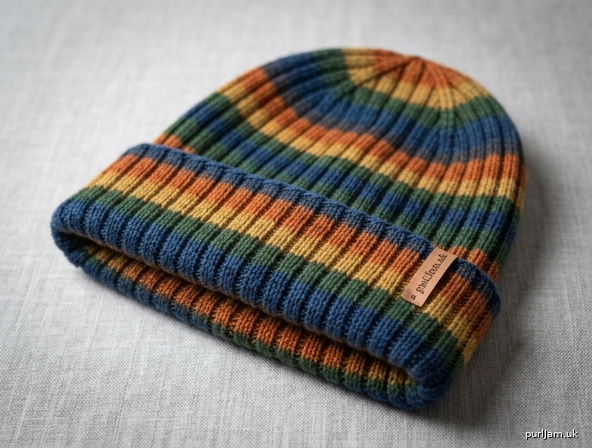
A Musselburgh-style reversible ribbed hat in self-striping sock yarn
A fully reversible, double-layer beanie worked in the round in k2, p2 rib. You knit the outer hat, shape the crown, then increase and knit the inner hat as a mirror image, joining live stitches to the cast-on edge. Two layers of fingering-weight rib give worsted-like warmth without bulk. Designed for Turtlepurl (or similar) self-striping sock yarn so the dye sequence runs in unbroken horizontal bands from brim to crown and onto the inner layer.
Skill level: Intermediate
Sizes
Child (Adult Small, Adult Medium, Adult Large)
To fit head circumference: 18 (20, 22, 24)" (45.5 [51, 56, 61] cm)
Shown in Adult Medium. Choose the size closest to your actual head measurement; ribbing supplies the ease. If you are between sizes and want the thickest possible self-striping bands, choose the smaller size — the fabric is stretchy.
Finished measurements
Circumference (blocked, lightly stretched): 16 (18¼, 20½, 22¾)" (40.5 [46.5, 52, 58] cm)
Height as worn (one body + crown): 7½ (8½, 9, 9½)" (19 [21.5, 23, 24] cm)
The hat is two identical layers. Height is measured on the finished, folded hat.
Yarn
Fingering-weight sock yarn (Turtlepurl or similar self-striping), about 400 yd / 366 m per 100 g; typically 75–85% superwash merino, 15–25% nylon.
300 (400, 480, 560) yd (275 [365, 440, 510] m)
Skeins at 400 yd / 100 g: 1 (2, 2, 2)
Adult Small can come in just under one 400 yd skein if your gauge is accurate and you skip a large swatch; buy two to be safe and to finish both layers from the same dye lot. Do not hold the yarn double — two layers of single-strand fingering is the intended fabric.
Needles
- US 3 / 3.25 mm, 16" (40 cm) circular, or size needed to obtain gauge
- Same size DPNs, or a long circular for magic loop, for the crown
- Spare circular, US 3 / 3.25 mm, for the brim join
- US 5 / 3.75 mm needle (straight or circular) for the 3-needle bind-off only (the extra size keeps the brim stretchy)
Notions
- Stitch marker for beginning of round, plus 7 additional markers (8 total) for crown shaping
- Tapestry needle
- Spare needle or stitch holder for picking up the cast-on edge
Gauge
28 sts and 36 rnds = 4" (10 cm) in k2, p2 rib, blocked and lightly stretched, on US 3 / 3.25 mm.
Work the swatch in the round. Measure the rib while stretching it just until the purl columns begin to show — that is the “as-worn” fabric of a double-layer hat. Change needle size if needed; fabric that is too dense will make a stiff double layer, and fabric that is too open will lose warmth.
Abbreviations (US)
BO — bind off BOR — beginning of round CO — cast on k — knit k2tog — knit 2 stitches together (1 st decreased) kfb — knit into the front and back of the stitch (1 st increased) M1L — make 1 left: lift the strand between the needles from front to back, knit through the back loop (1 st increased) p — purl pm — place marker rep — repeat rnd(s) — round(s) RS — right side slm — slip marker st(s) — stitch(es) WS — wrong side
Pattern notes
Construction. The hat is a reversible tube: outer body → crown decreases → turning rounds → crown increases → inner body → join to the cast-on. Do not cut the yarn at the crown. The dye sequence flows over the top and down the inside.
Rib. Every body round is *k2, p2; rep from * to end. The crown is worked in stockinette so the decreases and increases stay clean; the rib resumes as soon as the full stitch count is restored.
Self-striping / sock-stripe thickness. Stripe height is determined by stitches per round, not by the double-layer construction. A typical adult sock is 56–72 sts; this hat is 112 (128, 144, 160) sts, so each color band will be about 45–65% as tall as the same yarn on a 64-st sock. That is physics, not a gauge error. The bands remain clear, horizontal, and true to the dye sequence.
To keep stripes as thick as possible while still fitting:
- Wear the smallest size that goes on comfortably (ribbing plus two layers will still stretch).
- Do not add stitches “for luck.”
- Do not work short rows, slip-stitch colorwork, or knit flat — all of those break or tilt the stripes.
- Start from one end of the cake only. Pulling from both ends marls the colors and destroys the sock-like banding.
Fit. Two layers of rib stretch less than one. The finished lightly-stretched circumference is about 2" (5 cm) less than the head size. If you want a slouchier hat, add 1" (2.5 cm) to each body section (outer and inner).
Cast-on. German twisted (Old Norwegian) cast-on is specified because the stitches are easy to pick up later for the 3-needle join. A long-tail cast-on also works.
Instructions
Numbers are given as Child (Adult Small, Adult Medium, Adult Large).
Outer body
With US 3 / 3.25 mm circular needle, using a German twisted cast-on, CO 112 (128, 144, 160) sts. Join to work in the round, being careful not to twist. Pm for BOR.
Rib rnd: *k2, p2; rep from * to end.
Work Rib rnd until the piece measures 5½ (6, 6½, 7)" (14 [15, 16.5, 18] cm) from the cast-on edge.
Write down the number of rounds you worked. You will match this count exactly on the inner body so the layers are the same length (example: 50 rnds on the outer body → 50 rnds on the inner body).
Crown decreases (outer)
Setup rnd: Knit all sts, placing 7 additional markers evenly around — 8 markers total, 14 (16, 18, 20) sts in each section including the BOR marker. (8 × 14 = 112 ✓) (8 × 16 = 128 ✓) (8 × 18 = 144 ✓) (8 × 20 = 160 ✓)
Dec rnd: *Knit to 2 sts before marker, k2tog, slm; rep from * to end. 8 sts decreased.
Even rnd: Knit.
Work Dec rnd then Even rnd 8 (9, 10, 11) times.
- Child: 112 − (8 × 8) = 48 sts ✓
- Small: 128 − (8 × 9) = 56 sts ✓
- Medium: 144 − (8 × 10) = 64 sts ✓
- Large: 160 − (8 × 11) = 72 sts ✓
Now work Dec rnd every round 5 (6, 7, 8) times.
- Child: 48 − (8 × 5) = 8 sts ✓
- Small: 56 − (8 × 6) = 8 sts ✓
- Medium: 64 − (8 × 7) = 8 sts ✓
- Large: 72 − (8 × 8) = 8 sts ✓
Turning rnds: Knit 2 rounds even on these 8 sts. Remove extra markers; keep BOR marker. You are at the top of the hat. Do not cut yarn.
Crown increases (inner)
Inc setup rnd: Kfb in every st. 16 sts (8 + 8 = 16 ✓). Place 7 additional markers evenly — 8 markers total, 2 sts in each section.
Inc rnd: *Knit to marker, M1L, slm; rep from * to end. 8 sts increased.
Work Inc rnd every round 4 (5, 6, 7) times.
- Child: 16 + (8 × 4) = 48 sts ✓
- Small: 16 + (8 × 5) = 56 sts ✓
- Medium: 16 + (8 × 6) = 64 sts ✓
- Large: 16 + (8 × 7) = 72 sts ✓
Now work Even rnd then Inc rnd 8 (9, 10, 11) times.
- Child: 48 + (8 × 8) = 112 sts ✓
- Small: 56 + (8 × 9) = 128 sts ✓
- Medium: 64 + (8 × 10) = 144 sts ✓
- Large: 72 + (8 × 11) = 160 sts ✓
Remove extra markers; keep BOR. You should have 112 (128, 144, 160) sts, matching the cast-on.
Inner body
Next rnd: *k2, p2; rep from * to end.
Continue in k2, p2 rib until you have worked the same number of rounds as the outer body (the number you wrote down). Do not measure inches here — match the round count so the layers and any stripe bands stack.
Join the brim
The live stitches now sit at the inner brim, opposite the cast-on edge.
- Turn the hat so one layer is nested inside the other, WS together, with the two brim edges aligned. The RS of each layer faces outward (the hat as it will be worn).
- With the spare US 3 / 3.25 mm needle, pick up 112 (128, 144, 160) loops along the German twisted cast-on — one loop for each cast-on stitch. You now have two needles, each holding 112 (128, 144, 160) sts.
- Using the US 5 / 3.75 mm needle, join with a 3-needle bind-off in the k2, p2 rib as established: with the two needle tips parallel, work k2tog (one st from each needle) for each knit column and p2tog (one st from each needle) for each purl column, passing the previous st over in the usual bind-off manner. The larger needle keeps this edge stretchy.
Alternative join: Bind off the live sts loosely in rib (Jeny’s surprisingly stretchy bind-off is ideal), then mattress-stitch that edge to the cast-on edge with the layers nested.
Finishing
Weave in ends on the inside of the brim join, where they are hidden between layers.
Wet-block gently: soak in lukewarm water, press out water in a towel, and lay flat. Do not stretch the rib to the finished circumference — let it relax. Two layers take longer to dry; turn the hat inside out once the outer layer is damp-dry.
The hat is reversible. Wear either layer out. The 3-needle ridge can sit as a defined brim or be flipped inside for a softer fold.
Care (superwash sock yarn): Machine wash cold, gentle cycle, or hand wash. Lay flat to dry. Do not tumble on high heat.
Schematic (text)
- Cast-on = inner/outer brim join
- Outer rib body: 5½ (6, 6½, 7)" (14 [15, 16.5, 18] cm)
- 8-point crown down to 8 sts, 2 turning rounds, 8-point crown back up
- Inner rib body: same round count as outer
- As-worn height: 7½ (8½, 9, 9½)" (19 [21.5, 23, 24] cm)
- As-worn circumference, lightly stretched: 16 (18¼, 20½, 22¾)" (40.5 [46.5, 52, 58] cm)
Disclaimer: This pattern was generated by AI and should be reviewed for accuracy before use. While we strive for quality, AI-generated content may contain errors. Please verify measurements, stitch counts, charts, and instructions before beginning your project. Generated by purlJam.uk
Love this pattern?
Save this pattern to your free PurlJam libraryAccess your pattern anytime
Bookmark this page to access your pattern anytime