Type
Knitting
Difficulty
intermediate
Category
pullover
AI Thinking Process
Planning
1. **Design Strategy**:
- Top-down raglan pullover in stockinette stitch
- Size Small only requested (34-36" bust), with ~2-4" positive ease = ~38" finished bust
- Sport weight yarn, UK English terminology, metric first
- Crew neck (default per template)
- Easy difficulty level — keep instructions clear, minimal complex techniques
- Tension/gauge for sport weight: typically 24 sts × 32 rows = 10 cm (4") in stockinette on 3.5mm or 3.75mm needles
- I'll use 24 sts / 32 rows per 10 cm on 3.75mm needles (a common sport weight tension)
2. **Construction Plan**:
- Cast on neckline stitches for crew neck
- Set up raglan markers (4 raglan lines dividing: back, 2 sleeves, front)
- Work raglan increases every other round (M1L before marker, M1R after marker) = 8 increases per increase round
- Work yoke to armhole depth
- Separate sleeves onto holders
- Cast on underarm stitches, join body, work to hem
- Add ribbing at hem
- Pick up sleeves, work down to cuff with decreases
- Add ribbed cuffs
3. **Quality Assurance**:
- Verify stitch counts at every stage
- Ensure raglan math is consistent
- Check armhole depth is appropriate for size small
- Ensure sleeve decreases are evenly spaced
- Keep instructions simple for "easy" difficulty
- UK terminology throughout
4. **Final Calculations**:
**Tension**: 24 sts × 32 rows = 10 cm in stockinette on 3.75mm needles
**Size Small target**: Finished bust = 96 cm (38") with ~2-4" positive ease over 34-36" bust.
**Key measurements for Size Small**:
- Finished bust circumference: 96 cm (38")
- Finished length (underarm to hem): 38 cm (15")
- Armhole depth (yoke depth at side): approximately 20 cm (8")
- Upper sleeve circumference: ~35 cm (14")
- Sleeve length (underarm to cuff): 45 cm (17.75")
- Cuff circumference: ~20 cm (8")
**Stitch counts**:
Body stitches at underarm = 96 cm × 24 sts / 10 cm = 230.4 → 232 sts (divisible by 4 for ease, actually let me check: 232 / 2 = 116 front + 116 back — works)
Wait, let me be more precise. Total body circumference = 96 cm.
Body sts = 24 × 96 / 10 = 230.4 → round to 232 sts (front + back = 116 each)
**Sleeve sts at upper arm**:
Upper sleeve circumference = 35 cm
Sleeve sts = 24 × 35 / 10 = 84 sts per sleeve
**Raglan yoke construction**:
At cast-on (crew neck): The yoke is divided into:
- Back sts
- 2 raglan "seam" sts (1 each raglan line, or markers only)
- Front sts
- 2 sleeve sections
Standard crew neck cast-on for sport weight size small:
Neckline circumference ≈ 40 cm (16")
Neckline sts = 24 × 40 / 10 = 96 sts
Let me distribute these across sections. A typical raglan setup uses:
- 4 raglan seam stitches (1 st per raglan line, so 4 marker sts)
- Remaining sts split between back, front, and sleeves
Total neck sts = 96 sts
Distribution at cast-on:
- Back: 32 sts
- Front: 28 sts (fewer to allow for neckline — crew neck typically slightly shallower at front... actually for simplicity at easy level, let's keep front and back equal)
- Actually for easy level crew neck: keep front = back, and sleeves smaller
- Let's use: Back = 30, Front = 30, each Sleeve = 14, Raglan markers = 4 seam sts...
Let me use a common approach with just markers (no dedicated seam stitches) for easy construction:
Total CO = 96 sts
Back = 32 sts
Front = 32 sts
Each sleeve = 14 sts
Raglan sections: 4 markers
32 + 32 + 14 + 14 = 92 sts + 4 markers...
Actually with no dedicated seam sts:
Back + Front + Sleeve + Sleeve = 32 + 32 + 14 + 14 = 92. Hmm, let me target 92 cast on.
OR let me just use 1 seam stitch at each raglan line (4 seam sts total):
Back = 30, Front = 30, Sleeves = 13 each, Seam sts = 4 × 1 = 4
Total = 30 + 30 + 13 + 13 + 4 = 90 sts
Neckline = 90 sts → neckline circumference = 90/24 × 10 = 37.5 cm (14.75") — that's reasonable for a crew neck.
Let me try without seam stitches for simplicity (easier pattern):
CO 88 sts
Back = 30, Front = 28, Sleeves = 15 each
30 + 28 + 15 + 15 = 88 ✓
Neckline = 88/24 × 10 = 36.7 cm (14.4") — good for crew neck
After ribbed neckband, then start raglan increases.
Actually, let me reconsider. Let me pick cleaner numbers.
**Let me restart the math carefully:**
Tension: 24 sts / 32 rows per 10 cm
Target finished bust: 96 cm (38")
Body sts needed = 96 × 24 / 10 = 230.4 → 232 sts total in round for body
Front = 116, Back = 116
Target upper sleeve: 35 cm circumference
Sleeve sts = 35 × 24 / 10 = 84 sts per sleeve
**Underarm cast-on**: Typically 6-10 sts cast on at underarm for each side
Let's use 8 sts each underarm.
So at separation:
Body sts from yoke = 232 - (2 × 8) = 232 - 16 = 216 sts from yoke for body
But body sts from yoke (front + back) at separation = 216 sts... meaning front = 108, back = 108
Each sleeve sts at separation: 84 - 8 = 76 sts from yoke per sleeve
**Total yoke sts at separation**:
Front (108) + Back (108) + Sleeve (76) + Sleeve (76) = 368 sts
Plus 4 markers (no seam sts in this simple version) = 368 sts
**Cast-on sts for neckline**:
CO = 88 sts (let me verify this works)
Back CO = 30, Front CO = 28, each Sleeve CO = 15
Total CO = 30 + 28 + 15 + 15 = 88 sts
After the neckband, we start raglan increases.
**Raglan increase rounds**: Each increase round adds 8 sts (2 per raglan line × 4 lines)
We need to go from:
- Front: 28 → 108 sts = +80 sts = 40 increase rounds for front
- Back: 30 → 108 sts = +78 sts = 39 increase rounds for back
Hmm, front and back need different numbers of increases, which doesn't work in standard raglan (both increase at same rate). Let me adjust CO to make front = back.
Set Front CO = Back CO = 29, each Sleeve = 15
Total = 29 + 29 + 15 + 15 = 88 sts ✓
Now: Front 29 → 108 = +79 (not even — needs to be even for symmetrical increases)
Let me adjust final body counts.
Actually, I need body at separation to have even numbers when divided by front and back.
Let me work backwards more carefully:
CO sts for body and sleeve sections must satisfy:
- CO_back + (2 × num_increase_rounds) = back_sts_at_separation
- CO_front + (2 × num_increase_rounds) = front_sts_at_separation
- CO_sleeve + (2 × num_increase_rounds) = sleeve_sts_at_separation
Since front and back increase at same rate, if CO_front = CO_back, then front_sep = back_sep.
For sleeves and body: same number of increase rounds, so all sections determined by CO and number of rounds.
Let n = number of raglan increase rounds
front_sep = CO_front + 2n
back_sep = CO_back + 2n
sleeve_sep = CO_sleeve + 2n (each sleeve)
Total body sts at sep (before adding underarm) = front_sep + back_sep
Total body sts in round = front_sep + back_sep + 2 × underarm_sts = 232
So front_sep + back_sep = 232 - 16 = 216
If front = back: each = 108
sleeve_sep = 84 - 8 = 76 (subtracting underarm sts)
Now: n = (108 - CO_front) / 2
For this to be whole number: CO_front must be even.
Also: n = (76 - CO_sleeve) / 2
For whole number: CO_sleeve must be even.
Let's set:
- CO_front = CO_back = 30 (even)
- n = (108 - 30) / 2 = 78/2 = 39 increase rounds ✓
- CO_sleeve: n = (76 - CO_sleeve) / 2 → CO_sleeve = 76 - 2×39 = 76 - 78 = -2
That's negative! The sleeve starts with too few sts. The number of increase rounds gives sleeves too many stitches.
Problem: sleeves increase at same rate as body sections, but body needs more total increase than sleeves.
This is the fundamental constraint of raglan: with 39 increase rounds, sleeves gain 78 sts each. If sleeve at separation = 76, then sleeve CO = 76 - 78 = negative. Impossible.
So I need to reduce n, which means adjusting body and sleeve targets.
Let me try different approach. Set n = 36 increase rounds.
Then:
back_sep = CO_back + 72
front_sep = CO_front + 72
sleeve_sep = CO_sleeve + 72
For sleeve_sep = 76: CO_sleeve = 76 - 72 = 4 sts ← very few but okay (some patterns do start with very few sleeve sts)
For body: front_sep + back_sep = 216
If CO_front = CO_back: each = (216 - 144) / 2 = 72/2 = 36 sts CO per section
Total CO = 36 + 36 + 4 + 4 = 80 sts
Neckline = 80/24 × 10 = 33.3 cm (13.1") — a bit small for crew neck.
Let me try n = 32:
sleeve CO = 76 - 64 = 12 sts ✓
body CO each = (216 - 128) / 2 = 88/2 = 44 sts
Total CO = 44 + 44 + 12 + 12 = 112 sts
Neckline = 112/24 × 10 = 46.7 cm (18.4") — too large!
Let me try n = 34:
sleeve CO = 76 - 68 = 8 sts
body CO each = (216 - 136) / 2 = 80/2 = 40 sts
Total CO = 40 + 40 + 8 + 8 = 96 sts
Neckline = 96/24 × 10 = 40 cm (15.75") — perfect for crew neck!
Let me verify:
- n = 34 increase rounds
- CO: Back = 40, Front = 40, each Sleeve = 8
- Total CO = 96 sts ✓
- After 34 increase rounds:
- Back = 40 + 68 = 108 ✓
- Front = 40 + 68 = 108 ✓
- Each sleeve = 8 + 68 = 76 ✓
- Total at separation = 108 + 108 + 76 + 76 = 368 sts ✓
- Adding underarm (8 sts each side):
- Body: 108 + 108 + 8 + 8 = 232 sts ✓ (= 96 cm finished)
- Each sleeve: 76 + 8 = 84 sts ✓ (= 35 cm)
**Yoke depth**:
34 increase rounds, every other round, so total rounds in yoke = 34 × 2 = 68 rounds
Plus some plain rounds, neckband rounds etc.
Yoke depth = 68 rounds / 32 rows per 10 cm × 10 = 21.25 cm
That's approximately 21 cm (8.25") — reasonable for armhole depth on size small ✓
**Body length**:
From underarm to hem (excluding ribbing): 38 cm (15")
Rounds needed = 38 × 32 / 10 = 121.6 → ~122 rounds
Hem ribbing: 5 cm = 16 rounds
Total body length from underarm: 43 cm (17") including ribbing
**Sleeve decreases**:
Sleeve starts at: 84 sts
Cuff target: 48 sts (20 cm circumference: 48/24×10 = 20 cm ✓)
Decreases needed: (84 - 48) / 2 = 18 decrease rounds (each dec round removes 2 sts: k2tog, ssk or equiv)
Wait: each decrease round = 2 sts decreased, so 36 sts decreased over 18 dec rounds.
84 - 36 = 48 sts ✓
Sleeve length from underarm to cuff (including cuff ribbing): 45 cm (17.75")
Cuff ribbing: 5 cm = 16 rounds
Sleeve body: 40 cm = 128 rounds
18 decrease rounds over 128 rounds = every 7 rounds (128/18 = 7.1)
→ Decrease every 7th round, 18 times: 18 × 7 = 126 rounds — good, close enough, 2 plain rounds extra at top
Let me verify: starting at 84 sts, decrease every 7 rounds × 18 times = 84 - 36 = 48 sts ✓
Actually, I want to double-check the "every 7 rounds" fits within the sleeve length:
18 decreases × 7 rounds = 126 rounds + small adjustment at top
126 rounds = 126/32 × 10 = 39.4 cm (15.5") — then add a few plain rounds + 16 ribbing rounds = ~40 + 5 = 45 cm ✓
**Neckband**:
CO 96 sts, work k1, p1 rib for 2.5 cm (1") on smaller needles (3.25mm)
Join for working in the round after picking up neckband.
Actually in top-down, the neckband is worked first, then we transition to body. Let me reconsider.
For top-down crew neck:
1. Using smaller needles, CO 96 sts, pm, join for working in the round, work k1, p1 rib for 2.5 cm
2. Change to larger needles
3. Set up raglan: place markers for raglan sections
Actually, in many top-down patterns, neckband is CO on circular needle, worked in rib, then markers placed for raglan increases. This is correct.
CO 96 sts — this is the neckline cast-on.
After neckband, we begin raglan setup.
Actually, I should think about whether the neckband sts need adjustment. The CO sts of 96 become the actual working sts. After neckband rib on smaller needles (which has natural negative ease/tighter tension), we switch to larger needles and place markers.
Marker setup after neckband:
PM, k40 (back), PM, k8 (sleeve), PM, k40 (front), PM, k8 (sleeve) = 96 sts ✓
**Raglan increase setup**:
Increase Round: *K to 1 st before marker, M1R, k1, SM, k1, M1L; repeat from * 4 times, k to end.
Wait, I need to think about the raglan marker placement. Standard approach:
Method 1 (no seam stitch):
Place markers between sections. At each marker: M1R before marker, SM, M1L after marker.
Method 2 (with 1 seam stitch):
Each raglan line = 1 knit stitch. Increases go on either side of that stitch.
For easy pattern, I'll use Method 1 (markers only, no seam sts) — but actually Method 2 with a seam stitch makes the raglan line more visible and is considered a nice feature. Let me use 1 seam stitch per raglan line for clarity.
With 4 seam sts (one per raglan line):
We need to adjust the CO. Let me include 4 seam sts.
Revised CO = 96 + 4 = 100 sts? Or adjust sections?
Let me keep total CO = 96 and absorb seam sts into the count:
Back = 38 sts + 2 seam sts (one each side)
Front = 38 sts + 2 seam sts
Sleeves = 8 sts (the 4 seam sts are placed on body sections)
Hmm, this gets complicated. Let me just go with the clean marker-only method (Method 1).
After raglan increase round:
Back section increases by 2 (one at each end)
Each sleeve increases by 2
Front section increases by 2
So the 34 increase rounds work exactly as calculated.
Let me also consider: for an easy pattern, should I include the back neck short rows? The template says "optional." I'll skip them for easy difficulty.
**Summary of key numbers for pattern:**
Tension: 24 sts × 32 rows = 10 cm
Size Small:
- Finished bust: 96 cm (38")
- Body length underarm to hem: 38 cm (15") + 5 cm (2") ribbing = 43 cm (17")
- Sleeve length: 40 cm (15.75") + 5 cm (2") cuff = 45 cm (17.75")
- Neckband: 2.5 cm (1")
- Yoke depth: approx 21 cm (8.25")
Cast on: 96 sts
Setup: Back = 40, Sleeve = 8, Front = 40, Sleeve = 8
Raglan increase rounds: 34
After yoke: Back = 108, Front = 108, each Sleeve = 76
Underarm CO: 8 sts each side
Final body: 232 sts
Final sleeve: 84 sts each
Sleeve decrease to: 48 sts
Sleeve dec: every 7 rounds × 18 times
Needles:
- Main: 3.75mm (US 5) circular needle, 80 cm (32") for body
- Smaller: 3.25mm (US 3) for ribbing
- Also: 3.75mm DPNs or short circular for sleeves
Let me also think about what to use for markers. I'll specify stitch markers.
For stitch holders: waste yarn or stitch holders.
Let me now double-check the ease calculation:
Finished bust = 232 sts / 24 sts per 10 cm × 10 = 96.7 cm ≈ 96 cm
For size small (34-36" = 86-91 cm), ease = 96 - 88.5 (mid-range) = 7.5 cm ≈ 3" positive ease ✓
Everything checks out. Now I'll write the pattern.
One more check — the sleeve seam stitch approach: I'll keep it simple with just markers, no seam stitches, for easy difficulty.
The increase round will be:
**Raglan Increase Round**: [K to marker, M1L, SM, M1R] 4 times, k to end of round.
Wait, let me think about M1L and M1R placement carefully:
- M1L before marker = leans left, nice diagonal toward sleeve
- M1R after marker = leans right
Standard raglan: the increases lean away from the raglan line, creating the diagonal.
Standard convention:
- K to 1 st before marker, M1R, k1, SM, k1, M1L — when marker is between sections with seam st
Without seam st:
- K to marker, M1L, SM, M1R — but this creates increases that lean towards each other
Actually the conventional approach:
K to marker, M1R, SM, M1L — this places:
- M1R at the end of one section (leans right)
- M1L at the start of next section (leans left)
Both sts added to adjacent sections.
Hmm, let me think again. In a standard raglan:
- The raglan "seam" line is typically at the marker position
- On the body side: M1R just before marker (leans right, blends into body sts)
- On the sleeve side: M1L just after marker (leans left, blends into sleeve sts)
- At the other end of sleeve: M1R just before next marker
- Then M1L after next marker (blends into body)
So the increase round (without seam sts) is:
*K to 1 st before marker, M1R, k1, slip marker, k1, M1L; repeat from * 3 more times, k to end.
Wait — this adds 1 st before the marker and 1 st after, but those sts belong to adjacent sections. So effectively:
- Each body section grows by 1 st on each end (2 sts per section)
- Each sleeve section grows by 1 st on each end (2 sts per section)
→ Total +8 sts per increase round ✓
But this changes the marker positions slightly... Actually in standard raglan, the markers are placed between sections, and the increases are on either side. The convention:
"K to marker, M1R, SM, M1L" — this adds 1 st to the section just ending (body/sleeve) and 1 st to the section just starting.
Per traditional raglan instructions:
Increase Round: *K to marker, M1R, SM, M1L; rep from * 3 more times, k to end of round.
This is clean and easy to follow. Let me use this.
Effect:
- Round 1 setup: Back(40), M, Sleeve(8), M, Front(40), M, Sleeve(8), M — start of round at beginning of back
- After 1 inc round: Back(42), M, Sleeve(10), M, Front(42), M, Sleeve(10), M = 104 sts
- After 34 inc rounds: Back(40+68=108), Sleeve(8+68=76), Front(40+68=108), Sleeve(8+68=76) = 368 sts ✓
Great, this is consistent.
Now the full pattern is ready to write.
**Materials list:**
- Sport weight yarn: approximately 1000-1200m for size small
- Let me estimate:
- Body: 232 sts × 68 body rounds (38cm) = ~15,776 sts worked...
- Better to estimate by weight/yardage for sport weight
- A typical sport weight sweater size small: ~900-1100m
- I'll say approximately 1000 m (1094 yards)
**Needles:**
- 3.75mm (US 5) circular, 80 cm (32") — main body
- 3.25mm (US 3) circular, 80 cm (32") — ribbing
- 3.75mm circular or DPNs for sleeves
Actually, let me reconsider needle sizes. Sport weight is typically knit on 3.25-3.75mm needles. For tension of 24 sts/10 cm, 3.75mm is reasonable. Let me state this clearly and note to swatch.
Now write the pattern!
Verification
[PRE-FLIGHT CHECKS]
1. **Completeness**:
✅ Neckband section included
✅ Yoke/raglan setup and increase section included
✅ Sleeve separation instructions included
✅ Body section (underarm to hem) included
✅ Hem ribbing included
✅ Sleeve section (top-down, with decreases) included
✅ Cuff ribbing included
✅ Finishing instructions included
✅ Materials, tension, abbreviations, measurements all present
2. **Consistency checks (stitch count chain)**:
✅ Cast-on: 96 sts total (Back 40 + Sleeve 8 + Front 40 + Sleeve 8)
✅ Neckline circumference: 96 ÷ 24 × 10 = 40 cm (15.75") — correct crew neck size
✅ Raglan increases: 34 increase rounds, +8 sts per round = +272 sts total
✅ Total after yoke: 96 + 272 = 368 sts
✅ Back after yoke: 40 + (34×2) = 40 + 68 = 108 sts ✓
✅ Front after yoke: 40 + 68 = 108 sts ✓
✅ Each sleeve after yoke: 8 + 68 = 76 sts ✓
✅ Check: 108 + 76 + 108 + 76 = 368 sts ✓
✅ Underarm cast-on: 8 sts each side = 16 sts total added to body
✅ Total body sts: 108 (back) + 108 (front) + 8 + 8 (underarms) = 232 sts
✅ Finished bust: 232 ÷ 24 × 10 = 96.7 cm ≈ 96 cm (38") ✓ — 3" positive ease over 34-36" bust ✓
✅ Each sleeve total: 76 + 8 (underarm pickup) = 84 sts
✅ Upper sleeve circumference: 84 ÷ 24 × 10 = 35 cm (13.75") ✓
✅ Sleeve decrease: 84 sts → 48 sts = 36 sts decreased = 18 decrease rounds
✅ Each decrease round removes 2 sts (k2tog + ssk) ✓
✅ 18 decreases × every 7 rounds = 126 rounds = 39.4 cm — fits within ~40 cm sleeve body ✓
✅ Cuff circumference: 48 ÷ 24 × 10 = 20 cm (8") ✓
✅ Yoke depth: 34 increase rounds × 2 (every other round) = 68 rounds ÷ 32 rows × 10 = 21.25 cm ≈ 21 cm (8.25") — appropriate armhole depth for size small ✓
3. **Constraints**:
✅ Sport weight yarn specified
✅ UK English spelling throughout (colour, tension, centre, etc.)
✅ Metric measurements primary, imperial in parentheses
✅ "Tension" used (not gauge — though gauge mentioned in parentheses where appropriate)
✅ Needle sizes in metric first
✅ Top-down raglan construction as per template
✅ Seamless construction ✓
✅ Crew neck (default) ✓
✅ Easy difficulty — no short rows, clear step-by-step instructions ✓
✅ Stockinette (stocking stitch in UK) ✓
✅ Ribbed cuffs and hem ✓
4. **Safety (potential errors)**:
✅ Sleeve separation clearly described — body and sleeves separated onto waste yarn
✅ Underarm cast-on clearly explained
✅ Raglan increase round formula verified: *K to marker, M1R, SM, M1L; rep × 4 = +8 sts ✓
✅ Working in the round direction consistent (right side always facing)
✅ Magic loop or DPN alternative mentioned for sleeves
✅ No impossible negative stitch counts anywhere in the chain
✅ Yarn quantity estimate appropriate for sport weight size small
✅ Needle size recommendation consistent with 24 sts/10 cm tension on sport weight
Pattern
---

# TOP-DOWN RAGLAN PULLOVER
### A Seamless, Easy-to-Knit Sweater in Sport Weight

---

## AT A GLANCE

| Detail | Specification |
|---|---|
| **Size** | Small (finished bust: 96 cm / 38") |
| **Fit** | 34–36" bust with approx. 5–6 cm (2–3") positive ease |
| **Construction** | Top-down, seamless, worked in the round |
| **Yarn Weight** | Sport |
| **Primary Technique** | Raglan yoke with M1L/M1R increases |
| **Difficulty** | Easy |

---

## FINISHED MEASUREMENTS

| Measurement | Centimetres | Inches |
|---|---|---|
| Bust circumference | 96 cm | 38" |
| Body length (underarm to hem, including ribbing) | 43 cm | 17" |
| Yoke depth | 21 cm | 8.25" |
| Upper sleeve circumference | 35 cm | 13.75" |
| Sleeve length (underarm to cuff, including ribbing) | 45 cm | 17.75" |
| Cuff circumference | 20 cm | 8" |
| Neckline circumference | 40 cm | 15.75" |

---

## MATERIALS

**Yarn**: Sport weight (CYCA #2), any fibre
- Approximately **1,000–1,100 m (1,094–1,203 yds)**
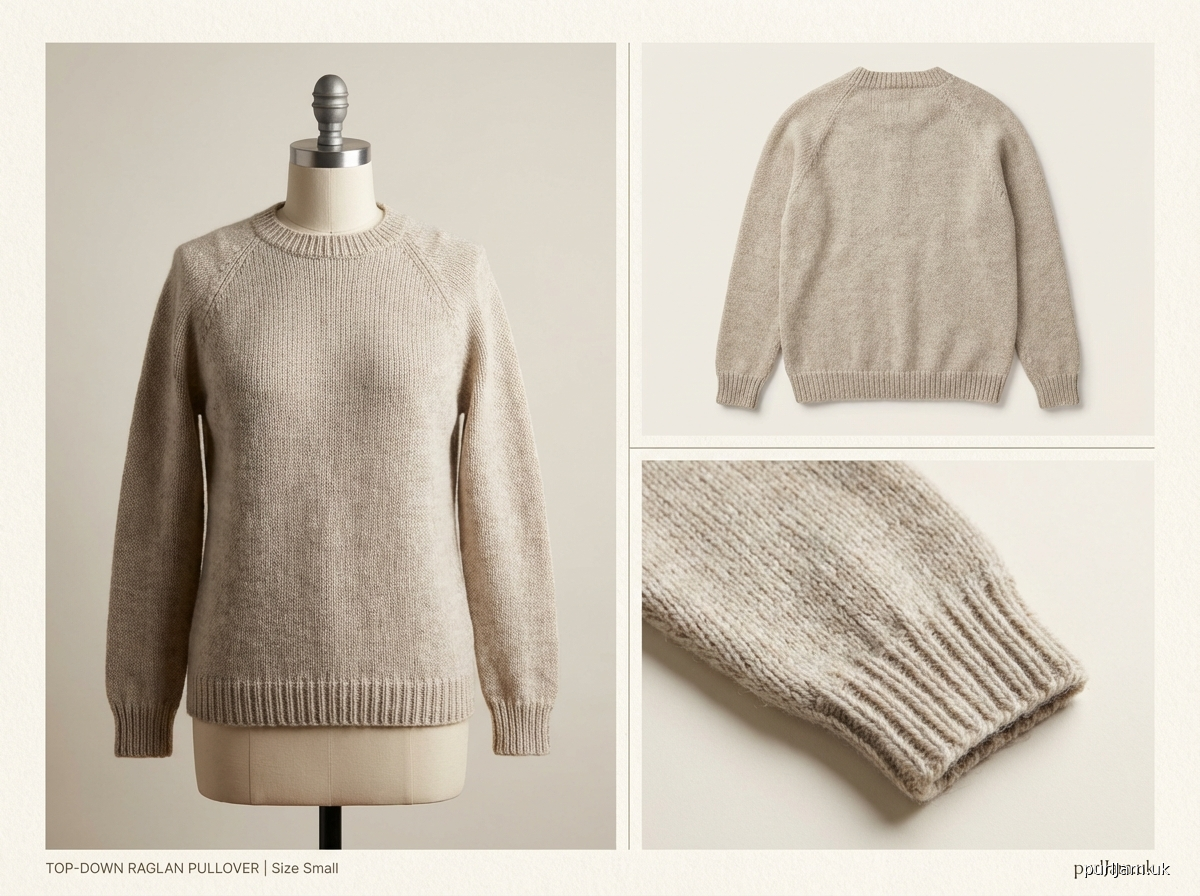
- *Sample shown in a smooth, plied wool-blend for stitch definition*

**Needles**:
- **3.75 mm (US 5)** circular needle, 80 cm (32") long — for yoke and body
- **3.25 mm (US 3)** circular needle, 80 cm (32") long — for neckband, hem, and cuffs
- **3.75 mm (US 5)** circular needle, 40 cm (16") long, *or* set of double-pointed needles (DPNs) — for sleeves
- *(Alternatively, use the magic-loop method with one long circular for sleeves)*

**Notions**:
- 4 stitch markers (use a unique/different marker for the start of round)
- Spare yarn or stitch holders (for holding sleeve stitches)
- Tapestry needle (for weaving in ends)
- Scissors

---

## TENSION (GAUGE)

**24 stitches × 32 rows = 10 cm (4") in stocking stitch, using 3.75 mm needles**

> ⚠️ **Tension is crucial.** Please work a tension swatch before beginning. Wash and block your swatch as you intend to wash the finished sweater, then measure. Adjust needle size as needed: go up a size if your stitches are too tight (fewer sts per 10 cm), go down a size if your stitches are too loose (more sts per 10 cm).

---

## ABBREVIATIONS

| Abbreviation | Meaning |
|---|---|
| **k** | knit |
| **p** | purl |
| **k2tog** | knit 2 stitches together (right-leaning decrease) |
| **ssk** | slip 1 knitwise, slip 1 knitwise, knit both through back loops (left-leaning decrease) |
| **M1L** | make 1 left: insert left needle from front to back under the bar between sts, knit through back loop |
| **M1R** | make 1 right: insert left needle from back to front under the bar between sts, knit through front loop |
| **PM** | place marker |
| **SM** | slip marker |
| **BOR** | beginning of round |
| **RS** | right side |
| **CO** | cast on |
| **rnd(s)** | round(s) |
| **st(s)** | stitch(es) |
| **rep** | repeat |
| **rem** | remaining |

---

## CONSTRUCTION OVERVIEW

This sweater is worked from the top down, entirely in the round, with no seaming required. Here is the order of construction:

1. **Neckband** — cast on, work ribbing at neck
2. **Yoke** — set up raglan sections; work increases to build the yoke
3. **Separate sleeves** — place sleeve stitches on holders; cast on underarm stitches; join body
4. **Body** — work body in the round down to hem; work hem ribbing
5. **Sleeves** — pick up sleeve stitches and underarm stitches; work sleeve decreases down to cuff; work cuff ribbing
6. **Finishing** — weave in ends and block

---

## PATTERN INSTRUCTIONS

---

### SECTION 1: NECKBAND

Using **3.25 mm** circular needle, cast on **96 stitches** using a long-tail cast-on or your preferred stretchy method.

Place a unique stitch marker and join to work in the round, being careful not to twist your stitches.

**Neckband Setup**:
Work [k1, p1] rib for **2.5 cm (1")** — approximately 8 rounds.

> *The neckband should be slightly snug so it sits neatly at the neck. If you prefer a slightly looser neckline, try going up one needle size for the neckband only.*

---

### SECTION 2: YOKE SETUP

Change to **3.75 mm** circular needle.

**Arrange stitches and place raglan markers as follows:**

Knit **40 sts** (back), PM, knit **8 sts** (left sleeve), PM, knit **40 sts** (front), PM, knit **8 sts** (right sleeve), PM (this last marker is your BOR marker).

You now have:
| Section | Stitch Count |
|---|---|
| Back | 40 sts |
| Left sleeve | 8 sts |
| Front | 40 sts |
| Right sleeve | 8 sts |
| **Total** | **96 sts** |

> *Tip: Use 3 identical markers for the raglan lines and a unique/different colour marker for the BOR.*

---

### SECTION 3: RAGLAN YOKE INCREASES

You will now work the raglan yoke, alternating between increase rounds and plain rounds.

**Raglan Increase Round**:
*\*K to marker, M1R, SM, M1L; rep from \* 3 more times, k to end of round.*

> This adds **8 stitches per increase round** (2 sts at each of the 4 raglan lines).

**Plain Round**: Knit all stitches, slipping markers as you pass them.

**Work these two rounds alternately** (Increase Round, Plain Round) for a total of **34 Increase Rounds**.

After all 34 Increase Rounds (68 rounds total), your stitch counts will be:

| Section | Stitches |
|---|---|
| Back | 108 sts |
| Left sleeve | 76 sts |
| Front | 108 sts |
| Right sleeve | 76 sts |
| **Total** | **368 sts** |

> **Inline check**: 40 + (34 × 2) = 40 + 68 = 108 sts per body section ✓
> 8 + (34 × 2) = 8 + 68 = 76 sts per sleeve ✓
> 108 + 76 + 108 + 76 = 368 sts ✓

> **Try it on!** One of the great advantages of top-down knitting is that you can slide your work onto a spare circular needle or waste yarn and try the sweater on to check the yoke depth and fit. The yoke depth at this point will be approximately **21 cm (8.25")**. If you would like more armhole depth, simply work additional increase rounds (and plain rounds) in pairs — each pair of rounds adds approximately 0.6 cm (¼"). Remember to update your stitch counts accordingly.

---

### SECTION 4: SEPARATE SLEEVES FROM BODY

Now you will place the sleeve stitches on hold and join the body into one circle.

**Step 1 — Remove the BOR marker.**

**Step 2 — Knit across the back**: Knit 108 back stitches.

**Step 3 — Place left sleeve on hold**: Remove marker. Slip the next **76 sts** (left sleeve) onto a length of spare yarn or stitch holder. Remove marker. Do not cut your working yarn.

**Step 4 — Cast on underarm stitches**: Using the backward loop (or cable) cast-on, CO **8 stitches** over the gap left by the sleeve.

**Step 5 — Knit across the front**: Knit 108 front stitches.

**Step 6 — Place right sleeve on hold**: Remove marker. Slip the next **76 sts** (right sleeve) onto a separate length of spare yarn or stitch holder. Remove marker.

**Step 7 — Cast on underarm stitches**: CO **8 stitches** over the gap left by the sleeve.

**Step 8 — Place new BOR marker** and join to work in the round.

You now have **232 stitches** on the needle for the body.

> **Inline check**: 108 (back) + 8 (underarm) + 108 (front) + 8 (underarm) = 232 sts ✓
> Finished bust: 232 ÷ 24 × 10 = **96.7 cm ≈ 96 cm (38")** ✓

---

### SECTION 5: BODY

Work all 232 body stitches in stocking stitch (knit every round) until the body measures **38 cm (15")** from the underarm, or your desired length less 5 cm (2") for the hem ribbing.

> *Try the sweater on periodically to check the length. This is a great opportunity to customise the length to suit you.*

---

### SECTION 6: HEM RIBBING

Change to **3.25 mm** circular needle.

Work [k1, p1] rib for **5 cm (2")** — approximately 16 rounds.

Cast off loosely using a stretchy cast-off. Recommended: work the cast-off in rib pattern (cast off k sts as k, p sts as p) or use a sewn cast-off for maximum stretch.

---

### SECTION 7: SLEEVES (WORK BOTH THE SAME)

> *Work one sleeve at a time. Repeat all instructions for the second sleeve.*

**Pick up sleeve stitches**:

Using your **3.75 mm** sleeve needle (DPNs, short circular, or magic loop), return the **76 held sleeve stitches** to the needle, ready to knit.

Rejoin yarn at the centre of the underarm. **Pick up and knit 8 stitches** across the underarm cast-on edge, then knit across the 76 held sleeve stitches. PM for BOR.

You now have **84 stitches** on the needle.

> **Inline check**: 76 (held sts) + 8 (underarm pickup) = 84 sts ✓
> Upper sleeve circumference: 84 ÷ 24 × 10 = **35 cm (13.75")** ✓

> *Note: Pick up the underarm stitches firmly and snugly to avoid holes at the underarm join. If small holes appear after blocking, these can be closed with the tapestry needle when finishing.*

**Sleeve body**:

Work 6 rounds in stocking stitch (knit every round) without shaping.

**Sleeve Decrease Round**:
K1, ssk, k to last 3 sts, k2tog, k1.
*(This removes 2 stitches.)*

Work the Sleeve Decrease Round, then work 6 plain rounds. Repeat this sequence (decrease round + 6 plain rounds) **18 times** in total.

> **Inline check**: 84 − (18 × 2) = 84 − 36 = **48 sts** ✓
> Decrease rounds worked over approximately 126 rounds = 126 ÷ 32 × 10 ≈ **39 cm (15.4")** — this fits within the sleeve body length before cuff ✓

After all 18 decrease rounds are complete, you will have **48 stitches** remaining.

Continue in stocking stitch without shaping until sleeve measures **40 cm (15.75")** from the underarm, or your desired length less 5 cm (2") for the cuff.

---

### SECTION 8: CUFF RIBBING

Change to **3.25 mm** needles.

Work [k1, p1] rib for **5 cm (2")** — approximately 16 rounds.

Cast off loosely using a stretchy cast-off.

> **Cuff circumference check**: 48 ÷ 24 × 10 = **20 cm (8")** ✓

---

### SECTION 9: FINISHING

1. **Weave in all ends** securely on the wrong side using a tapestry needle.
2. **Close any underarm holes**: Thread a short length of yarn through any small gap at the underarm join and draw closed. Weave in the end.
3. **Block your sweater**: Wet block by soaking in cool water, gently squeezing out excess water (do not wring), then lay flat to dry to the finished measurements. Blocking will even out stitches and open up the fabric beautifully.

---

## QUICK-REFERENCE STITCH COUNT SUMMARY

| Point in Pattern | Total Stitches |
|---|---|
| Cast-on (neckband) | 96 sts |
| After yoke setup (before increases) | 96 sts |
| After all 34 Increase Rounds | 368 sts |
| — Back section | 108 sts |
| — Each sleeve section | 76 sts |
| — Front section | 108 sts |
| Body (after separating sleeves) | 232 sts |
| Each sleeve (after underarm pickup) | 84 sts |
| Each sleeve at cuff (after decreases) | 48 sts |

---

## TIPS FOR SUCCESS

- **Stocking stitch in the round**: Because you are always on the right side, knit every stitch — no purling needed for the main fabric.
- **M1L vs M1R**: Picking up the bar with the correct orientation is key. M1L twists to the left and leans left; M1R twists to the right and leans right. Consistent technique creates neat, symmetrical raglan lines.
- **Marker slipping**: Always slip markers as you pass them (simply move from left to right needle) unless instructed otherwise.
- **Try-on as you go**: The beauty of top-down construction is that you can try on the sweater at any point to check length and fit — take full advantage of this!
- **Second sleeve syndrome**: The second sleeve feels repetitive, but the end result is worth it! Some knitters work both sleeves simultaneously on two separate sets of DPNs or with the two-at-once magic loop method.

---

## SIZING NOTE

This pattern is written for **Size Small** only (finished bust 96 cm / 38"). For other sizes or to customise ease, adjust the total number of raglan increase rounds and the cast-on stitch count accordingly, and re-check all stitch counts throughout.

---

*Pattern designed using UK knitting terminology and conventions. All tension measurements taken after washing and blocking. Metric needle sizes are recommended; imperial equivalents are given for reference only.*

---
Disclaimer: This pattern was generated by AI and should be reviewed for accuracy before use. While we strive for quality, AI-generated content may contain errors. Please verify measurements, stitch counts, and instructions before beginning your project. Generated by purlJam.uk
Access your pattern anytime
Bookmark this page to access your pattern anytime