Type
Knitting
Difficulty
intermediate
Category
custom
AI Thinking Process
Planning
Verification
Pattern
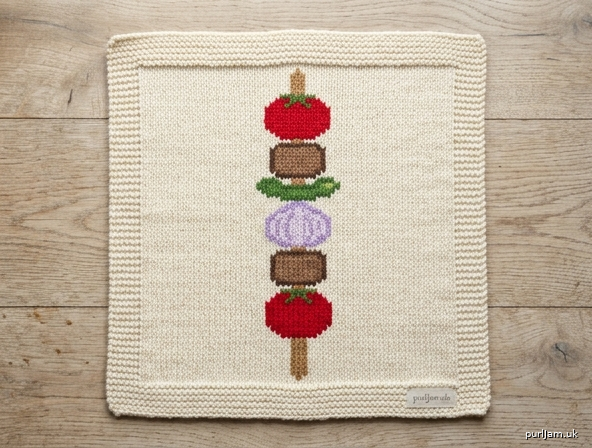
Turkish Kebab Canvas — Colorwork Chart Panel
A cheerful stranded-colorwork panel featuring a classic Turkish şiş kebab: cubes of meat alternating with tomato, green pepper, and onion, all skewered on a wooden stick. Knit as a flat rectangle with a tidy garter-stitch frame, this finished ~11.5" × 10.3" canvas is perfect as a mini wall hanging, a pillow front, a tote panel, or a bag insert. Beginner-friendly, with a bold blocky chart and no shaping.
Finished Measurements
- Width: approximately 11.5 in (29 cm)
- Height: approximately 10.3 in (26 cm)
(This is a single one-size panel; no sizing shaping required.)
Materials
Yarn: Worsted weight (US #4 / Medium), smooth wool or wool-blend recommended for crisp colorwork.
Approximate yardage (small amounts of each):
- A — Background (cream/beige): 90 yd (82 m)
- B — Skewer (brown/tan): 15 yd (14 m)
- C — Meat (medium brown): 30 yd (28 m)
- D — Tomato (red): 20 yd (18 m)
- E — Green pepper (green): 15 yd (14 m)
- F — Onion (light purple/lavender): 12 yd (11 m)
Needles: US 8 / 5 mm straight or circular needles (work flat).
Notions:
- Tapestry needle
- Bobbins (optional, for intarsia sections)
- Stitch markers (optional)
- Blocking mat and pins
Gauge
18 sts × 24 rows = 4 in (10 cm) in stranded/stockinette colorwork, blocked.
Gauge check: 18 sts ÷ 4 in = 4.5 sts/in. A gauge swatch is recommended; blocking evens out colorwork tension.
Abbreviations
- k – knit
- p – purl
- st(s) – stitch(es)
- RS – right side
- WS – wrong side
- CC/MC – contrast/main color
- A–F – yarn colors as listed above
- rep – repeat
Pattern Notes
- The panel is worked flat, bottom to top, in stockinette (knit RS rows, purl WS rows) with a 6-stitch garter border on each side and a 6-row garter border at top and bottom.
- The chart is 40 sts wide × 50 rows tall and sits centered between the borders.
- Read the chart from the bottom up. On RS (odd) rows read right to left; on WS (even) rows read left to right.
- Use stranded (Fair Isle) technique where two colors appear across a row, keeping floats loose (no longer than ~5 sts; catch longer floats). For isolated motif blocks (meat, veg), you may use intarsia with bobbins to reduce floats — either method works for this easy design.
- The border stitches are always worked in color A.
- Slip the first stitch of every row purlwise (optional) for a neat edge, or knit it — instructions below assume worked, not slipped, for simplicity.
Stitch count math: 6 (left border) + 40 (chart) + 6 (right border) = 52 sts cast on. This count stays constant throughout (no shaping). ✓
Instructions
Cast On & Bottom Border
With color A, cast on 52 sts.
- Rows 1–6: Knit all sts (garter bottom border). (6 rows)
Chart Section (Rows 7–56)
Set-up for each row of this section:
- RS rows (odd): k6 in A (border), work the 40-st chart row (reading right to left), k6 in A (border).
- WS rows (even): k6 in A (border), work the 40-st chart row in pattern — purl the chart sts, reading left to right — k6 in A (border).
Work all 50 chart rows (chart rows 1–50 correspond to pattern rows 7–56).
Row math: chart begins at pattern row 7 and ends at pattern row 56 → 56 − 7 + 1 = 50 chart rows. ✓
Top Border
With color A:
- Rows 57–62: Knit all sts (garter top border). (6 rows)
Bind Off
With color A, bind off all 52 sts knitwise. Weave in ends.
Total rows: 6 (bottom) + 50 (chart) + 6 (top) = 62 rows. 62 ÷ 24 rows/in × 4 = 10.33 in tall. ✓
The Chart (40 sts × 50 rows)
Color key:
·= A (background, cream)S= B (skewer, brown)M= C (meat, medium brown)T= D (tomato, red)P= E (green pepper)O= F (onion, lavender)
Read from bottom (Row 1) to top (Row 50). RS (odd) rows right-to-left; WS (even) rows left-to-right. Each row is exactly 40 sts.
Row 50 ·······················SS················· (skewer tip)
Row 49 ·······················SS·················
Row 48 ·······················SS·················
Row 47 ················TTTTTTTTTTTTTTT···········
Row 46 ···············TTTTTTTTTTTTTTTTT··········
Row 45 ··············TTTTTTTTTTTTTTTTTTT·········
Row 44 ··············TTTTTTTTTTTTTTTTTTT·········
Row 43 ··············TTTTTTTTTTTTTTTTTTT·········
Row 42 ···············TTTTTTTTTTTTTTTTT··········
Row 41 ················TTTTTTTTTTTTTTT···········
Row 40 ··············MMMMMMMMMMMMMMMMMMM·········
Row 39 ·············MMMMMMMMMMMMMMMMMMMMM········
Row 38 ·············MMMMMMMMMMMMMMMMMMMMM········
Row 37 ·············MMMMMMMMMMMMMMMMMMMMM········
Row 36 ·············MMMMMMMMMMMMMMMMMMMMM········
Row 35 ··············MMMMMMMMMMMMMMMMMMM·········
Row 34 ················PPPPPPPPPPPPPPP···········
Row 33 ··············PPPPPPPPPPPPPPPPPPP·········
Row 32 ·············PPPPPPPPPPPPPPPPPPPPP········
Row 31 ·············PPPPPPPPPPPPPPPPPPPPP········
Row 30 ·············PPPPPPPPPPPPPPPPPPPPP········
Row 29 ··············PPPPPPPPPPPPPPPPPPP·········
Row 28 ················PPPPPPPPPPPPPPP···········
Row 27 ··············OOOOOOOOOOOOOOOOOOO·········
Row 26 ·············OOOOOOOOOOOOOOOOOOOOO········
Row 25 ············OOOOOOOOOOOOOOOOOOOOOOO·······
Row 24 ············OOOOOOOOOOOOOOOOOOOOOOO·······
Row 23 ············OOOOOOOOOOOOOOOOOOOOOOO·······
Row 22 ·············OOOOOOOOOOOOOOOOOOOOO········
Row 21 ··············OOOOOOOOOOOOOOOOOOO·········
Row 20 ··············MMMMMMMMMMMMMMMMMMM·········
Row 19 ·············MMMMMMMMMMMMMMMMMMMMM········
Row 18 ·············MMMMMMMMMMMMMMMMMMMMM········
Row 17 ·············MMMMMMMMMMMMMMMMMMMMM········
Row 16 ·············MMMMMMMMMMMMMMMMMMMMM········
Row 15 ··············MMMMMMMMMMMMMMMMMMM·········
Row 14 ················TTTTTTTTTTTTTTT···········
Row 13 ···············TTTTTTTTTTTTTTTTT··········
Row 12 ··············TTTTTTTTTTTTTTTTTTT·········
Row 11 ··············TTTTTTTTTTTTTTTTTTT·········
Row 10 ··············TTTTTTTTTTTTTTTTTTT·········
Row 09 ···············TTTTTTTTTTTTTTTTT··········
Row 08 ················TTTTTTTTTTTTTTT···········
Row 07 ·······················SS·················
Row 06 ·······················SS·················
Row 05 ·······················SS·················
Row 04 ·······················SS·················
Row 03 ·······················SS················· (skewer handle)
Row 02 ·······················SS·················
Row 01 ·······················SS·················
Each charted row above contains exactly 40 characters = 40 sts. ✓ The skewer (S) runs vertically through all the food blocks; stacked from bottom: handle → tomato → meat → onion → pepper → meat → tomato → skewer tip.
Colorwork tip: Where a food block sits over the skewer, work the 2 skewer sts in B and the surrounding block color as an intarsia crossing, or carry B as a float if using stranded technique. For this easy version, intarsia with a small bobbin of B keeps the back tidy.
Finishing
- Weave in all ends on the wrong side, following the color paths so no strands show on the front.
- Block firmly: Soak the panel in lukewarm water with a drop of wool wash, gently squeeze out excess (do not wring), and pin to shape on a blocking mat at 11.5 in × 10.3 in, squaring the corners. Let dry completely — blocking is essential to even out the colorwork.
- Optional finishing uses:
- Pillow front: Sew to a coordinating fabric back and stuff.
- Wall hanging: Sew a fabric channel along the top border and insert a dowel.
- Bag panel: Stitch onto a canvas tote.
Enjoy your Turkish kebab canvas — afiyet olsun! 🍢
Disclaimer: This pattern was generated by AI and should be reviewed for accuracy before use. While we strive for quality, AI-generated content may contain errors. Please verify measurements, stitch counts, and instructions before beginning your project. Generated by purlJam.uk
Access your pattern anytime
Bookmark this page to access your pattern anytime