Type
Crochet
Difficulty
intermediate
Category
custom
AI Thinking Process
Planning
Verification
Pattern
Victoire
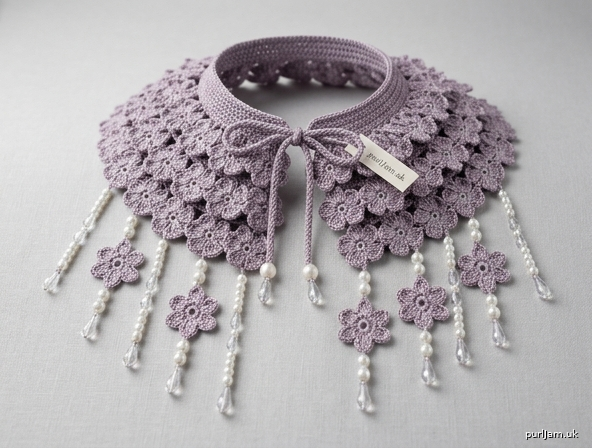
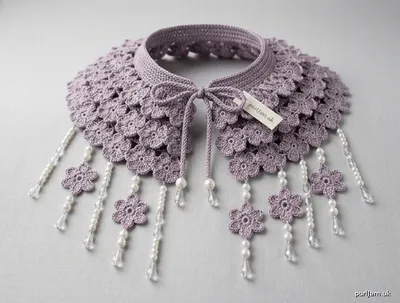
Victorian Tiered Floral Statement Collar with Beaded Flower Tassels
A detachable, romantic neck ruff in dusty lavender lace. A firm single-crochet neckband carries three overlapping tiers of five-petal flower motifs that gather into a voluminous Victorian ruff. It closes at center front with long braided ties tipped in pearls and crystals. From the lower edge hang asymmetrical chain tassels strung with glossy white pearls and clear teardrop crystals — some tassels carry a larger six-petal lace flower — and every strand ends in a teardrop.
This is a one-color lace project. The charts below are stitch, layout, and bead-sequence charts, not stranded colorwork.
Difficulty: Easy (repetitive motifs, no shaping, sewing joins)
Materials
Yarn (lace / size 10 crochet cotton)
- MC — Dusty lavender / muted lilac mercerized cotton, size 10: 400 yd (366 m) used; purchase 2 balls of 350 yd (320 m) so you do not run short. (No contrast yarn.)
Hook
- 1.75 mm (US steel 4) for the pattern
- 2.0 mm (US steel 4/0 or B-1) for the foundation chain and braid chains only (optional, prevents a tight starting chain)
- Range 1.5–2.0 mm is acceptable; change hook to match gauge
Beads (test that size 10 thread passes through every hole)
- 50 glossy round white pearl beads, 6 mm
- 50 clear acrylic teardrop crystal beads, 8–10 mm long, top-drilled
- Pattern uses 37 pearls + 37 teardrops; extras cover ties, centers, and breakage
Notions
- Tapestry needle
- Fine beading needle (if bead holes are snug)
- 6 stitch markers
- Pins and blocking board
- Fabric starch spray (optional, for a structured Victorian set)
- Small scissors
Gauge
10 sc and 10 rows = 1 in × 1 in (2.5 cm × 2.5 cm) in single crochet with 1.75 mm hook, unblocked.
Chain gauge: 12 ch = 1 in (2.5 cm).
Motif gauges (blocked):
- 5-petal flower: 1¼ in (3.2 cm) diameter
- 6-petal flower: 1½ in (3.8 cm) diameter
Swatch: ch 21, sc in 2nd ch from hook and in each ch across (20 sc). Work 20 rows sc. Block lightly and measure the center 10 sts × 10 rows.
If you have fewer than 10 sc per inch, go down a hook size (try 1.5 mm). If you have more than 10 sc per inch, go up (try 2.0 mm). Flower diameter may vary slightly; keep all flowers the same hook so the tiers match.
Size
Adult one size
| Piece | Measurement |
|---|---|
| Neckband (excluding ties) | 16 in (40.5 cm) long × 1 in (2.5 cm) wide |
| Fits neck circumference | 13–15½ in (33–39.5 cm) |
| Finished braid tie (each side) | about 17 in (43 cm) |
| Lowest tassel drop (from bottom of ruff) | about 5–6 in (12.5–15 cm) |
To lengthen the neckband by 1 in (2.5 cm): add 10 foundation chains (10 extra sc) and add 1 flower to each tier. To shorten by 1 in: subtract 10 sc and 1 flower per tier.
Abbreviations (US)
| Abb. | Meaning |
|---|---|
| ch | chain |
| sc | single crochet |
| dc | double crochet |
| tr | treble crochet |
| sl st | slip stitch |
| st(s) | stitch(es) |
| rnd | round |
| RS | right side |
| WS | wrong side |
| MC | main color (dusty lavender) |
| PM | place marker |
| rep | repeat |
| yo | yarn over |
Pattern Notes
- US crochet terms throughout. Turning ch-1 at the start of a sc row does not count as a stitch.
- Work through both loops unless told otherwise.
- Neckband is worked flat, in rows. Flowers are worked in joined rounds, RS always facing.
- Do not turn at the end of flower rounds.
- The beginning ch-4 (5-petal) or ch-5 (6-petal) ring counts as the center opening only, not as stitches.
- Stitch counts appear in parentheses at the end of every row and round. Counts are confirmed inline.
- Leave 6 in (15 cm) tails on flowers for sewing.
- Pre-string beads in reverse order (the teardrop that will sit at the bottom is strung first).
- This collar is heavy once beaded. Weave tails firmly into flower centers so joins cannot pull out.
Special stitch — 5-petal flower (worked in the round) See Chart A and the written motif.
Special stitch — 6-petal flower (worked in the round) See Chart B and the written motif.
Charts
This project is monochromatic lace. Charts map stitches, flower placement, and bead order. There are no stranded knitting floats.
How to read the charts
- Motif charts (A, B): Rnd 1 is at the bottom. Work every round from the RS, following the repeat brackets
[ ]around the ring. Do not work WS rows. - Layout chart (C): Top of the chart is the upper edge (nearest the face). Left and right edges are the two center-front ends of the band.
- Bead chart (D): Read top to bottom as the tassel hangs (collar at the top, teardrop at the bottom). One repeat is one pearl, 6 chains, one teardrop, 6 chains.
Color / symbol key
| Symbol | Meaning |
|---|---|
| ■ | sc in MC |
| ▲ | dc in MC |
| ★ | tr in MC |
| □ | ch in MC |
| ● | sl st in MC |
| ○ | white pearl bead |
| ◆ | clear teardrop crystal |
| ✿ | 5-petal flower |
| ❀ | 6-petal flower |
| █ | neckband fabric (MC sc) |
CHART A: 5-Petal Flower Motif (10 sts × 2 rnds)
Work the bracket 5 times around.
Rnd 2:  [ □ □ ▲ ▲ ▲ □ □ ● ] × 5
Rnd 1:  ■ ■ ■ ■ ■ ■ ■ ■ ■ ■
Key: ■ = sc (MC), ▲ = dc (MC), □ = ch (MC), ● = sl st (MC)
One petal uses 2 sc of Rnd 1 (3 dc in the first, sl st in the second).
5 petals × 2 sc = 10 sc ✓
CHART B: 6-Petal Large Flower Motif (12 sts × 2 rnds)
Work the bracket 6 times around.
Rnd 2:  [ □ □ □ ★ ★ ★ □ □ □ ● ] × 6
Rnd 1:  ■ ■ ■ ■ ■ ■ ■ ■ ■ ■ ■ ■
Key: ■ = sc (MC), ★ = tr (MC), □ = ch (MC), ● = sl st (MC)
6 petals × 2 sc = 12 sc ✓
CHART C: Three-Tier Collar Layout (RS, left CF → right CF)
Flower counts are the full tier, not a partial repeat.
Ties (braid)          Ties (braid)
     \                    /
T1:  ✿✿✿✿✿✿✿✿✿✿✿✿✿✿✿✿          16 five-petal
T2: ✿✿✿✿✿✿✿✿✿✿✿✿✿✿✿✿✿✿✿✿        20 five-petal
T3:✿✿✿✿✿✿✿✿✿✿✿✿✿✿✿✿✿✿✿✿✿✿✿✿      24 five-petal
Band:████████████████████████    160 sc × 10 rows
Tassels (hang from T3; see placement table — not evenly spaced):
     |  | |   |    |  |   |    |  |   |
Tier fullness (blocked 1¼ in flowers, joined at side petals ≈ 1¼ in per flower):
- T1: 16 × 1¼ in = 20 in gathered onto 15 in of band (20 ÷ 15 = 1.33 ✓)
- T2: 20 × 1¼ in = 25 in onto 15 in (25 ÷ 15 = 1.67 ✓)
- T3: 24 × 1¼ in = 30 in onto 15 in (30 ÷ 15 = 2.00 ✓)
CHART D: Bead Sequence Repeat (one unit)
Every tassel starts with a pearl and ends with a teardrop. Repeat the unit until the strand’s bead count is used, omitting the final 6 ch after the last teardrop.
Collar / flower
□ □ □ □ □ □
○                ← pearl
□ □ □ □ □ □
◆                ← teardrop
□ □ □ □ □ □      ← omit this ch-6 after the LAST teardrop
(repeat unit)
Stitch count per unit: 6 ch + 1 pearl + 6 ch + 1 teardrop = 12 ch and 2 beads ✓
Color Management
- MC only for all crochet. Beads are the only contrast.
- There are no stranded floats. Do not carry a second yarn.
- Weave each tail through the WS of a flower center for at least 1 in (2.5 cm), reversing direction once.
- When pre-stringing a tassel, slide unused beads up the ball end of the yarn so they wait out of the way; do not let them stretch the working chain.
- Wet-block the lace before attaching beads if you prefer to starch the ruff without wetting the pearls. If beads are already on, block face-up and do not soak the teardrops for long periods.
Neckband
With 2.0 mm hook (optional) and MC, ch 161.
Switch to 1.75 mm.
Row 1 (RS): Sc in 2nd ch from hook and in each ch across, turn. (160 sc)
(160 sc ÷ 10 sc per inch = 16 in ✓)
Row 2: Ch 1 (does not count as a st), sc in each sc across, turn. (160 sc)
Rows 3–10: Rep Row 2. (160 sc each row)
(10 rows ÷ 10 rows per inch = 1 in ✓)
Fasten off. Weave in the starting tail only; leave the last tail if you like it for sewing, or weave it now.
Mark the band (RS facing, long edges horizontal):
- PM in each short-end corner (4 corners).
- PM at the center st of Row 10 (the lower long edge): between sts 80 and 81 (80 + 80 = 160 ✓).
- PM 5 sc in from each short end on Row 10 (sts 5 and 156). The 15 in span between these two markers is the flower-mounting zone (150 sc ÷ 10 = 15 in ✓). The ½ in (5 sc) at each end stays clear for the braid.
Set the band aside.
Five-Petal Flower (make 60)
Make 16 for Tier 1, 20 for Tier 2, and 24 for Tier 3. Keep them in three labeled groups.
Rnd 1: Ch 4, sl st in first ch to form a ring. Ch 1, work 10 sc in the ring, sl st in first sc to join. (10 sc)
Rnd 2 (petals): *Ch 2, 3 dc in next sc, ch 2, sl st in next sc; rep from * 4 more times. (5 petals)
(5 petals × 2 sc used per petal = 10 sc used ✓)
Fasten off, leaving a 6 in (15 cm) tail.
Tip: The sl st that closes each petal sits in an sc of Rnd 1. After 5 petals you will have used every Rnd-1 stitch. If a petal looks twisted, flatten it so all 3 dc face you before starting the next ch-2.
Six-Petal Large Flower (make 5)
These hang on selected tassels only.
Rnd 1: Ch 5, sl st in first ch to form a ring. Ch 1, work 12 sc in the ring, sl st in first sc to join. (12 sc)
Rnd 2 (petals): *Ch 3, 3 tr in next sc, ch 3, sl st in next sc; rep from * 5 more times. (6 petals)
(6 petals × 2 sc used per petal = 12 sc used ✓)
Fasten off, leaving a 6 in (15 cm) tail.
Join Each Tier into a Garland
Work with RS of flowers facing you. You will sew flowers side by side into three separate strips.
Join rule: On each flower, treat two opposite petals as left join and right join. The remaining three petals stay free (one will point toward the neck, two will fall downward).
To join two flowers: Thread a tapestry needle with a flower tail (or a 12 in length of MC). Take 3 small stitches through the center dc of Flower A’s right petal and the center dc of Flower B’s left petal. Fasten off and weave in. Petals should touch, not overlap more than ⅛ in (3 mm).
Tier 1 garland: Join 16 flowers in a line. (15 joins)
Tier 2 garland: Join 20 flowers in a line. (19 joins)
Tier 3 garland: Join 24 flowers in a line. (23 joins)
Do not join the first flower to the last — the collar opens at center front.
Mark the center join of each garland (between flowers 8 and 9 on T1; between 10 and 11 on T2; between 12 and 13 on T3).
Attach the Flower Tiers to the Neckband
Lay the neckband RS up. You will ease each garland onto the 15 in mounting zone (the space between the markers at sts 5 and 156). Extra length is the ruffle — pin it in evenly; do not let fullness pile up only at the center.
Tier 1 (upper, nearest the face): Pin the T1 garland along Rows 2–5 of the band, matching center markers. Keep ½ in of band clear at each short end. The strip is about 20 in of flowers on 15 in of band (20 − 15 = 5 in to ease ✓). With MC, tack each flower center to the band with 4–5 small stitches through Rnd 1. Catch band fabric only; do not stitch through to the WS so hard that the back looks messy, but the join must be firm.
Tier 2 (middle): Pin the T2 garland so it overlaps Tier 1 by about ⅜ in (1 cm) and sits across Rows 5–9, with lower petals beginning to hang off the lower edge. Match centers. About 25 in of flowers on 15 in of band (25 − 15 = 10 in to ease ✓). Tack each flower center.
Tier 3 (lower, outer ruff): Pin the T3 garland so it overlaps Tier 2 by about ⅜ in (1 cm). Flower centers sit along Row 9–10; lower petals hang fully below the band. Match centers. About 30 in of flowers on 15 in of band (30 − 15 = 15 in to ease ✓). Tack each flower center.
Check: From the side you should see three distinct overlapping layers, densest at the neck, fullest at the bottom. Adjust tacking if a gap shows through.
Weave in all remaining flower tails on the WS.
Number the Tier 3 flowers 1–24, left to right, RS up. You will need these numbers for the tassels.
Braided Ties
Make two identical ties, one at each short end of the neckband.
For one tie:
With 2.0 mm hook (optional) and MC, join with sl st in the right-hand short end of the band, at the corner of Row 1. Ch 240. Fasten off, leaving a 4 in tail.
(240 ch ÷ 12 ch per inch = 20 in of chain ✓)
Join again at the midpoint of the same short end (Row 5) and ch 240. Fasten off.
Join again at the corner of Row 10 and ch 240. Fasten off.
You now have 3 chains of 20 in coming from one short end (3 × 240 ch ✓). Braid them snugly for their full length. The braid will measure about 17 in (43 cm) (20 in × 0.85 ≈ 17 in ✓). Knot the three tails together ½ in from the end.
Beads on the tie end: Using a beading needle and MC, sew 1 pearl just above the knot, then 1 teardrop hanging below the knot so the point faces down. Wrap the yarn twice through each bead and knot on the WS of the braid.
Repeat the entire tie on the left short end (3 × ch 240, braid, pearl + teardrop).
(Tie beads: 2 pearls + 2 teardrops ✓)
Dangling Beaded Tassels
Pre-stringing: For each strand, string the beads onto MC in reverse (last/bottom teardrop first, then the pearl above it, and so on, ending with the first/top pearl). Slide the group up the yarn.
Bead math for every strand: Even bead count, starting with a pearl and ending with a teardrop. Between beads, ch 6 (12 ch per pearl+teardrop pair, Chart D).
Working a plain strand (no extra flower): Join MC with sl st to the lowest petal (center dc or center tr space) of the listed Tier 3 flower. Work the chain/bead sequence in the table. After the final teardrop, ch 1, fasten off, and snug a small knot against the teardrop so it cannot slide off. Weave the tail back up through the last 6 ch.
Working a strand with a 6-petal flower:
- Join MC to the listed T3 flower, ch the Upper ch count, sl st in any petal of a 6-petal flower (center tr of the petal). Fasten off and weave in.
- Join MC to the opposite petal of that same 6-petal flower. Work the Lower sequence (this is the beaded portion, ending in a teardrop). Fasten off as above.
Chain gauge reminder: 6 ch ≈ ½ in; 12 ch ≈ 1 in.
Tassel placement table
T3 flowers are numbered 1–24, left to right, RS up. Skip flowers not listed — that is the asymmetry.
| Strand | T3 flower | Extra 6-petal flower? | Upper ch (plain) | Lower / full sequence (collar → teardrop) | Beads (P = pearl, T = teardrop) | Total beads | Total ch on beaded section |
|---|---|---|---|---|---|---|---|
| 1 | 1 | No | — | ch 6, P, ch 6, T, ch 6, P, ch 6, T | P-T-P-T | 4 | 24 |
| 2 | 3 | Yes | 18 | ch 6, P, ch 6, T, ch 6, P, ch 6, T, ch 6, P, ch 6, T, ch 6, P, ch 6, T | P-T-P-T-P-T-P-T | 8 | 48 |
| 3 | 4 | No | — | ch 6, P, ch 6, T, ch 6, P, ch 6, T | P-T-P-T | 4 | 24 |
| 4 | 6 | No | — | ch 6, P, ch 6, T, ch 6, P, ch 6, T, ch 6, P, ch 6, T | P-T-P-T-P-T | 6 | 36 |
| 5 | 8 | Yes | 12 | ch 6, P, ch 6, T, ch 6, P, ch 6, T, ch 6, P, ch 6, T, ch 6, P, ch 6, T, ch 6, P, ch 6, T | P-T-P-T-P-T-P-T-P-T | 10 | 60 |
| 6 | 11 | No | — | ch 6, P, ch 6, T, ch 6, P, ch 6, T | P-T-P-T | 4 | 24 |
| 7 | 13 | Yes | 24 | ch 6, P, ch 6, T, ch 6, P, ch 6, T, ch 6, P, ch 6, T, ch 6, P, ch 6, T | P-T-P-T-P-T-P-T | 8 | 48 |
| 8 | 15 | No | — | ch 6, P, ch 6, T, ch 6, P, ch 6, T, ch 6, P, ch 6, T | P-T-P-T-P-T | 6 | 36 |
| 9 | 17 | Yes | 15 | ch 6, P, ch 6, T, ch 6, P, ch 6, T, ch 6, P, ch 6, T, ch 6, P, ch 6, T, ch 6, P, ch 6, T | P-T-P-T-P-T-P-T-P-T | 10 | 60 |
| 10 | 20 | No | — | ch 6, P, ch 6, T, ch 6, P, ch 6, T | P-T-P-T | 4 | 24 |
| 11 | 23 | Yes | 20 | ch 6, P, ch 6, T, ch 6, P, ch 6, T, ch 6, P, ch 6, T | P-T-P-T-P-T | 6 | 36 |
Bead-count check (tassels only):
- Pearls: 2+4+2+3+5+2+4+3+5+2+3 = 35
- Teardrops: 35 (same even pairs; every strand ends on T ✓)
- Plus 2 pearls + 2 teardrops on the ties = 37 pearls and 37 teardrops total ✓
Chain-count check (beaded sections): each pair of beads uses 12 ch.
4 beads = 2 pairs = 24 ch; 6 beads = 36 ch; 8 beads = 48 ch; 10 beads = 60 ch. All table ch counts match ✓
Upper chains on flowered strands: 18, 12, 24, 15, 20 — five different lengths so the large flowers sit at uneven heights ✓
Drop length (approx., excluding bead bulk):
- Short plain (24 ch) ≈ 2 in (5 cm)
- Medium plain (36 ch) ≈ 3 in (7.5 cm)
- Flowered long (upper 12–24 + lower 36–60) ≈ 4–7 in (10–18 cm)
Finishing
- Weave in every remaining tail on the WS. Tug each tassel join and each flower center to confirm they are locked.
- Block the ruff (recommended before heavy wear):
- Mist or wet the crochet (avoid soaking pearls and crystals if they are already attached).
- Pin the neckband to 16 in × 1 in (40.5 × 2.5 cm) — do not stretch it longer or the fit will grow.
- Pin each visible petal out to a soft point so the lace opens. Let the three tiers overlap; do not flatten the ruffle away.
- Pin tassels straight down, staggered as they will hang.
- Dry fully. For a stiffer Victorian set, spray lightly with fabric starch on the flowers only and dry again.
- Trim braid ends even below the teardrops if needed.
- Optional: sew one leftover pearl into the center of any flower that looks empty. This is decorative only and is not required for the stitch counts.
To wear: Place the band around the base of the neck, ruff standing up and out. Tie the braids in a bow or a square knot at center front. Adjust tassel fall so the longest drops sit off-center, not in a hard line.
Care: Hand wash cold, beads supported, do not wring. Reshape and dry flat. Re-block petals if the ruff softens.
Quick Checklist
- Neckband: 160 sc × 10 rows (16 in × 1 in) ✓
- 5-petal flowers: 16 + 20 + 24 = 60 ✓
- 6-petal flowers: 5 ✓
- Ties: 2 braids, each from 3 × ch 240, each tipped P then T ✓
- Tassels: 11 strands, all P/T alternating, all ending in T ✓
Disclaimer: This pattern was generated by AI and should be reviewed for accuracy before use. While we strive for quality, AI-generated content may contain errors. Please verify measurements, stitch counts, charts, and instructions before beginning your project. Generated by purlJam.uk
Love this pattern?
Save this pattern to your free PurlJam libraryAccess your pattern anytime
Bookmark this page to access your pattern anytime