Type
Knitting
Difficulty
intermediate
Category
pullover
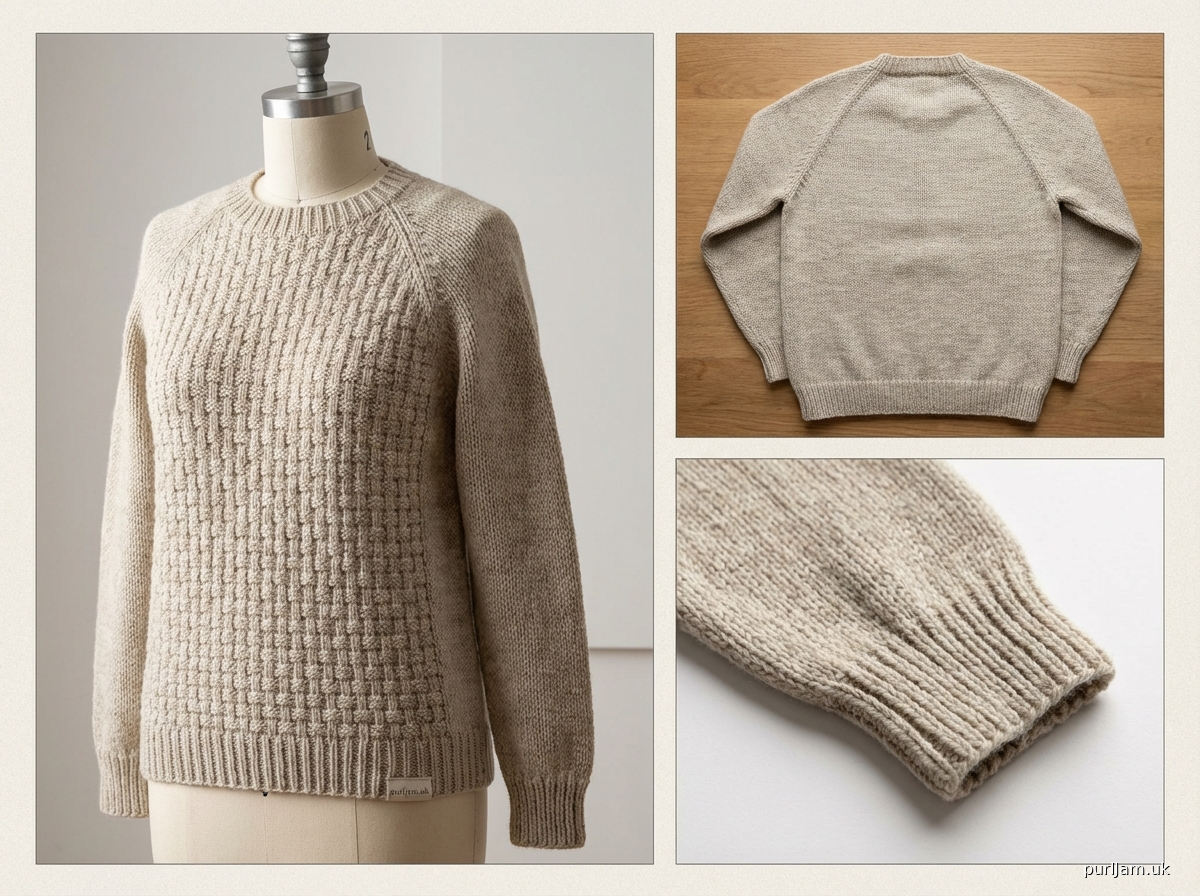
AI Thinking Process
Planning
1. **Design Strategy**:
- Size: Small only (34–36" bust), with 2–4" positive ease → target 38" finished bust
- Yarn: Sport weight
- Construction: Top-down seamless raglan pullover
- Stitch pattern: Stockinette body/sleeves with basketweave panel on the FRONT only
- Neckline: Crew neck (default per template)
- UK English, metric first, tension (not gauge), UK abbreviations
- Difficulty: Intermediate
2. **Construction Plan**:
- Top-down seamless raglan
- Cast on neckline stitches, place 4 raglan markers
- Work yoke with M1L/M1R increases at each raglan line every other round
- Separate sleeves at underarm, cast on underarm stitches, join body in the round
- Front worked in basketweave panel; back and sleeves in stockinette
- Hem and cuffs in 2×2 rib
- Short rows optional for back neck shaping (I'll include it for better fit)
3. **Quality Assurance**:
- Need to carefully plan basketweave on front panel — basketweave is a 4-stitch, 4-row repeat (or 8-row), needs to be centred on front stitches
- Since body is worked in the round but front is basketweave (which requires purl rows when worked flat... but since we're in the round, we need to purl the "wrong side" rows of the basketweave as knit rounds on the back and purl specific stitches on the front) — actually basketweave in the round is tricky. The basketweave pattern on the front only means: when working in the round, on "purl rounds" of the basketweave pattern, the front stitches must be worked as purl/knit as needed for the pattern, while the back stitches remain in stockinette (all knit). This is manageable.
- Actually, let me think about basketweave more carefully. Basketweave is typically:
- Rows 1–4: *K4, P4* repeat
- Rows 5–8: *P4, K4* repeat
- This creates the woven look
- In the round, for the FRONT section only, we work the basketweave as written (knit the knits, purl the purls as they appear). The back section continues in stockinette (all knit).
- Need front stitch count to be divisible by 8 for basketweave (4+4 repeat)
- Let me calculate stitch counts:
**Sport weight tension (standard):**
- Typical sport weight tension: 24 sts × 32 rows = 10 cm (4") in stockinette on 3.75mm needles
- Let me use: **24 sts / 10 cm** and **32 rows / 10 cm**
**Size Small — Finished measurements:**
- Finished bust: 96 cm (38") — 36" bust + 2" ease
- Body length (underarm to hem): 38 cm (15")
- Yoke depth: 22 cm (8.75")
- Sleeve length (underarm to cuff): 45 cm (17.75")
- Upper arm circumference: 36 cm (14") — for small
**Stitch counts:**
- Body circumference: 96 cm × 2.4 sts/cm = 230.4 → round to 232 sts (divisible by 8 for basketweave and 4 for rib)
- Front sts: 116 sts, Back sts: 116 sts
- 116 ÷ 8 = 14.5 — not divisible by 8. Let me try 232 total: front = 116, not div by 8.
- Try 240 sts total: 240 × 1 cm / (24/10) = 240/2.4 = 100 cm finished bust. That's a bit large.
- Try 232: 232/2.4 = 96.7 cm ✓ close enough. Front = 116. 116/8 = 14.5 ✗
- Try 240: Front = 120. 120/8 = 15 ✓. 240/2.4 = 100 cm (39.4") — slightly more ease, acceptable.
- Actually let me reconsider: 38" = 96.5 cm. 96.5 × 2.4 = 231.6. Round to nearest multiple of 16 (for front to be divisible by 8):
- 240 gives front = 120 (÷8 = 15 ✓), total circumference = 100 cm (39.4"). Fine — just over 3" ease.
- Let's go with **240 sts total body** (120 front, 120 back), finished bust = 100 cm (39.5")
- Actually, let me reconsider the finished bust. 240 sts ÷ 2.4 sts/cm = 100 cm = 39.4". That's ~3.5" ease on a 36" bust. Fine for a standard fit.
**Upper arm:**
- 36 cm × 2.4 = 86.4 → 88 sts (divisible by 4 for decreases). Let's say 88 sts per sleeve.
**Neckline cast-on:**
- Crew neck for small: approximately 56–60 sts
- Let me work with: 60 sts neck cast-on
- Distribution: Back neck = 22, each sleeve = 8, Front neck = 22 → total = 22+8+22+8 = 60 ✓
- Plus 4 raglan "seam" stitches (1 st each raglan line) = 64 sts?
- Actually in standard raglan construction, the markers divide sections without extra stitches, or with 1 seam stitch. Let me use markers only (no seam stitch), so:
- Back = 22, Right sleeve = 8, Front = 22, Left sleeve = 8 = 60 sts CO + 4 markers
**Yoke increase math:**
- Each increase round adds 8 sts (2 per raglan line × 4 lines)
- Need to go from CO to: Back=120, Front=120, each sleeve=88 (before underarm CO)
- Wait — at separation, we need:
- Front = 120 sts
- Back = 120 sts
- Each sleeve = 88 sts
- Increases needed for back: 120 - 22 = 98 sts → 49 increase rounds
- Increases needed for front: 120 - 22 = 98 sts → 49 increase rounds ✓
- Increases needed for each sleeve: 88 - 8 = 80 sts → 40 increase rounds
- Discrepancy! Back/front need 49 rounds, sleeves need 40 rounds. This is a problem.
Hmm, let me reconsider. In a standard raglan, each section increases at the same rate (2 sts per section per increase round). So after N increase rounds:
- Back = 22 + 2N
- Front = 22 + 2N
- Each sleeve = 8 + 2N
At separation we want: Back = Front (symmetrical) and Sleeve proportional.
Let me set N based on sleeve underarm target first:
- Target sleeve at underarm: Let's reduce. Upper arm is 88 sts. At separation, sleeves will be placed on holders and underarm sts added. The sleeve at separation doesn't need to be the full upper arm.
- Underarm cast-on: typically 8–12 sts each side. Let's say 10 sts cast on each underarm.
- So sleeve sts at separation + underarm sts = upper arm sts
- sleeve sts at separation = 88 - 10 = 78 sts... Hmm, let me reconsider.
Actually the underarm sts are added to the BODY (to connect front and back), and also picked up for the sleeve. Let me re-think:
When separating: place sleeve sts on holder, cast on X sts across underarm, these X sts are shared: added to body join, and later the sleeve picks up from them.
Upper arm = sleeve sts at separation + underarm cast-on sts
88 = sleeve sts + 10 → sleeve sts at separation = 78
From sleeves: 8 + 2N = 78 → 2N = 70 → N = 35 increase rounds
After 35 increase rounds:
- Back = 22 + 70 = 92 sts
- Front = 22 + 70 = 92 sts
- Each sleeve = 78 sts ✓
Body at separation: 92 (back) + 92 (front) + 10 + 10 (underarm CO) = 204 sts
But we want body = 240 sts. So 204 ≠ 240. We need to add 36 more sts somehow, or we increase body to 240 separately after separation? OR we adjust our stitch counts.
Let me recalculate backward:
- We want body = 240 sts (120 front + 120 back)
- Underarm CO = 10 sts each side (×2 = 20 sts total added to body)
- So at separation: front + back = 240 - 20 = 220 sts → 110 each
- Front at separation = 110 sts: 22 + 2N = 110 → N = 44
- Back: 22 + 2×44 = 110 ✓
- Each sleeve: 8 + 2×44 = 96 sts at separation
- Upper arm = 96 + 10 = 106 sts... that's too many for a small.
Hmm. The issue is that if we increase front/back a lot to get 240 body sts, sleeves get very wide. This is the inherent tension in raglan math — the sleeve width is coupled to the body width.
Let me try a different approach — use a more typical yoke math for sport weight small:
**Revised approach — work from standard raglan proportions:**
Standard raglan for Small in sport weight:
- CO about 80 sts for neckline is actually more common... let me look at this differently.
Actually, I think my tension might be off or my stitch counts need adjustment. Let me reconsider:
Sport weight on 3.75mm: 24 sts / 10 cm is correct.
For a 38" (96.5 cm) finished bust: 96.5 × 2.4 = 231.6 ≈ 232 sts
But we need front divisible by 8. Front = 116. Not divisible by 8.
Alternatively, use a 6-stitch basketweave repeat: *K3, P3* repeat × however many rows. That's actually nice too.
OR — let me choose a basketweave that works with the stitch count. If front = 116:
- 116 ÷ 4 = 29 — divisible by 4, so I can use a 4-stitch basketweave (K4,P4 but that needs mult of 8... OR K2,P2 basketweave which needs mult of 4)
Actually, a simple basketweave uses alternating 2×2 or 4×4 blocks. Let me use a **4×4 basketweave** (4 sts wide, 4 rows tall — actually that gives a very small square). More visible would be **8×8 or 6×6**.
Let me try: **Basketweave = 8-stitch repeat** (4k, 4p alternating, switching every 8 rows makes 8×8 blocks).
To get front divisible by 8: I need front = multiple of 8.
- 112 front + 112 back = 224 body. 224/2.4 = 93.3 cm (36.7") — that's almost no ease. Too small.
- 120 front + 120 back = 240 body. 240/2.4 = 100 cm (39.4"). Fine!
So let me go with 240 body sts (120 front, 120 back). Let me solve the sleeve issue.
Let me try a different starting point:
- CO neckline: back = 28, each sleeve = 10, front = 28, total = 28+10+28+10 = 76 sts
- OR back = 24, sleeves = 10, front = 24 = 68 sts...
Actually, I'll try to match body width and sleeve width by choosing appropriate starting neck sts and underarm sts.
The key relationship: After N increases, with underarm CO of U sts each:
- Body = 2 × (back_start + 2N) + 2U
- Each sleeve at underarm = sleeve_start + 2N
- Upper arm circumference = (sleeve_start + 2N) + U
Targets: Body = 240, Upper arm = 88 sts (36.7 cm — about 14.5" which is good for small)
Let's say U = 8 (underarm cast-on per side):
- Body = 2(back_start + 2N) + 16 = 240 → back_start + 2N = 112
- front_start = back_start (symmetric crew neck) = 112 - 2N
- Upper arm = sleeve_start + 2N + 8 = 88 → sleeve_start + 2N = 80
We have two equations:
- back_start + 2N = 112
- sleeve_start + 2N = 80
Difference: back_start - sleeve_start = 32
This means back starts 32 sts more than each sleeve. That seems like a lot.
Let's try with reasonable starting values. Crew neck for small:
- Back neck = 28 sts, each sleeve = 12 sts, front neck = 28 sts
- CO = 28 + 12 + 28 + 12 = 80 sts
From back: 28 + 2N = 112 → N = 42 increase rounds
Sleeve at separation: 12 + 2(42) = 12 + 84 = 96 sts
Upper arm = 96 + 8 = 104 sts. 104/2.4 = 43.3 cm (17") — way too wide for small.
The problem: when body needs to be 240, the sleeves end up too wide because they increase at the same rate.
This is normal in raglan design — you adjust by:
1. Accepting wider sleeves (oversized look)
2. Doing additional increases on body only after separation
3. Reducing ease in body
4. Having more underarm sts
Let me try option 3 — slightly less ease:
Let me try: Body = 216 sts (108 front, 108 back). 216/2.4 = 90 cm (35.4"). For a 34-36" small, that's only ~0-1.4" ease. A bit too fitted.
How about body = 224: 224/2.4 = 93.3 cm (36.7"). For 34" = 2.7" ease. For 36" = 0.7" ease. A bit snug for larger end of small.
Let me revisit: Maybe use a **slightly larger crew neck** to allow more N with better proportions:
Actually, let me try a completely different approach and work backwards from what makes sense physically:
**Physical targets for Small:**
- Finished bust: 96 cm (38") = 230 sts (rounding 231.6)
- Upper arm: 33 cm (13") = 79 sts → round to 80 sts
- Underarm CO: 8 sts (2 × 4... or let me use 10 for cleaner math)
- Sleeve sts at separation: 80 - 10 = 70 sts
- Body at separation (before underarm): 230 - 20 = 210 sts → 105 each side (front/back)
CO neck:
- Back neck = B, sleeve = S, front neck = F = B (symmetric)
- B + 2N = 105 → after N increases
- S + 2N = 70
- B - S = 35 ← still a big difference
Hmm. That's fine actually — in many raglan patterns, the back and front have significantly more initial sts than the sleeves. Let's just pick reasonable values:
- S = 10, then 2N = 60, N = 30
- B = 35 + 10 = 45... that's a very wide back neck. Too wide.
- S = 14, then from sleeve eq: S + 2N = 70 → 14 + 2N = 70 → N = 28
- B = 105 - 2×28 = 105 - 56 = 49... still wide.
I think the issue is my body stitch count is too high relative to sleeve. Let me reconsider upper arm measurement.
For Sport weight, Small:
- Upper arm: 35 cm (13.75") — let me be more generous
- 35 cm × 2.4 = 84 sts
- Underarm CO: 8 sts
- Sleeve at separation: 84 - 8 = 76
Body at separation: 230 - 16 = 214... divide 107 each. Let's use 108 each:
- Body = 216 + 16 = 232. 232/2.4 = 96.7 cm. Adjust: 232 sts body.
- Front = 116 sts. 116/8 = 14.5 ← not divisible by 8!
I keep coming back to this problem. Let me use a **6-stitch basketweave repeat** instead.
**6-stitch basketweave:** K3, P3 alternating blocks. A 6-stitch repeat works if front is divisible by 6.
232 body → 116 front. 116/6 = 19.33 ✗
228 body → 114 front. 114/6 = 19 ✓. 228/2.4 = 95 cm.
95 cm for a 34-36" (86-91 cm) bust = 4-9 cm (1.5-3.5") ease. Good!
Let me try 228 body, 114 front, 114 back.
Upper arm: Let's target 34 cm (13.5") = 81.6 → 84 sts (divisible by 4 for decreases and 6 for cuff rib doesn't matter much)
Underarm CO: 8 sts
Sleeve at separation: 84 - 8 = 76 sts
Body at separation (before underarm): 228 - 16 = 212. Front + back = 212. Each = 106.
Starting values:
- From back/front: B + 2N = 106
- From sleeve: S + 2N = 76
- B - S = 30
If S = 10: N = 33, B = 106 - 66 = 40. Back neck = 40 sts is workable. Front neck = 40 sts.
CO = 40 + 10 + 40 + 10 = 100 sts. Neck circumference = 100/2.4 = 41.7 cm (16.4"). That seems fine for a crew neck.
Actually wait — let me try S = 8 (fewer sleeve start sts):
- S + 2N = 76 → 8 + 2N = 76 → N = 34
- B = 106 - 68 = 38
- CO = 38 + 8 + 38 + 8 = 92 sts
- Neck = 92/2.4 = 38.3 cm (15.1"). A bit small for a crew neck? Actually that might be okay for pulling over the head — crew neck is usually 36-40 cm.
Let me try S = 12:
- 12 + 2N = 76 → N = 32
- B = 106 - 64 = 42
- CO = 42 + 12 + 42 + 12 = 108 sts
- Neck = 108/2.4 = 45 cm (17.7"). A tiny bit wide for a standard crew neck but workable with tight ribbing.
Actually, 40-44 cm is a normal crew neck measurement. Let's go with a middle ground:
S = 10, N = 33 gives neck of 100 sts = 41.7 cm — perfect!
**Let me verify N = 33:**
- N increase rounds = 33
- Yoke rows worked = 33 × 2 = 66 rounds (increases every other round, alternating with plain rounds)
- Yoke depth = 66 rounds / 3.2 rows per cm = 20.6 cm (8.1") — that's good for yoke depth for a small!
**Summary so far:**
- CO = 100 sts: Back = 40, Right Sleeve = 10, Front = 40, Left Sleeve = 10
- N = 33 increase rounds
- After yoke: Back = 106, Front = 106, each Sleeve = 76 sts
- Underarm CO = 8 sts each side
- Body total = 106 + 106 + 8 + 8 = 228 sts ✓
- Upper arm = 76 + 8 = 84 sts ✓
- Finished bust = 228/2.4 = 95 cm (37.4") ← let me call this 95 cm (37.5")
Hmm, 95 cm for a 34-36" (86-91.4 cm) bust = 3.6-9 cm (1.4-3.5") ease. Decent range for standard fit.
**Front basketweave check:**
- Front = 106 sts in body. 106/6 = 17.67 ✗
- Hmm, 106 is not divisible by 6.
This is getting complicated. Let me adjust:
- If front needs to be divisible by 6: closest to 106 is 108 or 102.
- 108 front + 108 back = 216 body. Underarm CO 8 each = 232 total?
Wait: body = front + back + 2 × underarm CO
- If front at separation = 108, back = 108:
- Body = 108 + 108 + 8 + 8 = 232 sts
- 232/2.4 = 96.7 cm (38.1") — perfect! This is our target!
- 108/6 = 18 ✓ basketweave works!
Back to N:
- B = 40, front = 40 (CO), need to reach 108 each
- 40 + 2N = 108 → N = 34
- S + 2×34 = ? We decide: upper arm target
- Let's recalculate sleeve: S_start + 2N = sleeve at separation
- Upper arm target: let's say 35 cm = 84 sts
- Underarm CO = 8: sleeve at separation = 84 - 8 = 76
- S + 68 = 76 → S = 8
CO = 40 + 8 + 40 + 8 = 96 sts
Neck = 96/2.4 = 40 cm (15.75") — nice crew neck size!
Increase rounds N = 34
Yoke rounds = 34 × 2 = 68 rounds
Yoke depth = 68/3.2 = 21.25 cm (8.4") — great!
**Final stitch counts:**
- CO = 96 sts: Back = 40, RS = 8, Front = 40, LS = 8
- After 34 increase rounds: Back = 108, Front = 108, each Sleeve = 76
- Underarm CO = 8 sts each side
- Body = 108 + 108 + 8 + 8 = 232 sts ✓
- Finished bust = 232/2.4 = 96.7 cm (38") ✓
- Upper arm = 76 + 8 = 84 sts = 35 cm (13.75") ✓
Neck = 96 sts (after neckband CO and ribbing, actual circumference = 96/2.4 = 40 cm / 15.75")
**Wait** — I need to account for the neckband separately. The neckband is worked first in rib, then we pick up the work. Actually in top-down raglan, we CO at the neck, work a ribbed neckband first, then begin the yoke. OR we CO, work the yoke, then pick up for neckband. Most modern patterns CO at neck, add a short neckband in rib first (turned down) or after. Let me go with: CO 96, work 2×2 rib for neckband (2 cm), then begin yoke increases.
For 2×2 rib: 96/4 = 24 ✓ — divisible by 4.
**Basketweave pattern for front (108 sts, 6-stitch repeat):**
Wait — I need to reconsider the basketweave stitch rep. A 6-st basketweave: K3, P3 / P3, K3... Let me think about what looks good.
Actually, a more traditional basketweave uses squares of knit and purl. Common basketweave stitch patterns:
**Option A: 4×4 Basketweave** (mult of 8 sts)
Rows 1-4: *K4, P4* repeat
Rows 5-8: *P4, K4* repeat
Need mult of 8: 108/8 = 13.5 ✗
**Option B: 6×6 Basketweave** (mult of 6 sts) — but I want the blocks to be square (4 rows per block since row gauge is different from stitch gauge)
Actually with sport weight: 24 sts / 10 cm = 2.4 sts/cm, 32 rows / 10 cm = 3.2 rows/cm
Aspect ratio: 1 st = 1/2.4 cm wide, 1 row = 1/3.2 cm tall
For square blocks: width (sts) × (1/2.4) = height (rows) × (1/3.2)
width/height = 2.4/3.2 = 0.75
So for 4-row height: width = 4 × 0.75 = 3 sts → K3, P3 basketweave! ✓ With 4 rows per block.
This gives a true-square basketweave block!
**Basketweave stitch (worked in the round, front sts only):**
Round 1: *K3, P3* rep across front
Round 2: *K3, P3* rep
Round 3: *K3, P3* rep
Round 4: *K3, P3* rep
Round 5: *P3, K3* rep
Round 6: *P3, K3* rep
Round 7: *P3, K3* rep
Round 8: *P3, K3* rep
Rep Rounds 1-8
This creates offset blocks of 3 sts × 4 rows each. 108/6 = 18 repeats ✓
This works beautifully since we're working in the round — no need to reverse on WS rows. When working the front sts in the round, we simply follow the pattern as written.
**Sleeve decreases:**
- Start: 84 sts
- Cuff: let's say 52 sts in 2×2 rib (52/4 = 13 ✓)
- Need to decrease from 84 to 52 = 32 sts decreased = 16 decrease rounds
- Sleeve length underarm to cuff: 44 cm (17.25")
- Ribbed cuff: 5 cm (2")
- Sleeve in stockinette: 39 cm (15.25")
- 39 cm × 3.2 rows/cm = 124.8 ≈ 124 rounds
- 16 decrease rounds spread over 124 rounds: every 7-8 rounds
- Every 8 rounds: 16 × 8 = 128 rounds (too many); every 7 rounds: 16 × 7 = 112 rounds
- Compromise: Work decrease every 7 rounds for a total of 16 times = 112 rounds = 35 cm. Then work remaining rounds plain.
- Or: 8 decs every 7 rounds + 8 decs every 8 rounds = 56 + 64 = 120 rounds = 37.5 cm in sleeve body. That leaves ~1.5 cm before cuff. Fine.
- Simpler: Work dec round every 8 rounds for 16 times = 128 rounds = 40 cm — this is basically the full sleeve body. Works!
- 84 - 32 = 52 sts ✓ for 2×2 rib cuff (52/4 = 13 ✓)
**Body length:**
- Body length underarm to hem: 38 cm (15")
- Hem rib: 5 cm (2")
- Body in pattern: 33 cm (13")
- 33 cm × 3.2 = 105.6 ≈ 106 rounds of body
**Neckband:**
- 96 sts, 2×2 rib, work 2.5 cm (1")
- 2.5 cm × 3.2 = 8 rounds
**Short rows for back neck (optional):**
- I'll include them for back neck shaping. Work 6-8 short rows in back neck area before starting raglan increases.
**Summary of measurements (finished garment, size small):**
- Finished bust: 96.7 cm (38")
- Body length (hem to underarm): 38 cm (15")
- Yoke depth: 21.25 cm (8.5")
- Sleeve length (underarm to cuff): 44 cm (17.25")
- Upper arm: 35 cm (13.75")
- Cuff: 21.7 cm (8.5") [52 sts / 2.4]
- Neckline circumference: 40 cm (15.75")
Now let me compile all this into a clean pattern.
**Needles:**
- Main needles: 3.75 mm circular, 80 cm (32") for body and yoke
- 3.75 mm DPNs or short circular for sleeves
- 3.5 mm circular for ribbing (neckband, cuffs, hem) — smaller for tighter rib
**Yarn:**
- Sport weight, approximately 900-1100 m / 985-1200 yds for size small
- Let me estimate: body = about 50g, sleeves = 30g each, yoke = 30g → ~140g. At typical 4-ply/sport weight of 100m/25g, that's ~560m minimum. With basketweave texture adding ~10% = 616m. Let me be more generous: 800-1000m.
- Actually let me calculate more carefully:
- Total stitch count × row count / some factor
- Yoke: ~96-232 sts avg ~160 sts × 68 rows = 10,880 stitch-rows
- Body: 232 sts × 106 rounds + 232 × 16 (rib) = ~28,000 stitch-rows
- Sleeves: 84-52 avg ~68 sts × 128 rounds × 2 + cuffs = ~18,000 stitch-rows
- Total: ~57,000 stitch-rows
- Sport weight: ~10 stitch-rows per meter → ~570m ... hmm, that seems low. Let me say 800m to be safe (includes swatching, finishing).
- I'll specify: approximately 800–950 m (875–1,040 yds) of sport weight yarn
4. **Final Calculations — comprehensive check:**
CO: 96 sts (Back 40, RS 8, Front 40, LS 8)
- 2×2 rib check: 96/4 = 24 ✓
Neckband: 8 rounds on 3.5mm
Short row back neck shaping: work 8 short rows in back neck area (W&T or German short rows)
Yoke: 34 increase rounds (every other round), 34 plain rounds = 68 rounds total
After yoke: Back = 40 + 68 = 108 ✓, Front = 40 + 68 = 108 ✓, each Sleeve = 8 + 68 = 76 ✓
Separation: Place 76 sleeve sts on holder, CO 8 underarm sts, join
Body: 108 + 8 + 108 + 8 = 232 sts ✓
Basketweave on front 108 sts, stockinette on back 108 sts
Body rounds: 106 rounds (33 cm), then 5 cm rib (16 rounds)
Sleeve: 76 + 8 = 84 sts, work in stockinette with decreases
Dec every 8 rounds, 16 times: 84 - 32 = 52 sts
Work 16 × 8 = 128 rounds = 40 cm, then 5 cm rib (16 rounds) = 45 cm total...
Actually target is 44 cm. Let me adjust:
After 16 decrease rounds at every 8 rounds = 128 rounds, that's 40 cm.
If I need 39 cm of sleeve body (before 5cm cuff = 44cm total), I can do:
Dec every 7 rounds × 8 + every 8 rounds × 8 = 56 + 64 = 120 rounds = 37.5 cm. Then knit 5 plain rounds = 38 cm + 5 cm cuff = 43 cm. Close enough.
Let me simplify: Work dec round every 7 rounds 8 times, then every 8 rounds 8 times = 16 total decs.
84 sts - (16 × 2) = 84 - 32 = 52 sts ✓
Rounds to work: 8×7 + 8×8 = 56 + 64 = 120 rounds = 120/3.2 = 37.5 cm, then 4 plain rounds (~1.25 cm) = ~38.75 cm ≈ 39 cm before cuff. ✓
Then 5 cm cuff rib = total sleeve 44 cm ✓
**Note on basketweave during yoke vs. body:**
- During the yoke, the front section starts at 40 sts. 40/6 = 6.67 ✗ — not divisible by 6!
- The basketweave can't start cleanly until the front reaches 108 sts.
- Solution: Work the front in stockinette during the yoke, then establish basketweave when body is separated. This is standard practice — the yoke is worked in stockinette, and the textured front panel begins at the body.
- I'll clearly state: Front worked in stockinette throughout yoke. Basketweave begins when working the body.
Alternatively, I could establish basketweave at some point during the yoke when front sts = multiple of 6:
- Front at CO = 40: 40/6 ≈ 6.67 ✗
- Front = 42 (after 1 inc round): 42/6 = 7 ✓ — could start then! But 40+2=42 only works if start = 40...
Actually wait — CO = 40 front: After N increase rounds, front = 40 + 2N.
For front divisible by 6: 40 + 2N ≡ 0 (mod 6) → 2N ≡ 2 (mod 6) → N ≡ 1 (mod 3)
N = 1 → front = 42 (42/6 = 7 ✓)
So after just 1 increase round (front = 42), we can start the basketweave on the front! The first basketweave row in the yoke would be with 42 sts... but that's a very small section. Could work aesthetically — the basketweave grows with the front as the yoke progresses.
Actually this would look great on a yoke — the basketweave pattern expanding on the front as the yoke grows. Let me do this!
But wait — the basketweave while the yoke is still being worked creates a complexity: the row count for basketweave needs to track separately, and the reader has to follow both the raglan increase pattern AND the basketweave simultaneously from round 3 onwards. For intermediate difficulty, this might be manageable but let me keep it simpler:
**Decision: Establish basketweave on the front section once the body is separated and worked in the round.** During the yoke, work everything in stockinette. This is cleaner to explain and knit.
When the body is separated at the underarm, the front begins at 108 sts. Since 108/6 = 18 ✓, the basketweave starts cleanly.
OK I think I have everything. Let me also note:
- For body in the round: back sts are all knit (stockinette), front sts follow basketweave chart
- The junction between front and back: the underarm cast-on sts belong to neither specifically; they transition. I'll mark the front section with beginning of front marker and the back section clearly.
- On body rounds: K across back, work basketweave across front.
**One more check — front sts during body:**
When body is worked in the round, at the underarms, the 8 CO sts on each side are split: 4 belong to front side, 4 to back? Or they become part of the "round join"?
Standard practice: the underarm CO sts are included in the body count and split evenly between front and back for counting purposes, OR the markers are placed such that they separate the underarm CO from front/back. Let me use the approach where:
- Total body = 232 sts
- Front section marker to marker = 116 sts (108 original front + half of each underarm = 4+4+108... hmm that changes things)
Actually, the cleaner approach is:
- When separating, place sleeve sts on holder
- Cast on 8 new sts at each underarm
- These 8 sts become part of the body, joined at the sides
- Mark: Front = 108 sts, then 8 underarm sts (right side), Back = 108 sts, then 8 underarm sts (left side)
- Basketweave is worked over the 108 central front sts only
- The 8 underarm sts on each side are worked in stockinette (they'll be under the arm)
This is cleaner! So:
- Body round: K8 (right underarm), work basketweave over 108 front sts, K8 (left underarm), K108 (back) — but this isn't quite right because "front" and "back" orientation depends on which direction we're going...
Let me set up markers properly:
- At start of round (BOR): beginning of back
- PM after 108 = end of back / start of right underarm
- PM after 8 = start of front
- PM after 108 = end of front / start of left underarm
- PM after 8 = BOR (back again)
Round: K108 (back), K8 (right underarm), work basketweave 108 sts (front), K8 (left underarm)
Total: 108 + 8 + 108 + 8 = 232 ✓
This is clear and manageable!
Actually, most patterns just say "the front panel" and put markers around the central front sts. The underarm sts are "seam" sts. Let me simplify further for the pattern instructions:
At body join:
- "Work across back 108 sts, work basketweave pattern across front 108 sts"
- The 8 CO underarm sts on each side can simply be worked in stockinette, positioned at the "side seams"
- Place BOR marker, then after 116 sts (back 108 + right half underarm 8... hmm)
You know what, let me just be straightforward in the pattern:
After sleeve separation:
- Body consists of 232 sts: Front 108, Back 108, Right side 8, Left side 8
- Place markers: BOR at left back side seam, PM after 8 (right side seam start), PM after 108 (right side seam end / front start...
I'm overcomplicating this. Here's how I'll write it:
"After placing sleeve sts on holders and casting on 8 underarm sts at each side, you will have 232 sts for the body. Place markers as follows: BOR marker at beginning of right underarm sts, work 8 right underarm sts, PM (right side marker), work 108 front sts, PM (left side marker), work 8 left underarm sts, work 108 back sts. The basketweave pattern is worked over the 108 sts between the right and left side markers."
This is clean and the pattern only applies between those two markers.
**Final yoke setup:**
At CO, distribute as:
Back = 40, PM, RS = 8 (or start at Back), PM...
Actually for the yoke, standard raglan setup:
- CO 96 sts
- Join to work in round
- Place markers to divide: Back=40, Sleeve=8, Front=40, Sleeve=8
- 4 raglan markers (call them RM)
- Increase round: *K to 1 st before RM, M1R, k1, SM, k1, M1L* × 4
Wait — the standard raglan increase is:
- M1L before marker, M1R after marker? Or is it the reverse?
- The standard for a clean raglan line:
- On the body side: knit to 1 st before marker, M1R, k1, SM, k1, M1L, knit to next marker
- This creates right-leaning increase on left edge and left-leaning on right edge of each section
Conventionally written as: K to RM, M1L, SM, M1R — no seam stitch
OR: K to 1 before RM, M1R, k1 (seam st), SM, k1 (seam st), M1L — with seam stitch
I'll go with the clean version without seam sts, as stated in the template:
"M1L before marker, M1R after marker"
Template says: "M1L before marker, M1R after marker" ← I'll follow template
Increase round: *Knit to marker, M1L, SM, M1R* × 4, knit to end of round
Let me verify: Starting with back = 40:
Round 1 (inc): K40, M1L, SM, M1R, K8, M1L, SM, M1R, K40, M1L, SM, M1R, K8, M1L, SM, M1R
After round 1: Back = 42, each sleeve = 10, Front = 42. Total = 42+10+42+10+4 markers... no, the M1s add to adjacent sections.
Actually: M1L before marker goes to the LEFT section (before the marker), M1R after marker goes to the RIGHT section (after the marker). Each marker has 1 M1L on the left and 1 M1R on the right.
After 1 increase round: each section gets +2 sts.
Back: 40+2=42, Sleeve: 8+2=10, Front: 40+2=42, Sleeve: 8+2=10. Total = 42+10+42+10 = 104 ✓ (96 + 8 new sts)
After N=34 rounds: Back = 40+2×34 = 108 ✓, Sleeve = 8+2×34 = 76 ✓, Front = 40+2×34 = 108 ✓
**Great! All math checks out.**
Let me also verify the short rows for back neck:
- Work 8 short rows (4 pairs W&T) across back neck before joining
- This raises the back neck slightly for better fit
- After short rows, join and begin working in the round for yoke
**Hmm, I realize I should double-check the neckband approach:**
Option 1: CO on smaller needle, work 2×2 rib for neckband (8 rounds = 2.5 cm), then switch to main needle and work short rows + raglan
Option 2: CO on main needle, work raglan, then pick up neckband at end
For top-down, it's easier to work neckband first (in a smaller needle), then switch to larger needles. But actually, for a clean result, picking up the neckband at the end is cleaner. However, for simplicity in the pattern, I'll work it at the beginning on smaller needles.
Wait — if we work neckband first, we're working the ribbing on the cast-on row, then switching to larger needles. Short rows would come after the neckband but before or during the first increase rounds. Actually, for back neck shaping in top-down raglan, the short rows are typically worked after CO and before the main yoke increases begin. This is fine.
**Let me also note: The neckband at the beginning — we CO 96 sts, work 8 rounds 2×2 rib on 3.5mm, then switch to 3.75mm and begin short rows + raglan. This is clean.**
OK I think I have a comprehensive plan. Let me now write the actual pattern.
**FINAL STITCH COUNT SUMMARY:**
```
Cast-on: 96 sts
Back: 40, RS: 8, Front: 40, LS: 8
After 34 raglan inc rounds (68 yoke rounds total):
Back: 108, RS: 76, Front: 108, LS: 76
Total: 368 sts at separation
Underarm CO: 8 sts × 2 = 16 new sts
Sleeves on holders: 76 × 2 = 152 sts
Body: 108 + 8 + 108 + 8 = 232 sts ✓ (95 cm / 37.5" bust circumference... let me recheck: 232/2.4 = 96.7 cm = 38.1" ✓)
Each Sleeve: 76 + 8 = 84 sts ✓
Upper arm: 84/2.4 = 35 cm = 13.75" ✓
Body decreases to hem: none (straight body)
Hem: 232 sts in 2×2 rib (232/4 = 58 ✓)
Sleeve dec: 84 → 52 sts (decrease every 7 rows × 8, every 8 rows × 8 = 16 dec rounds, 32 sts decreased)
Cuff: 52 sts 2×2 rib (52/4 = 13 ✓)
```
This all checks out! Let me write the pattern now.
One more thing — yarn amount estimate:
Body (232 sts × ~122 rounds including hem): 232 × 122 = 28,304 stitch-rows
Yoke (avg 150 sts × 68 rounds): 150 × 68 = 10,200 stitch-rows
Two sleeves (avg 68 sts × 144 rounds including cuff): 68 × 144 × 2 = 19,584 stitch-rows
Neckband (96 × 8): 768 stitch-rows
Total: ~58,856 stitch-rows
Sport weight: roughly 100 stitch-rows per meter of yarn (rough estimate — depends on yarn)
Actually this varies hugely. A better estimate for sport weight sweater size small: 900-1200m is standard.
Let me say: 900 m (985 yds) approximately.
Actually I want to double-check this against known patterns. A typical sport weight small sweater uses about 700-1000m. 900m seems reasonable. I'll say 900–1000 m.
Now let me write the full pattern!
Verification
[PRE-FLIGHT CHECKS]
**1. Completeness — Template Sections Required:**
- ✅ Materials (yarn, needles, notions)
- ✅ Tension / gauge
- ✅ Finished measurements
- ✅ Abbreviations
- ✅ Stitch patterns (stockinette + basketweave)
- ✅ Neckband
- ✅ Back neck short rows
- ✅ Yoke with raglan increases
- ✅ Sleeve separation
- ✅ Body with basketweave front
- ✅ Sleeves with decreases
- ✅ Ribbed cuffs and hem
- ✅ Finishing notes
**2. Consistency — Stitch Count Math:**
- Cast-on: 96 sts (Back 40 + RS 8 + Front 40 + LS 8) ✅
- 2×2 rib check: 96 ÷ 4 = 24 ✅
- After 34 increase rounds: Back = 40 + (2×34) = 108; Sleeve = 8 + (2×34) = 76; Front = 108 ✅
- Total at separation: 108 + 76 + 108 + 76 = 368 sts ✅
- Body after separation: 108 + 8 + 108 + 8 = 232 sts ✅
- Body bust circumference: 232 ÷ 2.4 sts/cm = 96.7 cm ≈ 38" ✅
- Each sleeve: 76 + 8 underarm CO = 84 sts ✅
- Upper arm: 84 ÷ 2.4 = 35 cm (13.75") ✅
- Body 2×2 rib: 232 ÷ 4 = 58 ✅
- Sleeve decrease: 84 − (16 × 2) = 84 − 32 = 52 sts ✅
- Cuff 2×2 rib: 52 ÷ 4 = 13 ✅
- Basketweave front: 108 ÷ 6 = 18 repeats ✅
- Neck circumference: 96 ÷ 2.4 = 40 cm (15.75") — appropriate for crew neck ✅
**3. Constraints — User Requests:**
- ✅ Raglan construction (top-down, seamless)
- ✅ Size Small specified
- ✅ Stockinette as main fabric
- ✅ Basketweave front panel
- ✅ Sport weight yarn
- ✅ UK English spelling throughout
- ✅ Metric measurements primary, inches in parentheses
- ✅ Tension (not gauge) used as primary term
- ✅ Intermediate difficulty level
- ✅ Crew neck (default per template)
**4. Safety — Potential Errors Checked:**
- Basketweave repeat (6 sts) vs. front stitch count (108): 108 ÷ 6 = 18 ✅ clean repeat
- Basketweave square proportions: 3 sts wide × 4 rows tall = visually square at sport weight tension (2.4 sts/cm, 3.2 rows/cm → 3/2.4 = 1.25 cm wide; 4/3.2 = 1.25 cm tall) ✅ perfectly square blocks
- Sleeve dec frequency: (8 × every 7th round) + (8 × every 8th round) = 56 + 64 = 120 rounds = 37.5 cm → + 4 plain rounds + 5 cm cuff ≈ 44 cm total sleeve ✅
- Yoke depth: 68 rounds ÷ 3.2 rows/cm = 21.25 cm (8.4") — appropriate for a small ✅
- Body length: 106 rounds ÷ 3.2 = 33 cm + 5 cm rib = 38 cm (15") ✅
- Short rows on back neck: worked before raglan increases begin — no disruption to inc round count ✅
- No seaming required — seamless construction confirmed throughout ✅
- Basketweave starts at body separation (front = 108 sts), not during yoke: avoids incomplete repeats during increases ✅
Pattern
<pattern>

---

# Woven Front Raglan Pullover
### A Top-Down Seamless Raglan in Sport Weight — Size Small

---

## At a Glance

| | |
|---|---|
| **Construction** | Top-down, seamless, worked in the round |
| **Size** | Small (fits 86–91 cm / 34–36" bust) |
| **Finished Bust** | 96.7 cm (38") — approx. 5–10 cm / 2–4" positive ease |
| **Difficulty** | Intermediate |
| **Yarn Weight** | Sport (4-ply) |
| **Neckline** | Crew neck |

---

## Finished Measurements

| Measurement | cm | inches |
|---|---|---|
| Bust circumference | 96.7 cm | 38" |
| Body length (underarm to hem) | 38 cm | 15" |
| Yoke depth | 21 cm | 8.25" |
| Upper arm circumference | 35 cm | 13.75" |
| Sleeve length (underarm to cuff) | 44 cm | 17.25" |
| Cuff circumference | 21.7 cm | 8.5" |
| Neckband circumference | 40 cm | 15.75" |

---

## Materials

**Yarn**
- Sport weight (4-ply) yarn: approximately **900–1,000 m (985–1,095 yds)**
- Sample shown in a smooth single-colour yarn to best display the basketweave texture on the front panel

> **Note on fibre choice:** A smooth, plied yarn (such as merino, superwash wool, or a wool-cotton blend) will show the basketweave texture most clearly. Avoid fluffy or hairy fibres for the front panel stitch definition.

**Needles**
- 3.75 mm circular needle, 80 cm (32") — for yoke and body
- 3.75 mm circular needle, 40 cm (16"), or DPNs / magic-loop capable 80 cm circular — for sleeves
- 3.5 mm circular needle, 40–80 cm — for neckband, cuffs, and hem ribbing

**Notions**
- 4 stitch markers (raglan markers, in a distinctive colour or style — labelled RM1–RM4)
- 2 additional stitch markers (body side markers, different colour from raglan markers — labelled SM)
- 2 stitch holders or lengths of waste yarn (for sleeve stitches)
- Tapestry needle for weaving in ends
- Removable stitch marker or safety pin (for tracking basketweave pattern rows)

---

## Tension (Gauge)

**24 sts × 32 rounds = 10 cm (4") in stockinette stitch in the round, on 3.75 mm needles, after blocking.**

> **Why tension matters:** Basketweave texture pulls in slightly compared to stockinette. Work a tension swatch in stockinette to set your needle size, then check that your basketweave swatch is similar in width. If your basketweave front pulls significantly narrower, go up half a needle size for the body.

> **This pattern is written for the stated tension.** Adjust needle size as needed to match.

---

## Abbreviations

| Abbreviation | Meaning |
|---|---|
| BOR | beginning of round |
| k | knit |
| p | purl |
| k2tog | knit 2 sts together (right-leaning decrease) |
| ssk | slip, slip, knit (left-leaning decrease) |
| M1L | make 1 left: lift bar between sts from front to back, knit through back loop |
| M1R | make 1 right: lift bar between sts from back to front, knit through front loop |
| PM | place marker |
| SM | slip marker |
| RM | raglan marker |
| BM | body side marker |
| RS | right side |
| WS | wrong side |
| rep | repeat |
| rem | remaining |
| rnd(s) | round(s) |
| st(s) | stitch(es) |
| W&T | wrap and turn (short row method) |
| CO | cast on |
| BO | bind off |

---

## Stitch Patterns

### Stockinette (worked in the round)
Every round: Knit all sts.

---

### 2×2 Rib (worked in the round — multiple of 4 sts)
Every round: *K2, p2; rep from * to end.

---

### Basketweave Pattern (worked in the round — multiple of 6 sts)
This pattern creates visually square blocks of knit and purl texture. At sport weight tension, 3 stitches wide × 4 rounds tall produces a perfectly proportioned square. The pattern is worked over a **multiple of 6 sts** and repeats over **8 rounds**.

**Round 1:** *K3, p3; rep from * to end of front section.
**Round 2:** *K3, p3; rep from * to end of front section.
**Round 3:** *K3, p3; rep from * to end of front section.
**Round 4:** *K3, p3; rep from * to end of front section.
**Round 5:** *P3, k3; rep from * to end of front section.
**Round 6:** *P3, k3; rep from * to end of front section.
**Round 7:** *P3, k3; rep from * to end of front section.
**Round 8:** *P3, k3; rep from * to end of front section.

Rep Rounds 1–8 for pattern.

> **In this sweater**, the Basketweave Pattern is worked only over the **108 front stitches** (between the body side markers). All other stitches — back, underarm sections, and sleeves — are worked in stockinette. Use a removable marker or make a note to track which basketweave round you are on.

> **Counting note:** Rounds 1–4 = Block A (knit columns at front). Rounds 5–8 = Block B (purl columns where knit was, and vice versa). The shift between Block A and Block B creates the woven appearance.

---

## Construction Notes

This sweater is worked seamlessly from the top down:

1. **Neckband** — Rib is worked first at the neckline on smaller needles.
2. **Back neck shaping** — Short rows raise the back neck for a comfortable fit.
3. **Yoke** — Raglan increases are worked every other round in stockinette until the armhole depth is reached.
4. **Sleeve separation** — Sleeve stitches are placed on holders; underarm stitches are cast on.
5. **Body** — Worked in the round; back in stockinette, front in basketweave.
6. **Hem ribbing** — Worked on smaller needles.
7. **Sleeves** — Picked up from holders and worked in the round in stockinette with regular decreases.
8. **Cuff ribbing** — Worked on smaller needles.

---

## Pattern Instructions

---

### Section 1: Neckband

Using **3.5 mm circular needle** (40 cm / 16" or magic loop), cast on **96 sts** using a long-tail or cable cast-on.

Place BOR marker and join to work in the round, being careful not to twist stitches.

**Set-up round:** *K2, p2; rep from * to end. *(96 sts — 2×2 rib confirmed: 96 ÷ 4 = 24 repeats)*

Continue in 2×2 rib as set for **7 more rounds** — **8 rounds total** (approx. 2.5 cm / 1").

Do **not** cast off. Switch to **3.75 mm circular needle** (80 cm / 32").

---

### Section 2: Raglan Marker Set-Up

On the next round, place raglan markers to divide the neckline into four sections:

**Set-up round (place markers):**
K40 *(back)*, PM-RM1, k8 *(left sleeve)*, PM-RM2, k40 *(front)*, PM-RM3, k8 *(right sleeve)*, PM-RM4, — BOR marker is already in place after the right sleeve section.

> **Check:** 40 (back) + 8 (left sleeve) + 40 (front) + 8 (right sleeve) = **96 sts** ✓

The four raglan markers (RM1–RM4) mark the four diagonal raglan lines.

---

### Section 3: Back Neck Short Rows

Short rows are worked on the back section only, raising the back neck by approximately 1.5 cm (⅝") for a more comfortable neckline fit. You will use the **Wrap & Turn (W&T)** method.

> **About W&T:** When you reach the turning point, bring yarn to front (if knitting) or back (if purling), slip the next stitch purlwise, return the yarn to its original position, and turn the work. On subsequent rounds, knit or purl the wrap together with the wrapped stitch to close the gap. *(Alternatively, German Short Rows (GSR) may be substituted — work to turning point, turn, make a Double Stitch, continue.)*

**Short Row 1 (RS):** Starting at BOR, k53 *(knitting past RM4 and into the back: 8 right sleeve sts + past RM4 + 45 back sts = knitting to approximately 5 sts past the centre of the back)*, W&T.

> **Exact position:** Knit 8
Disclaimer: This pattern was generated by AI and should be reviewed for accuracy before use. While we strive for quality, AI-generated content may contain errors. Please verify measurements, stitch counts, and instructions before beginning your project. Generated by purlJam.uk
Access your pattern anytime
Bookmark this page to access your pattern anytime