Type
Knitting
Difficulty
beginner
Category
blanket
AI Thinking Process
Planning
Verification
Pattern
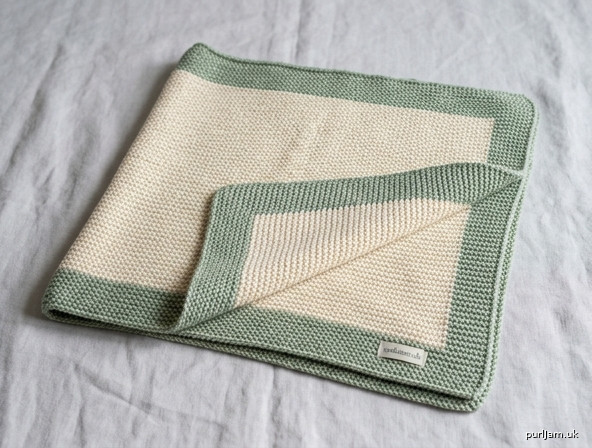
Bamboo Garter Baby Blanket with Color Border
A soft, washable baby blanket knit entirely in garter stitch (knit every row). A 2" contrasting border is worked as you go—no picking up stitches and no seaming. Bamboo-blend worsted yarn gives a silky drape and gentle sheen that is kind to baby skin. If this is one of your first projects after a scarf, you can make it: the only extra skill is changing colors at the same two places on every row.
Skill level: Beginner
Skills used: Long-tail cast-on, knit stitch, simple color changes (intarsia), binding off, weaving in ends.
Finished Size
30" wide × 36" long (76 × 91.5 cm), after blocking, including a 2" (5 cm) border on all four sides.
Center panel: 26" × 32" (66 × 81.5 cm).
Materials
Yarn: Worsted weight (CYC 4), bamboo or bamboo-blend (bamboo-cotton or bamboo-acrylic is easier for beginners than 100% bamboo, which can be slippery and splitty).
- Main Color (MC): 1,100 yards / 1,005 meters
- Contrast Color (CC): 400 yards / 365 meters
That is about 6 skeins MC and 2 skeins CC of a 200-yard skein. Extra yardage is included so you do not run short.
Suggested palette: Cream MC with sage, pale gray, dusty blue, or blush CC. Use a clear but gentle contrast so the border reads from across the room.
If your bamboo baby yarn is DK (category 3): Hold two strands together throughout as one strand to approximate worsted weight, and match the gauge below. Yardage below is for the combined (held-double) fabric; buy roughly twice the DK yardage.
Needles:
- US 8 / 5 mm, 32" (80 cm) circular or longer, worked back and forth (do not join in the round)
- Optional: US 9 / 5.5 mm for binding off only, to keep the top edge as stretchy as garter stitch
Straight needles will work but a circular needle supports the weight of the blanket more comfortably.
Notions:
- 2 stitch markers
- Yarn needle
- Scissors
- Row counter or paper and pencil (optional, but very helpful)
- Tape measure
Gauge
16 stitches and 32 rows (16 garter ridges) = 4" / 10 cm in garter stitch, washed and blocked, on US 8 / 5 mm.
- 4 stitches = 1"
- 8 rows = 1" (4 garter ridges = 1")
Swatch: Cast on 24 stitches. Knit 40 rows. Bind off. Wash the swatch the same way you will wash the blanket, lay it flat to dry, then measure the center 4".
Bamboo relaxes after washing. Always measure gauge after the swatch is dry. If you have too many stitches in 4", go up a needle size. If you have too few, go down a needle size. Matching stitch gauge matters more than row gauge; you can knit to the length measurements if your row gauge is slightly off.
Abbreviations (US)
| Abbr. | Meaning |
|---|---|
| BO | bind off |
| CC | contrast color |
| CO | cast on |
| k | knit |
| MC | main color |
| pm | place marker |
| RS | right side |
| sm | slip marker |
| st(s) | stitch(es) |
| WS | wrong side |
Garter stitch: Knit every stitch of every row. Two rows make one visible ridge.
Pattern Notes
- The blanket is a rectangle worked flat from the bottom edge to the top edge.
- Garter stitch looks the same on both sides. The first row of the bottom border is the RS. When you weave in ends, choose the neater color-change face as the public side.
- You will use three balls of yarn during the center section: one ball of CC for the right border, one ball of MC for the center, and a second ball of CC for the left border. Do not carry colors across the back.
- Twisting to close gaps: At every color change, drop the old yarn and bring the new yarn up from underneath it so the two strands twist around each other. Then knit with the new color. If you skip the twist, you will get a hole.
- Do not pull the first stitch of a new color too tight (the edge will pucker) or too loose (you will get a gap). The stitch should match the stitches next to it.
- Stitch markers sit between the border and the center. Slip them as you come to them.
- Count stitches every 8–10 rows until the color changes feel automatic. You should always have 8 CC, 104 MC, 8 CC (120 sts total).
- Count garter ridges on the RS if you lose your row count: 1 ridge = 2 rows.
- Leave 6" (15 cm) tails at every join and cut. Weave them in at the end.
- No buttons, beads, ties, or openwork. Weave every end in securely so nothing can come loose near a baby.
Schematic (after blocking)
              30" (76 cm)
     |-----------------------------|
     | 2" |      26"        | 2"  |
     | 8  |     104 sts     | 8   |
     +----+-----------------+----+  2" (16 rows)  CC
     | CC |                 | CC |
     |    |       MC        |    |  32" (256 rows)
     |    |                 |    |
     +----+-----------------+----+  2" (16 rows)  CC
Finished length: 2" + 32" + 2" = 36" (16 + 256 + 16 = 288 rows ✓).
Instructions
Cast on and bottom border (CC)
With CC and US 8 / 5 mm needle, using a long-tail cast-on, CO 120 sts.
(30" × 4 sts per inch = 120 sts ✓. Leave a 2-yard / 1.8 m tail so you do not run out of tail mid-cast-on.)
Bottom border: Knit 16 rows (8 garter ridges), or until the piece measures 2" (5 cm) from the cast-on edge.
(2" × 8 rows per inch = 16 rows ✓.)
End after a WS row (an even-numbered row). Cut CC, leaving a 6" (15 cm) tail.
Center panel with side borders (MC + CC)
You now join three yarns. Markers keep the borders easy to see.
Set-up row (RS): Join the first ball of CC, leaving a 6" tail, and k8. Pm. Join MC, leaving a 6" tail, and k104. Pm. Join the second ball of CC, leaving a 6" tail, and k8. (120 sts: 8 + 104 + 8 = 120 ✓)
Every following row (WS and RS): With CC, k8, sm; with MC, k104, sm; with CC, k8. Twist the yarns at each color change as described in Pattern Notes. (120 sts remain every row ✓)
Work as established until the center panel measures 32" (81.5 cm) from the top of the bottom border, ending after a WS row.
If you have matched row gauge, that is 256 rows (128 garter ridges).
(32" × 8 rows per inch = 256 rows ✓. Side borders: 8 sts × 2" gauge = 8 sts each side ✓. Center: 120 − 8 − 8 = 104 sts ✓.)
Cut MC and both CC balls, leaving 6" tails.
Top border (CC)
Join CC (a single ball is enough now).
Knit 16 rows (8 garter ridges), or until the top border measures 2" (5 cm).
(2" × 8 rows per inch = 16 rows ✓.)
Bind off: Knit bind-off loosely. If the edge draws in, bind off with US 9 / 5.5 mm, or bind off onto a needle one size larger than the one you used for the blanket.
(Total rows: 16 + 256 + 16 = 288. 288 rows ÷ 8 rows per inch = 36" length ✓. Width remains 120 sts ÷ 4 sts per inch = 30" ✓.)
Cut yarn, leaving a 6" tail. Pull the tail through the last stitch and snug gently—do not cinch.
Finishing
- Weave in all ends with a yarn needle. On the color-change columns, weave up (or down) along the twist for 1–1½" (2.5–4 cm), then double back a short way so the end cannot work free. On garter fabric you can also follow a ridge for a few stitches, then step to the next ridge. Trim tails to about ¼" (6 mm) after they are locked.
- Check that no tail is left long enough for little fingers to pull.
- Block: Soak the blanket in lukewarm water with a little wool wash or mild soap for 15–20 minutes. Lift it out without wringing. Press out water between towels. Lay flat on a dry towel or blocking mats. Pat—do not stretch aggressively—to 30 × 36" (76 × 91.5 cm). Bamboo can grow if you pull hard; ease it to size rather than yanking. Let it dry completely before moving it.
Care
Follow the ball band when it is stricter than this. In general:
- Hand wash or machine wash gentle, cold water.
- Do not bleach.
- Lay flat to dry. Do not tumble dry unless the label explicitly allows it; heat can shrink or harden some bamboo blends.
- Do not iron on high heat.
A washed bamboo-blend blanket often feels even softer than it did on the needles.
Beginner troubleshooting
Holes at the color changes: You forgot to twist, or the twist was too loose. On the next row, twist firmly from underneath and snug the first stitch of the new color to match its neighbors.
Puckered color-change line: The first stitch of each color is too tight. Ease it until it is the same size as the rest of the row.
Top or bottom edge tighter than the sides: The cast-on or bind-off is too tight. For the bind-off, redo it on a larger needle if you have not yet woven in that end. A slightly tight cast-on usually relaxes with blocking.
Blanket wider or narrower than 30": Stitch gauge is off. If you are still on the bottom border, this is the moment to change needle size and start again. If you are far along, you can block gently toward size, but gauge is more reliable than blocking a large correction.
Lost your place in the row: Count: 8 CC, marker, 104 MC, marker, 8 CC. If a marker has slipped off, replace it using that count.
Yarn splitting: Bamboo can split. Slow down, insert the needle into the whole stitch, and consider a slightly blunter needle tip if splitting continues.
Disclaimer: This pattern was generated by AI and should be reviewed for accuracy before use. While we strive for quality, AI-generated content may contain errors. Please verify measurements, stitch counts, charts, and instructions before beginning your project. Generated by purlJam.uk
Love this pattern?
Save this pattern to your free PurlJam libraryAccess your pattern anytime
Bookmark this page to access your pattern anytime