Type
Knitting
Difficulty
intermediate
Category
custom
AI Thinking Process
Planning
Verification
Pattern
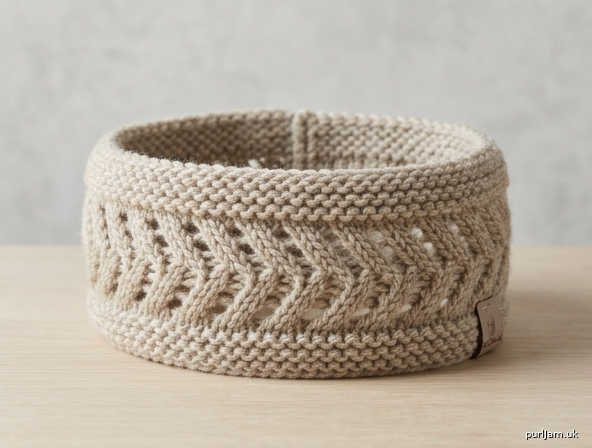
Bracken Eyelet Headband
A cosy intermediate headband in chunky wool-blend yarn, with a rhythmic chevron eyelet panel framed by garter-stitch borders. Worked flat from side to side and joined at the centre back — wear it plain or with a half-twist for a turban finish.
Sizes
S (M, L)
To fit head circumference: 52 (56, 60) cm (20½ (22, 23½) in)
Finished circumference (unstretched): 45 (50, 55) cm (17¾ (19¾, 21¾) in)
Finished width: 12.5 cm (5 in)
Shown in size M. Choose a size with about 5–8 cm of negative ease; the lace and bulky fabric will stretch to fit.
Materials
Yarn: Ella Rae Cozy Soft Chunky, or equivalent bulky (chunky) wool-blend yarn. Typical put-up: 100 g / approx. 100 m (109 yds); 80% acrylic, 20% wool (check your ball band). Amount: 1 ball; approximately 50 (55, 60) m (55 (60, 66) yds).
Needles: 6.5 mm (UK 3) straight needles, or a circular needle used flat. Optional: 7 mm needle for casting off loosely.
Notions: Tapestry needle; tape measure; scissors; blocking mats and pins (blocking wires optional).
Tension (gauge)
13 stitches and 16 rows = 10 cm (4 in) over Chevron Eyelet Pattern, after blocking, using 6.5 mm needles.
Work a swatch of the 16-st pattern (at least 3 full 4-row repeats tall), then wet-block and measure the centre.
- Too few stitches to 10 cm → try 6 mm needles.
- Too many stitches to 10 cm → try 7 mm needles.
Headband fabric should be supple but not flimsy; slightly firm tension keeps the eyelets neat in bulky yarn.
Abbreviations
k — knit p — purl st(s) — stitch(es) RS — right side WS — wrong side yo — yarn over (bring yarn forward and over the needle to make a stitch) k2tog — knit 2 stitches together (right-leaning decrease) ssk — slip 1 knitwise, slip 1 knitwise, knit the 2 slipped stitches together through the back loops (left-leaning decrease) sl1-k2tog-psso — slip 1 knitwise, knit 2 together, pass slipped stitch over (centred double decrease; 3 sts become 1) rep — repeat **rep from *** — repeat the instructions after the asterisk rem — remaining beg — beginning
Pattern notes
- Written in UK English. Worked flat, turning at the end of every row.
- The 16-st cast-on is the width of the headband; you knit until the piece matches the finished circumference. All sizes use the same stitch count; only the row count changes.
- Garter borders (k2 at each edge, every row) stop the lace from rolling.
- Stitch count remains 16 on every row. Count after Row 1 and Row 3 until the decreases and yarn overs feel automatic.
- Do not work yarn overs tightly — they should sit as open eyelets after blocking.
- Length is adjustable in 4-row chunks. Wrap the piece around your head before casting off: it should meet with a little stretch, not hang loose.
- Block before seaming so the lace opens and the rectangle is true.
- Optional half-twist at the join gives a turban look.
Stitch pattern
Chevron Eyelet Pattern (worked over 16 sts)
Multiple of 6 sts + 4 (2-st garter border each side). Two 6-st lace repeats sit between the borders (2 × 6 = 12; 12 + 2 + 2 = 16 ✓).
Row 1 (RS): k2, *yo, ssk, k1, k2tog, yo, k1; rep from * to last 2 sts, k2. (Each repeat: yo + ssk + k1 + k2tog + yo + k1 = 6 sts produced from 6 sts ✓)
Row 2 (WS): k2, p to last 2 sts, k2.
Row 3 (RS): k2, *k1, yo, sl1-k2tog-psso, yo, k2; rep from * to last 2 sts, k2. (Each repeat: k1 + yo + sl1-k2tog-psso + yo + k2 = 6 sts produced from 6 sts ✓)
Row 4 (WS): k2, p to last 2 sts, k2.
These 4 rows form the pattern.
Chart (12-st lace panel only; work k2 each side every row)
Read RS rows (1, 3) from right to left; WS rows (2, 4) from left to right. The chart shows one 6-st repeat; work it twice.
| Row | 6 | 5 | 4 | 3 | 2 | 1 |
|---|---|---|---|---|---|---|
| 4 (WS) | p | p | p | p | p | p |
| 3 (RS) | k2 | yo | sl1-k2tog-psso | yo | k1 | — |
| 2 (WS) | p | p | p | p | p | p |
| 1 (RS) | k1 | yo | k2tog | k1 | ssk | yo |
Chart key: k knit on RS / purl on WS; yo yarn over; k2tog; ssk; sl1-k2tog-psso. On Row 3 the last two cells of the repeat are k2 (stitches 6 and 5 when reading RS right to left).
Instructions
Cast on
Using 6.5 mm needles and a long-tail (or cable) cast-on, cast on 16 sts.
Long-tail gives a slightly elastic edge, which is helpful when the short ends are later seamed.
Begin pattern
Starting with Row 1 (RS), work in Chevron Eyelet Pattern until 72 (80, 88) rows have been completed, ending after a Row 4 (WS).
That is 18 (20, 22) full 4-row repeats (18 (20, 22) × 4 = 72 (80, 88) rows ✓).
Piece should measure approximately 45 (50, 55) cm (17¾ (19¾, 21¾) in) from the cast-on edge, and 12.5 cm (5 in) wide, before blocking. Stitch count remains 16 throughout (16 = 16 ✓).
Custom length: If you need a longer or shorter band, add or remove full 4-row repeats. Each repeat adds or subtracts about 2.5 cm (16 rows = 10 cm, so 4 rows = 2.5 cm ✓). End on Row 4 before casting off.
Cast off
With RS facing, cast off knitwise. Keep the cast-off relaxed — if it draws in, use a 7 mm needle to cast off.
Cut yarn, leaving a 40 cm tail for seaming.
Finishing
Weave and block
Weave in the cast-on tail (leave the long cast-off tail free for the seam).
Wet-block the rectangle:
- Soak in lukewarm water with a drop of wool wash for 15–20 minutes.
- Press out water in a towel — do not wring.
- Pin to 12.5 cm wide × 45 (50, 55) cm long, opening the eyelets so the chevrons are clear. The garter borders should lie flat.
- Leave until completely dry.
Join
With RS together or using mattress stitch from the RS (your preference), join the two short ends at the centre back.
Plain join: Align cast-on and cast-off edges and sew with mattress stitch, matching the garter borders and the lace columns.
Turban join (optional): Before sewing, twist one short end 180° so the RS of one end meets the WS of the other, then mattress-stitch. The twist sits at the back (or rotate it to the front when wearing).
Work the seam firmly but not tightly — the join should have similar stretch to the fabric. Weave in the remaining tail on the WS.
To wear
The garter borders sit at the top and bottom edges. Place the seam at the nape, or turn the twist to the forehead if you used the turban join.
Quick-reference row map
| Section | Rows | Running total | Stitch count |
|---|---|---|---|
| Repeat 1 | 1–4 | 4 | 16 |
| … | … | … | 16 |
| Size S ends | 72 | 18 repeats | 16 ✓ |
| Size M ends | 80 | 20 repeats | 16 ✓ |
| Size L ends | 88 | 22 repeats | 16 ✓ |
| Cast off | — | — | — |
Pattern designed for intermediate knitters. Matching tension and blocking the lace are the two steps that make the finished measurements true.
Disclaimer: This pattern was generated by AI and should be reviewed for accuracy before use. While we strive for quality, AI-generated content may contain errors. Please verify measurements, stitch counts, charts, and instructions before beginning your project. Generated by purlJam.uk
Love this pattern?
Save this pattern to your free PurlJam libraryAccess your pattern anytime
Bookmark this page to access your pattern anytime