Type
Knitting
Difficulty
intermediate
Category
pullover
AI Thinking Process
Planning
Verification
Pattern
Broad Cable Raglan
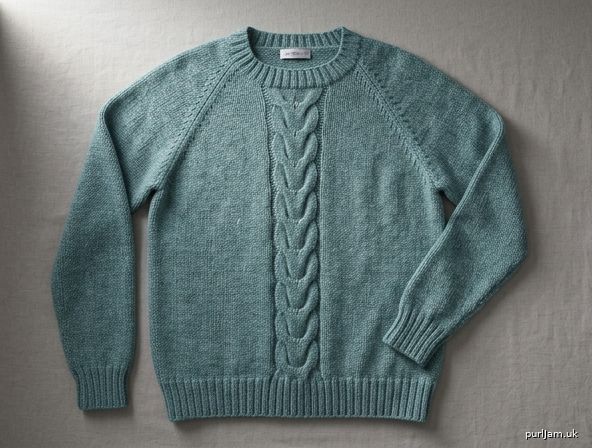
A seamless top-down raglan pullover with one wide rope cable centred on the front. The cable is a single 16-stitch twist in a reverse-stocking frame, running from the neckline to the hem. Diagonal raglan lines shape the yoke. There are no seams.
Construction: Full-circumference neckline. The complete neck is cast on and joined in the round. German short rows raise the back neck only. Do not cast on extra stitches at the front neck after the short rows.
Fit: Standard-relaxed, about 8–14 cm (3–5½ in) positive ease. The neckline is a relaxed crew; it is roomier in the larger sizes. Stitch counts include a small allowance so the cable does not pull the bust in.
Skill: Intermediate. You should be comfortable with knitting in the round, simple increases, and reading your knitting. Cables, German short rows and sleeve separation are explained.
Sizes
To fit bust: 86–91 (97–102, 107–112, 117–122, 127–132) cm
[34–36 (38–40, 42–44, 46–48, 50–52) in]
Figures are given for size S, then M, L, XL and 2XL in parentheses. Where only one figure is given, it applies to all sizes.
Finished measurements
| S | M | L | XL | 2XL | |
|---|---|---|---|---|---|
| Bust | 100 cm (39½ in) | 109 cm (43 in) | 122 cm (48 in) | 131 cm (51½ in) | 142 cm (56 in) |
| Length, top of neckband to hem (suggested) | 60 cm (23½ in) | 64 cm (25¼ in) | 66 cm (26 in) | 68 cm (26¾ in) | 71 cm (28 in) |
| Yoke depth, below neckband to underarm | 20 cm (8 in) | 21.5 cm (8½ in) | 23.5 cm (9¼ in) | 25 cm (9¾ in) | 26.5 cm (10½ in) |
| Sleeve, underarm to cuff end | 43 cm (17 in) | 44 cm (17¼ in) | 45 cm (17¾ in) | 46 cm (18 in) | 46 cm (18 in) |
| Upper arm | 35.5 cm (14 in) | 38 cm (15 in) | 41 cm (16 in) | 45.5 cm (18 in) | 50 cm (19¾ in) |
| Cuff, rib unstretched, approx. | 18 cm (7 in) | 19 cm (7½ in) | 20 cm (8 in) | 22 cm (8¾ in) | 23 cm (9 in) |
| Neckband, unstretched, approx. | 42 cm (16½ in) | 46 cm (18 in) | 52 cm (20½ in) | 56 cm (22 in) | 62 cm (24½ in) |
| Cable panel width, after blocking | 11 cm (4¼ in) | same | same | same | same |
Body and sleeve lengths are easy to change. Yoke figures above match the stitch counts; alter the yoke only if you are happy to recalculate.
Yarn
Worsted weight yarn (a smooth wool or wool-blend shows the cable best; a busy variegated yarn will hide it). Aran weight may be substituted if you match the tension.
Quantity: 1000 (1150, 1300, 1500, 1700) metres
[1090 (1260, 1420, 1640, 1860) yards]
Needles
- 4.5 mm circular needle, 40 cm long, for the neckband
- 4.5 mm circular needle, 80 cm long, for the hem, and 4.5 mm double-pointed needles (or a long circular) for the cuffs
- 5 mm circular needle, 40–60 cm long, for the yoke, and 80 cm long for the body
- 5 mm double-pointed needles, or a long 5 mm circular for magic loop, for the sleeves
- Cable needle
Metric sizes are the ones that matter. Match tension, not the needle name.
Notions
Stitch markers (at least 7), stitch holders or waste yarn, tapestry needle.
Tension (gauge)
18 sts and 24 rounds = 10 cm (4 in) over stocking stitch on 5 mm needles, after blocking.
The cable panel (24 sts) measures about 11 cm (4¼ in) wide after blocking. If your stocking-stitch tension is correct but the cable is much narrower, the bust will be slightly smaller; go up a needle size for the cable stitches only, or choose the next size.
Abbreviations
BOR beginning of round
C16B cable 16 back: slip next 8 sts to cable needle and hold at back, k8, then k8 from cable needle
CO cast on
dec decrease
DS double stitch (German short rows) — see Special techniques
k knit
k2tog knit 2 together
M1L make 1 left — see Special techniques
M1R make 1 right — see Special techniques
p purl
pm place marker
rep repeat
RS right side
sl slip
sm slip marker
ssk slip 2 sts knitwise one at a time, return them to the left needle and knit them together through the back loops
st(s) stitch(es)
WS wrong side
Special techniques
M1R (right-leaning): Insert the left needle from back to front under the bar between the stitches and knit into the front of it.
M1L (left-leaning): Insert the left needle from front to back under the bar and knit into the back of it.
German short-row DS: Turn the work. Bring the yarn to the front, slip the next stitch purlwise, then pull the yarn over the needle to the back firmly so the stitch is drawn up into two legs. If the following stitch is a purl, bring the yarn between the needles to the front again before you purl it. On a later row or round, knit or purl both legs of the DS together as one stitch. This does not change the stitch count.
C16B is a large cross. Work it loosely and tug the crossed stitches gently into place. A cable needle, or cabling without a needle if you prefer, both work.
Cable panel (24 sts, in the round)
The panel is the centre 24 front stitches, marked, and is worked on every yoke and body round.
- Rnds 1–11: P4, k16, p4.
- Rnd 12: P4, C16B, p4.
Repeat rounds 1–12. Keep the count running straight through yoke and body; do not restart it at the underarm.
Pattern notes
- The two knit stitches after each raglan marker are the raglan line. Increases sit either side of them and form the diagonal.
- On the first yoke increase round you place markers around the cable. Those markers stay until the hem. Raglan markers come out when you separate the sleeves.
- Try the yoke on before you separate. Body and sleeve length can be changed without affecting the stitch counts below.
Instructions
Neckband
With 4.5 mm needle and a stretchy cast-on (long-tail works well), cast on 84 (92, 104, 112, 124) sts. Join to work in the round, being careful not to twist. Place a BOR marker.
Rib round: *K1, p1; rep from * to end.
Work in 1×1 rib until the neckband measures 3 cm.
Change to 5 mm needle.
Set-up round
Knit one round, placing raglan markers as follows. This round sets the section counts; it is not an increase round.
- K28 (32, 38, 40, 44) back sts, pm, k2.
- K8 (8, 8, 10, 12) sleeve sts, pm, k2.
- K32 (36, 42, 44, 48) front sts, pm, k2.
- K8 (8, 8, 10, 12) sleeve sts, pm, k2.
You are back at the BOR.
Stitch check: 28+2+8+2+32+2+8+2 = 84; likewise 92, 104, 112 and 124 ✓
German short rows
Short rows are worked in stocking stitch over the back and part-way into each sleeve. They do not enter the front, and they do not change the stitch count. The cable has not started yet.
Short row 1 (RS): K to the first marker, sm, k2, k2, turn.
Short row 2 (WS): DS, purl to the BOR marker, sm, p2, p2, turn.
Short row 3 (RS): DS, knit to the previous DS, knit the DS as one stitch, k1, turn.
Short row 4 (WS): DS, purl to the previous DS, purl the DS as one stitch, p1, turn.
Rep the last 2 short rows a further 2 (2, 2, 3, 3) times.
Closing round (RS): DS, knit to the BOR, working each DS as one stitch. Continue in the round to the end of the round, working any remaining DS as one stitch.
8 (8, 8, 10, 10) short rows have been worked. Centre back is raised by about 3.5 (3.5, 3.5, 4, 4) cm. Stitch count is still 84 (92, 104, 112, 124) ✓
Yoke
Cable round 1 begins on the next round. Increase on every odd yoke round. Work the cable panel whether or not the round is an increase round.
Round 1 (increase and establish cable):
- Back: Knit to marker, M1R, sm, k2, M1L.
- Left sleeve: Knit to marker, M1R, sm, k2, M1L.
- Front: K4 (6, 9, 10, 12), pm, work Cable Panel round 1 over the next 24 sts, pm, k4 (6, 9, 10, 12), M1R, sm, k2, M1L.
- Right sleeve: Knit to marker, M1R, sm, k2, M1L.
8 sts increased. Front is now 34 (38, 44, 46, 50) sts, with 5 (7, 10, 11, 13) stocking stitches each side of the marked 24-st panel (4 (6, 9, 10, 12) original side sts + the new M1) ✓
Round 2 (plain): Knit every stitch, slipping markers, and work the next round of the Cable Panel between the cable markers. No increases.
Following rounds: Repeat rounds 1–2 a further 23 (25, 27, 29, 31) times, always working the next Cable Panel round between the cable markers. On later increase rounds you do not count side stitches: knit to the cable marker, work the panel, knit to the raglan marker, then work the M1R as set. The new stitches land outside the cable markers, so the panel stays centred.
You have worked 24 (26, 28, 30, 32) increase rounds and 48 (52, 56, 60, 64) yoke rounds in all.
Yoke stitch check:
- Sts increased: 24×8 = 192; 26×8 = 208; 28×8 = 224; 30×8 = 240; 32×8 = 256
- Total: 84+192 = 276; 92+208 = 300; 104+224 = 328; 112+240 = 352; 124+256 = 380 ✓
- Back: 76 (84, 94, 100, 108)
- Each sleeve: 56 (60, 64, 70, 76)
- Front: 80 (88, 98, 104, 112), cable still the centre 24, with 28 (32, 37, 40, 44) sts each side ✓
- Raglan lines: 2 sts × 4 = 8
Yoke depth below the neckband is about 20 (21.5, 23.5, 25, 26.5) cm. Each sleeve opening, measured straight down from the neckband, should be close to that depth.
Separate sleeves from body
Keep the cable markers. Remove raglan markers as you pass them.
From the BOR:
- Knit across the 76 (84, 94, 100, 108) back sts, remove marker, k2.
- Place the next 56 (60, 64, 70, 76) sleeve sts on a holder.
- Cast on 8 (8, 10, 12, 14) underarm sts.
- K2, remove marker.
- Work across the 80 (88, 98, 104, 112) front sts in pattern (Cable Panel between the cable markers), remove marker, k2.
- Place the next 56 (60, 64, 70, 76) sleeve sts on a holder.
- Cast on 8 (8, 10, 12, 14) underarm sts.
- K2, remove marker. You are back at the BOR.
The four pairs of raglan stitches have joined the body. The cable markers are still in the front.
Body stitch check:
76+80+8 raglan +16 underarm = 180
84+88+8+16 = 196
94+98+8+20 = 220
100+104+8+24 = 236
108+112+8+28 = 256 ✓
At 18 sts per 10 cm this is 100 (109, 122, 131, 142) cm around ✓
Body
Continue in the round. Knit every stitch except the Cable Panel, which continues in its 12-round repeat without resetting.
Work until the body measures 31 (33, 33, 34, 35) cm from the underarm cast-on, or 6 cm less than the length you want to the hem. If you can, finish after any cable round except round 12, so the cross is not sitting directly against the rib.
Next round (cable ease): Work as set, but within the 16 knit sts of the cable work k2tog four times, evenly spaced (for example k2, k2tog, k2, k2tog, k2, k2tog, k2, k2tog). 4 sts decreased. Remove the cable markers as you pass them.
176 (192, 216, 232, 252) sts. All even, ready for 1×1 rib (180−4 = 176; 196−4 = 192; 220−4 = 216; 236−4 = 232; 256−4 = 252) ✓
Change to 4.5 mm needle.
Hem: *K1, p1; rep from * to end. Work 6 cm. Cast off in rib.
Sleeves (both alike)
Return 56 (60, 64, 70, 76) held sleeve sts to 5 mm needles. With RS facing, and starting at the centre of the underarm cast-on, pick up and knit 8 (8, 10, 12, 14) sts along the underarm edge, then knit the held sts. Place a BOR marker at the centre of the picked-up sts.
64 (68, 74, 82, 90) sts (56+8 = 64; 60+8 = 68; 64+10 = 74; 70+12 = 82; 76+14 = 90) ✓
If a small hole shows at either end of the underarm, pick up one extra stitch in that corner and decrease it away on the next round so the count returns to 64 (68, 74, 82, 90).
Knit 6 (4, 6, 4, 4) rounds even.
Decrease round: K1, k2tog, knit to last 3 sts, ssk, k1. 2 sts decreased.
Work 5 (5, 4, 4, 3) rounds even.
Repeat the decrease round every 6th (6th, 5th, 5th, 4th) round a further 13 (14, 16, 18, 21) times. 14 (15, 17, 19, 22) decrease rounds in total; 28 (30, 34, 38, 44) sts decreased.
36 (38, 40, 44, 46) sts remain (64−28 = 36; 68−30 = 38; 74−34 = 40; 82−38 = 44; 90−44 = 46) ✓
Work even until the sleeve measures 38 (39, 40, 41, 41) cm from the underarm pick-up, or 5 cm less than the desired length to the cuff end.
Change to 4.5 mm needles.
Cuff: *K1, p1; rep from * to end. Work 5 cm. Cast off in rib.
Finishing
Weave in ends. Block to the measurements, pinning the cable gently so the rope opens and lies flat. Do not stretch the ribbing.
The suggested length from the top of the neckband to the hem is 60 (64, 66, 68, 71) cm: 3 cm neckband + 20 (21.5, 23.5, 25, 26.5) cm yoke + 31 (33, 33, 34, 35) cm body + 6 cm hem.
Fit notes
- Bust ease is about 9–14 cm (3½–5½ in) over the to-fit ranges. If you are between sizes, choose the size whose finished bust you prefer; the cable is the same width in every size.
- The neckband is ribbed on the smaller needle and should stretch comfortably over the head. Larger sizes have a more relaxed crew. That is intentional: a close neck and this yoke depth cannot both be had from the same increase rate without a pinched sleeve start.
- A 16-stitch cable draws in. The four extra stitches on the front (front is 4 sts larger than the back at every stage) offset that. Measure the bust around the cable after blocking.
Disclaimer: This pattern was generated by AI and should be reviewed for accuracy before use. While we strive for quality, AI-generated content may contain errors. Please verify measurements, stitch counts, charts, and instructions before beginning your project. Generated by purlJam.uk
Love this pattern?
Save this pattern to your free PurlJam libraryAccess your pattern anytime
Bookmark this page to access your pattern anytime