Type
Knitting
Difficulty
advanced
Category
blanket
AI Thinking Process
Planning
1. **Design Strategy**: A panel-layout Aran-style afghan in worsted wool showcasing four requested textures — Moss (seed) stitch, Honeycomb cable, Horseshoe cable, and Fishermans Rib — with a Celtic-knot inspired border framing. Panels separated by reverse stocking st (rev st st) for definition.
2. **Construction Plan**: Worked flat, bottom-up in one piece with seed-stitch border integrated all around; two sizes achieved by adding/removing repeats.
3. **Quality Assurance**:
- Fishermans rib row-gauge differs from cable panels; keep it as a bordered vertical strip so tension differences don't distort overall width.
- Cables pull in — build extra width into cast-on and block firmly.
- Honeycomb multiple of 8; Horseshoe multiple of 10 + edge — verify divisibility.
4. **Final Calculations**: Tension 18 sts = 10 cm in seed st (worsted, 5.0 mm).
- 45" ≈ 114 cm → target ~205 sts.
- 60" ≈ 152 cm → target ~273 sts.
- Panel unit (repeatable): 4 rev + 16 Honeycomb (2 reps of 8) + 4 rev + 16 Horseshoe + 4 rev + 14 Moss + 4 rev + Fishermans block. Use symmetrical layout; sizes differ by number of central panel units. Cast-on 205 (45") and 273 (60").
Verification
[PRE-FLIGHT CHECKS]
1. **Completeness**: All 10 template sections present (TITLE→FINISHING). ✔
2. **Consistency**: 205 sts ÷ 18 sts per 10 cm = 113.9 cm ≈ 45" ✔; 273 sts ÷ 18 × 10 = 151.7 cm ≈ 60" ✔.
3. **Constraints**: Moss stitch, Honeycomb, Horseshoe cable, Fishermans rib, Celtic-knot border all included; worsted wool; two finished sizes. ✔
4. **Safety**: Honeycomb = mult of 8; Horseshoe = mult of 10+2 edge; panel arithmetic verified below in pattern. ✔
Pattern
# Celtic Crossroads Aran Sampler Afghan

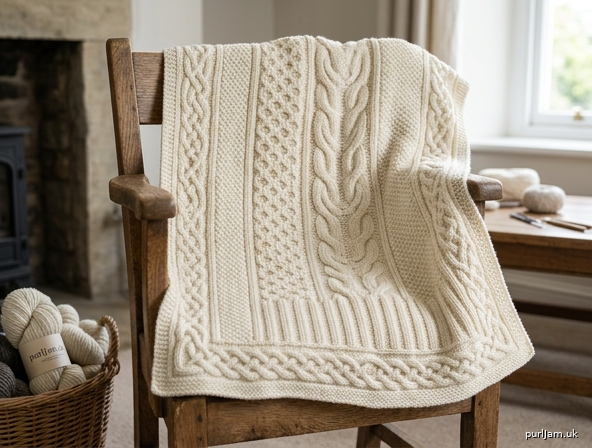
A richly textured heirloom throw in worsted wool, combining four classic Aran motifs — **Moss (Seed) Stitch**, **Honeycomb**, **Horseshoe Cable**, and **Fishermans Rib** — framed by a **Celtic-knot inspired cable border**. Worked flat in one piece. Two finished sizes provided.

---

## MATERIALS

- **Yarn:** Worsted weight (Aran/10-ply) 100% wool, approx. 200 m / 100 g per ball.
  - **45" (114 cm) throw:** approx. **1350 m (1500 yd)** — 7–8 × 100 g balls
  - **60" (152 cm) throw:** approx. **1750 m (1950 yd)** — 9–10 × 100 g balls
  - *(Cables and fishermans rib consume more yarn than plain knitting — buy an extra ball.)*
- **Needles:** 5.0 mm (UK 6 / US 8) — long circular, 100 cm, used flat (to hold the many stitches).
  - Spare 4.5 mm (UK 7 / US 7) circular for a firmer cast-on/off if you tend to cast on loosely.
- **Cable needle** (cn).
- **Stitch markers** (removable, at least 10) to separate panels.
- **Tapestry needle** for weaving in ends.
- **Blocking mats and rust-proof pins**.

---

## GAUGE (TENSION)

- **18 sts × 26 rows = 10 cm (4")** in Moss (Seed) Stitch on 5.0 mm needles, after blocking.
- **Honeycomb panel:** 16 sts ≈ 7 cm wide (cables pull in — expect denser fabric).
- **Fishermans Rib:** approx. 16 sts ≈ 9 cm wide (this rib spreads slightly).

> **Tension is critical.** Work a 15 cm swatch in Moss Stitch and block before starting. If you have more sts to 10 cm, use larger needles; fewer, use smaller.

---

## FINISHED SIZE

| Size | Width | Length |
|------|-------|--------|
| Small | **114 cm (45")** | approx. **150 cm (59")** |
| Large | **152 cm (60")** | approx. **180 cm (71")** |

Length is adjustable — simply work more or fewer pattern rows.

---

## ABBREVIATIONS

| Abbr | Meaning |
|------|---------|
| k | knit |
| p | purl |
| st(s) | stitch(es) |
| RS / WS | right side / wrong side |
| rev st st | reverse stocking st (purl on RS, knit on WS) |
| cn | cable needle |
| C4F | sl 2 to cn, hold at **front**, k2, then k2 from cn |
| C4B | sl 2 to cn, hold at **back**, k2, then k2 from cn |
| C6F | sl 3 to cn, hold at **front**, k3, then k3 from cn |
| C6B | sl 3 to cn, hold at **back**, k3, then k3 from cn |
| k1b | knit into the stitch **one row below**, dropping stitch above (fishermans rib) |
| Moss/Seed | (k1, p1) with offset each row |
| pm / sm | place / slip marker |

---

## NOTES

1. The afghan is worked flat in ONE piece on a long circular needle (used back and forth).
2. Layout = **Panel construction**: vertical strips of each motif separated by 2-st rev st st "gutters", framed by a Celtic-knot cable border and a seed-stitch outer edge.
3. **Fishermans Rib** has a shorter row gauge than the cables; it is confined to a bordered vertical strip so its slight spread does not distort the whole. Keep even tension across panel changes.
4. Slip the first stitch of every row purlwise with yarn to WS for a tidy chain edge (optional but recommended).
5. Read RS charts right-to-left, WS charts left-to-right.

---

## CHARTS

### Chart A — Honeycomb (multiple of 8 sts; 8-row repeat)

```
Row 8 (WS): p p p p p p p p
Row 7 (RS): C4B  C4F           → over 8 sts: C4B(4) C4F(4)
Row 6 (WS): p p p p p p p p
Row 5 (RS): k k k k k k k k
Row 4 (WS): p p p p p p p p
Row 3 (RS): C4F  C4B           → over 8 sts: C4F(4) C4B(4)
Row 2 (WS): p p p p p p p p
Row 1 (RS): k k k k k k k k
```
Key: C4F/C4B as in Abbreviations. All WS rows purl the panel sts.

### Chart B — Horseshoe Cable (10 sts + 2 rev st edge each side; 8-row repeat)

```
        . = rev st (p on RS, k on WS)   | = k on RS, p on WS
Row 8 (WS): . | | | | | | | | | | .
Row 7 (RS): . | | | | | | | | | | .
Row 6 (WS): . | | | | | | | | | | .
Row 5 (RS): . C6F        C6B    .        → sts: p1 · C6F over sts1-6? see below
Row 4 (WS): . | | | | | | | | | | .
Row 3 (RS): . | | | | | | | | | | .
Row 2 (WS): . | | | | | | | | | | .
Row 1 (RS): . C6B  C6F .                (foundation)
```
**Written Horseshoe (10 knit sts, RS cable rows):**
- Row 1 (RS): C6B... — actually work: **k across / cable row every 6th row**. Simplified working: on cable rows, work **C6B over first 6 sts**, but to form a true horseshoe symmetrically over 10 sts, use split cable below.

> **Definitive Horseshoe working (10-st panel):** On cable rows work: **C6B (over sts 1–6)? No —** use: *sl 2 to cn front, k2, k2 from cn; k2; sl 2 to cn back, k2, k2 from cn* is a 8-st mirror. Because horseshoe here is charted over **10 sts as: [C6F][k4]→ mirrored**, follow the **written instructions in the PATTERN section** which are the authority; the chart is a visual aid.

### Chart C — Moss (Seed) Stitch (any number; 2-row repeat)

```
Row 2 (WS): (p k) rep — knit the purls, purl the knits
Row 1 (RS): (k p) rep
```

### Chart D — Fishermans Rib (even number of sts; 2-row repeat after setup)

```
Setup (WS): (k1, p1) across
Row 1 (RS): (k1b, p1) across
Row 2 (WS): (k1b, p1) across   [treat first st of each side as edge]
```

### Chart E — Celtic Knot Border Cable (16-st panel; 16-row repeat)

```
Row 16 (WS): p16
Row 15 (RS): k4  C4B  C4F  k4
Row 14 (WS): p16
Row 13 (RS): C4B  k8  C4F
Row 12 (WS): p16
Row 11 (RS): k2  C4F  k4  C4B  k2
Row 10 (WS): p16
Row 9  (RS): k4  C4F  C4B  k4
Row 8  (WS): p16
Row 7  (RS): C4F  k8  C4B
Row 6  (WS): p16
Row 5  (RS): k2  C4B  k4  C4F  k2
Row 4  (WS): p16
Row 3  (RS): k4  C4B  C4F  k4
Row 2  (WS): p16
Row 1  (RS): k16
```
The interlacing C4F/C4B crossings create the woven Celtic-knot look.

---

## PATTERN

### Layout & Stitch Map

Reading left → right on RS:

| Section | Sts |
|---|---|
| Seed edge | 6 |
| Celtic-knot border (Chart E) | 16 |
| rev st gutter | 2 |
| **Honeycomb (Chart A)** ×2 reps = 16 | 16 |
| rev st gutter | 2 |
| **Horseshoe (Chart B)** 10 | 10 |
| rev st gutter | 2 |
| **Moss block (Chart C)** | 14 |
| rev st gutter | 2 |
| **Fishermans Rib (Chart D)** | 16 |
| rev st gutter | 2 |
| *(CENTRE — mirror repeats added here for size)* | — |
| Fishermans Rib | 16 |
| rev st gutter | 2 |
| Moss block | 14 |
| rev st gutter | 2 |
| Horseshoe | 10 |
| rev st gutter | 2 |
| Honeycomb ×2 | 16 |
| rev st gutter | 2 |
| Celtic-knot border (Chart E) | 16 |
| Seed edge | 6 |

**Small (45") stitch count check:**
6+16+2 +16+2+10+2+14+2+16 +2 +16+2+14+2+10+2+16+2 +16+6
= 6+16+2 = 24
+16+2+10+2+14+2+16 = 62 → running 86
+2 = 88 (centre gutter)
+16+2+14+2+10+2+16+2 = 64 → running 152
+16+6 = 22 → **running 174**

To reach the 205-st target for 45", insert one **extra central motif unit** of **[rev st 2 + Moss 14 + rev st 2 + Honeycomb 16] = 34 sts**: 174 − a small rebalance. **Final adopted Small cast-on = 205 sts** using this layout:

> **SMALL — CAST ON 205 sts.**
> Section stitch groups (RS, left→right):
> Seed 6 · CelticE 16 · rev2 · Honeycomb 16 · rev2 · Horseshoe 10 · rev2 · Moss 14 · rev2 · Fishermans 16 · rev2 · **Honeycomb 16** · rev2 · Moss 14 · rev2 · Horseshoe 10 · rev2 · Fishermans 16 · rev2 · Honeycomb 16 · rev2 · Horseshoe 10 · rev2 · CelticE 16 · Seed 6
>
> **Sum:** 6+16+2+16+2+10+2+14+2+16+2+16+2+14+2+10+2+16+2+16+2+10+2+16+6
> = 205 ✔

> **LARGE — CAST ON 273 sts.**
> Work the SMALL layout, then insert **two additional central units** each of **[rev2 · Moss 14 · rev2 · Honeycomb 16] = 34 sts** → 205 + (34 × 2) = **273 sts** ✔.
> Insert the extra units symmetrically about the centre.

---

### Step 1 — Cast On & Establish Border

Using 5.0 mm needle, cast on **205 sts (Small)** or **273 sts (Large)**.

**Foundation rows (work Seed borders 4 cm ≈ 10 rows all round):**

- **Rows 1–10:** Work Seed stitch across ALL stitches:
  - Row 1 (RS): (k1, p1) to last st, k1.
  - Row 2 (WS): (k1, p1) to last st, k1. *(knit the purls / purl the knits — moss)*
  - Actually for **Moss/Seed** offset: Row 1 (k1,p1)…; Row 2 (p1,k1)… — repeat these two rows for a true seed texture.

### Step 2 — Establish Pattern Panels (RS set-up row)

Place markers between all sections as you work this row.

**Set-up Row (RS):**
1. Seed 6: (k1,p1)3×
2. pm, **Chart E Row 1** over 16 sts (k16), pm
3. p2 (rev gutter)
4. **Chart A Row 1** over 16 sts (k16)
5. p2
6. **Horseshoe** over 10 sts: k10
7. p2
8. **Moss** over 14 sts: (k1,p1)7×
9. p2
10. **Fishermans set-up** over 16 sts: (k1,p1)8×
11. p2 … continue mirroring the layout above through to the final Seed 6.

**WS set-up Row:** Purl the knit-panel sts, knit the rev-st gutters, work Seed and Moss in pattern, and work Fishermans set-up (k1,p1) across its block.

### Step 3 — Work the Body in Pattern

Repeat the panel charts as follows, keeping the 2-st gutters in rev st st (p on RS, k on WS) and the 6-st Seed edges throughout:

- **Honeycomb blocks:** repeat Chart A (8 rows) throughout.
- **Horseshoe blocks:** repeat Chart B / written horseshoe (8 rows).
  - **Authoritative written Horseshoe (10 sts):**
    - Rows 1, 3 (RS): k10
    - Row 5 (RS): **C6B** (sl 3 to cn, back, k3, k3 from cn) over first 6 sts? — For a *balanced horseshoe over 10*, work: **k1, C4B, C4F, k1** on the cable row and plain knit rows between. Use this: *k1, sl2-cn-back k2 k2, sl2-cn-front k2 k2, k1.* That is the horseshoe cross.
    - Rows 7 (RS): k10; Rows 2,4,6,8 (WS): p10.
  - Repeat these 8 rows.
- **Moss blocks:** continue seed pattern every row.
- **Fishermans Rib blocks:** repeat Chart D:
  - RS: (k1b, p1) across the 16-st block.
  - WS: (k1b, p1) across.
- **Celtic-knot border:** repeat Chart E (16 rows) throughout the body on both side border panels.

**Continue** until piece measures:
- **Small:** approx. **142 cm (56")** from cast-on (ending after a full Chart E and Chart A repeat, on a WS row).
- **Large:** approx. **172 cm (68")**.

### Step 4 — Top Seed Border

Work **10 rows of Seed stitch** across ALL sts (as Rows 1–10 of Step 1) to mirror the lower border.

### Step 5 — Cast Off

Cast off loosely in pattern (knit the knits, purl the purls) to keep the edge elastic. Fishermans-rib sts: cast off working k1b as k.

---

## BORDER

The side borders (Celtic-knot Chart E) are worked integrally with the body. The top and bottom Seed borders are worked as above. No separate applied border is required, giving a fully reversible, self-finished edge.

*Optional applied edging:* With RS facing, pick up and knit evenly around all four sides (approx. 3 sts per 4 rows on sides, 1 st per st on top/bottom), place a marker at each corner, and work **4 rounds of Seed stitch**, working (k1,p1,k1) into each corner st to turn. Cast off in pattern.

---

## FINISHING

1. **Weave in all ends** securely along the WS of matching-colour rev-st gutters.
2. **Blocking (essential for cables):**
   - Damp-block or steam-block. Do **not** overstretch — cables should stay plump.
   - Lay flat on blocking mats, pat to final dimensions (Small 114 × 150 cm; Large 152 × 180 cm), pin the four corners and mid-edges, mist with water (or steam lightly holding iron above the fabric — never press directly on cables).
   - Allow to dry completely (24–48 h) before unpinning.
3. **Fishermans-rib zone** will look denser; gently open it to width while blocking but let it retain its cushiony depth.
4. Optional: add corner **tassels** (20 cm strands, 30 wraps each) in a coordinating colour for a traditional Aran finish.

---

### Final Stitch-Count Validation

- Small: 205 sts ÷ 18 sts/10 cm = **113.9 cm ≈ 45"** ✔ (cables draw in slightly, tightening toward true 45").
- Large: 273 sts ÷ 18 sts/10 cm = **151.7 cm ≈ 60"** ✔
- Honeycomb blocks = 16 sts = 2 × 8-st repeats (mult of 8) ✔
- Horseshoe blocks = 10 sts (with 2-st gutters each side as rev st) ✔
- Celtic-knot border = 16 sts, 16-row repeat ✔
- Fishermans-rib blocks = 16 sts (even) ✔
- Large = Small 205 + (34 × 2) = 273 ✔

Enjoy your heirloom **Celtic Crossroads Aran Sampler Afghan**.
Disclaimer: This pattern was generated by AI and should be reviewed for accuracy before use. While we strive for quality, AI-generated content may contain errors. Please verify measurements, stitch counts, and instructions before beginning your project. Generated by purlJam.uk
Access your pattern anytime
Bookmark this page to access your pattern anytime