Type
Knitting
Difficulty
intermediate
Category
cardigan
AI Thinking Process
Planning
Verification
Pattern
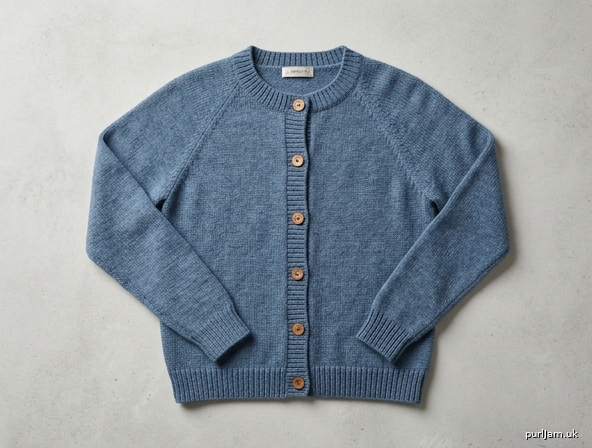
Close Crew-Neck Raglan Cardigan
Fitted sleeves · vertical button bands · 4-ply / fingering on 2.5 mm needles
A seamless top-down raglan cardigan worked in one piece from the neck down. The neckline is a close round/crew neck — it is deliberately not a boat neck. Short-row shaping raises the back of the neck, the fronts begin with very few stitches and curve down with neck-edge increases, and a ribbed neckband on a smaller needle draws the opening in.
Sleeves are fitted (tight upper arm and wrist) using a compound raglan: the body keeps increasing after the sleeves have reached their width. Vertical 2×2 rib button bands are picked up along the front edges so the ribs run up and down. Five buttons. Intermediate.
Sizes
S (M, L, XL, 2XL) To fit bust 86.5–91.5 (96.5–101.5, 106.5–112, 117–122, 127–132) cm / 34–36 (38–40, 42–44, 46–48, 50–52) in, with about 7.5–12.5 cm / 3–5 in positive ease at the bust when buttoned.
Shown in Small with fitted sleeves. Instructions are written for all five sizes; work the figures that match your size throughout.
Finished measurements
(after blocking, cardigan buttoned, bands overlapping)
| S | M | L | XL | 2XL | |
|---|---|---|---|---|---|
| Bust | 99 cm (39 in) | 109.5 cm (43 in) | 120 cm (47¼ in) | 129.5 cm (51 in) | 140.5 cm (55¼ in) |
| Back length (centre back neck to hem) | 56 cm (22 in) | 59 cm (23¼ in) | 61.5 cm (24¼ in) | 64.5 cm (25½ in) | 67 cm (26½ in) |
| Yoke depth (neck edge to underarm, at raglan) | 20 cm (8 in) | 21.5 cm (8½ in) | 23 cm (9 in) | 24.5 cm (9¾ in) | 26 cm (10¼ in) |
| Body length (underarm to hem) | 33 cm (13 in) | 34 cm (13½ in) | 35 cm (13¾ in) | 36 cm (14¼ in) | 37 cm (14½ in) |
| Upper arm (fitted) | 29.5 cm (11½ in) | 32.5 cm (12¾ in) | 35.5 cm (14 in) | 38 cm (15 in) | 41.5 cm (16¼ in) |
| Wrist (ribbed cuff) | 14.5 cm (5¾ in) | 16 cm (6¼ in) | 17.5 cm (7 in) | 18.5 cm (7¼ in) | 20 cm (8 in) |
| Sleeve length (underarm to cuff edge) | 43 cm (17 in) | 44 cm (17¼ in) | 45 cm (17¾ in) | 45 cm (17¾ in) | 46 cm (18 in) |
| Back neck width (before neckband draws in) | 16 cm (6¼ in) | 17.5 cm (7 in) | 18.5 cm (7¼ in) | 20 cm (8 in) | 21.5 cm (8½ in) |
Yarn
4-ply / fingering (thin yarn), approx. 400 m / 100 g. 1200 (1400, 1600, 1850, 2100) m / 1310 (1530, 1750, 2020, 2300) yd — about 300 (350, 400, 465, 525) g.
This pattern is written for a fine fabric on 2.5 mm needles. A smooth merino or merino-blend 4-ply gives clear raglan lines and a light cardigan.
Needles
- 2.5 mm circular needle, 80 cm / 32 in, for the body (worked flat; a circular holds the stitches comfortably), plus 2.5 mm DPNs or a short circular / magic loop for the sleeves
- 2.25 mm circular needle, 80 cm / 32 in, for ribbing (hem, cuffs, button bands, neckband)
Or sizes required to match tension.
Notions
- 4 stitch markers
- Waste yarn or stitch holders
- Tapestry needle
- 5 buttons, 12–15 mm diameter
Tension (gauge)
30 stitches and 40 rows = 10 cm / 4 in over stocking stitch on 2.5 mm needles, after blocking.
Tension square
With 2.5 mm needles, cast on 36 stitches. Work 48 rows in stocking stitch (knit RS, purl WS). Cast off. Wash and block the square. Count stitches and rows over a 10 cm / 4 in square in the centre.
- If you have more than 30 sts in 10 cm, your fabric is too tight — go up a needle size.
- If you have fewer than 30 sts in 10 cm, your fabric is too loose — go down a needle size.
Match stitch tension first; row tension affects yoke depth and length, which are also given in centimetres so you can measure as you go. Tension is critical for fit, especially on the fitted sleeves.
Abbreviations (UK)
k knit · p purl · st(s) stitch(es) · RS right side · WS wrong side · st st stocking stitch (k RS, p WS; in the round, k every round) · pm place marker · sm slip marker · CO cast on · rep repeat · rem remain(ing) · tog together · tbl through back loop
k2tog knit 2 together (right-leaning decrease)
ssk slip 1 knitwise, slip 1 knitwise, knit those 2 sts tog tbl (left-leaning decrease)
M1L make 1 left: lift the running thread from front to back, knit tbl
M1R make 1 right: lift the running thread from back to front, knit through the front
M1P make 1 purl: lift the running thread from front to back, purl tbl
w&t wrap and turn: slip next st purlwise, bring yarn to opposite side, slip st back, turn
yo yarn over
Pattern notes
- The cardigan is worked flat from the neck to the hem (except the sleeves, which are worked in the round). A circular needle is used as a long straight needle.
- Four raglan markers divide left front / left sleeve / back / right sleeve / right front. Increases are worked on both sides of each marker.
- Compound raglan: all four raglan lines increase at first; later, only the body raglans increase. This keeps the sleeves slim.
- Neck shaping happens at the same time as the raglan. Read each phase through before you start it.
- Buttonholes sit on the right front as worn (women’s traditional). For a men’s cardigan, work the buttonholes on the left front instead.
- Slip markers as you come to them unless instructed otherwise.
Raglan increase (RS)
Work to 1 st before marker, M1R, k1, sm, k1, M1L.
Worked at all 4 markers = 8 sts increased.
Body-only raglan increase (RS)
Work the increase only at the front/sleeve and sleeve/back markers that border the back and fronts — i.e. increase on the body side of each sleeve. In practice, on a RS row:
Knit left front to 1 st before first marker, M1R, k1, sm, k1 (no increase on the sleeve side), knit across sleeve to 1 st before next marker, k1, sm, k1, M1L, knit across back to 1 st before next marker, M1R, k1, sm, k1 (no sleeve increase), knit across sleeve to 1 st before last marker, k1, sm, k1, M1L, knit right front.
= 4 sts increased (1 each front, 2 on the back). Sleeves stay the same width.
Raglan increase (WS) — Phase 1 only
Work to 1 st before marker, M1P, p1, sm, p1, M1P.
All 4 markers = 8 sts increased.
Neck increase (RS only)
K1, M1L, work in pattern to last st, M1R, k1.
= 2 sts increased (1 at each front neck edge). A 1-st selvedge is kept at each front edge for picking up the bands.
Instructions
Numbers are given as S (M, L, XL, 2XL).
Neck and set-up
With 2.5 mm circular needle, cast on 82 (92, 102, 108, 118) sts.
Set-up row (WS): P5 (6, 7, 8, 9), pm, p12 (14, 16, 16, 18), pm, p48 (52, 56, 60, 64), pm, p12 (14, 16, 16, 18), pm, p5 (6, 7, 8, 9).
Stitch map: left front 5 (6, 7, 8, 9) · left sleeve 12 (14, 16, 16, 18) · back 48 (52, 56, 60, 64) · right sleeve 12 (14, 16, 16, 18) · right front 5 (6, 7, 8, 9).
82 = 5+12+48+12+5 ✓ · 92 = 6+14+52+14+6 ✓ · 102 = 7+16+56+16+7 ✓ · 108 = 8+16+60+16+8 ✓ · 118 = 9+18+64+18+9 ✓
This cast-on is a narrow crew neck, not a boat neck. The fronts start almost at a point; the back neck is 16 (17.5, 18.5, 20, 21.5) cm before the ribbed neckband draws it in further.
Short-row back-neck raise
These short rows raise the back of the neck so the front sits lower and closer to the body. Do not skip them — without them the neckline reads as a wide, shallow boat neck.
Short-row 1 (RS): Knit to the second marker (left sleeve / back), sm, k48 (52, 56, 60, 64) across the back, sm, k2 into the right sleeve, w&t.
Short-row 2 (WS): Purl 2 sleeve sts, sm, p48 (52, 56, 60, 64) across the back, sm, p2 into the left sleeve, w&t.
Short-row 3 (RS): Knit to the wrapped st, knit the wrap tog with the st, k2, w&t.
Short-row 4 (WS): Purl to the wrapped st, purl the wrap tog with the st, p2, w&t.
Repeat Short-rows 3–4 a further 4 (4, 5, 5, 6) times — you will have 6 (6, 7, 7, 8) wraps on each sleeve. You should still be on the sleeve stitches, not the fronts.
Next row (RS): Knit to end of row, working any remaining wrap tog with its stitch.
Next row (WS): Purl to end of row, working any remaining wrap tog with its stitch.
All 82 (92, 102, 108, 118) sts are back in work. Stitch count unchanged.
Yoke
Work in stocking stitch, with raglan and neck increases as given. The yoke is in three phases. Neck increases are worked at the same time as Phases 1 and 2.
Neck increases (at the same time): On every RS row, work a neck increase (k1, M1L, work to last st, M1R, k1) 19 (20, 21, 22, 23) times in total, then keep 1 selvedge st at each front edge with no further neck increases.
There are enough RS rows in Phases 1–2 to complete them. After the last neck increase, simply knit the first and last stitch of every RS row.
Phase 1 — raglan increase every row
Work 8 (12, 16, 20, 24) rows as follows:
RS rows: Neck increase (until those 19 (20, 21, 22, 23) RS times are used up), and raglan increase (RS) at all 4 markers.
WS rows: Raglan increase (WS) at all 4 markers; no neck increase.
Each of these rows adds 8 raglan sts. Each RS row also adds 2 neck sts until the neck total is reached.
Checkpoint — after Phase 1:
- Left/right front: 17 (24, 31, 38, 45) sts each
[S: 5 + 8 raglan + 4 neck = 17 ✓] - Each sleeve: 28 (38, 48, 56, 66) sts
[S: 12 + 2×8 = 28 ✓] - Back: 64 (76, 88, 100, 112) sts
[S: 48 + 2×8 = 64 ✓] - Total: 154 (200, 246, 288, 334) sts
[S: 82 + 8×8 raglan + 4×2 neck = 82+64+8 = 154 ✓]
Phase 2 — raglan increase every RS row (sleeves still growing)
Work 26 (25, 23, 23, 22) repeats of the next 2 rows (52 (50, 46, 46, 44) rows):
Row 1 (RS): Neck increase if you still have neck increases remaining, and raglan increase (RS) at all 4 markers. Knit all other sts.
Row 2 (WS): Purl.
8 sts increased on each RS row; 0 on WS.
Finish any remaining neck increases during this phase (remaining after Phase 1: 15 (14, 13, 12, 11) RS neck increases). Once they are done, work the front edges even.
Checkpoint — after Phase 2:
- Left/right front: 58 (63, 67, 73, 78) sts each
[S: 17 + 26 raglan + 15 neck = 58 ✓] - Each sleeve: 80 (88, 94, 102, 110) sts
[S: 28 + 2×26 = 80 ✓] — sleeve raglan increases are now complete - Back: 116 (126, 134, 146, 156) sts
[S: 64 + 2×26 = 116 ✓] - Total: 392 (428, 456, 496, 532) sts
[S: 154 + 26×8 raglan + 15×2 neck = 154+208+30 = 392 ✓]
Phase 3 — body-only increases (sleeves stay fitted)
Work 10 (12, 15, 16, 18) repeats of the next 2 rows (20 (24, 30, 32, 36) rows):
Row 1 (RS): Body-only raglan increase (see Pattern notes). Knit all other sts. Do not increase on the sleeve side of the markers, and do not increase at the neck.
Row 2 (WS): Purl.
4 sts increased on each RS row (body only). Sleeve stitch counts do not change.
Checkpoint — after Phase 3 (end of yoke):
- Left/right front: 68 (75, 82, 89, 96) sts each
[S: 58 + 10 = 68 ✓] - Each sleeve: 80 (88, 94, 102, 110) sts (unchanged) ✓
- Back: 136 (150, 164, 178, 192) sts
[S: 116 + 2×10 = 136 ✓] - Total: 432 (476, 516, 560, 604) sts
[S: 68+80+136+80+68 = 432 ✓]
Yoke should measure 20 (21.5, 23, 24.5, 26) cm from the first full (non-short) row to the needle, measured along a raglan line. If you are short of that depth, work even in st st (no increases) to length. If you have already reached the depth, proceed — stitch counts matter more than a few millimetres of yoke depth.
Divide body and sleeves
Next row (RS): Knit 68 (75, 82, 89, 96) left-front sts. Place the next 80 (88, 94, 102, 110) sleeve sts on waste yarn, removing the two markers that bounded the sleeve. Using the cable method, cast on 8 (10, 12, 12, 14) underarm sts. Knit 136 (150, 164, 178, 192) back sts. Place the next 80 (88, 94, 102, 110) sleeve sts on waste yarn, removing the remaining markers. Cast on 8 (10, 12, 12, 14) underarm sts. Knit 68 (75, 82, 89, 96) right-front sts.
Body on the needle: 288 (320, 352, 380, 412) sts.
[S: 68 + 8 + 136 + 8 + 68 = 288 ✓]
[M: 75+10+150+10+75 = 320 ✓]
[L: 82+12+164+12+82 = 352 ✓]
[XL: 89+12+178+12+89 = 380 ✓]
[2XL: 96+14+192+14+96 = 412 ✓]
WS: Purl.
Body
Continue in stocking stitch, worked flat, until the body measures 29 (30, 31, 32, 33) cm from the underarm cast-on, ending with a WS row. (Lengthen or shorten here if you want a different hem position.)
Hem ribbing
Change to 2.25 mm needles.
Rib row 1 (RS): K2, *p2, k2; rep from * to end.
Rib row 2 (WS): P2, *k2, p2; rep from * to end.
These rows fit every size: 288, 320, 352, 380 and 412 are all multiples of 4.
Rep Rib rows 1–2 until ribbing measures 4 cm, ending with a WS row. Cast off loosely in rib.
Sleeves
Both sleeves are identical. Fitted throughout.
Return 80 (88, 94, 102, 110) held sleeve sts to 2.5 mm DPNs or a short circular. With RS facing, starting at the centre of the underarm cast-on, pick up and knit 4 (5, 6, 6, 7) sts along the first half of the underarm, knit the held sts, pick up and knit 4 (5, 6, 6, 7) sts along the remaining underarm. Place a marker for the beginning of the round (centre underarm).
88 (98, 106, 114, 124) sts.
[S: 80 + 8 = 88 ✓]
[M: 88 + 10 = 98 ✓]
[L: 94 + 12 = 106 ✓]
[XL: 102 + 12 = 114 ✓]
[2XL: 110 + 14 = 124 ✓]
If a small hole appears at either underarm corner, pick up one extra stitch in the gap and decrease it away on the next round (k2tog at that point) so you return to the count above.
Knit 4 rounds even.
Sleeve decreases (fitted)
Decrease round: K1, k2tog, knit to 3 sts before marker, ssk, k1. (2 sts decreased.)
Work a Decrease round every 6th (6th, 5th, 5th, 5th) round 22 (25, 27, 29, 32) times.
44 (48, 52, 56, 60) sts remain.
[S: 88 − 2×22 = 44 ✓]
[M: 98 − 2×25 = 48 ✓]
[L: 106 − 2×27 = 52 ✓]
[XL: 114 − 2×29 = 56 ✓]
[2XL: 124 − 2×32 = 60 ✓]
Then knit even until the sleeve measures 37 (38, 39, 39, 40) cm from the underarm, or 6 cm less than the desired finished length.
Cuff
Change to 2.25 mm needles.
Rib round: *K2, p2; rep from * to end. (44, 48, 52, 56 and 60 are all multiples of 4.)
Work 2×2 rib until the cuff measures 6 cm. Cast off loosely in rib.
Work the second sleeve the same way.
Button bands (vertical / up-down rib)
Bands are picked up along the front edges and worked outwards so the ribs run up and down the opening. Pick up at a rate of 3 stitches for every 4 rows. The exact counts below assume you have not added or removed body length; if you changed the length, pick up 3 sts per 4 rows and adjust to the nearest multiple of 4 + 2.
With 2.25 mm needle and RS facing, beginning at the right front hem (lower right as worn), pick up and knit 158 (166, 174, 182, 190) sts evenly up the right front edge to the neck.
Band rib row 1 (WS): P2, *k2, p2; rep from * to end.
Band rib row 2 (RS): K2, *p2, k2; rep from * to end.
Work 4 rows in rib as set, ending after a WS row.
Buttonhole row (RS): K2, p2, [yo, k2tog, work 35 (37, 39, 41, 43) sts in rib as set] 4 times, yo, k2tog, p2, k2.
Check (Small): 4 sts, then four blocks of (2-st buttonhole + 35 sts) = 4×37 = 148, then 2-st buttonhole + 4 sts → 4+148+2+4 = 158 ✓. Five buttonholes, first 4 sts from the hem, last 4 sts from the neck.
Work 5 more rows in rib (so the band is 10 rows / about 2.5 cm in total). Cast off loosely in rib.
With RS facing, beginning at the left front neck and working down to the hem, pick up and knit 158 (166, 174, 182, 190) sts down the left front. Work 10 rows in 2×2 rib as for the right band, omitting buttonholes. Cast off loosely in rib.
Neckband
The neckband is worked on the smaller needle so it sits close to the neck and does not collapse into a boat neck.
With 2.25 mm needle and RS facing, beginning at the top of the right button band, pick up and knit:
- 8 sts across the top of the right band
- 24 (26, 28, 30, 32) sts down the right front neck slope
- 12 (14, 16, 16, 18) sts across the right sleeve cast-on edge
- 48 (52, 56, 60, 64) sts across the back neck
- 12 (14, 16, 16, 18) sts across the left sleeve cast-on edge
- 24 (26, 28, 30, 32) sts up the left front neck slope
- 8 sts across the top of the left band
136 (148, 160, 168, 180) sts.
[S: 8+24+12+48+12+24+8 = 136 ✓]
[M: 8+26+14+52+14+26+8 = 148 ✓]
[L: 8+28+16+56+16+28+8 = 160 ✓]
[XL: 8+30+16+60+16+30+8 = 168 ✓]
[2XL: 8+32+18+64+18+32+8 = 180 ✓]
If your pick-up is 1 or 2 sts off, increase or decrease on the next row to match; the count should be a multiple of 4.
Next row (WS) — draw-in row: P2, *k2, p2; rep from * to end, decreasing 8 sts evenly across the back-neck section only (k2tog at 8 evenly spaced points on the back).
128 (140, 152, 160, 172) sts. This snugs the back neck.
Work 2×2 rib (k2 at each end on RS) until the neckband measures 2.5 cm. Cast off firmly in rib — a loose cast-off will let the neck drop and widen.
Finishing
- Weave in all ends, using underarm tails to close any remaining gaps at the joins.
- Wet-block the cardigan to the finished measurements. Pin the neckline as a rounded crew, not a wide horizontal line; pin the sleeves slim. Allow to dry fully.
- Sew 5 buttons to the left band, opposite the buttonholes.
- Steam the bands lightly if they flare; do not stretch the neckband.
Schematic measurements (blocked)
Bust, buttoned: 99 (109.5, 120, 129.5, 140.5) cm
Centre-back length: 56 (59, 61.5, 64.5, 67) cm
Yoke depth at raglan: 20 (21.5, 23, 24.5, 26) cm
Body from underarm to hem: 33 (34, 35, 36, 37) cm
Upper arm: 29.5 (32.5, 35.5, 38, 41.5) cm
Cuff: 14.5 (16, 17.5, 18.5, 20) cm
Sleeve from underarm: 43 (44, 45, 45, 46) cm
To adjust
- Longer/shorter body: add or subtract stocking-stitch rows before the hem rib; then pick up 3 band sts per 4 rows along the new edge and keep a multiple of 4 + 2.
- Slightly less-tight sleeves: stop Phase 3 a few repeats early and work those rows even, or pick up 2 extra underarm sts each side and decrease them on the first sleeve rounds.
- Neck too open after blocking: pick up the neckband with 2.00 mm needles, or decrease 12 sts instead of 8 on the draw-in row.
- Neck too close: skip the draw-in decreases and cast off the neckband less firmly.
Do not widen the original cast-on or skip the short rows if you want to keep this a crew neck rather than a boat neck.
Disclaimer: This pattern was generated by AI and should be reviewed for accuracy before use. While we strive for quality, AI-generated content may contain errors. Please verify measurements, stitch counts, charts, and instructions before beginning your project. Generated by purlJam.uk
Love this pattern?
Save this pattern to your free PurlJam libraryAccess your pattern anytime
Bookmark this page to access your pattern anytime