Type
Crochet
Difficulty
intermediate
Category
shorts
AI Thinking Process
Planning
Verification
Pattern
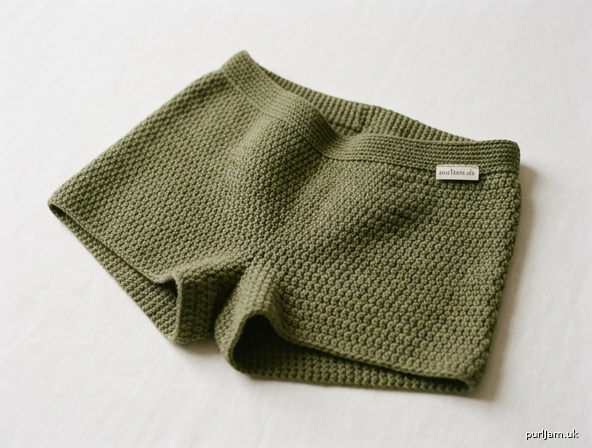
Close-Cut Microshorts
Seamless bottom-up crochet shorts with elastic waist
Skill level: Intermediate
Construction: Worked bottom-up in a spiral. Two identical legs are joined with crotch chains, then the body is shaped with crotch decreases, short-row back rise, and waist decreases. A folded double-crochet waistband encloses elastic.
These are fitted, high-cut pull-on microshorts — short in the leg, not necessarily ultra-low in the rise. The rise is a wearable mid-low so they stay put. Size by hip; the elastic sets the waist.
Sizes
XS (S, M, L, XL, 2X, 3X)
To fit hip: 86 (91, 97, 102, 109, 119, 130) cm / 34 (36, 38, 40, 43, 47, 51) in
To fit waist: 61 (66, 71, 76, 84, 94, 104) cm / 24 (26, 28, 30, 33, 37, 41) in
Shown as: XS (S, M, L, XL, 2X, 3X)
Choose the size closest to your hip. If you are between sizes, size up for less compression. The waist is gathered with elastic and does not need to match the fabric waist measurement.
Finished garment measurements
| XS | S | M | L | XL | 2X | 3X | |
|---|---|---|---|---|---|---|---|
| Hip circumference | 83 cm (32.75 in) | 89 cm (35 in) | 91.5 cm (36 in) | 97 cm (38.25 in) | 103 cm (40.5 in) | 114.5 cm (45 in) | 126 cm (49.5 in) |
| Fabric waist (before elastic) | 71.5 cm (28.25 in) | 77 cm (30.25 in) | 80 cm (31.5 in) | 85.5 cm (33.75 in) | 91.5 cm (36 in) | 100 cm (39.25 in) | 111.5 cm (44 in) |
| Suggested elastic length | 56 cm (22 in) | 61 cm (24 in) | 66 cm (26 in) | 71 cm (28 in) | 79 cm (31 in) | 89 cm (35 in) | 99 cm (39 in) |
| Leg opening | 48.5 cm (19 in) | 51.5 cm (20.25 in) | 54.5 cm (21.5 in) | 60 cm (23.5 in) | 64.5 cm (25.5 in) | 70 cm (27.5 in) | 77 cm (30.25 in) |
| Inseam (default) | 3.5 cm (1.5 in) | 3.5 cm (1.5 in) | 3.5 cm (1.5 in) | 3.5 cm (1.5 in) | 3.5 cm (1.5 in) | 3.5 cm (1.5 in) | 3.5 cm (1.5 in) |
| Front rise (crotch to top of folded waistband) | 20 cm (8 in) | 21 cm (8.25 in) | 22 cm (8.75 in) | 23 cm (9 in) | 24 cm (9.5 in) | 26 cm (10.25 in) | 27 cm (10.75 in) |
| Back rise | 23.5 cm (9.25 in) | 24.5 cm (9.75 in) | 25.5 cm (10 in) | 26.5 cm (10.5 in) | 27.5 cm (10.75 in) | 29.5 cm (11.5 in) | 30.5 cm (12 in) |
| Side outseam (hem to top of folded waistband) | 23.5 cm (9.25 in) | 24.5 cm (9.75 in) | 25.5 cm (10 in) | 26.5 cm (10.5 in) | 27.5 cm (10.75 in) | 29.5 cm (11.5 in) | 30.5 cm (12 in) |
Negative ease at the hip is intentional — the fabric should sit snug and stretch onto the body. Suggested elastic = body waist minus 5 cm (2 in); always measure your own waist and cut to fit.
Materials
Yarn: Worsted / aran (10-ply). A yarn with some recovery (wool, wool-blend, or acrylic-blend) will hold the seat and waist better than 100% cotton, which can sag.
Meterage: 350 (400, 450, 500, 575, 650, 750) m / 385 (440, 495, 550, 630, 710, 820) yd
Typical ball count: 2 (3, 3, 3, 3, 4, 4) × 100 g balls at ~196 m / 100 g, plus a spare for tension and joining.
Tension (gauge) yarn suggestion: Stylecraft Special Aran, Paintbox Yarns Simply Aran, or any worsted/aran that meets tension.
Hooks:
- 5 mm (UK 6 / US H/8) — main fabric
- 4.5 mm (UK 7 / US 7) — waistband
Notions:
- 8 locking stitch markers (4 one colour for crotch corners, 2 for centre front/back, 2 for sides)
- Tapestry needle
- 2.5 cm (1 in) wide elastic, length as table or your waist minus 5 cm (2 in)
- Sewing needle and strong thread (to join elastic)
- Smooth waste yarn (optional running marker for the spiral)
Tension (gauge)
With 5 mm hook, in htr worked in the round (or flat, unblocked then steamed/wet-blocked as you will treat the shorts):
14 htr and 11 rounds = 10 × 10 cm (4 × 4 in)
Work a swatch of at least 18 sts × 14 rounds, then measure the centre 10 cm. Fit depends on this tension. If you have too many stitches in 10 cm, go up a hook size; too few, go down.
Also hold the swatch up to a window or stretch it over your fist: if you can see through it clearly, the finished shorts will not be opaque. In that case, go down a hook size, choose a less drapey yarn, or plan a lining.
Abbreviations (UK terms)
- ch — chain
- sl st — slip stitch
- dc — double crochet (US single crochet)
- htr — half treble (US half double crochet)
- htr2tog — half treble 2 together (see Special stitches)
- FHtr — foundation half treble (see Special stitches)
- BLO — back loop only
- pm — place marker
- sm — stitch marker
- RS — right side
- WS — wrong side
- rnd(s) — round(s)
- st(s) — stitch(es)
- yoh — yarn over hook
- rep — repeat
- rem — remaining
Special stitches
Foundation half treble (FHtr):
Ch 3, yoh, insert hook in 3rd ch from hook, yoh, pull up a loop (3 loops on hook), yoh, pull through 1 loop (this makes the base chain), yoh, pull through all 3 loops (htr made).
*Yoh, insert hook under the 2 loops of the base chain just made, yoh, pull up a loop, yoh, pull through 1 loop, yoh, pull through all 3 loops; rep from * for the required number of FHtr.
htr2tog (compact, 4-loop version):
Yoh, insert hook in next st, yoh, pull up a loop, insert hook in following st, yoh, pull up a loop (4 loops on hook), yoh, pull through all 4 loops. One stitch decreased.
Working in a spiral: Do not join at the end of rounds and do not chain at the beginning. Place a running marker in the first stitch of the round and move it up each round so you can see where the round starts.
Pattern notes
- All body fabric is UK half treble (htr) unless stated. The waistband is UK double crochet (dc).
- Legs and body are worked in a spiral (no joining seam).
- The right side is the outside of the tube as you crochet (the side facing you if you work right-handed in the round).
- Counts are given as XS (S, M, L, XL, 2X, 3X). Highlight your size before you start.
- Default inseam is micro (about 3.5 cm / 1.5 in). Each extra htr round adds about 0.9 cm (⅜ in). See Customising length.
- Crotch decreases remove bulk and bring the joined tubes in to the hip. Do not skip them.
- Short rows add height at centre back so the waistband sits level and the seat does not drop.
- Opacity: microshorts in stretched htr may not be fully opaque. Wear with lining or substantial underwear, or sew in a lightweight stretch lining after blocking.
Customising length
- True micro / hot-pants inseam: work the 4 default leg rounds (as written).
- Cheeky / 5 cm inseam: work 6 leg rounds.
- Short-short / 7–8 cm inseam: work 8–9 leg rounds.
Do this on both legs before joining. Do not change the crotch, body, or waistband maths.
Pattern
1. Tension swatch
With 5 mm hook, FHtr 20 (or ch 21, htr in 3rd ch from hook and in each ch). Work 14 rows/rounds of htr. Fasten off. Block as you will block the shorts. Measure 14 sts and 11 rounds in the centre. Adjust hook until this matches 10 × 10 cm. Keep this swatch to check opacity.
2. Legs (make 2)
Both legs are identical. Mark the first stitch of each — that stitch is the inner thigh and is where you will join.
Foundation (leg opening):
With 5 mm hook, FHtr 68 (72, 76, 84, 90, 98, 108). Join to the first FHtr with a sl st, taking care not to twist, to form a ring. Pm in this first st (inner thigh).
Alternative foundation (less stretch at the hem): ch 68 (72, 76, 84, 90, 98, 108), join with sl st to first ch, ch 1 (does not count as a st), htr in each ch around. Pm in first htr. 68 (72, 76, 84, 90, 98, 108) sts.
Rnd 1: Htr in each st around in a spiral. 68 (72, 76, 84, 90, 98, 108) sts.
Rnds 2–4: Htr in each st around.
(4 htr rounds ≈ 3.6 cm / 1.5 in inseam, including the foundation. Add extra rounds now if you want a longer leg.)
Leg 1: Fasten off after Rnd 4, leaving a 20 cm (8 in) tail. Keep the inner-thigh marker in place.
Leg 2: Do not fasten off. End Rnd 4 at the stitch immediately before the inner-thigh marker. Yarn is in position to begin the join.
3. Joining the legs and crotch
Lay both legs RS out, inner thighs facing each other, markers aligned. Leg 2 is in your hook; Leg 1 is waiting.
Joining round:
Ch 6 (6, 8, 8, 10, 10, 12) (front crotch),
htr in each of the 68 (72, 76, 84, 90, 98, 108) sts of Leg 1 (begin in Leg 1’s marked inner-thigh st),
ch 6 (6, 8, 8, 10, 10, 12) (back crotch),
htr in each of the 68 (72, 76, 84, 90, 98, 108) sts of Leg 2 (begin in Leg 2’s marked inner-thigh st).
Do not join; continue in a spiral. You will work into the chains on the next round.
Stitch count check: 68 + 68 + 6 + 6 = 148 (XS); 72 + 72 + 6 + 6 = 156 (S); 76 + 76 + 8 + 8 = 168 (M); 84 + 84 + 8 + 8 = 184 (L); 90 + 90 + 10 + 10 = 200 (XL); 98 + 98 + 10 + 10 = 216 (2X); 108 + 108 + 12 + 12 = 240 (3X) ✓
Place markers for shaping:
- CF: centre stitch of the front crotch chain.
- CB: centre stitch of the back crotch chain.
- Four corner markers: one at each junction where a crotch chain meets a leg (4 corners). Use a contrasting colour for corners.
Crotch set-up round: Htr in each htr and in each ch around.
148 (156, 168, 184, 200, 216, 240) sts.
4. Crotch shaping
Decrease 8 stitches every round: two compact htr2tog at each of the four crotch corners (one decrease immediately before the corner marker, one immediately after). Move each corner marker up so it always sits between the two decreases.
Crotch decrease round:
*Htr until 2 sts remain before the next corner marker, htr2tog, slip marker, htr2tog; rep from * 4 times, htr to end of round.
8 sts decreased.
Work this decrease round 4 (4, 5, 6, 7, 7, 8) times.
Count after each size’s decrease rounds:
- XS: 4 rounds × 8 = 32. 148 − 32 = 116 sts ✓
- S: 4 × 8 = 32. 156 − 32 = 124 sts ✓
- M: 5 × 8 = 40. 168 − 40 = 128 sts ✓
- L: 6 × 8 = 48. 184 − 48 = 136 sts ✓
- XL: 7 × 8 = 56. 200 − 56 = 144 sts ✓
- 2X: 7 × 8 = 56. 216 − 56 = 160 sts ✓
- 3X: 8 × 8 = 64. 240 − 64 = 176 sts ✓
Hip fabric is now 116 (124, 128, 136, 144, 160, 176) sts
= 83 (89, 91.5, 97, 103, 114.5, 126) cm.
Remove the four corner markers. Keep CF and CB. Place a side marker halfway between CF and CB on each side (29 (31, 32, 34, 36, 40, 44) sts from CB). These mark the side “seams”.
5. Short-row back rise
The back needs extra height so the waistband sits level. Work 4 pairs of short rows across the back only. Each turning point is locked with a sl st; later you will work into those sl sts to close the steps.
Htr in a spiral from wherever you are until you reach CF. This is now the start of the round.
Set-up (RS): Htr from CF around, past CB, until you have worked 8 (8, 8, 10, 10, 12, 12) sts past CB. Sl st in next st, turn.
Short row 2 (WS): Ch 1, htr back across the back, past CB, until you have worked 8 (8, 8, 10, 10, 12, 12) sts past CB on the other side. Sl st in next st, turn.
(You have 16 (16, 16, 20, 20, 24, 24) htr, centred on CB.)
Short row 3: Ch 1, htr to the previous sl st, htr in that sl st, then htr 7 (8, 8, 8, 9, 9, 10) more sts into the round below, sl st in next st, turn.
Short row 4: Ch 1, htr across to the previous sl st on the other side, htr in that sl st, htr 7 (8, 8, 8, 9, 9, 10) more sts, sl st in next st, turn.
Short rows 5 and 6: As rows 3 and 4, extending a further 7 (8, 8, 8, 9, 9, 10) sts past each previous turning sl st.
Short rows 7 and 8: As rows 3 and 4, extending a further 7 (8, 8, 8, 9, 9, 10) sts past each previous turning sl st.
The last pair should land at or just before the side markers (about 29 (31, 32, 34, 36, 40, 44) sts each side of CB). If you reach a side marker early, stop that pair there — do not carry short rows onto the front.
Closing round: Ch 1, turn to RS, htr around the entire body. When you meet each turning sl st, work 1 htr into it (this closes the step). Continue past CF and onwards in a spiral.
116 (124, 128, 136, 144, 160, 176) sts.
You have added 4 extra rows at centre back (about 3.5 cm / 1.5 in), tapering to nothing at the sides.
6. Body (hip to waist)
Keep CF, CB, and both side markers, moving them up each round.
Hip even rounds: Htr in each st around for 9 (10, 10, 10, 10, 11, 11) rounds.
116 (124, 128, 136, 144, 160, 176) sts.
Waist decrease round:
*Htr until 2 sts remain before the next marker (use CF, two sides, and CB — 4 markers), htr2tog; rep from * 4 times, htr to end.
4 sts decreased.
Work the waist decrease round 4 (4, 4, 4, 4, 5, 5) times.
- XS–XL: 4 × 4 = 16. 116 − 16 = 100; 124 − 16 = 108; 128 − 16 = 112; 136 − 16 = 120; 144 − 16 = 128 ✓
- 2X: 5 × 4 = 20. 160 − 20 = 140 ✓
- 3X: 5 × 4 = 20. 176 − 20 = 156 ✓
Even waist rounds: Htr in each st around for 2 rounds.
100 (108, 112, 120, 128, 140, 156) sts.
Body fabric now measures about 71.5 (77, 80, 85.5, 91.5, 100, 111.5) cm at the waist — larger than the body waist so it pulls on over the hips; elastic will gather it.
If you want a higher rise, add extra even htr rounds before the waistband (each round ≈ 0.9 cm). If you want a lower rise, work 2–3 fewer hip-even rounds, keeping the decrease rounds.
7. Waistband (folded, for elastic)
Change to 4.5 mm hook.
Rnd 1: Dc in each st around. 100 (108, 112, 120, 128, 140, 156) sts.
Rnds 2–12: Dc in each st around.
12 dc rounds ≈ 6.5–7 cm (2.5–2.75 in) tall, which folds to about 3–3.5 cm (1.25 in) wearing height.
Do not fasten off. Try on the shorts (carefully — there is no elastic yet) and check that the top edge sits where you want the finished waistband to sit once folded. Add or remove 1–2 dc rounds if needed; keep an even number so the fold lines up.
Fold and enclose elastic:
- Cut elastic to 56 (61, 66, 71, 79, 89, 99) cm / 22 (24, 26, 28, 31, 35, 39) in, or to your waist minus 5 cm (2 in). Overlap the ends 2.5 cm (1 in) and sew a small square plus a cross so the join cannot slip.
- Fold the dc waistband to the inside so the first dc round meets the last, forming a tube.
- Slip the elastic into the fold, keeping it flat and un-twisted.
- Working from the RS, sl st the live edge to the corresponding stitches of Rnd 1 of the waistband, catching one loop of Rnd 1 with each sl st, and easing the fabric evenly around the elastic. Do not crochet into the elastic itself.
- Fasten off.
The elastic should sit freely inside the casing so the waistband can gather.
Optional ribbed waistband (instead of folded)
If you prefer a ribbed band sewn on:
With 4.5 mm hook, ch 13.
Row 1: Dc in 2nd ch from hook and in each ch. 12 dc. Turn.
Row 2: Ch 1, dc BLO in each st. Turn.
Rep Row 2 until the strip, slightly stretched, matches the top edge of the shorts: about 100 (108, 112, 120, 128, 140, 156) rows, or until it fits the top opening comfortably stretched.
Fasten off, leaving a long tail. Sew the short ends of the ribbing together to form a ring. Pin to the top of the shorts, easing evenly, and whip stitch in place. On the inside, sew a channel of ribbon or a second row of stitching and thread elastic through as above, or sew the elastic to the inside of the ribbing at the join only, stretching it as you sew.
8. Finishing
Weave in ends. Take joining tails and crotch tails along the crotch chain on the WS for at least 8 cm (3 in) and double back. Leg and waistband ends should be woven into the WS of neighbouring stitches, not into the elastic casing in a way that snags the elastic.
Hem (optional): If the foundation edge curls or looks unfinished, join yarn at the inner thigh of one leg with 4.5 mm hook and work 1 rnd dc around the leg opening; sl st to join; fasten off. Repeat for the second leg. For a sportier edge, work that round as reverse dc (crab stitch).
Blocking:
- Wool or wool-blend: soak in lukewarm water with a little wool wash, press out water in a towel, and lay flat. Shape the legs as matching tubes, smooth the crotch curve, and set the waistband fold. Do not stretch the hip beyond the finished measurements. Dry flat.
- Acrylic: hover a steam iron over the fabric (do not rest the iron on it) and pin to measurements.
- Cotton: wet block, but expect less snap-back — dry at the finished hip, not larger.
Elastic check: After blocking, try the shorts on. The waistband should sit at your natural or slightly dropped waist without sliding, and the crotch should cup rather than hang. If the elastic is loose, open a few sl sts at the back of the casing, tighten, re-sew the elastic, and close the casing.
Lining (recommended for wear in bright light): After blocking, cut two lightweight stretch-knit panels (or use ready-made stretch lining shorts) to the same rise and inseam. Tack at the waistband fold and at the crotch on the WS so the lining takes the strain off the crochet at the seat.
Schematic (measurements in cm)
                 fabric waist
          71.5 (77, 80, 85.5, 91.5, 100, 111.5)
                 _______________
                /               \      folded WB ~3 cm
               /                 \
              |        HIP        |     front rise
              | 83 (89, 91.5, 97, |     20 (21, 22, 23, 24, 26, 27)
              |  103, 114.5, 126) |
               \      / \        /      crotch curve
                \____/   \______/       (short-row extra at back ~3.5 cm)
                |    |   |    |
                |    |   |    |         inseam 3.5 (add rnds to lengthen)
                |____|   |____|
           leg opening 48.5 (51.5, 54.5, 60, 64.5, 70, 77)
Fit checklist
- Hip: snug on the body, not baggy. If the hip fabric pools, you may need a smaller size or a firmer tension.
- Crotch: should follow the body; if it sags, the short rows were skipped or the elastic is too loose. If it feels tight or pulls the legs inward, you decreased too far — next time stop one crotch-decrease round early.
- Leg opening: should sit high on the thigh. If it cuts in, add 4 sts to each leg foundation next time (and add 8 to every later count).
- Waist: elastic does the cinching. Fabric waist is meant to be larger than your waist.
Yarn quantities (approximate)
XS 350 m · S 400 m · M 450 m · L 500 m · XL 575 m · 2X 650 m · 3X 750 m, including a tension swatch. Always buy one extra ball of the same dye lot.
Pattern uses UK crochet terms throughout. UK htr = US hdc; UK dc = US sc.
Disclaimer: This pattern was generated by AI and should be reviewed for accuracy before use. While we strive for quality, AI-generated content may contain errors. Please verify measurements, stitch counts, charts, and instructions before beginning your project. Generated by purlJam.uk
Love this pattern?
Save this pattern to your free PurlJam libraryAccess your pattern anytime
Bookmark this page to access your pattern anytime