Type
Knitting
Difficulty
beginner
Category
pullover
AI Thinking Process
Planning
Verification
Pattern
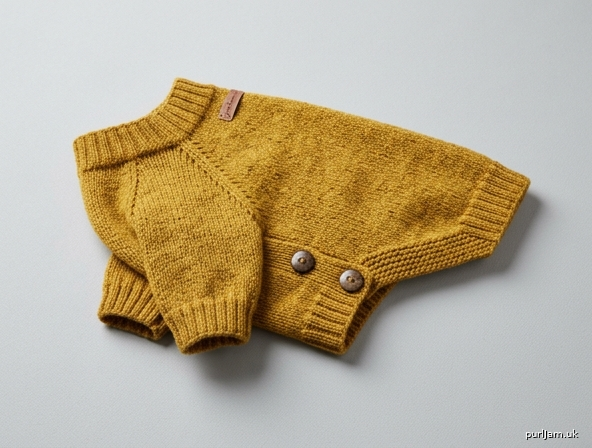
Cosy Walks Dog Jumper
Seamless top-down raglan · beginner · worsted / Aran
A soft, machine-washable pullover for dogs, worked seamlessly from the neck down. Raglan increases shape the yoke, the front legs are divided off into short ribbed cuffs, and the body is knitted in the round to a short belly, then continued as a longer back so your dog can toilet comfortably. A simple buttoned belly strap keeps the jumper in place on walks.
Designed for everyday wear. Choose a machine-washable yarn — dogs get muddy.
Sizes
XS (S, M, L, XL)
To fit chest (widest point, behind the front legs): 28–32 (36–40, 44–48, 52–56, 60–66) cm [11–12½ (14–16, 17½–19, 20½–22, 23½–26) in]
Typical breeds (guide only — always measure your dog):
- XS: Chihuahua, Yorkshire Terrier, toy Pomeranian
- S: Jack Russell, Pug, Shih Tzu, miniature Dachshund
- M: Cocker Spaniel, Beagle, Corgi, French Bulldog
- L: Border Collie, Staffordshire Bull Terrier, Springer Spaniel
- XL: Labrador, Boxer, Golden Retriever
Choose the size by chest circumference first. Length is easy to add or subtract as you knit.
Finished measurements
| XS | S | M | L | XL | |
|---|---|---|---|---|---|
| Chest | 34 cm (13½ in) | 42 cm (16½ in) | 50 cm (19¾ in) | 58 cm (22¾ in) | 66 cm (26 in) |
| Neck, unstretched | 22 cm (8¾ in) | 28 cm (11 in) | 34 cm (13½ in) | 40 cm (15¾ in) | 46 cm (18 in) |
| Neck to front leg (incl. rib) | 8 cm (3¼ in) | 10 cm (4 in) | 13 cm (5 in) | 16 cm (6¼ in) | 20 cm (8 in) |
| Belly length (cast-on to belly hem) | 14 cm (5½ in) | 18 cm (7 in) | 23 cm (9 in) | 28 cm (11 in) | 34 cm (13½ in) |
| Back length (cast-on to back hem) | 24 cm (9½ in) | 32 cm (12½ in) | 40 cm (15¾ in) | 48 cm (19 in) | 58 cm (22¾ in) |
| Front-leg cuff circumference | 12 cm (4¾ in) | 15 cm (6 in) | 18 cm (7 in) | 21 cm (8¼ in) | 24 cm (9½ in) |
Ease is about 2–6 cm at the chest so the jumper sits over the coat without twisting.
Measure your dog
Use a soft tape. The tape should be snug but not tight — you should be able to slip two fingers underneath.
- Chest: widest point of the ribcage, just behind the front legs. This is your size.
- Neck: where a collar sits.
- Back length: from the collar point to the base of the tail.
- Belly length: from the collar point along the underside, stopping well before the genitals / last ribs so your dog can toilet.
- Front leg: around the top of the leg, where it meets the body.
If your dog is between sizes, size up. You can lengthen the back and belly as you go.
Yarn
Worsted / Aran (10-ply), machine-washable, soft against the skin.
Approximate metreage: 160 (240, 360, 500, 700) m Approximate weight: 100 (150, 200, 280, 380) g
Allow an extra ball if you lengthen the back or add longer sleeves.
Suggested fibres: superwash wool, acrylic, or a wool–acrylic blend. Avoid non-superwash wool (felts in the wash) and anything scratchy at the neck.
Example yarns: Stylecraft Special Aran, Paintbox Yarns Simply Aran, Cascade 220 Superwash, King Cole Comfort Aran, Rico Essentials Soft Merino Aran.
Needles
- 4.5 mm (UK 7) circular needle, 40 cm long, for the body (use 60 cm for L and XL if the stitches feel crowded)
- 4 mm (UK 8) circular needle, 40 cm long, for ribbing
- 4.5 mm and 4 mm double-pointed needles, or an 80 cm circular for the magic-loop method, for the neck of smaller sizes and the leg cuffs
Use whichever small-circumference method you prefer. A set of double-pointed needles and a short circular will both work.
Notions
- 4 stitch markers (one of them distinct for the beginning of the round)
- 2 stitch holders or lengths of smooth waste yarn
- Tapestry needle
- 2 buttons, 15–20 mm diameter (or plastic snaps if you prefer no buttons)
- Measuring tape
- Optional: 1 extra marker for the centre back
Tension
20 stitches and 28 rounds = 10 cm over stocking stitch on 4.5 mm needles, after a light steam or wet block.
(US readers: this is gauge.)
Work a 15 cm stocking-stitch swatch in the round if you can — many knitters are tighter in the round than when knitting flat. Change needle size to match this tension. A slightly firm fabric is ideal: it wears better on dogs and is less likely to snag.
Abbreviations
| beg | beginning |
| cm | centimetres |
| k | knit |
| kfb | knit into the front and then the back of the same stitch (1 stitch increased) |
| k2tog | knit 2 stitches together |
| p | purl |
| PM | place marker |
| rep | repeat |
| rnd(s) | round(s) |
| RS | right side |
| SM | slip marker |
| st(s) | stitch(es) |
| st st | stocking stitch (knit every round in the round; knit RS / purl WS when flat) |
| WS | wrong side |
| yo | yarn over |
Cast off is used throughout (UK). Work cast-offs in rib where the edge is ribbed, so the edge stays stretchy.
Construction notes
The jumper is a tube with two holes for the front legs. The “Front” sits on the dog’s chest and belly; the “Back” sits on the dog’s back.
- Cast on at the neck and work ribbing in the round.
- Place four raglan markers: Back, Right Sleeve, Front, Left Sleeve.
- Increase with kfb at both ends of every section, every other round.
- Place each sleeve on hold, cast on underarm stitches, and continue the body in the round.
- Hem the shorter belly, then work the back and forth on the longer back.
- Pick up for short ribbed front-leg cuffs.
- Pick up a belly strap and sew on buttons.
Try the jumper on your dog (or measure against them) before you divide for the legs and again before you hem the belly. Neck-to-leg depth varies a lot between breeds.
Pattern
Numbers are given as XS (S, M, L, XL). When only one number appears, it applies to all sizes.
Neck
With 4 mm needles and a stretchy method (long-tail is ideal), cast on 44 (56, 68, 80, 92) sts. Join to work in the round, being careful not to twist, and place a distinct marker for the beginning of the round.
Rib rnd: *K1, p1; rep from * to end.
Work in 1×1 rib until the neck measures 3 (3, 4, 4, 5) cm from the cast-on edge.
The unstretched neck is 22 (28, 34, 40, 46) cm and the ribbing will stretch over the head. If your dog has a very large head (Pug, French Bulldog, Boxer), work the rib on 4.5 mm needles instead, or cast on the next size’s neck stitches and decrease to your size on the first stocking-stitch round.
Yoke
Change to 4.5 mm needles.
Set-up rnd: K 16 (20, 24, 28, 32) and PM (Back), k 6 (8, 10, 12, 14) and PM (Right Sleeve), k 16 (20, 24, 28, 32) and PM (Front), k 6 (8, 10, 12, 14) to the beginning-of-round marker (Left Sleeve).
16 + 6 + 16 + 6 = 44 ✓ · 20 + 8 + 20 + 8 = 56 ✓ · 24 + 10 + 24 + 10 = 68 ✓ · 28 + 12 + 28 + 12 = 80 ✓ · 32 + 14 + 32 + 14 = 92 ✓
You now have four sections, each sitting between a pair of markers.
Raglan increases
Increase rnd: *Kfb, knit to 1 st before marker, kfb, SM; rep from * 3 more times. (8 sts increased — 2 in each section.)
Even rnd: Knit all sts, slipping markers as you meet them.
Work the last two rounds a further 6 (7, 8, 10, 11) times — that is 7 (8, 9, 11, 12) increase rounds in total, each followed by an even round except as noted below.
Stitch count after all increase rounds: 100 (120, 140, 168, 188) sts.
Check: 7 × 8 = 56; 44 + 56 = 100 ✓ 8 × 8 = 64; 56 + 64 = 120 ✓ 9 × 8 = 72; 68 + 72 = 140 ✓ 11 × 8 = 88; 80 + 88 = 168 ✓ 12 × 8 = 96; 92 + 96 = 188 ✓
Section counts:
- Back: 30 (36, 42, 50, 56) sts
- Right Sleeve: 20 (24, 28, 34, 38) sts
- Front: 30 (36, 42, 50, 56) sts
- Left Sleeve: 20 (24, 28, 34, 38) sts
Back 16 + 14 = 30; Sleeve 6 + 14 = 20 ✓ (XS). Same pairing for every size.
Yoke length
Continue in stocking stitch (knit every round), with no further increases, until the yoke measures 5 (7, 9, 12, 15) cm from the end of the neck rib, ending after a knit round.
If you reach this length before all the increase rounds are done (possible on a very compact dog), work any remaining increase rounds consecutively, without even rounds between them, then stop.
Try on / measure now. The work should reach the front of the dog’s front legs. If it is short of the legs, knit extra even rounds. If it has already passed the legs, divide in the next section even if you are a little under the listed depth.
Divide for front legs
You will now park the sleeve stitches and join the Front to the Back with a few new underarm stitches.
Dividing rnd:
- Knit across the 30 (36, 42, 50, 56) Back sts.
- Slip the next 20 (24, 28, 34, 38) Right Sleeve sts onto a holder or waste yarn.
- Cast on 4 (6, 8, 8, 10) sts using the backward-loop (e-wrap) method for the right underarm.
- Knit across the 30 (36, 42, 50, 56) Front sts.
- Slip the next 20 (24, 28, 34, 38) Left Sleeve sts onto a holder or waste yarn.
- Cast on 4 (6, 8, 8, 10) sts for the left underarm.
Body: 68 (84, 100, 116, 132) sts.
30 + 4 + 30 + 4 = 68 ✓ · 36 + 6 + 36 + 6 = 84 ✓ · 42 + 8 + 42 + 8 = 100 ✓ · 50 + 8 + 50 + 8 = 116 ✓ · 56 + 10 + 56 + 10 = 132 ✓
Chest circumference at tension: 68 sts ÷ 2 = 34 cm ✓; 84 ÷ 2 = 42 cm ✓; 100 ÷ 2 = 50 cm ✓; 116 ÷ 2 = 58 cm ✓; 132 ÷ 2 = 66 cm ✓.
The beginning-of-round marker now sits at the start of the Back, which is the left-hand side of the dog’s back as worn. You may replace the four raglan markers with a single beginning-of-round marker.
Body (chest, in the round)
Work even in stocking stitch (knit every round) until the piece measures 6 (8, 10, 12, 14) cm from the underarm cast-on.
Total length from the cast-on edge is now about 14 (18, 23, 28, 34) cm. This should land on the dog’s underside before the hind legs and genitals. Try it on. Add or subtract rounds here — a belly that is too long is uncomfortable.
Split for belly and back
The belly stops here; the back continues.
Next rnd: Knit 40 (50, 60, 70, 80) sts (this is the Back panel, including the sides). Slip the remaining 28 (34, 40, 46, 52) sts onto a holder for the Belly.
40 + 28 = 68 ✓ · 50 + 34 = 84 ✓ · 60 + 40 = 100 ✓ · 70 + 46 = 116 ✓ · 80 + 52 = 132 ✓
You will now work the two sections separately.
Belly hem
With 4 mm needles, return to the 28 (34, 40, 46, 52) held Belly sts. Join yarn with the RS facing (the knit side, which is the outside of the jumper).
Work 1×1 rib (*k1, p1; rep from * to end) back and forth for 2.5 (2.5, 3, 3, 3.5) cm.
Cast off loosely in rib.
Back
With 4.5 mm needles, return to the 40 (50, 60, 70, 80) Back sts. Join yarn with the RS facing if it is not already attached.
Work back and forth in stocking stitch with a 3-stitch garter border so the side edges lie flat:
Row 1 (RS): Knit to end. Row 2 (WS): K3, purl to last 3 sts, k3.
Repeat Rows 1 and 2 until the back measures 21 (29, 36, 44, 53) cm from the original cast-on edge, ending with a WS row.
Back hem
Change to 4 mm needles.
Work 1×1 rib across all sts for 3 (3, 4, 4, 5) cm.
Cast off loosely in rib.
Total back length: 21 + 3 = 24 cm ✓; 29 + 3 = 32 cm ✓; 36 + 4 = 40 cm ✓; 44 + 4 = 48 cm ✓; 53 + 5 = 58 cm ✓.
The back should end near the base of the tail. Add extra stocking-stitch rows before the hem if your dog has a long back (Dachshund, Corgi, Greyhound).
Front-leg cuffs
Work one cuff at a time.
With 4 mm double-pointed needles (or magic loop), and with the RS facing, return to one set of held sleeve sts.
Set-up: Knit across the 20 (24, 28, 34, 38) held sts, then pick up and knit 4 (6, 8, 8, 10) sts along the underarm cast-on edge. Join to work in the round and PM for the beginning of the round.
24 (30, 36, 42, 48) sts.
20 + 4 = 24 ✓ · 24 + 6 = 30 ✓ · 28 + 8 = 36 ✓ · 34 + 8 = 42 ✓ · 38 + 10 = 48 ✓
Cuff circumference at tension: 24 sts ÷ 2 = 12 cm ✓; 30 ÷ 2 = 15 cm ✓; 36 ÷ 2 = 18 cm ✓; 42 ÷ 2 = 21 cm ✓; 48 ÷ 2 = 24 cm ✓.
Work 1×1 rib (*k1, p1; rep from * to end) for 2.5 (3, 3, 3.5, 4) cm.
Cast off loosely in rib.
Repeat for the second leg.
Longer sleeves (optional): Stay on 4.5 mm needles after picking up. Knit in the round, decreasing 2 sts (k2tog at the start of the round and ssk at the end) every 6th round until the sleeve is the length you want, then change to 4 mm and work 2.5–4 cm of 1×1 rib. Cast off in rib.
Belly strap
The strap sits just behind the front legs and buttons under the belly so the jumper cannot twist or ride up.
Lay the jumper flat, RS up, with the Back toward you. The left side edge of the Back (as the dog wears it — your right as you look at the back) is where you pick up.
Starting 2 cm down from the underarm along that side edge, and with 4 mm needles and RS facing, pick up and knit 10 (10, 12, 12, 14) sts evenly over about 5–7 cm of edge.
Row 1 (WS): *K1, p1; rep from * to end. Row 2 (RS): *K1, p1; rep from * to end.
Continue in 1×1 rib until the strap measures 16 (19, 22, 25, 28) cm, or until it wraps under your dog’s belly and overlaps the opposite side edge by about 4 cm. End with a WS row.
Buttonhole row (RS): Work 3 (3, 3, 3, 4) sts in rib, yo, k2tog, rib to last 5 (5, 5, 5, 6) sts, k2tog, yo, rib to end. (2 buttonholes.)
Work 4 more rows in 1×1 rib. Cast off in rib.
Try the jumper on the dog, bring the strap under the belly, and mark the button positions on the opposite side edge of the Back. Sew on the two buttons to match the buttonholes.
If you would rather not use buttons (puppies, chewers), sew on plastic snaps, or work two shorter straps and tie them in a soft bow, trimming the ends short.
Finishing
- Weave in all ends on the WS. Take particular care at the underarms — close any small gap at each corner with the tail from the underarm cast-on.
- Sew on the buttons (or snaps) as marked.
- Block lightly: soak in lukewarm water with a little wool wash, press out water in a towel, and lay flat to dry to the finished measurements. Do not stretch the ribbing.
- Check the neck and chest on the dog: you should be able to slip two fingers under the fabric at both places. If the neck is tight, run a round of slip-stitch crochet (or a second pass of mattress stitch from the inside) is not needed — instead, pick out the cast-on and re-cast onto a larger needle, or keep the jumper for a smaller dog.
Fit notes
- The jumper should cover the back to the base of the tail and the chest to mid-belly. It should not cover the hind legs or the genital area.
- Front legs should move freely. If a cuff twists, it is too tight — pick it out and recast off more loosely, or pick up 2 extra stitches next time.
- After a wet walk, dry the jumper flat. Machine-wash on a gentle cycle if your yarn band allows it; that is why superwash or acrylic is recommended.
- Safety: Do not leave a dog unattended in a buttoned jumper if they are likely to chew. Check that nothing dangles where it could catch on crate bars or undergrowth.
Quick customisation
| If you need… | Do this |
|---|---|
| A longer back | Knit extra Rows 1–2 of the Back before the hem |
| A shorter back | Start the back hem sooner |
| A longer belly | Knit extra rounds in the Body before the split |
| A wider chest | Cast on 2 extra underarm sts each side when dividing |
| A deeper neck-to-leg | Knit extra even yoke rounds before dividing |
| A snugger neck | Work the neck rib on 3.5 mm needles |
| Stripes | Change colour every 4–8 rounds in the yoke or body; carry the unused colour up the inside for short intervals |
Enjoy the walks.
Disclaimer: This pattern was generated by AI and should be reviewed for accuracy before use. While we strive for quality, AI-generated content may contain errors. Please verify measurements, stitch counts, charts, and instructions before beginning your project. Generated by purlJam.uk
Love this pattern?
Save this pattern to your free PurlJam libraryAccess your pattern anytime
Bookmark this page to access your pattern anytime