Type
Knitting
Difficulty
intermediate
Category
tank
AI Thinking Process
Planning
Verification
Pattern
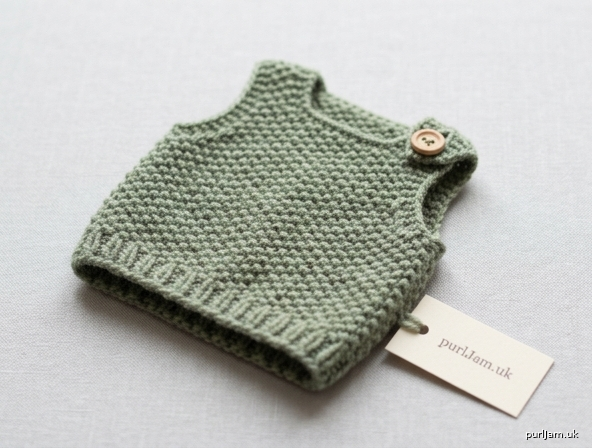
Doll’s Moss Stitch Tank
A beginner sleeveless jumper for a small doll
This tiny vest is knitted flat in two identical pieces, then seamed. Moss stitch (UK) lies flat, hides uneven stitches, and needs no ribbed bands — ideal for a first garment. A button at one shoulder makes dressing easy.
Skill level: Beginner (knit, purl, cast on, cast off, simple seaming)
Size
One size, to fit a doll with:
- Chest 11 cm (4¼ in)
- Waist 10.5 cm (4 in)
- Shoulder to hip 8 cm (3¼ in)
Finished measurements
- Chest circumference: 13 cm (5 in) — about 2 cm ease
- Length, shoulder to hem: 8 cm (3¼ in)
- Armhole depth: 3.5 cm (1½ in)
- Neck width (when buttoned): 3.5 cm (1½ in)
- Each piece: 6.5 cm (2½ in) wide × 8 cm (3¼ in) long
Waist is worked straight. At this scale the 0.5 cm difference between chest and waist is less than one stitch; moss stitch has enough give to sit at the waist.
Materials
- Yarn: Oddment (about 20 g / 40 m) of worsted weight yarn (UK Aran / 10-ply). Any fibre; a smooth wool or acrylic blend shows the moss stitch clearly.
- Needles: Pair of 4 mm straight needles (UK 8). The slightly smaller needle gives a firm fabric that holds its shape on the doll.
- Notions:
- Yarn needle
- 1 small button, 8–10 mm
- Scissors
- Pins (for blocking and seaming)
Safety note: If the doll will be given to a child under 3 years, omit the button. Sew both shoulders instead, or embroider a small yarn knot as a pretend button.
Tension (gauge)
20 stitches and 32 rows = 10 cm (4 in) over moss stitch on 4 mm needles, measured after a light block.
Work a 12 cm square, then measure 20 sts and 32 rows in the centre.
- Too many stitches to 10 cm (fabric too tight): try 4.5 mm needles and re-check.
- Too few stitches to 10 cm (fabric too loose): try 3.75 mm needles and re-check.
This pattern is so small that tension must match. A difference of 2 sts in 10 cm changes the chest by more than 1 cm.
Abbreviations (UK knitting)
| Abbreviation | Meaning |
|---|---|
| K | knit |
| P | purl |
| st(s) | stitch(es) |
| RS | right side |
| WS | wrong side |
| rep | repeat |
| rem | remaining |
Cast on and cast off are written in full.
Moss stitch (worked over an odd number of sts): every row K1, *P1, K1; rep from * to end.
Notes
- Front and back are identical. Make two.
- Moss stitch is reversible; mark the cast-on edge so you can measure length from the same place on both pieces.
- Count stitches at the end of every row until the moss pattern feels automatic (always 13 sts).
- Do not join in a new ball in the middle of a tiny piece — 20 g is plenty for the whole jumper.
- Measurements are more important than row counts. Row counts are a guide only.
Front and Back (make 2 the same)
Using 4 mm needles, cast on 13 sts.
Moss stitch row: K1, *P1, K1; rep from * to end.
(13 sts: K, P, K, P, K, P, K, P, K, P, K, P, K ✓)
Repeat the moss stitch row until the piece measures 8 cm (3¼ in) from the cast-on edge (approximately 26 rows: 26 rows ÷ 32 rows × 10 cm = 8.1 cm ✓).
Cast off in pattern: work each stitch as moss stitch (K the next st if it should be knitted, P if it should be purled) and pass the previous stitch over, so the cast-off edge matches the fabric.
Fasten off, leaving a 20 cm tail for seaming.
You now have two rectangles, each 13 sts wide (6.5 cm) and 8 cm long ✓.
Making up
Block
Pin each piece to 6.5 cm wide × 8 cm long (2½ × 3¼ in). Spray lightly with water and leave to dry completely. Blocking evens the moss stitch and makes seaming easier.
Right shoulder
Place the two pieces together, WS facing each other, with cast-off edges at the top.
Starting at the right armhole edge, join 1.5 cm (½ in) of the shoulder using mattress stitch or backstitch (about 3 sts; 3 sts ÷ 20 sts × 10 cm = 1.5 cm ✓).
Leave the remaining 5 cm of the top edge open (6.5 − 1.5 = 5 cm, of which 1.5 cm will be the buttoned left shoulder and 3.5 cm the neck ✓).
Side seams and armholes
Still with WS together, sew each side seam from the cast-on edge (hem) upwards for 4.5 cm (1¾ in) (8 − 3.5 = 4.5 cm ✓).
Leave the top 3.5 cm (1½ in) of each side open for the armholes.
Use mattress stitch for a flat join, or whip stitch if you prefer a quicker finish. Keep seams snug but not pulled — on 13 sts a tight seam will steal width.
Left shoulder (button)
The left shoulder is the dressing opening.
- On the back left shoulder, sew the button 1 cm in from the armhole edge, centred on the cast-off edge.
- On the front left shoulder, make a loop to match: thread a 15 cm length of yarn on the yarn needle, secure it at the cast-off edge 1 cm in from the armhole, make a loop that slips snugly over the button (about 1 cm long), wrap the loop a few times to strengthen it, and fasten off on the WS.
When the button is closed the shoulders match (1.5 cm each side) and the neck opening is 3.5 cm wide ✓.
Ends
Weave in all remaining ends on the WS. Trim.
To dress the doll
Undo the shoulder button. Slip the jumper over the doll’s head, or pass it up from the hips. Button the left shoulder. The 13 cm chest sits with a little ease over the 11 cm chest; moss stitch has enough give at the 10.5 cm waist.
Quick reference
| Piece | Stitches | Work until | Then |
|---|---|---|---|
| Front | 13 sts moss | 8 cm | Cast off in pattern |
| Back | 13 sts moss | 8 cm | Cast off in pattern |
| Seam | Measurement |
|---|---|
| Right shoulder | 1.5 cm in from armhole |
| Each side seam | 4.5 cm up from hem |
| Each armhole left open | 3.5 cm |
| Left shoulder | Button + loop, 1 cm in from armhole |
Stitch counts never change: 13 sts from cast-on to cast-off ✓.
Disclaimer: This pattern was generated by AI and should be reviewed for accuracy before use. While we strive for quality, AI-generated content may contain errors. Please verify measurements, stitch counts, charts, and instructions before beginning your project. Generated by purlJam.uk
Love this pattern?
Save this pattern to your free PurlJam libraryAccess your pattern anytime
Bookmark this page to access your pattern anytime