Type
Knitting
Difficulty
intermediate
Category
tank
AI Thinking Process
Planning
Verification
Pattern
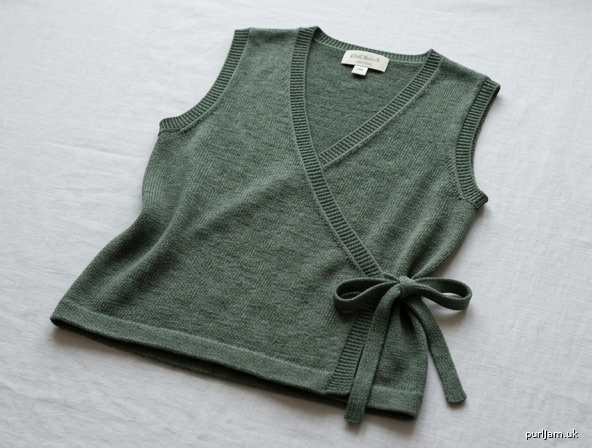
Machine-Knit Wrap Tank Top
A sleeveless wrap top worked on a standard-gauge knitting machine in three pieces (back and two overlapping fronts), then seamed. Very fine 100% cotton is held three strands together to give a fingering-weight fabric. The wrap fronts are mirror images; the right front (as worn) closes over the left. Waist ties make the fit adjustable. Intermediate: fully-fashioned shaping, wrap decreases, seaming and picked-up bands.
Difficulty: Intermediate
Construction: Flat, machine-knit pieces, seamed
Sizes
XS (S, M, L, XL)
To fit bust: 76–81 (86–91, 96–101, 106–111, 116–121) cm / 30–32 (34–36, 38–40, 42–44, 46–48) in
Shown in size M. Choose the size closest to your bust; the wrap and ties allow 0–8 cm of adjustment.
Finished measurements
Measured after washing and blocking, with fronts overlapped by approximately 12 (13, 14, 15, 16) cm at the bust.
| XS | S | M | L | XL | |
|---|---|---|---|---|---|
| Back width | 40 cm | 45 cm | 50 cm | 55 cm | 60 cm |
| Each front width (at hem) | 32 cm | 36 cm | 39 cm | 43 cm | 46 cm |
| Approximate bust when wrapped | 80 cm | 90 cm | 100 cm | 110 cm | 120 cm |
| Length from shoulder | 56 cm | 58 cm | 60 cm | 62 cm | 64 cm |
| Armhole depth | 19 cm | 20 cm | 21 cm | 22 cm | 23 cm |
| Shoulder / strap width | 8 cm | 8.5 cm | 9 cm | 10 cm | 10.5 cm |
| Back neck width | 13.5 cm | 15.5 cm | 18 cm | 20 cm | 22 cm |
| Hem depth | 4 cm | 4 cm | 4 cm | 4 cm | 4 cm |
Ease is close to standard (about 0–4 cm) and is adjustable with the wrap.
Yarn
Fibre: 100% cotton (bomull), very fine machine-knitting yarn (listed 15 000 m / 100 g), held 3 strands together throughout.
The 3-strand fabric must match the tension below (fingering-weight equivalent). If your cones are a different count, change the number of strands (or the tension dial) until the washed swatch matches. Do not knit the garment until it does.
Quantity (combined weight of all 3 strands): 150 (175, 200, 230, 270) g
You need three cones or balls so the strands can be fed together. Single-strand metreage is high on industrial cones; you will use only a portion of each cone.
Suggested colour: a solid or marled cotton; three strands of the same colour give a smooth fabric. For a subtle heather, mix two matching shades.
Machine and tools
- Standard-gauge knitting machine (4.5 mm pitch, 200 needles) — Brother, Silver Reed/Knitmaster, or equivalent
- Tension dial approximately T7 for stocking stitch with 3 strands (adjust to match tension)
- Claw weights and a ribber comb or cast-on comb
- Transfer tools (2-prong and 3-prong)
- Waste yarn and ravel cord
- Optional: ribber (for 1×1 hems instead of a hung hem)
- 3.25 mm circular needle, 80 cm, for wrap/neck and armhole bands (hand-finished)
- Tapestry needle
- Blocking mats and pins
- 2 stitch markers or locking pins to mark waist-tie placement
Tension (gauge)
28 stitches and 40 rows = 10 cm over stocking stitch on the machine, measured after washing and drying.
Knit a swatch of at least 40 sts × 50 rows at your chosen tension dial, with 3 strands held together. Take the swatch off on waste yarn, wash as you will wash the garment, dry flat, then measure the centre 10 cm.
Cotton relaxes. If you skip washing the swatch, the top will grow.
Conversion: 2.8 sts = 1 cm; 4 rows = 1 cm.
Adjust the tension dial (and if needed the number of strands) until you match this tension. A mid-gauge machine may be used if the same tension is obtained.
Abbreviations
| alt | alternate |
| beg | beginning |
| CO | cast on |
| COL / COR | carriage on left / right |
| cont | continue |
| dec | decrease |
| foll | following |
| HP | holding position |
| k | knit |
| meas | measures |
| NWP | non-working position |
| p | purl |
| RC | row counter |
| rem | remain(ing) |
| rep | repeat |
| RS / WS | right side / wrong side |
| st(s) | stitch(es) |
| st st | stocking stitch |
| T | tension dial |
| WP | working position |
| WY | waste yarn |
Machine decrease (fully fashioned): Using a 2-prong tool, move the edge 2 stitches one needle inward. Leave the emptied edge needle in NWP. This slants the edge and is used at armholes and wrap edges.
Machine cast off: Back-stitch bind-off, or transfer-tool chain bind-off. Keep the edge elastic, especially at shoulders and underarms.
Notes
- Three strands. Thread all three through the tension mast so they feed as one yarn. If a strand loops, the stitch will drop — check the first 10 rows of every piece.
- Stocking stitch on the machine is knit every row. The knit side is the right side of the garment.
- Row counter. Set RC = 000 after the hem join. Length measurements include the hem unless stated otherwise.
- Mirror the fronts. Left and Right Fronts are identical in stitch count but reversed in shaping. Mark each piece as soon as it comes off the machine.
- Wrap convention. As worn, the Right Front overlaps the Left Front.
- Cotton. Seam firmly (mattress stitch, one extra strand of cotton). Wet-block to measurements; do not steam-press aggressively or the fabric will grow and the armholes will drop.
- Needle bed. All garment pieces fit a 200-needle standard-gauge bed. The wrap/neck band is too long for the bed and is worked by hand on a circular needle.
BACK
Hem
With waste yarn, cast on 112 (126, 140, 154, 168) stitches. Knit 8–10 rows WY. Knit 1 row ravel cord.
Change to main yarn (3 strands). Tension T7 (or your swatch dial).
Set RC = 000. Knit 16 rows (4 cm).
Hang the hem: Pick up the first main-yarn row (the stitches above the ravel cord) and hang those loops onto the corresponding needles (2 loops per needle). Knit 1 row at a tighter tension (about T4–T5) to join. Return to garment tension.
Remove waste yarn and ravel cord after a few more rows, or at the end.
Set RC = 000.
(Ribber option: instead of a hung hem, work 16 rows 1×1 rib at ribber tension, then transfer all stitches to the main bed and continue in st st.)
Body
Working in st st, knit until the piece meas 37 (38, 39, 40, 41) cm from the cast-on edge (including hem), ending COR.
RC will be approximately 132 (136, 140, 144, 148) after the hem join
(16 hem rows + 132 body rows = 148 rows from cast-on = 37 cm for XS ✓).
Shape armholes
Cast off 5 (6, 7, 8, 9) sts at the beg of the next 2 rows.
102 (114, 126, 138, 150) sts
(112 − 5 − 5 = 102 ✓).
Dec 1 st at each end of every 2nd row 10 (11, 12, 13, 14) times, using fully-fashioned transfers.
82 (92, 102, 112, 122) sts
(102 − 20 = 82 ✓; 114 − 22 = 92 ✓; 126 − 24 = 102 ✓; 138 − 26 = 112 ✓; 150 − 28 = 122 ✓).
These decreases occupy 20 (22, 24, 26, 28) rows.
Cont in st st without shaping until the armhole meas 17 (17.5, 18.5, 19, 20) cm from the underarm cast-off, ending with COR (RS row next).
Shape back neck and shoulders
Next row (RS): Work 30 (33, 36, 39, 42) sts, cast off the centre 22 (26, 30, 34, 38) sts, work to end.
(30 + 22 + 30 = 82 ✓; 33 + 26 + 33 = 92 ✓; 36 + 30 + 36 = 102 ✓; 39 + 34 + 39 = 112 ✓; 42 + 38 + 42 = 122 ✓).
Place the first group of stitches in HP (or take them off on waste yarn). Work the side with the yarn attached first.
Each side (30 (33, 36, 39, 42) sts):
At the neck edge, dec 1 st every row 8 (9, 10, 11, 12) times.
At the same time, at the armhole edge, cast off for the shoulder on the next 3 opportunities (beg of armhole-edge rows, i.e. every alt row):
- XS: 8 sts, then 7 sts, then 7 sts (8 + 7 + 7 = 22 ✓)
- S: 8 sts, then 8 sts, then 8 sts (8 + 8 + 8 = 24 ✓)
- M: 9 sts, then 9 sts, then 8 sts (9 + 9 + 8 = 26 ✓)
- L: 10 sts, then 9 sts, then 9 sts (10 + 9 + 9 = 28 ✓)
- XL: 10 sts, then 10 sts, then 10 sts (10 + 10 + 10 = 30 ✓)
Neck total: 22 + 8 + 8 = 38 sts (13.5 cm) for XS ✓
44 / 50 / 56 / 62 sts for S–XL ✓
Shoulder rem after neck decs: 22 (24, 26, 28, 30) sts, all cast off ✓
Rejoin yarn to the held side and reverse the shaping.
Armhole depth when shoulders are complete: 19 (20, 21, 22, 23) cm
(76 (80, 84, 88, 92) rows ✓).
Total back length: 56 (58, 60, 62, 64) cm
(16 + 132 + 76 = 224 rows = 56 cm for XS ✓).
LEFT FRONT (inner wrap, as worn)
This front sits underneath. The wrap edge is the centre-front edge (wearer’s right when worn). The side edge is seamed to the left side of the back and becomes the left armhole.
Cast on and work the hem as for the Back, but over 90 (100, 110, 120, 130) stitches.
Set RC = 000 after the hem join.
Body, wrap and armhole
Work in st st.
Wrap edge (every 3 rows): Dec 1 st at the wrap edge every 3 rows, fully fashioned, 53 (59, 65, 71, 77) times in all. These decreases run through the body and into the armhole. After they are complete, work that edge even.
At the same time, when the piece meas 37 (38, 39, 40, 41) cm from the cast-on edge (same as the Back), shape the armhole at the side edge only:
- Cast off 5 (6, 7, 8, 9) sts at the beg of the next side-edge row.
- Then dec 1 st at the armhole edge every 2nd row 10 (11, 12, 13, 14) times.
Armhole decrease total on this edge: 5 + 10 = 15 sts for XS
(6 + 11 = 17; 7 + 12 = 19; 8 + 13 = 21; 9 + 14 = 23 ✓).
Stitch count when all wrap and armhole shaping is complete:
22 (24, 26, 28, 30) sts
(90 − 53 wrap − 15 armhole = 22 ✓
100 − 59 − 17 = 24 ✓
110 − 65 − 19 = 26 ✓
120 − 71 − 21 = 28 ✓
130 − 77 − 23 = 30 ✓).
Wrap-decrease length: 53 × 3 = 159 rows after the hem for XS, which is 39.75 cm of slope, finishing part-way up the armhole; then the strap is worked even ✓. Larger sizes likewise finish the wrap decreases before the shoulder (77 × 3 = 231 rows after the hem for XL; 234 rows are available before shoulder shaping ✓).
Cont until the armhole meas 19 (20, 21, 22, 23) cm, matching the Back, and 22 (24, 26, 28, 30) sts rem.
Shape shoulder
At the armhole edge only, cast off in three steps as for the matching Back shoulder:
- XS: 8, 7, 7
- S: 8, 8, 8
- M: 9, 9, 8
- L: 10, 9, 9
- XL: 10, 10, 10
RIGHT FRONT (outer wrap, as worn)
Work as for the Left Front, reversing all shaping.
The wrap edge is now the opposite side of the needle bed (wearer’s left when worn). The side/armhole edge seams to the right side of the Back.
Mark the piece “RIGHT — outer” as soon as it is off the machine.
TIES (make 2)
On the machine, e-wrap cast on 6 stitches (2 cm).
Knit in st st for 60 cm (240 rows). Cast off.
Optional third short tie (25 cm) can be sewn inside the left side seam as an anchor; two ties are enough for a side bow.
FINISHING
Block
Soak the three pieces (and ties) in lukewarm water with a little wool wash or mild detergent. Do not agitate. Roll in a towel. Pin to the finished measurements, keeping the wrap edges as straight diagonals and the armholes the same depth on front and back. Dry completely.
Cotton must be blocked before seaming.
Shoulders
Join each front shoulder to the corresponding back shoulder with mattress stitch (or a linker), matching the 22 (24, 26, 28, 30) sts.
Side seams
Join the side edges of Back and Fronts from the top of the hem to the underarm cast-off. Use mattress stitch. Leave the wrap edges open.
Place a marker on each side seam 26 (27, 28, 29, 30) cm up from the cast-on edge — this is waist-tie height (about 11 cm below the underarm).
Armhole bands
With RS facing and 3.25 mm circular needle, pick up and knit 120 (126, 132, 140, 148) sts around each armhole, as follows:
- 5 (6, 7, 8, 9) sts from the underarm cast-off
- 3 sts for every 4 rows up the front armhole
- 3 sts for every 4 rows down the back armhole
(For XS: 76 armhole rows each side × 3/4 = 57, plus 57, plus 5 underarm = 119, rounded to 120 for 1×1 rib ✓.)
Work 8 rows (2 cm) of k1, p1 rib. Cast off in rib, not tightly.
Wrap and neck band
The band runs up the Left Front wrap edge, across the back neck, and down the Right Front wrap edge. It is too long for a 200-needle bed; work it by hand.
With RS facing and 3.25 mm circular needle, pick up and knit at 7 sts per 10 rows along each wrap edge (the diagonal is longer than the vertical) and 38 (44, 50, 56, 62) sts across the back neck.
Approximate pick-up: 155 (165, 175, 190, 205) sts per wrap edge + back neck
= 348 (374, 400, 436, 472) sts.
Work 8 rows of k1, p1 rib. Cast off in rib, keeping the edge elastic so the wrap still lies flat.
If you prefer to work on the machine, knit three separate bands (two wrap edges, one back neck) of 8 rows 1×1 rib and join them at the shoulders with a flat seam.
Attach ties
Sew one tie to the Right Front (outer) wrap-edge band at the waist marker, on the wearer’s left.
Sew the second tie to the Left Front side-seam (inner) at the same height, on the wearer’s right.
To wear: wrap the left front across the body and secure it with the inner tie; wrap the right front over it and tie at the side or back.
Ends
Darn in all ends. If a 3-strand end is bulky, split the strands and darn them separately.
Give the seamed garment a light mist and a final flatten; do not re-soak unless the bands have flared.
Schematic (cm)
                    shoulder 8 (8.5, 9, 10, 10.5)
                   |------|     |------|
              \    |      |     |      |    /
               \   |      back neck     |   /
                \  |  13.5 (15.5, 18, 20, 22) |  /
                 \ |                    | /
        armhole   \|                    |/   armhole
        19 (20,    |                    |    19 (20,
        21, 22, 23)|       BACK         |    21, 22, 23)
                   |                    |
                   |                    |
                   |                    |
                   |____________________|
                     40 (45, 50, 55, 60)

   LEFT FRONT (inner)              RIGHT FRONT (outer)
   wrap edge \                     / wrap edge
              \                   /
               \                 /
                \               /
   side/armhole  |             |  side/armhole
                 |             |
                 |_____________|
                 32 (36, 39, 43, 46) at hem

   Total length 56 (58, 60, 62, 64)
   Hem 4
   Tie height from hem 26 (27, 28, 29, 30)
Overlap at bust: about 12 (13, 14, 15, 16) cm.
To wear and care
Wrap the inner (left) front across and fasten, then the outer (right) front over it. The V depth is set by how tightly you wrap; the bands should lie flat, not stand away.
Care: Hand wash cold or machine wash on a cotton gentle cycle in a bag. Dry flat. Do not tumble-dry. Cotton will stretch if hung wet. Recheck length after the first wash; if it has grown, re-block to the schematic.
Checklist before you start
- Washed swatch = 28 sts × 40 rows to 10 cm
- Three strands feeding cleanly
- Size chosen from the to fit bust column
- Needle bed has at least 168 needles in work for XL back
- 3.25 mm circular needle ready for the bands
Disclaimer: This pattern was generated by AI and should be reviewed for accuracy before use. While we strive for quality, AI-generated content may contain errors. Please verify measurements, stitch counts, charts, and instructions before beginning your project. Generated by purlJam.uk
Love this pattern?
Save this pattern to your free PurlJam libraryAccess your pattern anytime
Bookmark this page to access your pattern anytime