Type
Machine Knitting
Difficulty
intermediate
Category
custom
AI Thinking Process
Planning
Verification
Pattern
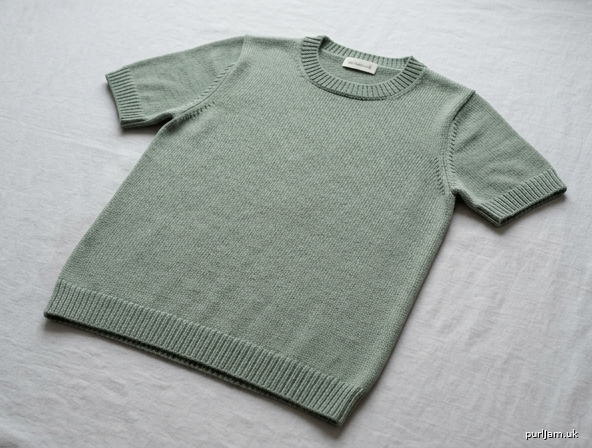
Everyday DK Ladies T-Shirt
Machine-knit short-sleeve crew-neck tee
A classic, easy-fitting ladies T-shirt in DK yarn: stocking-stitch body, short sleeves, crew neck, and 1×1 rib trims. Pieces are knitted flat on a mid-gauge machine and seamed. Fully fashioned armhole and neck shaping plus a rehung rib neckband make this an intermediate project.
Materials
Yarn: DK (double knitting; approx. 11–14 wpi). Cotton or cotton-blend recommended for a true T-shirt hand; wool or acrylic DK also work. Meterage: 450 (500, 550, 600, 650, 700) m — approximately 200 (225, 250, 275, 300, 325) g at 110 m / 50 g. Buy an extra ball if substituting a heavier cotton. Waste yarn: Smooth contrast yarn in a similar or finer weight, plus ravel cord.
Machine: Mid-gauge 6.5 mm (e.g. Silver Reed LK150 or equivalent) with at least 120 needles. A ribber is required for true 1×1 hems, cuffs and neckband (single-bed alternatives are given in Pattern Notes). Not required: punchcard or electronic patterning — this is plain stocking stitch (every needle). Standard-gauge (4.5 mm) machines are not recommended for DK; only attempt if a swatch at T9–T10 matches the stated gauge and the fabric is flexible, not board-like.
Tools: Cast-on comb and weights; claw weights; ravel cord; 1-prong, 2-prong and 3-prong transfer tools; latch tool; tapestry needle; blocking surface and steam iron; optional decker comb.
Tension / Gauge
Always swatch and block before you begin.
| Tension dial | Fabric | Gauge (blocked) | |
|---|---|---|---|
| Main yarn, stocking stitch | T7 | Every needle, main bed | 20 sts and 28 rows = 10 cm (4 in) |
| Main yarn, 1×1 rib | T4 | Zigzag 1×1, both beds | Rib fabric (hem measures 4 cm over 12 rows) |
| Waste yarn | T10 | Every needle | — |
If your blocked stocking swatch is not 20 sts × 28 rows, change the tension dial (T6–T8 typical) and re-swatch. Do not start the garment until gauge matches; stitch counts are calculated from this gauge only.
Sizes
Instructions are written XS (S, M, L, XL, XXL). Choose by to-fit bust; the tee has about 7–11 cm positive ease.
| XS | S | M | L | XL | XXL | |
|---|---|---|---|---|---|---|
| To fit bust | 81 cm (32 in) | 86 cm (34 in) | 91 cm (36 in) | 97 cm (38 in) | 102 cm (40 in) | 107 cm (42 in) |
| Finished bust | 88 cm (34¾ in) | 94 cm (37 in) | 100 cm (39½ in) | 106 cm (41¾ in) | 112 cm (44 in) | 118 cm (46½ in) |
| Finished length | 58 cm (22¾ in) | 59 cm (23¼ in) | 60 cm (23½ in) | 62 cm (24½ in) | 64 cm (25¼ in) | 66 cm (26 in) |
| Length to underarm | 40 cm (15¾ in) | 40 cm (15¾ in) | 40 cm (15¾ in) | 41 cm (16¼ in) | 42 cm (16½ in) | 43 cm (17 in) |
| Armhole depth | 18 cm (7 in) | 19 cm (7½ in) | 20 cm (8 in) | 21 cm (8¼ in) | 22 cm (8¾ in) | 23 cm (9 in) |
| Upper sleeve width | 32 cm (12½ in) | 34 cm (13½ in) | 36 cm (14¼ in) | 38 cm (15 in) | 40 cm (15¾ in) | 42 cm (16½ in) |
| Sleeve length (underarm, incl. rib) | 14 cm (5½ in) | 14 cm (5½ in) | 15 cm (6 in) | 15 cm (6 in) | 16 cm (6¼ in) | 16 cm (6¼ in) |
Finished bust is after 1-st mattress-stitch side seams.
Abbreviations and machine terms
| Term | Meaning |
|---|---|
| MB | Main bed |
| RB | Ribber bed |
| T | Tension dial setting |
| RC | Row counter |
| COR / COL | Carriage on right / carriage on left |
| ndl(s) | Needle(s) |
| WP | Working position |
| HP | Holding position |
| NWP | Non-working position |
| FWP | Fully working position |
| 1×1 rib | Alternate needles MB and RB (zigzag) |
| SS | Stocking stitch (plain knit, every ndl WP, carriage set to knit) |
| FF dec | Fully fashioned decrease (see Pattern Notes) |
| BO | Bind off |
| WY | Waste yarn |
| K | Knit (carriage pass) |
Carriage is always set for plain knit (stocking): both Part buttons out, MC/slip/tuck off, Russell levers / side levers as required for your model to knit every needle in WP. Hold cam / Russell levers are changed only when HP is specified.
Pattern notes
- Read the whole pattern before casting on. Figures are given XS (S, M, L, XL, XXL).
- Needle arrangement, stocking stitch: every needle in WP across the required width.
- Needle arrangement, 1×1 rib: zigzag — every other needle on MB, opposite needles on RB. After the rib, transfer all RB stitches to the empty MB needles so every MB needle is in WP (stitch count doubles from “needles per bed” to total garment stitches). Then drop the ribber.
- Fully fashioned decrease (FF dec) at the right edge (COR, knitting to the left): with a 2-prong tool, transfer the two stitches on ndls 1–2 (counting from the edge) one needle inward; leave the empty edge needle in NWP. Reverse at the left edge. This slants the decrease one stitch in from the selvedge and leaves a clean mattress-stitch edge.
- Fully fashioned increase: bring the empty adjacent needle to WP and fill it by picking up the side bar of the adjacent stitch (or e-wrap). Work increases one stitch in from the edge.
- Weights: hang the cast-on comb after the waste/ravel set-up. Add claw weights at both edges and move all weights up every 20–30 rows, and always after shaping.
- Single-bed (no ribber) hems: e-wrap the full stitch count at T7, K 12 rows, hang the cast-on loops back onto the corresponding needles (hung hem), K 1 row T8, reset RC 000 and continue in SS at T7. For cuffs and neckband, knit a 12-row hung hem the same way, or pick up and knit 8 rows SS and bind off loosely.
- Selvedges: 1 stitch each side is the seam allowance and is included in the stitch counts.
- Reverse shaping on the left neck/shoulder by working the same numbers with the carriage at the opposite side.
- Do not cut the main yarn until the piece is finished or you are instructed to break it; use WY and ravel cord wherever stitches are parked.
BACK
Machine set-up (ribber 1×1 hem)
- Set MB and RB for 1×1 zigzag over 45 (48, 51, 54, 57, 60) needles on each bed (90 (96, 102, 108, 114, 120) sts after transfer).
- Cast on with WY at T10. K several rows. K 1 row ravel cord. Hang the cast-on comb and weights.
- Change to main yarn. Zigzag cast-on (or e-wrap) at T4. K 1 circular row (left bed then right bed, or as your ribber requires) so the zigzags close.
- Set both carriages to knit 1×1 rib. RC 000. COR.
- K 12 rows 1×1 rib at T4 (≈ 4 cm). RC 012. COL or COR as your last pass ends — note the side.
Transfer to stocking stitch
- Transfer every RB stitch to its empty MB needle using a transfer tool (90 (96, 102, 108, 114, 120) sts now on MB). All MB needles in WP; take RB needles to NWP and drop or drop-out the ribber. Hang extra claw weights at the edges.
- Change to T7. Set carriage for plain SS. RC 000. COR.
Body to underarm
- K 100 (100, 100, 104, 106, 108) rows SS. RC 100 (100, 100, 104, 106, 108). COR. (100 rows × 10 cm / 28 rows = 35.7 cm + 4 cm rib = 39.7 cm, blocks to 40 cm ✓)
Shape armholes
-
BO 3 (3, 4, 4, 5, 5) sts at the beginning of the next 2 rows (latch-tool BO, or transfer to adjacent needles and knit through). 84 (90, 94, 100, 104, 110) sts. RC 102 (102, 102, 106, 108, 110). (90 − 3 − 3 = 84 ✓; 96 − 3 − 3 = 90 ✓; 102 − 4 − 4 = 94 ✓; 108 − 4 − 4 = 100 ✓; 114 − 5 − 5 = 104 ✓; 120 − 5 − 5 = 110 ✓)
-
FF dec 1 st at each end of the next and every following 2nd row 1 (2, 2, 3, 3, 4) time(s). 82 (86, 90, 94, 98, 102) sts. (84 − 2×1 = 82 ✓; 90 − 2×2 = 86 ✓; 94 − 2×2 = 90 ✓; 100 − 2×3 = 94 ✓; 104 − 2×3 = 98 ✓; 110 − 2×4 = 102 ✓)
-
Continue in SS without shaping until armhole measures 50 (54, 56, 58, 62, 64) rows from the first armhole BO, including the shaping rows already worked. RC 150 (154, 156, 162, 168, 172) from the start of SS, COR. You should be 8 rows short of the full armhole; the next 8 rows shape the back neck and shoulders together.
Shape back neck and shoulders
Work each side separately. The centre back neck is 20 (22, 24, 24, 26, 28) sts; 6 further sts are decreased each side (3 + 2 + 1) so the finished back neck is 32 (34, 36, 36, 38, 40) sts (20+6+6=32 ✓ and sized equivalents). Each shoulder is 25 (26, 27, 29, 30, 31) sts, bound off in three groups.
- Next row (COR): K 31 (32, 33, 35, 36, 37) sts (right shoulder + right neck decreases). Take the centre 20 (22, 24, 24, 26, 28) ndls to HP (or scrap them off onto WY). Take the remaining left-side needles to HP. Turn. COL. (31 + 20 + 31 = 82 for XS ✓; 32+22+32=86 ✓; 33+24+33=90 ✓; 35+24+35=94 ✓; 36+26+36=98 ✓; 37+28+37=102 ✓)
Right back neck and shoulder (work on the 31 (32, 33, 35, 36, 37) sts in WP only; Hold cam set to hold HP needles):
- Row 1 (COL, neck edge): BO 3 sts, K to end. 28 (29, 30, 32, 33, 34) sts.
- Row 2 (COR, shoulder edge): BO 8 (8, 9, 9, 10, 10) sts, K to end. 20 (21, 21, 23, 23, 24) sts.
- Row 3 (COL, neck edge): BO 2 sts, K to end. 18 (19, 19, 21, 21, 22) sts.
- Row 4 (COR, shoulder edge): BO 8 (9, 9, 10, 10, 10) sts, K to end. 10 (10, 10, 11, 11, 12) sts.
- Row 5 (COL, neck edge): BO 1 st, K to end. 9 (9, 9, 10, 10, 11) sts. (3+2+1 = 6 neck sts removed ✓)
- Row 6 (COR, shoulder edge): BO remaining 9 (9, 9, 10, 10, 11) sts. Shoulder total 8+8+9=25 (XS) ✓; 8+9+9=26 (S) ✓; 9+9+9=27 (M) ✓; 9+10+10=29 (L) ✓; 10+10+10=30 (XL) ✓; 10+10+11=31 (XXL) ✓
Break yarn. Return the held centre neck needles to WP and scrap them off onto WY (or latch-tool BO loosely if you prefer not to graft the neckband).
Left back neck and shoulder:
- Rejoin main yarn at the neck edge of the remaining 31 (32, 33, 35, 36, 37) sts, COR. Bring those needles from HP to WP; all other needles NWP/HP.
- Work as for the right side, reversing shapings: BO 3 sts at the neck edge on the first row, then 2 sts, then 1 st; and BO the shoulder in the same three groups 8 (8, 9, 9, 10, 10), 8 (9, 9, 10, 10, 10), 9 (9, 9, 10, 10, 11) at the armhole edge.
- RC 158 (162, 164, 170, 176, 180) from the start of SS. Remove the piece. 8 shoulder/neck rows + 150 (154, 156, 162, 168, 172) = 158 (162, 164, 170, 176, 180) ✓
FRONT
- Work exactly as for the Back through the armhole shaping and the straight armhole, until RC 124 (128, 128, 132, 138, 140) from the start of SS, COR. Armhole so far: 24 (28, 28, 28, 32, 32) rows. Remaining to shoulder line: 26 (26, 28, 30, 30, 32) rows, which is the front neck depth (26 rows × 10 / 28 = 9.3 cm ✓).
Divide for front neck
Front neck = centre 12 (14, 14, 14, 16, 16) sts + 10 (10, 11, 11, 11, 12) FF dec each side. 12+10+10=32 (XS) ✓ matching back neck.
- Next row (COR): K 35 (36, 38, 40, 41, 43) sts. Take the centre 12 (14, 14, 14, 16, 16) ndls to HP (or scrap onto WY). Take remaining left-side needles to HP. Turn. COL. Check: 35+12+35=82 (XS) ✓; 36+14+36=86 ✓; 38+14+38=90 ✓; 40+14+40=94 ✓; 41+16+41=98 ✓; 43+16+43=102 ✓
Right front neck and shoulder (35 (36, 38, 40, 41, 43) sts in WP):
-
Neck decreases: FF dec 1 st at the neck edge on the next row and every following 2nd row 10 (10, 11, 11, 11, 12) times. 25 (26, 27, 29, 30, 31) sts remain. (35−10=25 ✓; 36−10=26 ✓; 38−11=27 ✓; 40−11=29 ✓; 41−11=30 ✓; 43−12=31 ✓) These decreases occupy 20 (20, 22, 22, 22, 24) rows. Then K without neck shaping until the armhole reaches 50 (54, 56, 58, 62, 64) rows from the first armhole BO (6 (6, 6, 8, 8, 8) rows of this are the remaining neck-straight + the first part of the shoulder). Claw-weight the neck edge.
-
Shoulder (same three groups as the Back, armhole edge): when 6 rows remain to the full armhole depth, BO at the armhole edge
- 8 (8, 9, 9, 10, 10) sts,
- then 8 (9, 9, 10, 10, 10) sts on the following armhole-edge row,
- then the remaining 9 (9, 9, 10, 10, 11) sts. 8+8+9=25 ✓ (and sized equivalents as for Back). Break yarn.
Left front neck and shoulder:
- Rejoin main yarn at the neck edge of the held 35 (36, 38, 40, 41, 43) sts, COR. Work as for the right front, reversing shapings (neck FF dec at the neck edge every 2nd row the same number of times; shoulder BO at the armhole edge in the same three groups).
- Scrap the held centre front neck stitches onto WY. Remove the piece. Final RC matches the Back: RC 158 (162, 164, 170, 176, 180).
SLEEVES (make 2)
Cuff
- Set MB and RB for 1×1 zigzag over 29 (31, 33, 35, 37, 39) needles on each bed (58 (62, 66, 70, 74, 78) sts after transfer).
- Waste yarn + ravel cord + comb and weights as for the Back. Main yarn, 1×1 rib at T4. RC 000. COR.
- K 8 rows 1×1 rib (≈ 2.5 cm). Transfer all RB stitches to MB: 58 (62, 66, 70, 74, 78) sts on MB. Drop ribber. T7, SS. RC 000. COR.
Sleeve to underarm
-
K 4 rows.
-
Inc row: FF inc 1 st each end. Repeat the inc row every 4th row 3 more times (4 increase rows total). 8 sts increased. 66 (70, 74, 78, 82, 86) sts. (58+8=66 ✓; 62+8=70 ✓; 66+8=74 ✓; 70+8=78 ✓; 74+8=82 ✓; 78+8=86 ✓) Increase rows fall at RC 004, 008, 012, 016.
-
Continue in SS until RC 032 (032, 035, 035, 038, 038). COR. (32 rows × 10 / 28 = 11.4 cm + 2.5 cm rib = 13.9 cm, blocks to 14 cm ✓; 35 rows = 12.5 cm + 2.5 = 15 cm ✓; 38 rows = 13.6 cm + 2.5 = 16.1 cm ✓)
Shape sleeve cap (modified drop / shallow set-in)
-
BO 3 (3, 4, 4, 5, 5) sts at the beginning of the next 2 rows. 60 (64, 66, 70, 72, 76) sts. (66−3−3=60 ✓; 70−3−3=64 ✓; 74−4−4=66 ✓; 78−4−4=70 ✓; 82−5−5=72 ✓; 86−5−5=76 ✓)
-
FF dec 1 st at each end of the next and every following 2nd row 8 (9, 9, 10, 10, 11) times. 44 (46, 48, 50, 52, 54) sts. (60−16=44 ✓; 64−18=46 ✓; 66−18=48 ✓; 70−20=50 ✓; 72−20=52 ✓; 76−22=54 ✓)
-
Cap occupies 2 BO rows + 16 (18, 18, 20, 20, 22) decrease rows = 18 (20, 20, 22, 22, 24) rows (6.4 (7.1, 7.1, 7.9, 7.9, 8.6) cm ✓). COR.
-
Latch-tool BO the remaining 44 (46, 48, 50, 52, 54) sts (or scrap onto WY and graft later). Remove the sleeve. Make a second identical sleeve.
NECKBAND
Join both shoulders first (see Finishing, step A) so the neck is a closed ring.
-
With the right side facing you, rehang the neckline on the MB, T7, as follows (pick up from the garment edge, 1 loop per needle):
- Back neck (sts on WY or bound-off edge): 32 (34, 36, 36, 38, 40) sts.
- Each back-neck side slope: 5 sts.
- Each front-neck vertical edge: 16 (16, 18, 19, 19, 21) sts (about 3 sts per 4 rows).
- Front neck centre (sts on WY): 12 (14, 14, 14, 16, 16) sts. Total: 32+5+5+16+16+12 = 86 (XS) ✓; 34+5+5+16+16+14 = 90 (S) ✓; 36+5+5+18+18+14 = 96 (M) ✓; 36+5+5+19+19+14 = 98 (L) ✓; 38+5+5+19+19+16 = 102 (XL) ✓; 40+5+5+21+21+16 = 108 (XXL) ✓ If you are 1–2 sts off, adjust evenly along the front curves so the total is even (needed for 1×1). Aim for 86 (90, 96, 98, 102, 108) sts.
-
Hang weights evenly. K 1 row SS at T7 across all neck stitches (this equalises the pick-up). COR.
-
Transfer to 1×1 rib: raise the ribber, arrange zigzag, transfer every other stitch to RB. T4. RC 000.
-
K 8 rows 1×1 rib. RC 008.
-
Bind off very loosely in 1×1 rib around the gate pegs (or use a latch-tool BO one size looser than the rib). The neck must stretch over the head; if in doubt, bind off on T6 after one loose row at T6.
No ribber: after the pick-up row, K 12 rows SS at T6, hang the first SS row back onto the needles (folded band), K 1 loose row at T8, latch-tool BO.
Finishing
A. Shoulders. Mattress-stitch (or backstitch just inside the BO chain) the front and back shoulder bind-offs, matching the three step-groups. Steam the seams flat.
B. Neckband. Work the Neckband (above) now that the shoulders are joined. Weave in the join.
C. Set in sleeves. With right sides together, pin the sleeve cap BO edge to the armhole: match the sleeve underarm BO of 3 (3, 4, 4, 5, 5) sts to the body armhole BO, then ease the remaining cap around the armhole, matching the sleeve centre to the shoulder seam. Mattress-stitch. Repeat for the second sleeve.
D. Side and sleeve seams. One continuous mattress-stitch seam from the hem rib, up the side, and down the sleeve to the cuff, taking 1 selvedge stitch. Match the rib-to-stocking transition exactly.
E. Ends. Darn all yarn tails on the wrong side.
F. Blocking. Steam-block to the schematic measurements, or wet-block cotton. Do not press the rib; hover-steam it so it remains elastic. Pin the hems, cuffs and side seams straight; allow to dry fully.
Schematic (blocked, after seaming)
        shoulder 25 (26, 27, 29, 30, 31) sts  |  back neck 32 (34, 36, 36, 38, 40) sts  |  shoulder
                         \________________________|________________________________________/
          armhole 18 (19, 20, 21, 22, 23) cm     |     crew front drop ≈ 9 cm
                                                 |
          bust width 44 (47, 50, 53, 56, 59) cm  |  (finished bust = ×2)
                                                 |
          length to underarm 40 (40, 40, 41, 42, 43) cm
                                                 |
          1×1 hem 4 cm                           |
          total length 58 (59, 60, 62, 64, 66) cm

Sleeve: cuff 58 (62, 66, 70, 74, 78) sts → upper 66 (70, 74, 78, 82, 86) sts
        hanging length 14 (14, 15, 15, 16, 16) cm + shallow cap sewn into armhole
Quick RC checklist
| Piece | Event | RC (from start of SS at T7) |
|---|---|---|
| Back / Front | End of rib, transfer, RC reset | 000 |
| Back / Front | Start of armhole BO | 100 (100, 100, 104, 106, 108) |
| Front | Divide neck | 124 (128, 128, 132, 138, 140) |
| Back | Start back neck / shoulders | 150 (154, 156, 162, 168, 172) |
| Back / Front | Piece complete | 158 (162, 164, 170, 176, 180) |
| Sleeve | Inc rows | 004, 008, 012, 016 |
| Sleeve | Start cap BO | 032 (032, 035, 035, 038, 038) |
Knit a blocked gauge swatch, follow the RC checkpoints, and the stitch-count checks (✓) will keep every size mathematically exact.
Disclaimer: This pattern was generated by AI and should be reviewed for accuracy before use. While we strive for quality, AI-generated content may contain errors. Please verify measurements, stitch counts, charts, and instructions before beginning your project. Generated by purlJam.uk
Love this pattern?
Save this pattern to your free PurlJam libraryAccess your pattern anytime
Bookmark this page to access your pattern anytime