Type
Knitting
Difficulty
intermediate
Category
custom
AI Thinking Process
Planning
Verification
Pattern
Golden Maple Leaf Table Cover
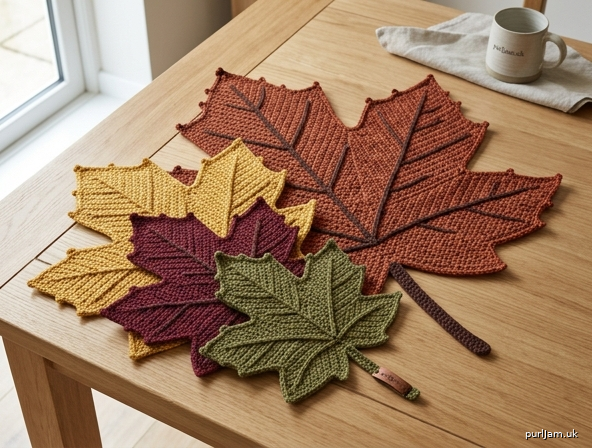
Crochet maple-leaf table mat in four sizes
(Taplak meja daun maple — worked with a crochet hook / hakpen)
A five-lobed maple leaf worked in one piece from the base to the tip, with a picked-up stem, picot tips, and surface-crochet veins. Make a small mat, a placemat, a centerpiece, or a table topper from the same shaping recipe. Cotton worsted blocks crisply and sits well on a table.
Materials
Yarn: Worsted weight (medium #4), preferably cotton or cotton blend for table use (heat, wash, and blocking). Acrylic is acceptable if you prefer easy care.
Yardage:
- S: 150 yd (137 m)
- M: 280 yd (256 m)
- L: 520 yd (475 m)
- XL: 1000 yd (914 m)
Allow a little extra for a contrasting vein color. Typical 100 g / 200–220 yd skeins: 1 (2, 3, 5) skeins.
Color ideas: rust, golden yellow, burgundy, olive, cream, or a long-color-change autumn yarn.
Hook: US I/9 (5.5 mm), or size needed to obtain gauge.
Notions:
- Yarn needle
- 6 stitch markers
- Scissors
- Blocking pins and a towel or blocking mats
- Optional: contrasting leftover yarn for veins
Gauge
12 dc and 8 rows = 4" (10 cm) in double crochet, blocked.
Swatch at least 6" (15 cm), wet-block, then measure the center 4" (10 cm).
- Too few stitches per 4": go down a hook size.
- Too many stitches per 4": go up a hook size.
- Slightly looser than gauge is fine for drape; the leaf will simply finish a bit larger.
Sizes
Finished measurements after wet blocking, width × length including stem:
| Size | Width | Length | Suggested use |
|---|---|---|---|
| S | 12" (30.5 cm) | 15" (38 cm) | Mug rug, small mat, chair back |
| M | 16" (40.5 cm) | 19" (48.5 cm) | Placemat |
| L | 22" (56 cm) | 25" (63.5 cm) | Table centerpiece |
| XL | 30" (76 cm) | 35" (89 cm) | Table topper / small tablecloth |
Instructions for the leaf body are written separately by size so stitch counts stay easy to follow. Stem, edging, veins, and finishing are shared.
To go larger than XL: work the XL stitch counts in bulky yarn with a US K/10.5 (6.5 mm) hook. Expect roughly 40" × 46" (101.5 × 117 cm).
Abbreviations (US)
- beg — beginning
- ch — chain
- dc — double crochet
- dc2tog — double crochet 2 together (see Special Stitches)
- dc3tog — double crochet 3 together
- pm — place marker
- rem — remaining
- rep — repeat
- rnd — round
- RS — right side
- sc — single crochet
- sk — skip
- sl st — slip stitch
- st(s) — stitch(es)
- WS — wrong side
- yo — yarn over
Pattern Notes
- This is crochet, worked flat in turning rows with a hook.
- Ch 3 at the start of a row counts as the first dc unless a row says otherwise.
- Work the last dc of every standard row into the top of the previous row’s ch-3.
- Read each Inc- and Dec- row from Special Stitches — do not improvise extra stitches at the edges.
- Row 1 is the base of the leaf (stem end of the blade). The stem is added later.
- Odd-numbered body rows are RS if you treat Row 1 as RS; the leaf is reversible until veins are added.
- Blocking is not optional. Unblocked, the piece looks like a wavy diamond. Pinned out, it reads as a maple leaf.
- Stitch counts appear in parentheses at the end of each row. Inline checks (✓) confirm the math.
- Size key for shared sections only: S (M, L, XL).
Special Stitches
dc2tog: Yo, insert hook in next st, yo, pull up a loop, yo, pull through 2 loops (2 loops on hook); yo, insert hook in following st, yo, pull up a loop, yo, pull through 2 loops (3 loops on hook); yo, pull through all 3 loops. (1 dc decreased)
dc3tog: Work as dc2tog but over 3 stitches, leaving the extra loops on the hook, then yo and pull through all 4 loops.
Inc-2 (increase 2 sts, 1 at each end): Ch 3 (counts as dc), dc in first st, dc in each st to last st, 2 dc in last st.
Inc-4: Ch 3, 2 dc in first st, dc in each st to last st, 3 dc in last st.
Inc-6: Ch 3, 3 dc in first st, dc in each st to last st, 4 dc in last st.
Dec-2 (use only when you have 6 dc or more): Ch 3 (counts as dc), dc2tog over the next 2 sts, dc in each st to last 3 sts, dc2tog, dc in last st.
Dec-4 (use only when you have 10 dc or more): Ch 3, [dc2tog] twice, dc in each st to last 5 sts, [dc2tog] twice, dc in last st.
Dec-6 (use only when you have 14 dc or more): Ch 3, [dc2tog] 3 times, dc in each st to last 7 sts, [dc2tog] 3 times, dc in last st.
Work even: Ch 3, dc in each st across (including top of turning ch). Count does not change.
Close Row (always worked on 6 dc): Ch 2 (does not count as a st), [dc2tog] 3 times. (3 dc)
Picot Point (always worked on 3 dc): Ch 2 (does not count), dc3tog, ch 3, sl st in top of dc3tog. Fasten off.
Pattern
Leaf Body
Work only your size.
Size S — 12" × 15" (30.5 × 38 cm)
Row 1 (RS): Ch 10. Dc in 4th ch from hook (skipped ch-3 counts as first dc) and in each ch across. (8 dc)
Row 2: Inc-6. (8 + 6 = 14 dc ✓)
Row 3: Inc-6. (14 + 6 = 20 dc ✓)
Row 4: Inc-6. (20 + 6 = 26 dc ✓)
Row 5: Inc-4. (26 + 4 = 30 dc ✓)
Row 6 (lower-lobe peak): Inc-2. Pm in first and last st. (30 + 2 = 32 dc ✓)
Row 7: Dec-2. (32 − 2 = 30 dc ✓)
Row 8: Dec-2. (30 − 2 = 28 dc ✓)
Row 9: Inc-2. (28 + 2 = 30 dc ✓)
Row 10: Inc-4. (30 + 4 = 34 dc ✓)
Row 11 (middle-lobe peak, widest): Inc-2. Pm in first and last st. (34 + 2 = 36 dc ✓)
Row 12: Dec-2. (36 − 2 = 34 dc ✓)
Row 13: Dec-4. (34 − 4 = 30 dc ✓)
Row 14: Dec-4. (30 − 4 = 26 dc ✓)
Row 15: Dec-2. (26 − 2 = 24 dc ✓)
Row 16 (center-lobe shoulder): Inc-2. (24 + 2 = 26 dc ✓)
Row 17: Dec-2. (26 − 2 = 24 dc ✓)
Row 18: Dec-4. (24 − 4 = 20 dc ✓)
Row 19: Dec-4. (20 − 4 = 16 dc ✓)
Row 20: Dec-4. (16 − 4 = 12 dc ✓)
Row 21: Dec-4. (12 − 4 = 8 dc ✓)
Row 22: Dec-2. (8 − 2 = 6 dc ✓)
Row 23: Close Row. (6 → 3 dc ✓)
Row 24: Picot Point. (3 → 1 st ✓)
Do not weave in the tip tail yet — you may use it to neaten the picot. Proceed to Stem.
Size M — 16" × 19" (40.5 × 48.5 cm)
Row 1 (RS): Ch 12. Dc in 4th ch from hook (skipped ch-3 counts as first dc) and in each ch across. (10 dc)
Row 2: Inc-6. (10 + 6 = 16 dc ✓)
Row 3: Inc-6. (16 + 6 = 22 dc ✓)
Row 4: Inc-6. (22 + 6 = 28 dc ✓)
Row 5: Inc-6. (28 + 6 = 34 dc ✓)
Row 6: Inc-4. (34 + 4 = 38 dc ✓)
Row 7 (lower-lobe peak): Inc-4. Pm in first and last st. (38 + 4 = 42 dc ✓)
Row 8: Dec-2. (42 − 2 = 40 dc ✓)
Row 9: Dec-2. (40 − 2 = 38 dc ✓)
Row 10: Dec-2. (38 − 2 = 36 dc ✓)
Row 11: Inc-4. (36 + 4 = 40 dc ✓)
Row 12: Inc-4. (40 + 4 = 44 dc ✓)
Row 13 (middle-lobe peak, widest): Inc-4. Pm in first and last st. (44 + 4 = 48 dc ✓)
Row 14: Work even. (48 dc ✓)
Row 15: Dec-2. (48 − 2 = 46 dc ✓)
Row 16: Dec-4. (46 − 4 = 42 dc ✓)
Row 17: Dec-4. (42 − 4 = 38 dc ✓)
Row 18: Dec-4. (38 − 4 = 34 dc ✓)
Row 19: Dec-2. (34 − 2 = 32 dc ✓)
Row 20: Inc-2. (32 + 2 = 34 dc ✓)
Row 21 (center-lobe shoulder): Inc-2. (34 + 2 = 36 dc ✓)
Row 22: Dec-2. (36 − 2 = 34 dc ✓)
Row 23: Dec-4. (34 − 4 = 30 dc ✓)
Row 24: Dec-4. (30 − 4 = 26 dc ✓)
Row 25: Dec-4. (26 − 4 = 22 dc ✓)
Row 26: Dec-4. (22 − 4 = 18 dc ✓)
Row 27: Dec-4. (18 − 4 = 14 dc ✓)
Row 28: Dec-4. (14 − 4 = 10 dc ✓)
Row 29: Dec-4. (10 − 4 = 6 dc ✓)
Row 30: Close Row. (6 → 3 dc ✓)
Row 31: Picot Point. (3 → 1 st ✓)
Proceed to Stem.
Size L — 22" × 25" (56 × 63.5 cm)
Row 1 (RS): Ch 14. Dc in 4th ch from hook (skipped ch-3 counts as first dc) and in each ch across. (12 dc)
Row 2: Inc-6. (12 + 6 = 18 dc ✓)
Row 3: Inc-6. (18 + 6 = 24 dc ✓)
Row 4: Inc-6. (24 + 6 = 30 dc ✓)
Row 5: Inc-6. (30 + 6 = 36 dc ✓)
Row 6: Inc-6. (36 + 6 = 42 dc ✓)
Row 7: Inc-6. (42 + 6 = 48 dc ✓)
Row 8: Inc-6. (48 + 6 = 54 dc ✓)
Row 9 (lower-lobe peak): Inc-4. Pm in first and last st. (54 + 4 = 58 dc ✓)
Row 10: Dec-2. (58 − 2 = 56 dc ✓)
Row 11: Dec-4. (56 − 4 = 52 dc ✓)
Row 12: Dec-4. (52 − 4 = 48 dc ✓)
Row 13: Inc-4. (48 + 4 = 52 dc ✓)
Row 14: Inc-4. (52 + 4 = 56 dc ✓)
Row 15: Inc-4. (56 + 4 = 60 dc ✓)
Row 16: Inc-4. (60 + 4 = 64 dc ✓)
Row 17 (middle-lobe peak, widest): Inc-2. Pm in first and last st. (64 + 2 = 66 dc ✓)
Row 18: Work even. (66 dc ✓)
Row 19: Dec-2. (66 − 2 = 64 dc ✓)
Row 20: Dec-4. (64 − 4 = 60 dc ✓)
Row 21: Dec-4. (60 − 4 = 56 dc ✓)
Row 22: Dec-6. (56 − 6 = 50 dc ✓)
Row 23: Dec-4. (50 − 4 = 46 dc ✓)
Row 24: Dec-2. (46 − 2 = 44 dc ✓)
Row 25: Inc-4. (44 + 4 = 48 dc ✓)
Row 26 (center-lobe shoulder): Inc-2. (48 + 2 = 50 dc ✓)
Row 27: Dec-2. (50 − 2 = 48 dc ✓)
Row 28: Dec-4. (48 − 4 = 44 dc ✓)
Row 29: Dec-4. (44 − 4 = 40 dc ✓)
Row 30: Dec-4. (40 − 4 = 36 dc ✓)
Row 31: Dec-4. (36 − 4 = 32 dc ✓)
Row 32: Dec-4. (32 − 4 = 28 dc ✓)
Row 33: Dec-4. (28 − 4 = 24 dc ✓)
Row 34: Dec-4. (24 − 4 = 20 dc ✓)
Row 35: Dec-4. (20 − 4 = 16 dc ✓)
Row 36: Dec-4. (16 − 4 = 12 dc ✓)
Row 37: Dec-4. (12 − 4 = 8 dc ✓)
Row 38: Dec-2. (8 − 2 = 6 dc ✓)
Row 39: Close Row. (6 → 3 dc ✓)
Row 40: Picot Point. (3 → 1 st ✓)
Proceed to Stem.
Size XL — 30" × 35" (76 × 89 cm)
Row 1 (RS): Ch 18. Dc in 4th ch from hook (skipped ch-3 counts as first dc) and in each ch across. (16 dc)
Row 2: Inc-6. (16 + 6 = 22 dc ✓)
Row 3: Inc-6. (22 + 6 = 28 dc ✓)
Row 4: Inc-6. (28 + 6 = 34 dc ✓)
Row 5: Inc-6. (34 + 6 = 40 dc ✓)
Row 6: Inc-6. (40 + 6 = 46 dc ✓)
Row 7: Inc-6. (46 + 6 = 52 dc ✓)
Row 8: Inc-6. (52 + 6 = 58 dc ✓)
Row 9: Inc-6. (58 + 6 = 64 dc ✓)
Row 10: Inc-6. (64 + 6 = 70 dc ✓)
Row 11: Inc-4. (70 + 4 = 74 dc ✓)
Row 12 (lower-lobe peak): Inc-4. Pm in first and last st. (74 + 4 = 78 dc ✓)
Row 13: Dec-2. (78 − 2 = 76 dc ✓)
Row 14: Dec-4. (76 − 4 = 72 dc ✓)
Row 15: Dec-4. (72 − 4 = 68 dc ✓)
Row 16: Dec-4. (68 − 4 = 64 dc ✓)
Row 17: Dec-2. (64 − 2 = 62 dc ✓)
Row 18: Inc-4. (62 + 4 = 66 dc ✓)
Row 19: Inc-6. (66 + 6 = 72 dc ✓)
Row 20: Inc-6. (72 + 6 = 78 dc ✓)
Row 21: Inc-6. (78 + 6 = 84 dc ✓)
Row 22: Inc-4. (84 + 4 = 88 dc ✓)
Row 23 (middle-lobe peak, widest): Inc-2. Pm in first and last st. (88 + 2 = 90 dc ✓)
Rows 24–25: Work even. (90 dc ✓)
Row 26: Dec-2. (90 − 2 = 88 dc ✓)
Row 27: Dec-4. (88 − 4 = 84 dc ✓)
Row 28: Dec-4. (84 − 4 = 80 dc ✓)
Row 29: Dec-6. (80 − 6 = 74 dc ✓)
Row 30: Dec-6. (74 − 6 = 68 dc ✓)
Row 31: Dec-4. (68 − 4 = 64 dc ✓)
Row 32: Dec-4. (64 − 4 = 60 dc ✓)
Row 33: Dec-2. (60 − 2 = 58 dc ✓)
Row 34: Inc-4. (58 + 4 = 62 dc ✓)
Row 35: Inc-4. (62 + 4 = 66 dc ✓)
Row 36 (center-lobe peak): Inc-2. (66 + 2 = 68 dc ✓)
Row 37: Work even. (68 dc ✓)
Row 38: Dec-2. (68 − 2 = 66 dc ✓)
Rows 39–53: Dec-4 fifteen times.
(66 − 4 = 62, 58, 54, 50, 46, 42, 38, 34, 30, 26, 22, 18, 14, 10, 6 ✓ — 15 rows × 4 = 60; 66 − 60 = 6 dc ✓)
Row 54: Close Row. (6 → 3 dc ✓)
Row 55: Picot Point. (3 → 1 st ✓)
Proceed to Stem.
Stem (all sizes)
The stem is worked onto the unused loops of the foundation chain, centered, leaving 2 chains free on each side so the leaf base is slightly wider than the petiole (as on a real maple).
With RS facing, join yarn with sl st in the 3rd foundation chain.
Stem Row 1: Ch 3 (counts as dc), dc in the next 3 (5, 7, 11) foundation chains. Leave the last 2 foundation chains unworked.
4 (6, 8, 12) dc ✓
(S: chains 3–6 of 8; M: 3–8 of 10; L: 3–10 of 12; XL: 3–14 of 16.)
Stem Rows 2–6 (2–8, 2–10, 2–14): Work even on these sts.
6 (8, 10, 14) stem rows total ✓
Length: 3 (4, 5, 7)" / 7.5 (10, 12.5, 18) cm.
Fasten off.
Edging (all sizes)
With RS facing, join yarn with sl st at the stem tip.
Rnd 1: Ch 1. Work sc evenly around the entire leaf as follows:
- 3 sc in the stem tip.
- 2 sc in each dc row-end along the stem and both sides of the blade.
- 1 sc in each leftover foundation chain at the leaf base (the 2 unused chains on each side of the stem).
- At each marked lower-lobe and middle-lobe tip (4 markers): (sc, ch 3, sc) in the same row-end. Remove markers as you go.
- At the Picot Point (top lobe): sc in the picot ring, or work (sc, ch 3, sc) in the point if you prefer a matching picot.
- In each sinus (the four inward dips between lobes), work sc without extra stitches so the dip stays deep — do not put 3 sc in those “corners.”
Join with sl st to the first sc. Fasten off.
Optional Rnd 2 (XL and L, for a more finished tablecloth edge): Ch 1, sc in each sc around, working (sc, ch 3, sc) again in each of the 5 lobe picots. Join, fasten off.
Veins (all sizes)
Veins are worked on the RS in surface slip stitch. Use the same yarn, or a darker leftover (brown, burgundy, or deep rust) for contrast.
Keep the working yarn under the fabric. Insert the hook from the RS down through a gap, yo, pull up a loop, *insert the hook down through the next gap along your path, yo, pull the new loop through the fabric and through the loop on the hook; repeat from * for a chain that sits on the surface.
1. Midrib: Begin at the stem–leaf junction (center of Row 1). Surface-sl-st in a straight line up the center of the leaf to the Picot Point. Fasten off, or continue into a branch without cutting.
2. Middle-lobe veins (2): From a point about 40% of the blade length up from the base, surface-sl-st out toward each middle-lobe marker, stopping ½–1" (1.5–2.5 cm) before the picot.
3. Lower-lobe veins (2): From a point about 20% of the blade length up from the base, surface-sl-st out toward each lower-lobe marker, stopping ½–1" (1.5–2.5 cm) before the picot.
Keep veins slightly curved, not ruler-straight. Weave in vein tails on the WS.
Finishing
- Weave in all remaining ends on the WS.
- Wet-block (required):
- Soak in lukewarm water with a drop of wool wash or mild soap for 15–20 minutes.
- Press out water (do not wring). Roll in a towel.
- Pin to the schematic measurements:
- Pull the 5 lobe tips out and pin.
- Push the 4 sinuses inward and pin (this is what makes it read as maple, not as a spade).
- Pin the stem straight.
- Ease the sides into gentle curves, not straight lines.
- Dry completely before unpinning.
- If the leaf cups, block again and pin more aggressively at the sinuses.
- For table use, a light press on WS with a damp cloth (cotton yarn only) can flatten the dc fabric. Do not crush the picots.
Care: Cotton — gentle machine or hand wash, reblock, lie flat. Acrylic — machine wash cool, lie flat to dry.
Schematic (after blocking)
                    /\
                   /  \          center lobe (tip picot)
                  /    \
                 /      \
            ____/        \____
           /                  \     middle lobes (widest point)
           \                  /
            \                /
             \              /
              \            /        sinuses pinned IN
               \          /
           _____\        /_____
          /                    \    lower lobes
          \                    /
           \______    ______/
                  |  |              stem
                  |  |
                  |  |
| S | M | L | XL | |
|---|---|---|---|---|
| A. Width at middle lobes | 12" (30.5 cm) | 16" (40.5 cm) | 22" (56 cm) | 30" (76 cm) |
| B. Blade length, base to tip | 12" (30.5 cm) | 15" (38 cm) | 20" (51 cm) | 28" (71 cm) |
| C. Stem length | 3" (7.5 cm) | 4" (10 cm) | 5" (12.5 cm) | 7" (18 cm) |
| D. Total length | 15" (38 cm) | 19" (48.5 cm) | 25" (63.5 cm) | 35" (89 cm) |
Tips for a Crisp Maple Shape
- Count at the end of every shaping row. One missed inc/dec on an XL row is 90 stitches of regret.
- If a lobe looks weak after blocking, you can add a second (sc, ch 3, sc) in that tip on a later pass.
- A set of S + M + L in related autumn colors makes a strong table story; use XL alone as a topper on a round or square table.
- For a lacy, vintage tablecloth look, work L or XL in a slightly larger hook (US J/10 / 6 mm) and add Optional Edging Rnd 2.
- Do not skip the surface veins — they are what turn a five-point silhouette into a maple leaf.
Skill level: Intermediate
Craft: Crochet (US terms)
Construction: Flat, base-to-tip, picked-up stem, worked-around edging
Disclaimer: This pattern was generated by AI and should be reviewed for accuracy before use. While we strive for quality, AI-generated content may contain errors. Please verify measurements, stitch counts, charts, and instructions before beginning your project. Generated by purlJam.uk
Love this pattern?
Save this pattern to your free PurlJam libraryAccess your pattern anytime
Bookmark this page to access your pattern anytime