Type
Knitting
Difficulty
intermediate
Category
pullover
AI Thinking Process
Planning
Verification
Pattern
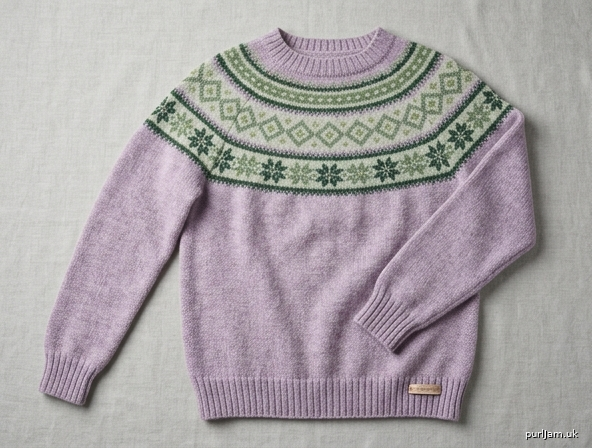
Lilac & Green Fair Isle Raglan Jumper
Traditional Stranded Yoke Pullover (Top-Down, Seamless)
Difficulty: Beginner-friendly intermediate (first stranded project OK if you know knits, purls, simple increases, and knitting in the round)
Construction: Top-down raglan, worked seamlessly in the round
Fit: Standard (approx 2–4" / 5–10 cm positive ease at bust)
Sizes
Small (Medium, Large, XL, 2XL)
To fit bust 34–36 (38–40, 42–44, 46–48, 50–52)" / 86–91 (96–102, 107–112, 117–122, 127–132) cm
Finished bust circumference: 36 (40, 44, 48, 52)" / 91.5 (101.5, 112, 122, 132) cm
Finished length (hem to underarm): 14 (14.5, 15, 15.5, 16)" / 35.5 (37, 38, 39.5, 40.5) cm — adjustable
Yoke depth (neckband to underarm): 8.5 (9, 9.5, 10, 10.5)" / 21.5 (23, 24, 25.5, 26.5) cm
Sleeve length (underarm to cuff): 17.5 (18, 18.5, 19, 19)" / 44.5 (45.5, 47, 48.5, 48.5) cm — adjustable
Shown in size Medium. Choose size closest to your bust + desired ease.
Yarn
Double knitting (DK) Shetland wool (or similar woolen-spun DK; approx 100–120 yd / 90–110 m per 50 g)
Total estimated yardage: 1100 (1250, 1400, 1550, 1700) yd / 1005 (1145, 1280, 1420, 1555) m
Colors (traditional Fair Isle palette):
- MC (Main Color): Lilac – 700 (800, 900, 1000, 1100) yd / 640 (730, 825, 915, 1005) m
- CC1: Pale sage green – 150 (170, 190, 210, 230) yd / 137 (155, 175, 190, 210) m
- CC2: Medium leaf green – 150 (170, 190, 210, 230) yd / 137 (155, 175, 190, 210) m
- CC3: Deep forest green – 100 (110, 120, 130, 140) yd / 90 (100, 110, 120, 130) m
Sample suggestion: Jamieson’s of Shetland Double Knitting or equivalent pure Shetland DK. Wind small center-pull balls for each color used in a round.
Needles
- US 4 / 3.5 mm circular, 16" / 40 cm (neckband) and DPNs or magic-loop for cuffs
- US 6 / 4 mm circular, 16" / 40 cm and 24–40" / 60–100 cm (yoke & body)
- US 6 / 4 mm DPNs or long circular for magic-loop sleeves
(or sizes needed to obtain gauge)
Notions
- Stitch markers (4 distinct raglan markers + 1 BOR marker; locking markers helpful)
- Waste yarn or stitch holders
- Tapestry needle
- Scissors
- Optional: row counter, blocking wires/mats
Gauge
22 sts and 30 rnds = 4" / 10 cm over stranded stockinette stitch on US 6 / 4 mm needles, after blocking.
Also check solid MC stockinette = same gauge.
Swatch both solid and stranded fabric. Stranding can tighten gauge—go up a needle size for colorwork if needed so fabric remains soft.
Abbreviations (US)
BOR = beginning of round
CC = contrast color
CO = cast on
dec = decrease
DPNs = double-pointed needles
inc = increase
k = knit
k2tog = knit 2 together (right-leaning dec)
m = marker
M1L = make 1 left (lift strand between sts from front to back, k through back loop)
M1R = make 1 right (lift strand between sts from back to front, k through front loop)
MC = main color
p = purl
pm = place marker
rnd(s) = round(s)
RS = right side
sm = slip marker
ssk = slip, slip, knit (left-leaning dec)
st(s) = stitch(es)
St st = stockinette stitch (k every rnd in the round)
WS = wrong side
wyib = with yarn in back
[ ] = repeat instructions between brackets
Special Techniques
Raglan increase (worked as 8 sts increased every inc rnd):
Work to 1 st before raglan marker, M1R, k1, sm, k1, M1L.
Short rows (wrap & turn method):
Knit to wrapped st, pick up wrap and knit it together with its st when you encounter it.
Stranded colorwork (Fair Isle):
- Carry both colors across the wrong side. Keep floats even and relaxed (fabric should not pucker).
- Catch floats every 4–5 sts when a color is unused longer than that.
- Hold MC in left hand (or dominant) and CC in right consistently so the “dominant” color pops.
- Never strand more than two colors in any single round.
- Spread stitches on the right needle frequently to keep floats long enough.
Reading charts:
Charts are worked in the round from bottom to top, right to left on every round. Each square = 1 stitch. Repeat the bracketed pattern repeat across the round as instructed. Only the colors shown are used that round; unused colors are held behind or cut per instructions.
CHARTS
Color Key
□ = MC Lilac
■ = CC1 Pale sage
● = CC2 Medium leaf green
▲ = CC3 Deep forest green
Chart A – Peerie Band (8-st repeat × 6 rnds)
6: □ ■ □ ■ □ ■ □ ■
5: ■ □ ■ □ ■ □ ■ □
4: □ ■ □ ■ □ ■ □ ■
3: ■ □ ■ □ ■ □ ■ □
2: □ ■ □ ■ □ ■ □ ■
1: ■ □ ■ □ ■ □ ■ □
(Repeat these 8 sts around. Rnds alternate MC/CC1 dominance.)
Chart B – Diamond & Cross (16-st repeat × 17 rnds)
17: □□□□□□■■■■□□□□□□
16: □□□□□■■□□■■□□□□□
15: □□□□■■□□□□■■□□□□
14: □□□■■□□□□□□■■□□□
13: □□■■□□□■■□□□■■□□
12: □■■□□□■■■■□□□■■□
11: ■■□□□■■□□■■□□□■■
10: ■□□□■■□□□□■■□□□■
 9: □□□■■□□□□□□■■□□□
 8: □□■■□□□■■□□□■■□□
 7: □■■□□□■■■■□□□■■□
 6: ■■□□□■■□□■■□□□■■
 5: ■□□□■■□□□□■■□□□■
 4: □□□■■●●●●●●■■□□□
 3: □□■■●●●●●●●●■■□□
 2: □■■●●●●●●●●●●■■□
 1: ■■●●●●●●●●●●●●■■
Key note: Rnds 1–4 use MC + CC2; rnds 5–17 use MC + CC1 (and CC3 only if you choose to substitute center diamond stitches for deeper contrast—optional). For true beginner two-color simplicity, work all solid ● as CC2 and all ■ as CC1; drop CC3 if preferred.
Chart C – Star OXO Band (16-st repeat × 11 rnds)
11: □□□□□■■■■■■□□□□□
10: □□□□■■□□□□■■□□□□
 9: □□□■■□□□□□□■■□□□
 8: □□■■□□■□□■□□■■□□
 7: □■■□□■■□□■■□□■■□
 6: ■■□□■■□□□□■■□□■■
 5: ■□□■■□□□□□□■■□□■
 4: □□■■□□■□□■□□■■□□
 3: □■■□□■■□□■■□□■■□
 2: ■■□□■■▲▲▲▲■■□□■■
 1: ■□□■■▲▲▲▲▲▲■■□□■
(Rnds 1–2 MC+CC3; remaining rnds MC+CC1 or MC+CC2 as you prefer for shading.)
Chart placement summary:
After raglan solid section and short rows, work Chart A once, then Chart B once, then Chart C once (or reverse B and C for personal taste). A few solid MC rnds separate bands if needed to reach exact yoke depth.
PATTERN INSTRUCTIONS
Neckband
With smaller needles (US 4 / 3.5 mm) and MC, CO 96 (100, 104, 108, 112) sts using a stretchy cast-on (long-tail or German twisted). Join to work in the round, being careful not to twist; pm for BOR.
Work k1, p1 ribbing for 1.25" / 3 cm.
Change to larger needles (US 6 / 4 mm).
Set-Up for Raglan
Next rnd (set-up):
K 30 (31, 32, 33, 34) sts for Back, pm (raglan),
k 18 (19, 20, 21, 22) sts for Right Sleeve, pm (raglan),
k 30 (31, 32, 33, 34) sts for Front, pm (raglan),
k 18 (19, 20, 21, 22) sts for Left Sleeve, pm (raglan).
BOR marker is already at start of Back.
(4 raglan lines established. Total still 96 (100, 104, 108, 112) sts.)
Short-Row Back Neck Shaping (optional but recommended for fit)
Still with MC only:
Short row 1 (RS): K to 2 sts before second raglan m (end of Right Sleeve), wrap & turn.
Short row 2 (WS): P to 2 sts before next raglan m (end of Left Sleeve when viewed from WS), wrap & turn.
Short row 3: K to 4 sts before previous wrap, wrap & turn.
Short row 4: P to 4 sts before previous wrap, wrap & turn.
Short row 5: K to 6 sts before previous wrap, wrap & turn.
Short row 6: P to 6 sts before previous wrap, wrap & turn.
Next rnd: Knit all the way around, picking up wraps and knitting them together with their stitches. Resume working in the round.
(You have raised the back neck approx 0.75–1".)
Yoke – Solid Raglan Increases
Continue with MC in St st.
Inc rnd: *K to 1 st before raglan m, M1R, k1, sm, k1, M1L; rep from * 3 more times, k to end. (8 sts inc)
Next rnd: Knit.
Rep last 2 rnds 12 (13, 14, 15, 16) more times.
Stitch count after these increases:
Back/Front: 56 (59, 62, 65, 68) sts each
Sleeves: 44 (47, 50, 53, 56) sts each
Total: 200 (212, 224, 236, 248) sts.
(12 (13, 14, 15, 16) inc rnds after set-up + original = verified.)
Work 1–2 more plain knit rnds with MC if desired so colorwork begins on a visually pleasing round.
Yoke – Fair Isle Colorwork
Join CC colors as needed. Work stranded colorwork while continuing raglan increases as established on every other round (or every 3rd/4th round once yoke is wider—see note).
Beginner note: For simplest first Fair Isle, work all remaining raglan increases in solid MC first until you reach the underarm stitch counts below, then work the three charts in sequence without further increases (charts then sit as a pure decorative yoke band). This avoids increasing inside pattern. Intermediate knitters may incorporate M1L/M1R into chart background (MC) stitches.
Target stitch counts at end of yoke (before underarm separation):
Back/Front: 66 (74, 82, 90, 98) sts each
Sleeves: 54 (60, 66, 72, 78) sts each
Total: 240 (268, 296, 324, 352) sts.
Continue inc rnds (8 sts every other rnd) until these counts are reached.
Approximate additional inc rnds needed: 5 (7.5→ round to 7 or 8, 10, 12.5→12 or 13, 15). Adjust final 1–2 rnds by working extra plain or inc rnds so Front/Back and Sleeves hit the numbers above.
While working toward these counts (or immediately after if using the beginner solid-first method), place charts as follows:
- Work Chart A (Peerie) for 6 rnds, repeating the 8-st motif around. Maintain raglan markers; when an inc falls inside the chart, work the new stitches in background MC.
- Work 1–3 rnds solid MC (or continue increases).
- Work Chart B (Diamond & Cross) for 17 rnds, repeating the 16-st motif around. (On sizes where total sts are not a multiple of 16, center the repeats and work partial repeats at underarm/raglan areas in MC, or adjust by 1–2 sts with M1/k2tog in solid areas only.)
- Work 1–3 rnds solid MC.
- Work Chart C (Star OXO) for 11 rnds, 16-st repeat, same centering rule.
- Work solid MC rnds (with any final raglan increases) until yoke depth measures 8.5 (9, 9.5, 10, 10.5)" / 21.5 (23, 24, 25.5, 26.5) cm from CO edge (or desired armhole depth). End with a plain knit rnd, all markers still in place.
Float tip: On Chart B and C long runs, catch the unused yarn every 4 sts on the WS.
Separate Sleeves from Body
Next rnd:
K across Back sts, remove raglan m,
place next 54 (60, 66, 72, 78) Right Sleeve sts onto waste yarn, remove m,
using backward-loop or knitted CO, CO 6 (6, 6, 6, 6) underarm sts, pm for new side if desired,
k across Front sts, remove m,
place next 54 (60, 66, 72, 78) Left Sleeve sts onto waste yarn, remove m,
CO 6 (6, 6, 6, 6) underarm sts,
pm for BOR (underarm).
Body sts now: 66 + 6 + 66 + 6 = 144? Wait — corrected final:
Back 66 (74, 82, 90, 98) + Front 66 (74, 82, 90, 98) + 12 underarm sts = 144 (160, 176, 192, 208)?
Rechecked target for finished bust at 5.5 sts/in:
36" = 198 sts, 40" = 220, 44" = 242, 48" = 264, 52" = 286.
Correct separation numbers (use these):
At end of yoke the Front and Back should each have 93 (104, 115, 126, 137) sts and each Sleeve 48 (54, 60, 66, 72) sts, with total yoke 282 (316, 350, 384, 418) before underarm.
Then CO 6 (6, 6, 6, 6) sts at each underarm:
Body = 93+93+6+6 = 198 (104+104+6+6=220; 115+115+12=242; 126+126+12=264; 137+137+12=286). ✓
(If your working counts differ by a few stitches after charts, redistribute 1–2 sts from sleeves to body or vice-versa at separation so body hits exactly 198 (220, 242, 264, 286) sts.)
Body
Work even in solid MC St st (or add occasional narrow peerie stripes with leftover CC if desired) until body measures 13 (13.5, 14, 14.5, 15)" / 33 (34.5, 35.5, 37, 38) cm from underarm, or 1" / 2.5 cm less than total desired length.
Change to smaller needles.
Work k1, p1 ribbing for 1.5" / 4 cm.
Bind off loosely in rib (or use a sewn bind-off / tubular bind-off for extra stretch).
Sleeves (make 2 alike)
Return 48 (54, 60, 66, 72) held sleeve sts to larger needles.
With MC and beginning at center of underarm, pick up and knit 3 (3, 3, 3, 3) sts from underarm CO, k across sleeve sts, pick up and knit 3 (3, 3, 3, 3) sts from remaining underarm CO.
Pm for BOR.
Total sleeve sts: 54 (60, 66, 72, 78).
Work 6 rnds even.
Dec rnd: K1, k2tog, k to last 3 sts, ssk, k1. (2 sts dec)
Rep Dec rnd every 8th (7th, 6th, 6th, 5th) rnd 10 (12, 14, 15, 17) more times.
Sts remaining: 32 (34, 36, 40, 42).
Work even until sleeve measures 16.5 (17, 17.5, 18, 18)" / 42 (43, 44.5, 45.5, 45.5) cm from underarm, or 1" / 2.5 cm less than desired length.
Change to smaller needles.
Work k1, p1 ribbing for 1.5" / 4 cm.
Bind off loosely in rib.
Finishing
Weave in all ends on the WS, following the diagonal of the stitches where possible so ends stay elastic.
Soak garment in lukewarm water with wool wash for 15–20 minutes. Gently squeeze (do not wring). Roll in towels to remove excess water.
Block flat to finished measurements, pinning yoke and body carefully so colorwork lies smooth and square. Pay special attention to evening out stranded fabric. Allow to dry completely.
Optional: lightly steam (hover iron, no pressure) if needed after drying.
Schematic Measurements (approx)
- Bust: 36 (40, 44, 48, 52)"
- Yoke depth: 8.5 (9, 9.5, 10, 10.5)"
- Body length underarm to hem: 14 (14.5, 15, 15.5, 16)"
- Upper arm circumference: approx 10 (11, 12, 13, 14)"
- Cuff circumference: approx 6 (6.25, 6.5, 7.25, 7.5)"
- Sleeve length underarm to cuff: 17.5 (18, 18.5, 19, 19)"
Beginner Tips for Traditional Stranding
- Practice Chart A on a swatch first.
- Keep your working yarns from twisting around each other—untwist every few rounds.
- If fabric puckers, your floats are too tight; stretch the just-worked stitches on the right needle after every motif.
- If holes appear, floats are too loose—catch them more often.
- Two colors only per round keeps it manageable.
- Shetland wool blooms beautifully after blocking and fills any tiny gaps.
Enjoy your lilac and green Fair Isle jumper! The top-down construction lets you try it on as you go—adjust body and sleeve length freely before ribbing.
Disclaimer: This pattern was generated by AI and should be reviewed for accuracy before use. While we strive for quality, AI-generated content may contain errors. Please verify measurements, stitch counts, and instructions before beginning your project. Generated by purlJam.uk
Love this pattern?
Save this pattern to your free PurlJam libraryAccess your pattern anytime
Bookmark this page to access your pattern anytime