Type
Knitting
Difficulty
beginner
Category
cardigan
AI Thinking Process
Planning
Verification
Pattern
Long-Wing Bosom Friend
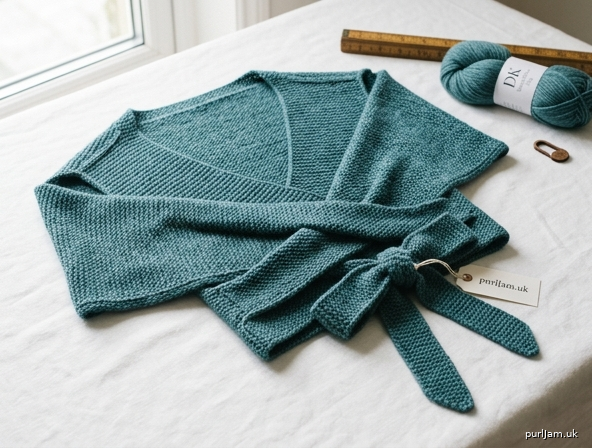
A beginner sontag (also called a bosom friend): a shoulder wrap in DK garter stitch with extra-long wings and knitted-on ties. Every row is knit. There are no purl stitches, no sleeves, and no buttons. The centre back sits across the shoulders; the wings come forward over the bust, wrap the waist, and tie.
The second size is written for an 86 cm (34 in) bust and a 76 cm (30 in) waist.
MATERIALS
- DK-weight yarn, approximately 1000 (1250, 1500, 1750, 2000) m / 1090 (1370, 1640, 1915, 2190) yd
- About 9 (11, 14, 16, 18) × 50 g balls if each ball has 110–120 m. Buy one extra ball; garter stitch and the long wings use more yarn than a small shawl, and dye lots can differ
- Wool, wool-blend, or acrylic DK. A smooth plied yarn is easier to knit and to seam than a fuzzy or highly textured yarn
- 4.0 mm (US 6) needles — straight needles, or a circular needle 80 cm long used back and forth
- Optional: 3.5 mm (US 4) needles if you prefer a slightly firmer neck edging
- Tapestry needle
- 2 locking stitch markers or safety pins
- Tape measure
No buttons, no ribbon, and no stitch holders are required.
TENSION (GAUGE)
22 stitches and 44 rows = 10 cm (4 in) in garter stitch (every row knit), after a gentle block, using 4.0 mm needles.
Knit a swatch before you begin. Cast on 30 stitches and knit 52 rows. Lightly wet or steam the swatch, let it dry, and measure the centre 10 cm. You should count 22 stitches and 44 rows (22 garter ridges = 44 rows).
- Too many stitches in 10 cm: use a larger needle.
- Too few stitches in 10 cm: use a smaller needle.
- Row tension often differs from stitch tension. Throughout this pattern, trust the centimetre measurements for length. Row counts are a guide only.
SIZES
Figures are given for five sizes. The smallest size is shown first, and the larger sizes follow in parentheses: 30 (34, 38, 42, 46). Where only one figure is given, it applies to all sizes.
Choose your size by bust and waist, not by a shop label. Size 2 — the second figure in each set — is the size drafted for a 34 in bust and a 30 in waist.
| 1 | 2 | 3 | 4 | 5 | |
|---|---|---|---|---|---|
| To fit bust | 76 cm (30 in) | 86 cm (34 in) | 96.5 cm (38 in) | 106.5 cm (42 in) | 117 cm (46 in) |
| To fit waist | 66 cm (26 in) | 76 cm (30 in) | 86.5 cm (34 in) | 96.5 cm (38 in) | 106.5 cm (42 in) |
Finished measurements
- Back width: 40 (46.5, 52, 58, 63.5) cm / 15¾ (18¼, 20½, 23, 25) in
- Back length, shoulder to lower edge: 34 (36, 38, 40, 42) cm / 13½ (14¼, 15, 15¾, 16½) in
- Wing width at the fullest point: 28 (32, 36.5, 40, 43.5) cm / 11 (12½, 14¼, 15¾, 17¼) in
- Each wing, shoulder to tip of tie: 127 (142.5, 160, 176, 192) cm / 50 (56, 63, 69¼, 75½) in
- Tie length (included in the wing length): 40 (42, 45, 48, 50) cm / 15¾ (16½, 17¾, 18¾, 19¾) in
- Tie width: 3.5 (3.5, 4.5, 4.5, 4.5) cm / 1½ (1½, 1¾, 1¾, 1¾) in
- Shoulder seam: 11 (12.5, 14, 15.5, 17.5) cm / 4¼ (5, 5½, 6, 6¾) in
- Shaped armhole depth (left open; not a sleeve): 16 (17, 18, 19, 20) cm / 6¼ (6¾, 7, 7½, 7¾) in
The back covers the shoulders and upper back with a little ease, so the wrap can be worn over a light layer. The wings are wider than the shoulder seams so they cover the bust, then stay wide enough to wrap the waist like a broad sash. Overlap is built into the length: for Size 2, about 126 cm of wing and tie sits below the shoulder shaping, against a 76 cm waist.
ABBREVIATIONS
- k — knit
- kfb — knit into the front and back of the next stitch (1 stitch increased). Knit the stitch, leave it on the left needle, then knit into the back loop of the same stitch and slip it off
- k2tog — knit 2 stitches together (1 stitch decreased)
- ssk — slip 2 stitches knitwise one at a time, return them to the left needle, and knit them together through the back loops (1 stitch decreased). If this feels awkward, knit 2 together through the back loops instead; in garter stitch the lean hardly shows
- RS — right side (the face you keep the marker on; garter stitch looks the same on both sides)
- WS — wrong side
- st(s) — stitch(es)
- cm — centimetres
- beg — beginning
Cast on and cast off are written in full. “Cast off” is the UK term for bind off.
NOTES
- Knit only. Every row of the back, wings, ties, and neck edging is knit. You do not purl anywhere in this pattern.
- Garter stitch is produced by knitting every row. Two rows make one ridge. The fabric is reversible and does not curl, which is why the long wrap edges need no border.
- Worked flat. Do not join to work in the round. If you use a circular needle, turn at the end of every row as if the needle were straight.
- Mark a “right side”. Pin a safety pin to one face when you cast on each piece, and work every increase and decrease with that face toward you. This keeps the shaping on the same rows even though both faces look alike.
- Two identical wings. Knit both wings from the same instructions. At sewing time, match the armhole edge of each wing to an armhole edge of the back. You do not need a separate mirror-image pattern.
- Reading the sizes. Follow one column all the way through. For the requested 34 in bust and 30 in waist, follow the second number every time: 34, and every figure in the second position inside the parentheses.
- Where to change the length. The long plain section of each wing is the adjustment point. Add or remove length there before you start the shoulder shaping. Every extra 10 cm on both wings uses roughly 120 (135, 155, 170, 185) m more yarn. A longer torso or a fuller wrap needs more length; a petite torso can shorten the plain section by 8–10 cm and still wrap a 26 (30, 34, 38, 42) in waist.
- Ties are part of the wings. They are not sewn on. A sewn join would take the strain of the knot.
- This is not a cardigan. Sides are left open for the arms. There is no sleeve cap and no button band. The neck edging is a short picked-up trim, not a buttonhole band.
- Blocking. Garter stitch can grow a little when blocked. The extra wing length allows for that. Pin the wings out straight; do not stretch the ties.
BACK
The back is a short upper-back panel, worked from the lower edge up to the shoulders.
Using 4.0 mm needles and the long-tail cast on, cast on 88 (102, 114, 128, 140) sts.
88 ÷ 2.2 = 40 cm; 102 ÷ 2.2 = 46.5 cm; 114 ÷ 2.2 = 52 cm; 128 ÷ 2.2 = 58 cm; 140 ÷ 2.2 = 63.5 cm. ✓
Knit every row until the piece measures 18 (19, 20, 21, 22) cm / 7 (7½, 7¾, 8¼, 8¾) in from the cast-on edge, ending with a WS row.
Shape the armholes
Cast off 3 (4, 4, 5, 5) sts at the beg of the next 2 rows. 82 (94, 106, 118, 130) sts.
88 − 6 = 82; 102 − 8 = 94; 114 − 8 = 106; 128 − 10 = 118; 140 − 10 = 130. ✓
Decrease row (RS): K1, k2tog, knit to the last 3 sts, ssk, k1. 2 sts decreased. Next row: Knit.
Repeat these 2 rows 2 (3, 3, 4, 4) times more — 3 (4, 4, 5, 5) decrease rows in total. 76 (86, 98, 108, 120) sts.
82 − 6 = 76; 94 − 8 = 86; 106 − 8 = 98; 118 − 10 = 108; 130 − 10 = 120. ✓
Continue in garter stitch, with no further decreases, until the armhole measures 16 (17, 18, 19, 20) cm / 6¼ (6¾, 7, 7½, 7¾) in from the first armhole cast-off row, ending with a WS row.
Shape the shoulders and back neck
Next row (RS): Cast off 24 (27, 31, 34, 38) sts, knit to end. 52 (59, 67, 74, 82) sts. Next row (WS): Cast off 24 (27, 31, 34, 38) sts, knit to end. 28 (32, 36, 40, 44) sts.
Cast off the remaining 28 (32, 36, 40, 44) sts for the back neck.
Check: 24 + 28 + 24 = 76; 27 + 32 + 27 = 86; 31 + 36 + 31 = 98; 34 + 40 + 34 = 108; 38 + 44 + 38 = 120. ✓
Each shoulder is 24 (27, 31, 34, 38) sts, about 11 (12.5, 14, 15.5, 17.5) cm. The back neck is 28 (32, 36, 40, 44) sts, about 12.5 (14.5, 16.5, 18, 20) cm.
FRONTS
Make 2 identical wings. Each wing begins at the tie, widens, runs extra long, then shapes in to the shoulder.
The armhole edge is the edge you cast off at the start of the shaping. The neck edge is the other edge, where the longer run of decreases sits. Mark the neck edge with a pin when the decreases begin, so the neck edging is easy to find later.
Tie
Using 4.0 mm needles and the long-tail cast on, cast on 8 (8, 10, 10, 10) sts. Cast on firmly; a loose tie will stretch at the knot.
Knit every row until the tie measures 40 (42, 45, 48, 50) cm / 15¾ (16½, 17¾, 18¾, 19¾) in, ending with a WS row.
Width: 8 ÷ 2.2 = 3.5 cm; 10 ÷ 2.2 = 4.5 cm. ✓
Taper to wing width
Increase row (RS): K1, kfb, knit to the last 2 sts, kfb, k1. 2 sts increased. Next row: Knit.
Repeat these 2 rows 27 (31, 35, 39, 43) times in total — 54 (62, 70, 78, 86) rows. 62 (70, 80, 88, 96) sts.
8 + (27 × 2) = 62; 8 + (31 × 2) = 70; 10 + (35 × 2) = 80; 10 + (39 × 2) = 88; 10 + (43 × 2) = 96. ✓
This taper is about 12.5 (14, 16, 17.5, 19.5) cm long. The wing is now 28 (32, 36.5, 40, 43.5) cm wide (62 ÷ 2.2 = 28; 70 ÷ 2.2 = 32; 80 ÷ 2.2 = 36.5; 88 ÷ 2.2 = 40; 96 ÷ 2.2 = 43.5). ✓
Extra-long straight section
Knit every row until this plain section, measured from the last increase row, measures 60 (70, 80, 90, 100) cm / 23½ (27½, 31½, 35½, 39½) in, ending with a WS row.
This is the only place to lengthen or shorten the wrap. Do not change the tie, the taper, or the shoulder shaping if you want the pieces to match.
At the stated tension, 10 cm of this section is 44 rows. If your row tension does not match, follow the tape measure.
Shape the armhole and neck
Next row (RS): Cast off 3 (4, 4, 5, 5) sts (armhole edge), knit to end. 59 (66, 76, 83, 91) sts. Next row: Knit.
Pin the opposite edge: that is the neck edge.
Combined decrease row (RS): K1, k2tog, knit to the last 3 sts, ssk, k1. 2 sts decreased — one at the armhole edge and one at the neck edge. Next row: Knit.
Work the combined decrease row 3 (4, 4, 5, 5) times in total. 53 (58, 68, 73, 81) sts.
59 − 6 = 53; 66 − 8 = 58; 76 − 8 = 68; 83 − 10 = 73; 91 − 10 = 81. ✓
Neck decrease row (RS): Knit to the last 3 sts, ssk, k1. 1 st decreased at the neck edge only. Next row: Knit.
Work the neck decrease row 29 (31, 37, 39, 43) times in total. 24 (27, 31, 34, 38) sts remain.
53 − 29 = 24; 58 − 31 = 27; 68 − 37 = 31; 73 − 39 = 34; 81 − 43 = 38. ✓
Full check from the wide wing: cast-off stitches plus armhole decreases plus neck decreases return the shoulder count.
- Size 1: 62 − 3 − 3 − (3 + 29) = 24. ✓
- Size 2: 70 − 4 − 4 − (4 + 31) = 27. ✓
- Size 3: 80 − 4 − 4 − (4 + 37) = 31. ✓
- Size 4: 88 − 5 − 5 − (5 + 39) = 34. ✓
- Size 5: 96 − 5 − 5 − (5 + 43) = 38. ✓
These 24 (27, 31, 34, 38) shoulder stitches match the back shoulders exactly.
The neck decreases total 32 (35, 41, 44, 48) on each wing — 3 (4, 4, 5, 5) in the combined rows plus 29 (31, 37, 39, 43) neck-only rows. That number is the pick-up count for the neck edging. ✓
Cast off the remaining 24 (27, 31, 34, 38) sts.
Finished length from shoulder cast-off to tie tip is about 127 (142.5, 160, 176, 192) cm / 50 (56, 63, 69¼, 75½) in: tie + taper + straight section + about 15 (16.5, 19, 20.5, 22.5) cm of shaping.
Make the second wing the same.
SLEEVES
No sleeves are knitted. A bosom friend is a shoulder wrap, not a cardigan: the arms come out through the open sides, and the long wings wrap the body instead.
Do not seam the side edges. After the shoulder seams are joined, each arm opening is the space between the back side edge and the wing.
The shaped armhole depth is 16 (17, 18, 19, 20) cm / 6¼ (6¾, 7, 7½, 7¾) in, measured on the back from the first armhole cast-off to the shoulder. On each wing, the matching shaped edge is the short cast-off-and-decrease edge at the top, not the long side of the wing. That short edge sits near the shoulder. It does not need a sleeve cap, and garter stitch will not curl if you leave it plain.
Leave these edges unseamed and unpicked-up. An edging around the opening would stiffen the shoulder and work against the wrap.
BUTTON_BANDS
This sontag has no buttons, no buttonholes, and no separate button band. The fastening is the pair of knitted ties already worked at the start of each wing. Do not cast off those ties early, and do not replace them with ribbon unless you cannot get a comfortable knot — a knitted tie stretches with the shawl and is the intended closure.
Neck edging
The edging is worked after the shoulder seams are sewn (see Finishing). It tidies the slope that frames the neck. It does not continue down the long wrap edges.
Using 4.0 mm needles and with the outside of the work facing you, pick up and knit stitches as follows. To pick up one stitch: insert the needle through the edge, wrap the yarn as if to knit, and pull a loop through.
- 32 (35, 41, 44, 48) sts along the first wing’s neck edge, from the pin at the start of the neck decreases up to the shoulder seam (about 1 stitch for each garter ridge)
- 28 (32, 36, 40, 44) sts across the back neck, 1 stitch in each cast-off stitch
- 32 (35, 41, 44, 48) sts down the second wing’s neck edge, from the shoulder seam to the pin
92 (102, 118, 128, 140) sts.
32 + 28 + 32 = 92; 35 + 32 + 35 = 102; 41 + 36 + 41 = 118; 44 + 40 + 44 = 128; 48 + 44 + 48 = 140. ✓
If you are short or over by 1 stitch on a sloped edge, skip or add one pick-up in the middle of that edge so the total matches. The back-neck count should be exact.
Knit 6 rows. Cast off loosely knitwise, so the edging does not pull the neck in.
Six rows are about 1.5 cm. For a firmer trim, work these 6 rows on 3.5 mm needles; keep the same stitch count, and still cast off loosely.
There are no buttonholes in this edging. The ties close the garment at the waist, not at the neck.
FINISHING
- Weave in the cast-on tails at the tips of the ties now, before the ties are knotted in wear. Leave the other ends until the seams are sewn.
- Lay the back flat, lower edge at the bottom. Place a wing at each side, tie downward, shoulder cast-off against a back shoulder. The armhole edge of the wing — the edge with the short cast-off — lies next to the back armhole. The pinned neck edge lies toward the back neck. Garter stitch has no wrong side; choose the tidier face as the outside and use it for both wings.
- Sew each shoulder seam. Match stitch for stitch across the 24 (27, 31, 34, 38) cast-off stitches (24 = 24, 27 = 27, 31 = 31, 34 = 34, 38 = 38). ✓ A whip stitch through the cast-off edge, or mattress stitch, is enough. Keep the seam soft, not tight.
- Work the neck edging in Button Bands.
- Do not sew the side seams. The sides are the arm openings.
- Optional stay: if the wrap slips off the shoulders, tack the top 5 cm of each side seam just below the armhole shaping, leaving the rest open. Try the shawl on before you add these tacks; many wearers will not need them once the wings are crossed and tied.
- Weave in the remaining ends on the inside.
- Block gently to the finished measurements. Pin the wings straight and the ties at their knitted width. Do not stretch the ties lengthwise.
How to wear it
- Put the centre of the back at the nape, with the shoulder seams on the shoulders and the lower back edge across the upper back.
- Bring both wings forward over the bust and cross them.
- Take the long ends around the waist. They are long enough to overlap behind a 66 (76, 86.5, 96.5, 106.5) cm waist and still leave the ties free.
- Tie a bow at the back, the side, or the front. Crossing the wings over the chest before you wrap is what keeps the shoulders in place.
- The back panel is meant to stop around the mid-back. The wrapped wings cover the waist. If a wing feels short once it is on the body, the plain section of a second version can be knitted longer; do not unpick the shoulder shaping to add length in the middle of it.
Disclaimer: This pattern was generated by AI and should be reviewed for accuracy before use. While we strive for quality, AI-generated content may contain errors. Please verify measurements, stitch counts, charts, and instructions before beginning your project. Generated by purlJam.uk
Love this pattern?
Save this pattern to your free PurlJam libraryAccess your pattern anytime
Bookmark this page to access your pattern anytime