Type
Knitting
Difficulty
beginner
Category
scarf
AI Thinking Process
Planning
Verification
Pattern
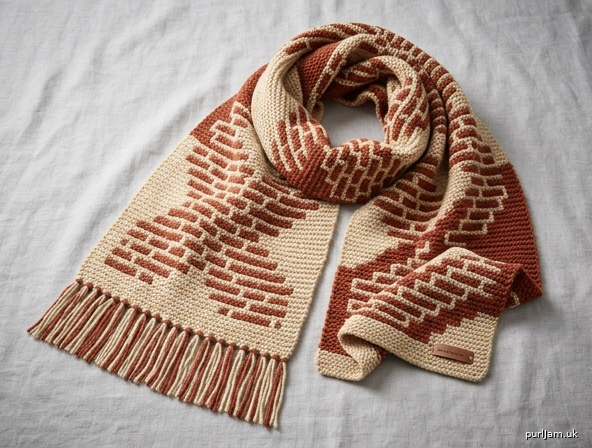
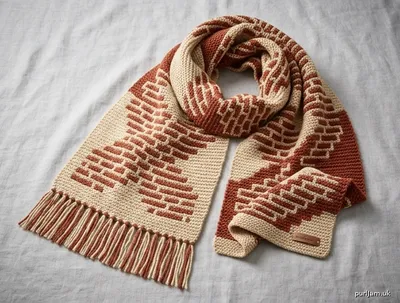
Mesa Steps Mosaic Wrap
A cozy rectangular wrap in beginner mosaic (slip-stitch) colorwork. You knit every row and use only one color at a time—no stranding, no Fair Isle, no purling. Two high-contrast worsted colors build a 12-stitch by 24-row stepped-brick motif that walks diagonally like canyon mesas.
Skill level: Beginner (knit and slip stitches)
Materials
Yarn: Worsted weight, two solid colors with strong light/dark contrast (wool or wool blend recommended for warmth and blocking).
- MC (Main Color): 430 yards / 395 m (shown as □). Example: cream, sand, or light gray.
- CC (Contrast Color): 430 yards / 395 m (shown as ■). Example: terracotta, navy, charcoal, or forest.
Needles: US 8 / 5 mm, straight or a 24–32" (60–80 cm) circular needle (circular recommended for 90 sts).
Notions:
- Tapestry needle
- Scissors
- 8 stitch markers (optional, to mark 12-st repeats)
- Blocking mats and pins (or wires)
Yardage note: Mosaic uses the two colors in nearly equal amounts. If you lengthen the wrap, allow extra of both colors.
Gauge
18 stitches and 36 rows = 4" (10 cm) in mosaic garter stitch (Chart A), after blocking.
Row gauge counts knitted rows (each chart row is worked twice).
Take time to swatch Chart A over at least 2 full 12-st repeats and 24 chart rows. Change needle size to match stitch gauge; length can be adjusted by working more or fewer chart repeats.
Finished Size
20" (51 cm) wide × 65" (165 cm) long, after blocking.
A generous rectangular wrap / oversized scarf. To change length, work more or fewer 24-row chart repeats (each full repeat adds about 5¼" / 13.5 cm).
Abbreviations
| Abbr | Meaning |
|---|---|
| BO | bind off |
| CC | contrast color |
| CO | cast on |
| k | knit |
| MC | main color |
| rep | repeat |
| RS | right side |
| sl | slip stitch purlwise (as if to purl) |
| st(s) | stitch(es) |
| WS | wrong side |
| wyib | with yarn in back |
| wyif | with yarn in front |
Pattern
Mosaic notes (read before you begin)
Mosaic knitting is not stranded colorwork. Only one yarn is used for two consecutive rows; stitches of the resting color are slipped.
- Work garter stitch: knit every row (RS and WS).
- Each chart row is worked twice with the same color—once on the RS, once on the WS—then the color changes.
- Knit stitches that match the working color; slip stitches of the other color.
- Slip purlwise (as if to purl) so the stitch does not twist.
- On RS rows, slip wyib. On WS rows, slip wyif. This parks the working yarn on the WS.
- Do not pull slipped stitches tight; they must span two rows comfortably.
- Edge stitches: the first 3 and last 3 sts of every row are always knitted in the working color (no slipping). This makes a striped garter border.
- Carry the unused color up the selvedge at the beginning of RS rows. Twist the two yarns around each other at each color change so a hole does not form. Do not cut yarn at every stripe.
- Optional: place a marker after the first 3 sts, then after every 12-st repeat (7 repeats), with 3 sts left before the last marker.
Both sides are presentable; the RS (the side you read the chart on) shows the steps more sharply.
Cast on
With MC, CO 90 sts.
(3 border + 12 × 7 repeats + 3 border = 90 ✓)
Lower border
With MC, knit 4 rows (2 garter ridges). End ready for a RS row.
Join CC at the beginning of the next RS row (leave a 6" / 15 cm tail) but do not use it until Chart Row 2.
Mosaic body
Work Chart A (see Charts) 12 times.
(12 repeats × 24 chart rows × 2 knitted rows each = 576 knitted rows ✓)
(576 rows ÷ 36 rows × 4" = 64" of pattern ✓)
You may follow the chart, the written instructions below, or both. If you use written instructions, still read the mosaic notes above.
WS rows (all chart rows): K3, *knit every working-color stitch; sl every other-color stitch wyif; rep from * until 3 sts remain, k3.
(In other words: knit the stitches you knitted on the RS just worked; slip the same stitches you slipped, wyif.)
RS rows are written below. Every RS row is: k3, work the 12-st bracket 7 times, k3.
Chart Rows 1 and 3 — MC, RS
K3, [k3, sl 3, k3, sl 3] 7 times, k3.
Then WS with MC as given above.
Chart Rows 2 and 4 — CC, RS
K3, [sl 3, k3, sl 3, k3] 7 times, k3.
Then WS with CC.
(12-st repeat: 3 + 3 + 3 + 3 = 12 ✓)
Chart Rows 5 and 7 — MC, RS
K3, [k2, sl 3, k3, sl 3, k1] 7 times, k3.
Then WS with MC.
Chart Rows 6 and 8 — CC, RS
K3, [sl 2, k3, sl 3, k3, sl 1] 7 times, k3.
Then WS with CC.
(2 + 3 + 3 + 3 + 1 = 12 ✓)
Chart Rows 9 and 11 — MC, RS
K3, [k1, sl 3, k3, sl 3, k2] 7 times, k3.
Then WS with MC.
Chart Rows 10 and 12 — CC, RS
K3, [sl 1, k3, sl 3, k3, sl 2] 7 times, k3.
Then WS with CC.
(1 + 3 + 3 + 3 + 2 = 12 ✓)
Chart Rows 13 and 15 — MC, RS
K3, [sl 3, k3, sl 3, k3] 7 times, k3.
Then WS with MC.
Chart Rows 14 and 16 — CC, RS
K3, [k3, sl 3, k3, sl 3] 7 times, k3.
Then WS with CC.
(3 + 3 + 3 + 3 = 12 ✓)
Chart Rows 17 and 19 — MC, RS
K3, [sl 2, k3, sl 3, k3, sl 1] 7 times, k3.
Then WS with MC.
Chart Rows 18 and 20 — CC, RS
K3, [k2, sl 3, k3, sl 3, k1] 7 times, k3.
Then WS with CC.
(2 + 3 + 3 + 3 + 1 = 12 ✓)
Chart Rows 21 and 23 — MC, RS
K3, [sl 1, k3, sl 3, k3, sl 2] 7 times, k3.
Then WS with MC.
Chart Rows 22 and 24 — CC, RS
K3, [k1, sl 3, k3, sl 3, k2] 7 times, k3.
Then WS with CC.
(1 + 3 + 3 + 3 + 2 = 12 ✓)
After Chart Row 24 of the 12th repeat, cut CC, leaving a 6" (15 cm) tail.
(Still 90 sts ✓)
Upper border
With MC, knit 4 rows.
(4 + 576 + 4 = 584 knitted rows ÷ 36 × 4" ≈ 65" ✓)
BO knitwise on the RS, loosely (use a larger needle if the edge draws in).
Charts
How to read Chart A
- The chart shows the RS appearance of the 12-st repeat only (the 3-st borders are not charted).
- Stitch 1 is at the right. RS rows are read right to left.
- Rows are numbered bottom to top.
- Each chart row is worked twice (RS, then WS) with the color listed at the right of that row.
- RS: Knit squares of the working color; sl squares of the other color wyib.
- WS: Do not re-read the chart. Knit working-color stitches; sl the others wyif.
- Repeat the 12-st bracket 7 times between the 3-st borders (84 + 6 = 90 sts ✓).
- Work the full 24-row chart 12 times.
Color key
| Symbol | Color | On MC rows | On CC rows |
|---|---|---|---|
| □ | MC | Knit | Slip |
| ■ | CC | Slip | Knit |
Chart A: Mesa Steps (12 sts × 24 rows)
        12-st repeat — stitch 1 at RIGHT
        [ ■ = CC    □ = MC ]
24 CC   ■■□□□■■■□□□■
23 MC   ■■□□□■■■□□□■
22 CC   ■■□□□■■■□□□■
21 MC   ■■□□□■■■□□□■
20 CC   ■□□□■■■□□□■■
19 MC   ■□□□■■■□□□■■
18 CC   ■□□□■■■□□□■■
17 MC   ■□□□■■■□□□■■
16 CC   □□□■■■□□□■■■
15 MC   □□□■■■□□□■■■
14 CC   □□□■■■□□□■■■
13 MC   □□□■■■□□□■■■
12 CC   □□■■■□□□■■■□
11 MC   □□■■■□□□■■■□
10 CC   □□■■■□□□■■■□
 9 MC   □□■■■□□□■■■□
 8 CC   □■■■□□□■■■□□
 7 MC   □■■■□□□■■■□□
 6 CC   □■■■□□□■■■□□
 5 MC   □■■■□□□■■■□□
 4 CC   ■■■□□□■■■□□□
 3 MC   ■■■□□□■■■□□□
 2 CC   ■■■□□□■■■□□□
 1 MC   ■■■□□□■■■□□□
        ↑ left (st 12)         (st 1) right ↑
The motif is 3-st MC blocks and 3-st CC blocks that hold for four chart rows (eight knitted rows), then shift one stitch. After Row 24 the next Row 1 continues the same stair—the 24-row repeat tiles vertically with no jump.
Finishing
- Weave in all ends on the WS, following the same color so they disappear into matching stitches. Do not weave a dark tail across a light block (it may show).
- Wet-block (important for mosaic): Soak in lukewarm water with a little wool wash for 15–20 minutes. Press out water in a towel; do not wring. Pin to 20" × 65" (51 × 165 cm), evening the side edges and relaxing the slipped stitches. Let dry completely. Mosaic fabric can look tight or uneven until it is blocked; the steps open and flatten with blocking.
- Optional fringe: For each short end, cut 60 strands of yarn 12" (30 cm) long (30 MC, 30 CC, or mixed). Use 2 strands as one fringe. Fold in half, latch through every other bound-off (or cast-on) stitch, and pull the ends through the loop. Trim even. Fringe uses extra yarn (about 40 yards / 37 m total).
- No seaming. Steam the borders lightly if they flare, without flattening the garter ridges.
Wear folded lengthwise as a wrap, or open as a long scarf.
Disclaimer: This pattern was generated by AI and should be reviewed for accuracy before use. While we strive for quality, AI-generated content may contain errors. Please verify measurements, stitch counts, charts, and instructions before beginning your project. Generated by purlJam.uk
Love this pattern?
Save this pattern to your free PurlJam libraryAccess your pattern anytime
Bookmark this page to access your pattern anytime