Type
Knitting
Difficulty
beginner
Category
scarf
AI Thinking Process
Planning
Verification
Pattern
The Endless Horizon Scarf — An Extra-Long Ombré Stripe Wrap
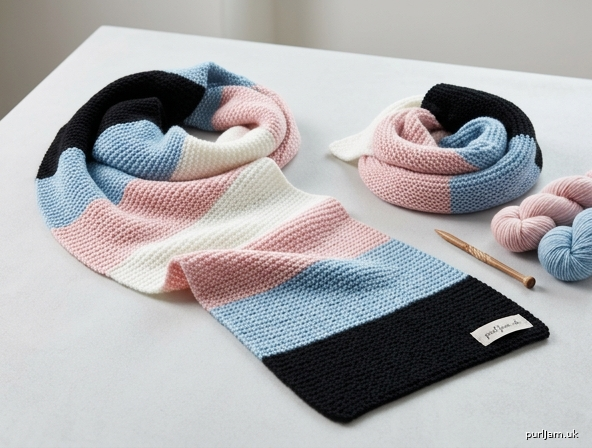
A wonderfully long, cosy scarf worked in simple garter stitch — the perfect first project. Seven bold colour blocks flow symmetrically from end to end: black → light blue → light pink → white → light pink → light blue → black, giving a mirror-image effect with a soft white centre. Every row is knit, so there is nothing tricky to learn — just relax and enjoy the rhythm.
MATERIALS
- Yarn: Sport-weight (4-ply) yarn in 4 colours:
- Black — 100 g
- Light blue — 100 g
- Light pink — 100 g
- White — 80 g
- (Total approx. 380 g — within the 250–400 g range for a scarf this long. Buy an extra ball of each shade if you tend to knit loosely.)
- Needles: A pair of 3.75 mm (UK/old size 9; US 5) straight or circular needles. (A circular needle used back and forth is helpful, as it comfortably holds the large number of stitches over such a long piece.)
- Notions: Wool needle for weaving in ends; scissors; optional stitch marker.
GAUGE (TENSION)
24 sts and 48 rows = 10 cm (4") over garter stitch (knit every row) on 3.75 mm needles.
Tension tip: Cast on 30 sts, knit about 48 rows, then measure. Garter stitch is very forgiving for a scarf, but checking tension helps you predict how much yarn you will use. If you have more stitches per 10 cm than stated, try a larger needle; fewer, try a smaller needle.
FINISHED SIZE
- Width: approx. 20 cm (8")
- Length: approx. 250 cm (98½", roughly 2.5 m) — an extremely long, wrap-around-twice scarf.
(Width check: 48 sts ÷ 24 sts per 10 cm × 10 = 20 cm ✓)
ABBREVIATIONS
- k — knit
- st(s) — stitch(es)
- RS — right side
- WS — wrong side
- cm — centimetres
(Garter stitch = knit every row. Because both sides look the same, this scarf is fully reversible.)
PATTERN
Colour sequence and block lengths
Work the blocks in this exact order. The sequence is symmetric, so the two ends match.
| Block | Colour | Length | Approx. rows |
|---|---|---|---|
| 1 | Black | 30 cm | 144 rows |
| 2 | Light blue | 35 cm | 168 rows |
| 3 | Light pink | 35 cm | 168 rows |
| 4 | White (centre) | 50 cm | 240 rows |
| 5 | Light pink | 35 cm | 168 rows |
| 6 | Light blue | 35 cm | 168 rows |
| 7 | Black | 30 cm | 144 rows |
Total length: 30 + 35 + 35 + 50 + 35 + 35 + 30 = 250 cm ✓ Total rows: 144 + 168 + 168 + 240 + 168 + 168 + 144 = 1200 rows (= 250 cm at 48 rows/10 cm ✓)
How to measure as you go: Rather than counting every row, simply lay the work flat and measure each block with a tape measure. Change colour once a block reaches its target length. The row numbers above are just a guide.
Cast on
Using black and 3.75 mm needles, cast on 48 sts.
Block 1 — Black (30 cm)
- Every row: k across all 48 sts.
- Continue in garter stitch until the black section measures 30 cm from the cast-on edge.
Changing colour
To join a new colour, simply begin knitting with the new shade at the start of a row. Leave a tail of about 10–15 cm on both the old and new yarn to weave in later. Do not cut the working yarn until you have knit a few stitches with the new colour and checked it is secure.
Block 2 — Light blue (35 cm)
- Join light blue.
- Knit every row until this block measures 35 cm (total from cast-on: 65 cm).
Block 3 — Light pink (35 cm)
- Join light pink.
- Knit every row until this block measures 35 cm (total: 100 cm).
Block 4 — White, centre (50 cm)
- Join white.
- Knit every row until this block measures 50 cm (total: 150 cm).
Block 5 — Light pink (35 cm)
- Join light pink.
- Knit every row until this block measures 35 cm (total: 185 cm).
Block 6 — Light blue (35 cm)
- Join light blue.
- Knit every row until this block measures 35 cm (total: 220 cm).
Block 7 — Black (30 cm)
- Join black.
- Knit every row until this block measures 30 cm (total: 250 cm ✓).
Cast off
With black still attached, cast off all 48 sts knitwise. Do not cast off too tightly — the cast-off edge should stretch to the same width as the cast-on edge (20 cm). Cut the yarn, leaving a 15 cm tail, and pull through the last stitch.
FINISHING
- Weave in ends: Thread each tail onto a wool needle and weave it into the garter ridges of its own colour block (working along the wrong side) for about 4–5 cm. Trim close. With seven colour changes there are up to 14 ends, so take your time for a neat result.
- Optional fringe (for extra flair): Cut 24 lengths of black yarn, each 30 cm long. For each tassel, fold 2 strands in half, use a crochet hook to pull the folded loop through an edge stitch of the cast-on edge, then pass the tails through the loop and pull snug. Space 6 tassels evenly across the 20 cm end. Repeat on the cast-off (black) end. Trim the fringe level.
- Blocking: Soak the finished scarf in lukewarm water with a little wool wash, gently press out the water (do not wring), then lay flat to dry. Pat it out to 20 cm wide and let it relax lengthways. Blocking evens out the garter stitch and helps the colour blocks lie smooth and flat.
Congratulations — you have made an extremely long, fully reversible ombré scarf! Because it is worked entirely in garter stitch, it lies perfectly flat with no curling, and the mirrored black-to-white colour flow looks identical from either end.
Disclaimer: This pattern was generated by AI and should be reviewed for accuracy before use. While we strive for quality, AI-generated content may contain errors. Please verify measurements, stitch counts, and instructions before beginning your project. Generated by purlJam.uk
Access your pattern anytime
Bookmark this page to access your pattern anytime