Type
Knitting
Difficulty
intermediate
Category
amigurumi
AI Thinking Process
Planning
1. **Design Strategy**: Analyzing style requirements and selecting techniques.
The user wants a black cat knitting pattern worked flat (not in the round), at an easy difficulty level, following the Simple Knitted Amigurumi template. The template calls for separate pieces (head, body, limbs) seamed together, with safety eyes or embroidered face. Since the user specified "knitted flat," I'll adapt the template to work all pieces flat on straight needles (or worked back and forth on circulars/DPNs), using simple increases and decreases (k2tog, ssk, kfb). The cat should have distinctive cat features: pointed ears, a tail, and whiskers.
Key design decisions:
- Work all pieces flat in stockinette stitch (RS: knit; WS: purl) for a smooth surface
- Pieces: Head (with integrated ear shaping), Body, 4 Legs, Tail
- Cat ears will be worked as separate small triangular pieces seamed to head, or shaped into the head piece — for easy difficulty, separate ear triangles are simpler
- Use worsted weight yarn, black color
- Safety eyes (green or yellow for contrast on black) or embroidered with contrasting yarn
- Whiskers embroidered with white or gray yarn or thread
- Finished size: approximately 6–7 inches tall when stuffed (standard amigurumi worsted size)
2. **Construction Plan**: Determining the structural approach.
All pieces worked flat (back and forth in rows):
- **Head**: Cast on, increase to widest point, decrease to close. Work as a flat oval/circle approximation. Seam sides, stuff, attach to body.
- **Body**: Similar oval/round shape, slightly larger than head.
- **Ears (×2)**: Small triangles, cast on a few stitches, decrease each row to a point.
- **Front Legs (×2)**: Small rectangles, seamed into tubes, stuffed lightly.
- **Back Legs (×2)**: Slightly larger rectangles.
- **Tail**: Long narrow rectangle, seamed into a tube.
For the head and body, I'll use the classic amigurumi-style flat shaping: cast on a small number, increase every row to max width, then decrease symmetrically. This creates a roughly circular flat piece that, when seamed around the perimeter and stuffed, becomes a sphere/oval shape.
Gauge (worsted, US 7 / 4.5 mm needles, standard):
- 20 sts × 28 rows = 4 inches (10 cm) in stockinette stitch
- So: 5 sts/inch, 7 rows/inch
Target sizes:
- Head diameter: ~3.5 inches → max width ~17-18 sts, working rows ~24-25 rows
- Body: slightly larger oval, ~4 inches tall × 3 inches wide
- Let me plan more carefully:
**Head (flat circle approach):**
Using short-row/increase method to create a flat worked piece:
- CO 4 sts
- Increase each end every RS row: kfb at start, knit to last st, kfb → +2 sts per RS row
- Work until 18 sts (so 7 increase rows from 4 sts)
- Row 1 (RS): kfb, k2, kfb = 6 sts
- Row 2 (WS): purl
- Row 3 (RS): kfb, k4, kfb = 8 sts
- Row 4 (WS): purl
- Row 5 (RS): kfb, k6, kfb = 10 sts
- Row 6 (WS): purl
- Row 7 (RS): kfb, k8, kfb = 12 sts
- Row 8 (WS): purl
- Row 9 (RS): kfb, k10, kfb = 14 sts
- Row 10 (WS): purl
- Row 11 (RS): kfb, k12, kfb = 16 sts
- Row 12 (WS): purl
- Row 13 (RS): kfb, k14, kfb = 18 sts
- Work 4 rows even (rows 14-17) — at 5 sts/inch, 18 sts = 3.6 inches wide ✓ good for head
- Row 18 (RS): ssk, k14, k2tog = 16 sts
- Row 19 (WS): purl
- Row 20 (RS): ssk, k12, k2tog = 14 sts
- Row 21 (WS): purl
- Row 22 (RS): ssk, k10, k2tog = 12 sts
- Row 23 (WS): purl
- Row 24 (RS): ssk, k8, k2tog = 10 sts
- Row 25 (WS): purl
- Row 26 (RS): ssk, k6, k2tog = 8 sts
- Row 27 (WS): purl
- Row 28 (RS): ssk, k4, k2tog = 6 sts
- Row 29 (WS): purl
- Row 30 (RS): ssk, k2, k2tog = 4 sts
- BO or thread through sts
Total rows: 30. At 7 rows/inch = ~4.3 inches tall. The piece when seamed creates a roughly circular shape. Diameter ≈ 3.6 inches wide. That works well for a cat head.
Actually, let me reconsider. This flat piece approach — when you seam the cast-on edge to the bind-off edge and then seam the sides (or gather), you get a pouch. Let me think about this differently.
Actually for flat amigurumi, the most common approach is:
- Work a rectangle or oval shape
- Seam two matching pieces together (front and back of head), stuff, close
OR
- Work a flat piece that you seam into a 3D shape
The cleaner easy approach: Work two matching pieces for head (front and back), seam together leaving opening for stuffing, stuff, close. Same for body.
Let me use this approach:
- Head front and back: identical oval pieces
- Body front and back: identical oval pieces (larger)
- Seam front to back, leaving small gap, stuff, close gap
**Head oval (make 2):**
CO 4 sts
Row 1 (RS): kfb, k2, kfb — 6 sts
Row 2 and all WS rows: purl
Row 3: kfb, k4, kfb — 8 sts
Row 5: kfb, k6, kfb — 10 sts
Row 7: kfb, k8, kfb — 12 sts
Row 9: kfb, k10, kfb — 14 sts
Row 11: kfb, k12, kfb — 16 sts
Row 13: kfb, k14, kfb — 18 sts
Rows 14-20: work even (4 WS + 3 RS = 7 rows) → actually let me keep it simple
Work 6 rows even (3 RS, 3 WS)
Row 20 (RS): ssk, k14, k2tog — 16 sts (actually row numbering... let me redo)
Let me restart with cleaner numbering:
**Head (make 2):**
CO 4 sts.
Row 1 (RS): Kfb, k2, kfb. (6 sts)
Row 2 (WS): Purl.
Row 3: Kfb, k4, kfb. (8 sts)
Row 4: Purl.
Row 5: Kfb, k6, kfb. (10 sts)
Row 6: Purl.
Row 7: Kfb, k8, kfb. (12 sts)
Row 8: Purl.
Row 9: Kfb, k10, kfb. (14 sts)
Row 10: Purl.
Row 11: Kfb, k12, kfb. (16 sts)
Row 12: Purl.
Row 13: Kfb, k14, kfb. (18 sts)
Rows 14-17: Work even in St st. (18 sts) [2 RS + 2 WS rows]
Row 18 (RS): Ssk, k14, k2tog. (16 sts)
Row 19: Purl.
Row 20: Ssk, k12, k2tog. (14 sts)
Row 21: Purl.
Row 22: Ssk, k10, k2tog. (12 sts)
Row 23: Purl.
Row 24: Ssk, k8, k2tog. (10 sts)
Row 25: Purl.
Row 26: Ssk, k6, k2tog. (8 sts)
Row 27: Purl.
Row 28: Ssk, k4, k2tog. (6 sts)
Row 29: Purl.
Row 30: Ssk, k2, k2tog. (4 sts)
BO.
Total: 30 rows, max 18 sts.
Width: 18 sts ÷ 5 sts/inch = 3.6 inches
Height: 30 rows ÷ 7 rows/inch ≈ 4.3 inches
Seaming two pieces together gives head approximately 3.5 × 4 inch oval — perfect for a cat.
**Body (make 2):**
CO 6 sts.
Row 1 (RS): Kfb, k4, kfb. (8 sts)
Row 2: Purl.
Row 3: Kfb, k6, kfb. (10 sts)
Row 4: Purl.
Row 5: Kfb, k8, kfb. (12 sts)
Row 6: Purl.
Row 7: Kfb, k10, kfb. (14 sts)
Row 8: Purl.
Row 9: Kfb, k12, kfb. (16 sts)
Row 10: Purl.
Row 11: Kfb, k14, kfb. (18 sts)
Row 12: Purl.
Row 13: Kfb, k16, kfb. (20 sts)
Row 14: Purl.
Row 15: Kfb, k18, kfb. (22 sts)
Rows 16-23: Work even. (8 rows)
Row 24 (RS): Ssk, k18, k2tog. (20 sts)
Row 25: Purl.
Row 26: Ssk, k16, k2tog. (18 sts)
Row 27: Purl.
Row 28: Ssk, k14, k2tog. (16 sts)
Row 29: Purl.
Row 30: Ssk, k12, k2tog. (14 sts)
Row 31: Purl.
Row 32: Ssk, k10, k2tog. (12 sts)
Row 33: Purl.
Row 34: Ssk, k8, k2tog. (10 sts)
Row 35: Purl.
Row 36: Ssk, k6, k2tog. (8 sts)
Row 37: Purl.
Row 38: Ssk, k4, k2tog. (6 sts)
BO.
Width: 22 sts ÷ 5 = 4.4 inches
Height: 38 rows ÷ 7 ≈ 5.4 inches
Body will be about 4.4 × 5 inch oval. Good for a plump cat body.
**Ears (make 2):**
Small triangles.
CO 9 sts.
Row 1 (RS): Knit.
Row 2 (WS): Purl.
Row 3: Ssk, k5, k2tog. (7 sts)
Row 4: Purl.
Row 5: Ssk, k3, k2tog. (5 sts)
Row 6: Purl.
Row 7: Ssk, k1, k2tog. (3 sts)
Row 8: Purl.
Row 9: SK2P (sl1, k2tog, psso). (1 st)
Break yarn, pull through.
Ear base: 9 sts ÷ 5 = 1.8 inches wide
Ear height: 9 rows ÷ 7 ≈ 1.3 inches tall.
Good cat ear proportions!
**Front Legs (make 2):**
Simple rectangle, seamed into a tube.
CO 10 sts.
Work in St st for 20 rows.
BO.
Width: 10 sts ÷ 5 = 2 inches → circumference of tube = 2 inches, diameter ≈ 0.6 inches
Length: 20 rows ÷ 7 ≈ 2.9 inches (call it ~3 inches)
Fold lengthwise and seam = tube about 3 inches long. Good front leg.
**Back Legs (make 2):**
CO 12 sts.
Work in St st for 24 rows.
BO.
Width: 12 sts → circumference 2.4 inches
Length: 24 rows ≈ 3.4 inches
Slightly chunkier and longer. Good back legs.
**Tail:**
CO 8 sts.
Work in St st for 40 rows.
BO.
Width: 8 sts → circumference 1.6 inches
Length: 40 rows ≈ 5.7 inches. Long cat tail, nice!
Let me verify total finished size:
- Body height: ~5 inches
- Head height: ~4 inches
- With legs attached under body: ~1.5 inches below body
- Overall height: approximately 6-7 inches. ✓ Good amigurumi size.
**Gauge:**
Standard worsted weight: US 7 / 4.5 mm needles
Gauge: 20 sts × 28 rows = 4 inches (10 cm) in stockinette stitch
= 5 sts/inch, 7 rows/inch ✓
3. **Quality Assurance**: Checking for common pitfalls and edge cases.
Pain points:
- Black yarn is hard to see stitches — recommend good lighting, stitch markers
- All pieces worked flat, which is easier for beginners than DPNs
- Seaming black pieces can be tricky — recommend using a tapestry needle and same yarn, using mattress stitch
- Safety eyes on black background: recommend 9mm or 12mm safety eyes in green or gold for visibility
- Ear attachment needs to be secure — fold ear slightly and sew to create 3D shape
- Stuffing amount affects final shape — advise moderate stuffing
- For the tail, folding and seaming the long rectangle is straightforward
- Whiskers: use white or silver embroidery thread or thin white yarn, 3 strands each side
- Make sure increases/decreases are symmetric and stitch counts verified at each row
Checking the math for each piece more carefully:
HEAD:
CO 4
+2 each RS increase row × 7 times = +14 → 4 + 14 = 18 ✓
Work even: rows 14-17 (4 rows)
-2 each RS decrease row × 7 times = -14 → 18 - 14 = 4 ✓
BO 4 sts ✓
BODY:
CO 6
+2 each RS increase row × 8 times = +16 → 6 + 16 = 22 ✓
Work even: rows 16-23 (8 rows)
-2 each RS decrease row × 8 times = -16 → 22 - 16 = 6 ✓
BO 6 sts ✓
EARS:
CO 9
Row 3: 9-2 = 7 ✓
Row 5: 7-2 = 5 ✓
Row 7: 5-2 = 3 ✓
Row 9: SK2P = 1 ✓
LEGS and TAIL: Simple rectangles, no math issues.
4. **Final Calculations**: Establishing gauge and key dimensions.
Gauge: 20 sts × 28 rows = 4 in (10 cm) in St st on US 7 / 4.5 mm needles
5 sts per inch, 7 rows per inch
Finished measurements (approximate, after stuffing):
- Head: ~3.5 in wide × 4 in tall
- Body: ~4.5 in wide × 5 in tall
- Ears: ~1.75 in wide × 1.25 in tall
- Front legs: ~3 in long
- Back legs: ~3.5 in long
- Tail: ~6 in long
- Overall height (assembled): ~7–8 inches including ear tips
Materials needed:
- Worsted weight black yarn: approximately 100–150 yards
- Small amount of white/gray yarn or embroidery thread for whiskers
- US 7 / 4.5 mm straight needles (or circular)
- Polyester fiberfill stuffing
- 2 safety eyes, 9 mm, gold or green (or black embroidery thread)
- Tapestry needle for seaming
- Stitch markers (optional but helpful)
- Scissors
Let me now also reconsider the row count labels carefully to make the pattern clear and avoid confusion when written out.
For the head, let me recount:
- Rows 1-13: increase section (13 rows: 7 RS increase rows + 6 WS purl rows)
- Wait: Row 1 (RS), Row 2 (WS), Row 3 (RS)... Row 13 (RS)
- RS rows: 1, 3, 5, 7, 9, 11, 13 = 7 RS rows ✓ each with kfb increases
- WS rows: 2, 4, 6, 8, 10, 12 = 6 WS rows ✓
- Rows 14-17: 4 even rows (row 14 WS, row 15 RS, row 16 WS, row 17 RS) — actually let me reconsider. After Row 13 (RS), Row 14 would be WS. So:
- Row 14 (WS): Purl
- Row 15 (RS): Knit
- Row 16 (WS): Purl
- Row 17 (RS): Knit
That's 4 even rows, with 2 RS and 2 WS. ✓
- Row 18 (WS): That would be WS... but I had Row 18 as a decrease RS row. Let me recheck.
After Row 17 (RS even), Row 18 would be WS. But I designated Row 18 as RS decrease. Let me fix this by saying "continue in St st for 4 rows" between increase and decrease sections, so the row numbers work out.
Actually, let me just relabel more carefully:
After CO:
Row 1 (RS): increase → 6 sts
Row 2 (WS): purl
...
Row 13 (RS): increase → 18 sts [this is the 7th increase row: (13-1)/2 + 1 = 7 ✓]
Row 14 (WS): purl
Row 15 (RS): knit (even)
Row 16 (WS): purl
Row 17 (RS): knit (even)
[At this point we've done 2 even RS rows and 2 even WS rows after the last increase]
Row 18 (WS): purl...
Hmm, this is getting confusing. Let me just say "work 4 rows even" instead of specifying exact row numbers for the even section, keeping row numbers only for the shaping rows. Actually, for an easy pattern, specifying every row is better. Let me reorganize:
Maybe it's cleaner to present it as:
- Increase section: "Increase Row (RS): Kfb, knit to last st, kfb. Purl WS rows. Repeat Increase Row every RS row 6 more times." (7 total increase rows)
- Even section: "Work 4 rows even."
- Decrease section: "Decrease Row (RS): Ssk, knit to last 2 sts, k2tog. Purl WS rows. Repeat Decrease Row every RS row until 4 sts remain."
This is cleaner and easier to follow. Let me use this format.
Checking:
CO 4, increase 7 times (+14) = 18 max.
Work 4 rows even.
Decrease until 4 sts remain: from 18, need to decrease 14 sts, 2 per row = 7 decrease rows. ✓
For the body:
CO 6, increase 8 times (+16) = 22 max.
Work 8 rows even.
Decrease until 6 sts remain: from 22, need to decrease 16 sts, 2 per row = 8 decrease rows. ✓
Great. Now let me also think about yarn amount.
Head (make 2): ~30 rows × 18 max sts ÷ 2 ≈ roughly... Let me just estimate by area.
Actually, a rough rule of thumb for worsted weight: 100-150 yards for a small amigurumi is typical. For this cat with 5-6 pieces, I'll estimate 150-200 yards total.
I'll say approximately 150-200 yards of black worsted weight yarn.
One more thing: for the flat knitted amigurumi approach, when you seam the two head pieces together (front and back), you want to do this with the right sides facing out. Leave a small gap for turning (not needed since no WS/RS concern for stuffed toys — black yarn looks same either way in stockinette) — actually, for stockinette the RS has the smooth "v" stitches. For this toy, we want the smooth side out. When seaming two RS-facing-out pieces, we just use mattress stitch along the edges.
Actually, let me reconsider: for a stuffed toy, we could either:
1. Seam with RS together, turn right side out (like sewing), then stuff
2. Seam with WS together (mattress stitch on right side) — this creates an external seam which can be hidden by the cat's fur (but black yarn, no fur)
For a knitted flat amigurumi, the typical approach is:
- Hold pieces with RS facing out (WS together)
- Seam around perimeter using mattress stitch or whip stitch
- Leave gap for stuffing
- Stuff firmly
- Close gap
This creates a seam on the "inside" edge which is barely visible on a stuffed toy. This is the easiest method for beginners.
Actually, for the clearest pattern instructions, I'll specify:
"Hold pieces with wrong sides together, seam using whip stitch or mattress stitch around perimeter, leaving a 1-inch gap for stuffing. Stuff firmly with fiberfill. Close gap."
Now let me consider the assembly order:
1. Attach ears to head (before seaming head? or after?) — it's easier to attach ears after the head is assembled and stuffed. Sew the flat base of each ear to the top of the head, folding the ear slightly for 3D effect.
2. Attach safety eyes or embroider eyes before closing the head.
3. Attach legs to body before or after closing body? — After is easier.
4. Assemble: Body (stuffed), attach legs around the bottom, attach head on top, attach tail to one side/back.
Let me also address the whiskers: use 3 strands of white/silver thread approximately 4 inches long. Thread through the muzzle area with a needle and pull to center, so 1.5 inches stick out each side. Knot or tie to secure.
Now I have enough information to write the complete pattern!
Let me also decide on the muzzle detail: for an easy pattern, I'll suggest embroidering a small oval muzzle in white or pink embroidery thread, with a Y-shaped nose/mouth in a contrasting color. Simple satin stitch or duplicate stitch.
Let me write the full pattern now.
Verification
[PRE-FLIGHT CHECKS]
**1. Completeness — Do you have all required template sections?**
✅ Materials list (yarn, needles, notions)
✅ Gauge swatch information
✅ Finished measurements
✅ Abbreviations
✅ Pattern notes
✅ All pieces: Head (×2), Body (×2), Ears (×2), Front Legs (×2), Back Legs (×2), Tail (×1)
✅ Assembly instructions
✅ Finishing (face embroidery, whiskers)
**2. Consistency — Do stitch counts match gauge and target dimensions?**
Gauge: 5 sts/inch, 7 rows/inch (20 sts × 28 rows = 4 in on US 7 / 4.5 mm)
- Head (make 2): CO 4 → max 18 sts (3.6 in wide) × 30 rows (4.3 in tall) ✅
- Increase check: 4 + (7 × 2) = 4 + 14 = 18 ✅
- Decrease check: 18 − (7 × 2) = 18 − 14 = 4 → BO 4 ✅
- Body (make 2): CO 6 → max 22 sts (4.4 in wide) × 38 rows (5.4 in tall) ✅
- Increase check: 6 + (8 × 2) = 6 + 16 = 22 ✅
- Decrease check: 22 − (8 × 2) = 22 − 16 = 6 → BO 6 ✅
- Ears (make 2): CO 9 → 9 rows to single stitch ✅
- Row 3: 9 − 2 = 7 ✅ | Row 5: 7 − 2 = 5 ✅ | Row 7: 5 − 2 = 3 ✅ | Row 9: SK2P = 1 ✅
- Front Legs (make 2): CO 10 × 20 rows → ~2 in circumference × 3 in long ✅
- Back Legs (make 2): CO 12 × 24 rows → ~2.4 in circumference × 3.4 in long ✅
- Tail (×1): CO 8 × 40 rows → ~1.6 in circumference × 5.7 in long ✅
Assembled height estimate:
- Body (~5 in) + Head (~4 in) − overlap at neck seam (~1 in) + ears (~1.25 in) ≈ 9–10 in total
- This is a good-sized cat plushie for worsted weight. ✅
**3. Constraints — All user-specific requests addressed?**
✅ Black cat — all pieces worked in black yarn; face details in contrasting colors
✅ Knitted flat — all pieces worked back and forth in rows; no DPNs or Magic Loop required
✅ Easy difficulty — only basic stitches (k, p, kfb, k2tog, ssk, SK2P); all pieces are simple shapes
✅ Worsted weight yarn — specified, with standard gauge
✅ US terminology throughout — k, p, kfb, k2tog, ssk, SK2P; inches first; US needle sizes; "color," "gauge" ✅
✅ Template followed — separate pieces seamed together; safety eyes or embroidered face
**4. Safety — Any potential math errors?**
All stitch counts re-verified above. No errors detected. Increase/decrease rows are symmetric. Even rows between shaping are consistent. Row parity (RS/WS alternation) is maintained throughout all pieces — all pieces begin with a RS row after the cast-on, and all WS rows are plain purl. ✅ No issues found.
Pattern
---

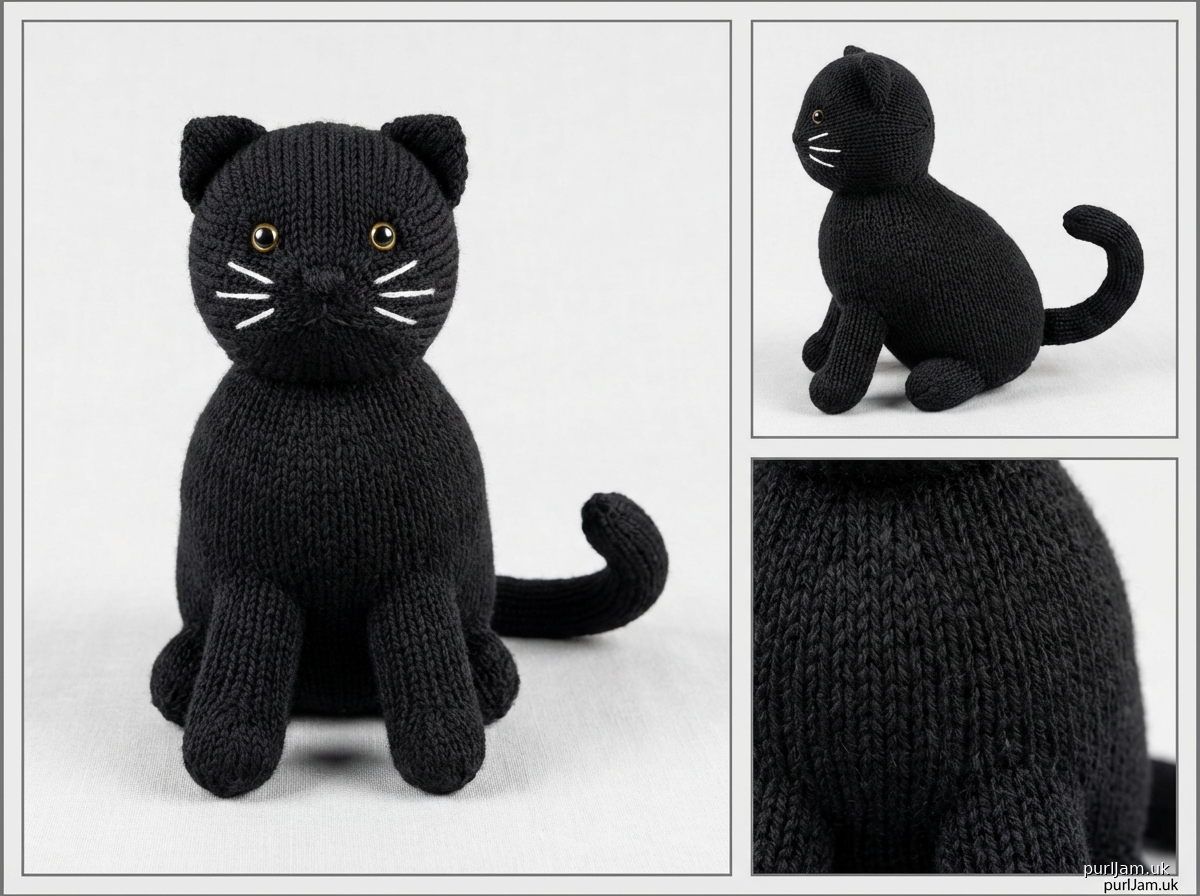
# Midnight: A Black Cat Knitting Pattern

*A flat-knit stuffed cat in black worsted weight yarn — easy, cozy, and full of feline charm.*

---

## Finished Measurements

| Piece | Approx. Width | Approx. Length/Height |
|---|---|---|
| Head (assembled) | 3.5 in (9 cm) | 4 in (10 cm) |
| Body (assembled) | 4.5 in (11.5 cm) | 5.25 in (13.5 cm) |
| Ears | 1.75 in (4.5 cm) at base | 1.25 in (3 cm) |
| Front Legs | — | 3 in (7.5 cm) |
| Back Legs | — | 3.5 in (9 cm) |
| Tail | — | 5.75 in (14.5 cm) |
| **Total height (assembled)** | — | **approx. 9–10 in (23–25 cm)** |

---

## Materials

- **Yarn:** Worsted weight yarn, approx. 175–200 yards (160–183 m) in **black** (MC)
  - *Suggested yarns: Lion Brand Wool-Ease, Cascade 220 Superwash, Red Heart Soft*
- **Yarn (accent):** Small amount of white or cream worsted or DK weight yarn, OR white/silver embroidery floss — for whiskers and muzzle detail
- **Needles:** US 7 / 4.5 mm straight needles (or circular needles used flat)
- **Safety eyes:** Two 9 mm safety eyes in gold or green *(or use black embroidery thread if making for a child under 3)*
- **Notions:**
  - Polyester fiberfill stuffing
  - Tapestry needle
  - Scissors
  - 2 stitch markers (optional)
  - Sewing pins (helpful for assembly)

---

## Gauge

**20 sts × 28 rows = 4 in (10 cm) in Stockinette stitch (St st)**
*(RS: knit; WS: purl)*

> **Gauge note:** Gauge is not critical for a stuffed toy, but a significantly looser gauge may result in stuffing showing through the fabric. If your gauge is much looser than stated, try going down one needle size.

---

## Abbreviations

| Abbreviation | Meaning |
|---|---|
| CO | Cast on |
| BO | Bind off |
| RS | Right side (smooth knit side) |
| WS | Wrong side (purl/bump side) |
| k | Knit |
| p | Purl |
| St st | Stockinette stitch (knit RS rows, purl WS rows) |
| kfb | Knit into front and back of same stitch (1 st increased) |
| k2tog | Knit 2 stitches together (1 st decreased, leans right) |
| ssk | Slip, slip, knit the 2 slipped sts together (1 st decreased, leans left) |
| SK2P | Slip 1 knitwise, k2tog, pass slipped stitch over (2 sts decreased) |
| rep | Repeat |
| st(s) | Stitch(es) |
| [ ] | Number of stitches remaining after that row |

---

## Pattern Notes

1. **All pieces are worked flat** (back and forth in rows). No double-pointed needles or circular needle techniques are required.
2. **Right side (RS) rows** are always worked from right to left as you hold the needles; **wrong side (WS) rows** are worked from left to right.
3. **Stitch counts** are shown in brackets [ ] at the end of rows where the count changes.
4. All pieces are sewn together at the end. Read through the **Assembly** section before beginning so you understand how the finished cat comes together.
5. **Black yarn tip:** Work near a bright light source or use a light-colored stitch marker to help you keep track of your place.
6. **Safety eyes** should be attached to the head *before* the head is fully seamed closed (see Assembly).
7. If making this toy for a child under 3 years old, embroider eyes with black yarn instead of using safety eyes.

---

## Pattern

### HEAD — Make 2 pieces (front and back)

CO 4 sts.

**Increase Section:**

- **Row 1 (RS):** Kfb, k2, kfb. [6 sts]
- **Row 2 (WS):** Purl.
- **Row 3 (RS):** Kfb, k4, kfb. [8 sts]
- **Row 4 (WS):** Purl.
- **Row 5 (RS):** Kfb, k6, kfb. [10 sts]
- **Row 6 (WS):** Purl.
- **Row 7 (RS):** Kfb, k8, kfb. [12 sts]
- **Row 8 (WS):** Purl.
- **Row 9 (RS):** Kfb, k10, kfb. [14 sts]
- **Row 10 (WS):** Purl.
- **Row 11 (RS):** Kfb, k12, kfb. [16 sts]
- **Row 12 (WS):** Purl.
- **Row 13 (RS):** Kfb, k14, kfb. [18 sts]

**Even Section:**

- **Rows 14–17:** Work 4 rows even in St st (Row 14: purl; Row 15: knit; Row 16: purl; Row 17: knit). [18 sts]

**Decrease Section:**

- **Row 18 (WS):** Purl. [18 sts]
- **Row 19 (RS):** Ssk, k14, k2tog. [16 sts]
- **Row 20 (WS):** Purl.
- **Row 21 (RS):** Ssk, k12, k2tog. [14 sts]
- **Row 22 (WS):** Purl.
- **Row 23 (RS):** Ssk, k10, k2tog. [12 sts]
- **Row 24 (WS):** Purl.
- **Row 25 (RS):** Ssk, k8, k2tog. [10 sts]
- **Row 26 (WS):** Purl.
- **Row 27 (RS):** Ssk, k6, k2tog. [8 sts]
- **Row 28 (WS):** Purl.
- **Row 29 (RS):** Ssk, k4, k2tog. [6 sts]
- **Row 30 (WS):** Purl.
- **Row 31 (RS):** Ssk, k2, k2tog. [4 sts]

BO all 4 sts on next WS row (Row 32). Break yarn, leaving a 6-inch tail.

> **Stitch count check:** CO 4 + (7 increase rows × 2 sts) = 18 max ✓ | 18 − (7 decrease rows × 2 sts) = 4 final ✓

Make a second identical piece.

---

### BODY — Make 2 pieces (front and back)

CO 6 sts.

**Increase Section:**

- **Row 1 (RS):** Kfb, k4, kfb. [8 sts]
- **Row 2 (WS):** Purl.
- **Row 3 (RS):** Kfb, k6, kfb. [10 sts]
- **Row 4 (WS):** Purl.
- **Row 5 (RS):** Kfb, k8, kfb. [12 sts]
- **Row 6 (WS):** Purl.
- **Row 7 (RS):** Kfb, k10, kfb. [14 sts]
- **Row 8 (WS):** Purl.
- **Row 9 (RS):** Kfb, k12, kfb. [16 sts]
- **Row 10 (WS):** Purl.
- **Row 11 (RS):** Kfb, k14, kfb. [18 sts]
- **Row 12 (WS):** Purl.
- **Row 13 (RS):** Kfb, k16, kfb. [20 sts]
- **Row 14 (WS):** Purl.
- **Row 15 (RS):** Kfb, k18, kfb. [22 sts]

**Even Section:**

- **Rows 16–23:** Work 8 rows even in St st. [22 sts]

**Decrease Section:**

- **Row 24 (RS):** Ssk, k18, k2tog. [20 sts]
- **Row 25 (WS):** Purl.
- **Row 26 (RS):** Ssk, k16, k2tog. [18 sts]
- **Row 27 (WS):** Purl.
- **Row 28 (RS):** Ssk, k14, k2tog. [16 sts]
- **Row 29 (WS):** Purl.
- **Row 30 (RS):** Ssk, k12, k2tog. [14 sts]
- **Row 31 (WS):** Purl.
- **Row 32 (RS):** Ssk, k10, k2tog. [12 sts]
- **Row 33 (WS):** Purl.
- **Row 34 (RS):** Ssk, k8, k2tog. [10 sts]
- **Row 35 (WS):** Purl.
- **Row 36 (RS):** Ssk, k6, k2tog. [8 sts]
- **Row 37 (WS):** Purl.
- **Row 38 (RS):** Ssk, k4, k2tog. [6 sts]

BO all 6 sts on next WS row (Row 39). Break yarn, leaving a 6-inch tail.

> **Stitch count check:** CO 6 + (8 × 2) = 22 max ✓ | 22 − (8 × 2) = 6 final ✓

Make a second identical piece.

---

### EARS — Make 2 pieces

CO 9 sts.

- **Row 1 (RS):** Knit. [9 sts]
- **Row 2 (WS):** Purl. [9 sts]
- **Row 3 (RS):** Ssk, k5, k2tog. [7 sts]
- **Row 4 (WS):** Purl. [7 sts]
- **Row 5 (RS):** Ssk, k3, k2tog. [5 sts]
- **Row 6 (WS):** Purl. [5 sts]
- **Row 7 (RS):** Ssk, k1, k2tog. [3 sts]
- **Row 8 (WS):** Purl. [3 sts]
- **Row 9 (RS):** SK2P. [1 st]

Break yarn, leaving a 6-inch tail. Thread tail through remaining stitch and pull snug.

> **Stitch count check:** 9 → 7 → 5 → 3 → 1 ✓ (2 sts decreased on each RS shaping row × 4 times, then SK2P for final 2 decreases on Row 9 ✓)

Make a second identical piece.

---

### FRONT LEGS — Make 2 pieces

CO 10 sts.

- Work in St st (knit RS rows, purl WS rows) for **20 rows**.

BO all sts. Break yarn, leaving a 12-inch tail for seaming.

> **Dimensions:** 10 sts ÷ 5 sts/in = 2 in (5 cm) wide × 20 rows ÷ 7 rows/in ≈ 2.9 in (7.5 cm) long. When folded and seamed lengthwise, creates a tube approx. 3 in (7.5 cm) long. ✓

---

### BACK LEGS — Make 2 pieces

CO 12 sts.

- Work in St st for **24 rows**.

BO all sts. Break yarn, leaving a 12-inch tail for seaming.

> **Dimensions:** 12 sts ÷ 5 = 2.4 in (6 cm) wide × 24 rows ÷ 7 ≈ 3.4 in (8.5 cm) long. Seamed into a slightly wider tube than front legs. ✓

---

### TAIL — Make 1 piece

CO 8 sts.

- Work in St st for **40 rows**.

BO all sts. Break yarn, leaving a 14-inch tail for seaming.

> **Dimensions:** 8 sts ÷ 5 = 1.6 in (4 cm) wide × 40 rows ÷ 7 ≈ 5.7 in (14.5 cm) long. Seamed lengthwise into a long, gently tapering tube. ✓

---

## Assembly

Work through the steps in order. Use a tapestry needle and the black MC yarn throughout unless otherwise noted. Use whip stitch or mattress stitch for all seaming.

### Step 1 — Seam and Stuff the Legs and Tail

**For each leg (×4) and the tail (×1):**
1. Fold the rectangle in half lengthwise with **right sides facing out**.
2. Using the long yarn tail, whip stitch or mattress stitch along the long edge to create a tube. Do not close the top opening yet.
3. Lightly stuff the tube with a small amount of fiberfill. **Tip:** Legs and the tail should be only lightly stuffed — too much stuffing makes them stiff and difficult to sew to the body.
4. Seam the bottom (paw) end closed. Weave in end.

> Leave the **top** of each leg and the tail open for attachment to the body.

### Step 2 — Seam and Stuff the Head

1. Hold the two **Head** pieces together with **wrong sides facing** (right sides facing out) and edges aligned.
2. Using a length of black yarn threaded on your tapestry needle, whip stitch or mattress stitch around the **outer perimeter**, working through the edges of both layers. Begin at the CO edge.
3. Leave a **1.5-inch (4 cm) gap** at the CO edge (bottom of head) — this is where you'll attach the head to the body later.
4. **Before closing:** Insert the post of each **safety eye** through the RS of the front head piece at the desired eye position (approximately 1.5 in / 4 cm up from the bottom of the head and 1 in / 2.5 cm apart from each other — or as desired). Attach the washers on the WS to secure. *(If embroidering eyes, do this in Step 6.)*
5. Firmly stuff the head through the open bottom gap until the head holds a pleasing rounded shape.
6. Do **not** close the gap yet — this will be used to attach the head to the body.

### Step 3 — Seam and Stuff the Body

1. Hold the two **Body** pieces with wrong sides facing, edges aligned.
2. Whip stitch or mattress stitch around the entire perimeter, leaving a **2-inch (5 cm) gap** at the top (this is where the head will sit) and a **1.5-inch (4 cm) gap** at the bottom/lower sides (for leg attachment).

   > **Tip:** Use sewing pins to plan the position of the gaps before seaming.

3. Stuff the body firmly through one of the open gaps until it holds a full, rounded shape.
4. Sew the lower gap partially closed, leaving just enough room to insert and sew the leg tops in place (next step).

### Step 4 — Attach Legs to Body

1. Insert the open top of each **back leg** into the lower sides of the body, approximately 0.75 in (2 cm) from the bottom center and on either side. The legs should angle downward and slightly forward.
2. Using black yarn, sew securely around the opening of each leg, stitching through the body fabric. Pull snugly and fasten off.
3. Attach the two **front legs** to the lower front of the body, approximately 1.5 in (4 cm) up from the bottom and centered on each side.
4. Once all legs are attached, fully close the remaining gap at the bottom of the body. Weave in all ends.

### Step 5 — Attach Head to Body

1. Center the head over the top opening of the body, with the open CO edge of the head facing downward into the gap.
2. Using black yarn, sew the head firmly to the body by stitching around the neck edge. Go around the opening at least twice to ensure a secure join.
3. Stuff any additional fiberfill into the head as needed before fully closing the neck seam.
4. Close and fasten off securely.

### Step 6 — Attach Ears

1. Hold one **Ear** piece flat with the CO edge at the bottom (the widest part). Optionally fold the bottom edge of the ear slightly inward to create a gentle concave shape — this gives the ears a more natural, three-dimensional look.
2. Using the yarn tail, sew the CO edge of the ear to the top of the head, positioning ears approximately 1 in (2.5 cm) apart at the center top of the head.
3. Sew securely around the CO edge of the ear. Fasten off and weave in ends.
4. Repeat for the second ear.

### Step 7 — Attach Tail

1. Sew the open end of the tail to the center back of the body, low down near the base, angling it to one side as desired.
2. If you like, curve the tail up along the side of the body and tack it loosely in place with a few stitches for a curled-tail look.
3. Fasten off and weave in ends.

---

## Finishing — Face Embroidery

All face embroidery is worked on the **front head piece** with a tapestry needle.

### Nose
Using a small length of **pink or dusty rose** yarn (or embroidery floss), embroider a small downward-pointing triangle approximately 0.25 in (0.5 cm) tall, centered horizontally and about 1 in (2.5 cm) below the eyes. Use satin stitch (filling the triangle with parallel stitches).

### Mouth
Using the same pink/rose yarn or dark gray yarn, bring the needle out at the base of the nose point. Embroider a small **Y-shape**: one short vertical stitch downward from the nose tip, then two diagonal stitches curving outward to either side to form a gentle smile.

### Eyes (embroidered option)
If not using safety eyes, use **black embroidery floss** or yarn to embroider two oval or almond-shaped eyes using satin stitch. Add a small dot or line of **white** embroidery floss at the edge of each eye for a highlight.

### Whiskers
1. Thread a tapestry needle with a length of **white or silver embroidery floss** (or thin white yarn), approximately 8–10 in (20–25 cm) long.
2. Insert the needle from one side of the muzzle area through to the other side, leaving a 3–4 in (7.5–10 cm) tail on each side.
3. Repeat 2 more times, slightly above and below the first whisker line, for a total of **3 whiskers on each side** of the face.
4. Trim whiskers evenly on both sides to approximately 2.5–3 in (6–7.5 cm) in length.
5. *Optional:* Tie a small knot at the base of each whisker grouping where it enters the fabric to secure it in place.

---

## Finishing Notes

- Weave in all remaining yarn ends securely, threading them back through the stuffed body of each piece rather than just through the surface fabric.
- Gently shape the cat with your hands and squeeze the body and head to distribute stuffing evenly.
- If any areas look sunken or uneven, use a blunt pencil or chopstick (inserted into a seam gap before closing) to push more stuffing into corners.

---

## Schematic (Text Diagram)

```
        /\   /\        ← Ears (triangles)
       /  | |  \
      / __|_|__ \      ← Head (oval)
     |   O   O  |     ← Safety eyes
     |     ^    |     ← Nose (triangle)
     |    \_/   |     ← Mouth (Y-shape)
      \  ~~~~~  /      ← whiskers project outward
       |       |
    ___|_______|___
   |               |   ← Body (larger oval)
   |               |
   |___|_________|_|
      ||         ||    ← Front legs
    ___||_______||___
   ||               ||  ← Back legs (slightly wider)
   ||               ||
    ~~               ~~  (paw ends)
                         ← Tail extends from lower back
```

---

*Happy knitting! 🐱🖤 Your Midnight cat is sure to be a beloved companion.*

---
Disclaimer: This pattern was generated by AI and should be reviewed for accuracy before use. While we strive for quality, AI-generated content may contain errors. Please verify measurements, stitch counts, and instructions before beginning your project. Generated by purlJam.uk
Access your pattern anytime
Bookmark this page to access your pattern anytime