Type
Knitting
Difficulty
advanced
Category
scarf
AI Thinking Process
Planning
Verification
Pattern
Moonlit Vines Pixel-Art Colorwork Scarf
A Note on Technique
This request calls for a pixel-art scene (twisting vines, leaves, a centered moon, and scattered stars) rather than a textured cable or lace stitch. To honor that request within the "Advanced Textured Scarf" template, this pattern uses stranded and intarsia colorwork as the advanced technique instead of cables/lace — the pixel-art grid takes the place of a cable/lace chart, framed by textured seed-stitch borders exactly as the template's Layout Option 1 specifies (edge sts + pattern panel + edge sts).
Finished Measurements
- Width: approximately 9.25–9.5" (23.5–24 cm), blocked
- Length: 68" (172.5 cm)
Materials
- Yarn: Worsted weight (Aran/#4), 3 colors
- MC (background/night sky, e.g. deep navy or black): 240 yds
- CC1 (vines & leaves, e.g. forest/olive green): 130 yds
- CC2 (moon & stars, e.g. cream or pale gold): 60 yds
- Total: approximately 430 yds — buy one extra partial skein of MC for insurance
- Needles: US 7 (4.5 mm) straight or 24" circular (worked flat); a circular needle is recommended even though the piece is flat, as it manages the extra weight of stranded floats more comfortably. Adjust to US 8 (5 mm) if needed to match gauge.
- Notions:
- Yarn bobbins or small butterflies (for intarsia moon section)
- Stitch markers (to flag the seed-stitch border/chart panel boundary on every row)
- Tapestry needle (weaving ends + optional duplicate-stitch stars)
- Blocking pins and mat
Gauge
18 sts and 24 rows = 4" (10 cm) in stranded colorwork stockinette (Chart pattern), US 7 (4.5 mm) needles, after blocking. Swatch in the actual colorwork pattern, not plain stockinette — stranded fabric is noticeably denser and will pull in more than a solid-color swatch suggests.
Abbreviations
- MC / CC1 / CC2 — Main Color / Contrast Color 1 / Contrast Color 2
- k — knit | p — purl | st(s) — stitch(es)
- RS / WS — right side / wrong side
- rep — repeat
- Seed st (even count) — Row 1: k1, p1; rep to end. Row 2: purl the knits and knit the purls as they present (offset every row).
Stitch Patterns / Design Overview
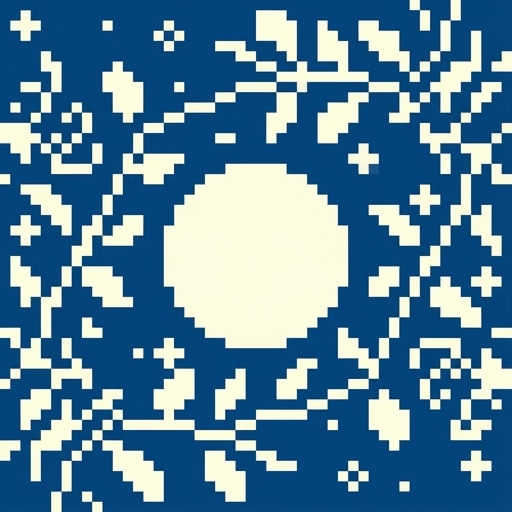
- Chart A — "Twisting Vine & Leaf" (30 sts × 44 rows): the main pixel-art motif, worked in stranded colorwork (MC background, CC1 vine/leaves), with individual CC2 star pixels scattered through the field. Repeated to run vines and leaves the entire length of the scarf.
- Chart B — "Moon Focal Motif" (30 sts × 44 rows): a single large pixel-art moon in CC2, set into the vine field at the vertical center of the scarf, with additional scattered CC2 stars and CC1 vine/leaf detail continuing at the panel edges.
Attached Stitch Chart
- The visual pixel-art grid for both Chart A (Vine & Leaf) and Chart B (Moon Focal Motif) is provided as the separate attached chart panel accompanying this pattern — it is not reproduced as ASCII text here.
- Placement in the pattern: the attached chart replaces the written row-by-row instructions for the 30-stitch central panel referenced in the "Body" section below. Wherever the pattern says "work Row [x] of Chart A" or "work Row [x] of Chart B," refer to the corresponding row on the attached grid.
- How to read it: Charts are read bottom-to-top, matching your knitting direction. Right-side (RS, odd-numbered) rows are read right-to-left; wrong-side (WS, even-numbered) rows are read left-to-right. Each square = 1 stitch and 1 row; each color in the key = the yarn color to use for that stitch.
- Color-change handling:
- For small color blocks and single-pixel stars (spans of 5 sts or fewer), strand the unused color loosely across the back of the work, twisting it with the working color every 3–4 sts on longer carries to avoid loose floats snagging.
- For the solid moon disc in Chart B (any run of CC2 wider than about 6 sts), switch to intarsia: use a separate bobbin of CC2 for the disc rather than stranding it across the background — this avoids long floats behind a large solid shape.
- On WS rows, keep your stranding tension relaxed; stranded fabric tightens more than the knitter expects, and over-tight WS floats are the most common cause of puckering in stranded scarves.
- Stitch-count integration math: The 30-chart-stitch panel sits inside the working needle between the borders: sts 1–6 = seed border, sts 7–36 = Chart A/B (chart columns 1–30), sts 37–42 = seed border. Always work all 42 sts on every row; only sts 7–36 follow the attached chart.
Panel Layout
6 seed sts (MC) + 30-st Chart panel (A or B) + 6 seed sts (MC) = 42 sts
Cast-on math check: 6 + 30 + 6 = 42 sts ✓ Width check: 42 sts ÷ 4.5 sts/in = 9.33" (pre-block; blocks to ~9.5") ✓
Pattern Instructions
Setup
With MC, cast on 42 sts.
Border (bottom edge)
Work 6 rows in seed st across all 42 sts (this anti-curl border also serves as your gauge check zone).
Body — Colorwork Panel
On the next row, establish the panel:
- Sts 1–6: continue in seed st (MC only, throughout the entire body of the scarf)
- Sts 7–36: work Row 1 of Chart A, following the attached chart
- Sts 37–42: continue in seed st (MC only)
Continue in pattern as follows:
- Work Rows 1–44 of Chart A (sts 7–36) with seed-st borders (sts 1–6 and 37–42) on every row. This is repeat 1 of 8.
- Repeat Chart A (Rows 1–44) a total of 4 times (4 × 44 = 176 rows) — this places roughly the first third of the scarf's vines and leaves.
- Work Rows 1–44 of Chart B (Moon Focal Motif) once, keeping the seed-st borders unchanged — this centers the moon in the scarf's length. (176 rows before + 44 moon rows = 220th row of the panel, the true vertical center of the 396-row colorwork section.)
- Repeat Chart A (Rows 1–44) a total of 4 more times (176 rows), continuing the seed borders throughout, to mirror the vine growth above the moon.
Colorwork panel row check: (4 × 44) + 44 + (4 × 44) = 176 + 44 + 176 = 396 rows ✓
Border (top edge)
Work 6 rows in seed st across all 42 sts, matching the bottom border.
Total row check: 6 (bottom border) + 396 (colorwork panel) + 6 (top border) = 408 rows Length check: 408 rows ÷ 6 rows/in = 68" ✓ — matches finished length target.
Bind Off
Bind off all 42 sts loosely in pattern (seed st) with MC. A loose bind-off is essential here, since stranded colorwork fabric has less natural stretch than plain stockinette.
Optional: Extra Scattered Stars
For a more random "scattered" night-sky effect beyond the fixed star pixels charted into Charts A and B, use a tapestry needle and CC2 to add a few duplicate-stitch stars into the seed-stitch borders or between chart repeats after blocking. Duplicate stitch sits on top of an existing knit stitch and adds no bulk or extra floats, so it is a safe way to add asymmetry without altering the stitch count.
Finishing
- Weave in all ends invisibly along color-change boundaries, running MC ends through MC areas and CC ends through their own color areas to keep the reverse side clean.
- Wet block (not steam) the scarf: soak in cool water with a gentle wool wash, press out excess water in a towel, then pin to finished measurements (9.5" × 68") on a blocking mat. Stranded colorwork benefits from a true wet block, which evens out stitch tension between the stranded and intarsia sections and lets the seed-stitch borders relax into a flat, non-curling edge.
- Let dry completely (24–48 hours) before unpinning.
- Do not press or flatten the intarsia moon section with an iron — finger-press only if needed once dry, to preserve the slight dimensional pop of the pixel motif.
Disclaimer: This pattern was generated by AI and should be reviewed for accuracy before use. While we strive for quality, AI-generated content may contain errors. Please verify measurements, stitch counts, and instructions before beginning your project. Generated by purlJam.uk
Love this pattern?
Save this pattern to your free PurlJam libraryAccess your pattern anytime
Bookmark this page to access your pattern anytime