Type
Crochet
Difficulty
intermediate
Category
custom
AI Thinking Process
Planning
Verification
Pattern
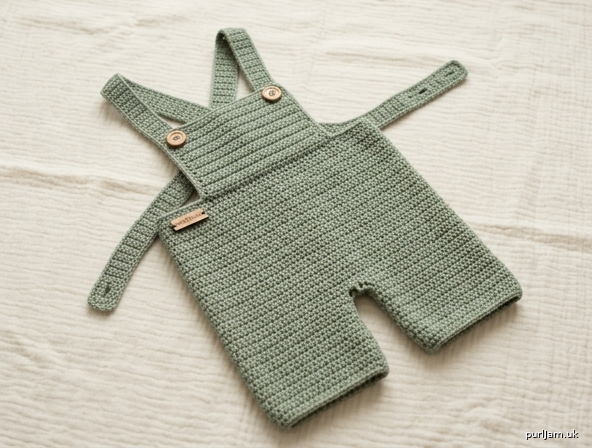
Newborn Crochet Overalls (Dungarees)
A simple, sturdy pair of shortie overalls for a newborn, worked entirely in UK double crochet. Two legs are joined at the crotch, the body is worked as a tube, then a front bib and buttoned straps are added. Designed with nappy ease and an unbutton-to-dress opening. Beginner-friendly: one stitch, no complex shaping.
Difficulty: Beginner
Size
Newborn (0–3 months) — one size
Finished measurements (after light blocking, laid flat and doubled where relevant):
| Measurement | cm | in |
|---|---|---|
| Chest / hip circumference | 42.5 | 16¾ |
| Leg circumference | 20 | 8 |
| Inseam | 10 | 4 |
| Rise (crotch to waist) | 16 | 6¼ |
| Bib width × height | 12.5 × 9 | 5 × 3½ |
| Strap width × length | 3.75 × 23.5 | 1½ × 9¼ |
| Back waist panel height | 3.5 | 1¼ |
To fit chest approx. 36–41 cm (14–16 in). The 42.5 cm finished chest includes ease for a nappy.
Materials
- Yarn: Worsted weight (UK aran; CYC 4), 200 g / 400 m. Cotton or a cotton-blend baby yarn is recommended (soft, washable, less itchy than pure wool). Acrylic baby aran is also suitable.
- Hook: 4.5 mm (the size used to write this pattern). A 4 mm hook gives a firmer, slightly smaller fabric; a 5 mm hook gives a softer, slightly larger fabric. Use whichever hook you need to match the tension. A 3 mm hook with worsted yarn will make a stiff, undersized garment — do not use 3 mm unless you can still obtain 16 dc = 10 cm (you will not, with this yarn).
- Notions:
- 4 stitch markers
- Yarn needle
- 2 buttons, 15–18 mm diameter (plus 2 spare if you like)
- Scissors
Tension (gauge)
16 dc and 18 rows = 10 cm × 10 cm using a 4.5 mm hook, working UK dc in both loops, lightly blocked.
Work a swatch of at least 18 sts × 22 rows, then measure the centre 10 cm.
- Too few stitches in 10 cm → go down a hook size.
- Too many stitches in 10 cm → go up a hook size.
Tension matters for a wearable size. At this tension, 68 sts = 42.5 cm around.
Abbreviations (UK)
This pattern uses UK crochet terms throughout.
| Abbreviation | Meaning |
|---|---|
| ch | chain |
| dc | double crochet (US single crochet / sc) |
| sl st | slip stitch |
| st(s) | stitch(es) |
| sp | space |
| rnd(s) | round(s) |
| RS | right side |
| WS | wrong side |
| rem | remaining |
| PM | place marker |
Turning chain: ch 1 at the start of a row or round does not count as a stitch. Work the first dc into the first stitch of the row/round.
Pattern notes
- Legs and body are worked in joined rounds with the RS always facing. Do not turn at the end of a round.
- Bib, back and straps are worked in rows. Turn at the end of every row.
- Work in both loops of every stitch unless told otherwise.
- Join each round with a sl st in the first dc, then ch 1 to begin the next round.
- Stitch counts are given in parentheses at the end of each round or row. Check them as you go.
- Two chain-2 bridges form the front and back of the crotch. They become ordinary dc on the following round (32 + 2 + 32 + 2 = 68 ✓).
- Keep the joins of each round at the side of a leg (inner thigh) so the join line is hidden in the crotch.
- The overalls are pulled on from the top with the straps unbuttoned, then the straps are buttoned onto the bib.
Pattern
Legs (make 2)
Leg 1
Ch 32, join with sl st in the first ch to form a ring, taking care not to twist the chain.
Tip: The back bump of each foundation chain makes a tidier hem if you work into it on Rnd 1, but working under the top loop of the chain is fine.
Rnd 1: Ch 1 (does not count as a st here and throughout), 1 dc in each ch around, sl st in first dc to join. (32 sts)
Rnds 2–18: Ch 1, 1 dc in each st around, sl st in first dc to join. (32 sts)
18 rnds = 10 cm at stated tension ✓.
Fasten off. Place a marker in the first st of the round (this marks the inner-thigh / crotch edge).
Leg 2
Work as Leg 1 through Rnd 18. Do not fasten off. Place a marker in the first st of the round (inner-thigh / crotch edge).
You now have two tubes of 32 sts, each 10 cm tall.
Join the legs
Lay the legs side by side with RS facing you and the marked inner-thigh edges together. The working yarn on Leg 2 should sit at the inner thigh.
Joining rnd: Ch 2 (front crotch bridge), 1 dc in each of the 32 sts of Leg 1, ch 2 (back crotch bridge), 1 dc in each of the 32 sts of Leg 2, sl st in the first dc of Leg 1 to join.
You have 64 dc and two ch-2 spaces.
Body
Rnd 1: Ch 1, 1 dc in each of the next 32 dc (Leg 1), 1 dc in each of the next 2 ch (back crotch), 1 dc in each of the next 32 dc (Leg 2), 1 dc in each of the next 2 ch (front crotch), sl st in first dc to join. (32 + 2 + 32 + 2 = 68 sts ✓)
Rnds 2–29: Ch 1, 1 dc in each st around, sl st in first dc to join. (68 sts)
29 rnds = 16.1 cm at stated tension ✓. 68 sts = 42.5 cm around ✓.
Fasten off.
Place markers for the split (count with the RS facing, working yarn end at the front crotch):
Fold the body so the front crotch ch-2 sits at centre front and the back crotch ch-2 sits at centre back.
- PM A and PM B 20 sts apart, centred on centre front — these 20 sts are the Front Bib.
- From PM B, skip 10 sts and PM C — these 10 sts are the Right Underarm (left unworked).
- From PM C, the next 28 sts (PM C to PM D) are the Back.
- The remaining 10 sts (PM D to PM A) are the Left Underarm (left unworked).
Check: 20 + 10 + 28 + 10 = 68 ✓.
Front bib
With RS facing, join yarn in the first bib st (PM A).
Row 1 (RS): Ch 1, 1 dc in each of the 20 bib sts, turn. (20 sts)
Rows 2–16: Ch 1, 1 dc in each st across, turn. (20 sts)
16 rows = 8.9 cm at stated tension ✓. Bib width 20 sts = 12.5 cm ✓.
Fasten off.
Back waist panel
With RS facing, join yarn in the first back st (PM C).
Row 1 (RS): Ch 1, 1 dc in each of the 28 back sts, turn. (28 sts)
Rows 2–6: Ch 1, 1 dc in each st across, turn. (28 sts)
6 rows = 3.3 cm ✓.
Do not fasten off — the first strap is worked from this edge.
Straps
The 28 back sts divide as 6 (strap) + 16 (centre back) + 6 (strap) = 28 ✓.
First strap (continues from the end of Back Row 6)
Row 1: Ch 1, 1 dc in each of the first 6 sts, turn, leaving the rem 22 sts unworked. (6 sts)
Rows 2–30: Ch 1, 1 dc in each st across, turn. (6 sts)
Row 31 (buttonhole): Ch 1, 1 dc in each of first 2 sts, ch 2, skip 2 sts, 1 dc in each of last 2 sts, turn. (6 sts counting the ch-2 as 2 sts)
Row 32: Ch 1, 1 dc in each of first 2 sts, 2 dc in ch-2 sp, 1 dc in each of last 2 sts, turn. (2 + 2 + 2 = 6 sts ✓)
Rows 33–38: Ch 1, 1 dc in each st across, turn. (6 sts)
Row 39 (buttonhole): Ch 1, 1 dc in each of first 2 sts, ch 2, skip 2 sts, 1 dc in each of last 2 sts, turn. (6 sts)
Row 40: Ch 1, 1 dc in each of first 2 sts, 2 dc in ch-2 sp, 1 dc in each of last 2 sts, turn. (6 sts)
Rows 41–42: Ch 1, 1 dc in each st across, turn. (6 sts)
42 rows = 23.3 cm at stated tension ✓.
Fasten off.
Second strap
With RS facing, join yarn in the first st at the opposite end of the back panel (the 6 sts at the far edge, so 16 sts remain unworked in the centre).
Work Rows 1–42 exactly as for the first strap. Fasten off.
Edging
Edging neatens the armhole gaps, bib top and strap ends. Work with RS facing and a comfortable tension (do not pull tight).
Armholes (work each the same): Join yarn in the first unworked underarm st.
Work 1 dc in each of the 10 underarm sts, 1 dc in each row-end up the bib side (16 dc), 3 dc across the inner corner at the bib/strap meeting if the strap inner edge is reachable, 1 dc in each row-end down the back side (6 dc), sl st in the first dc. Fasten off.
Aim for about 1 dc per row-end so the edge lies flat. If it flares, skip an occasional row-end; if it pulls in, work 2 dc in a row-end.
Bib top: Join yarn in the first st of the bib top. Ch 1, 1 dc in each of 20 sts across. Fasten off.
Strap ends (optional): Work 1 row of dc across the 6 sts at each strap end for a firmer buttonhole edge.
Finishing
- Weave in all ends on the WS. The crotch join has the most ends — weave each tail along the crotch bridges so the join cannot pull open.
- Buttons: Sew one button to the bib, about 2 cm down from the top edge and 2 cm in from the side edge, so it lines up with a strap. Repeat on the other side. Use the two buttonholes on each strap as growth positions (use the upper hole now; move to the lower hole as the baby grows).
- Baby safety: Sew each button on with many firm stitches and knot securely on the WS. Give a strong tug. Do not use buttons that can be pulled off. If you prefer no hard buttons, crochet two small firm dc discs and sew those on instead, or use sewn-on press snaps rated for baby garments.
- Block lightly: dampen, pat into shape (chest 42.5 cm around, legs 10 cm long), and dry flat. Do not stretch the straps.
- To dress: unbutton the straps, slip the baby in from the top, bring the straps over the shoulders and button onto the bib.
Helpful tips
- Twisted foundation ring: If Rnd 1 of a leg looks like a Möbius strip, frog and re-join the chain before continuing.
- Counting rounds: Drop a marker in the first st of every round and move it up; joined dc rounds are easy to lose count of.
- Crotch holes: If a small gap appears at either crotch bridge after Rnd 1 of the body, use the Leg 1 yarn tail to sew 2–3 stitches across the gap on the WS.
- Straps twist: They should lie flat. If a strap corkscrews, you are turning extra times or skipping the first st — keep 6 sts every row.
- Yarn choice: Smooth cotton shows every stitch (very clear for beginners). A lightly fuzzy acrylic hides small tension wobbles.
Schematic (not to scale)
          [strap 6 sts, 42 rows]     [strap 6 sts, 42 rows]
                    \                   /
                     \                 /
                  ____\_______________/____
                 |      bib 20 sts × 16    |
                 |                         |
        underarm |                         | underarm
         10 sts  |      body 68 sts        |  10 sts
                 |      × 29 rnds          |
                 |                         |
                 |________  crotch  ________|
                 /                         \
           leg 32 sts                  leg 32 sts
            × 18 rnds                   × 18 rnds
Disclaimer: This pattern was generated by AI and should be reviewed for accuracy before use. While we strive for quality, AI-generated content may contain errors. Please verify measurements, stitch counts, charts, and instructions before beginning your project. Generated by purlJam.uk
Love this pattern?
Save this pattern to your free PurlJam libraryAccess your pattern anytime
Bookmark this page to access your pattern anytime