Type
Crochet
Difficulty
intermediate
Category
custom
AI Thinking Process
Planning
Verification
Pattern
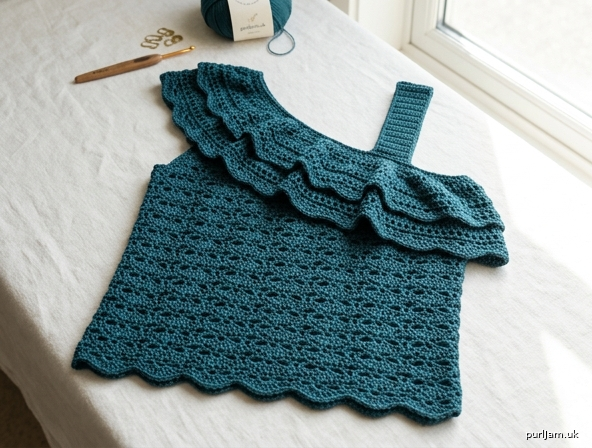
Peacock Cascade — One-Shoulder Asymmetrical Ruffle Tank
A breezy, cropped one-shoulder tank featuring a single wide shoulder strap, a dramatic cascading ruffle along the neckline, an airy openwork shell/lace body, and a soft scalloped hem. Worked flat in two simple panels and seamed — perfect for confident beginners ready for a pretty, wearable project.
Yarn note: This pattern is written for DK weight 100% cotton with a 4.0 mm (US G-6) hook, exactly as requested. (If you prefer a lighter, more delicate drape, you may substitute a fingering/lace cotton with a 3.0 mm hook and follow the next size up, but gauge below is written for DK.)
Skill Level
Easy / Advanced Beginner
Finished Measurements (Bust, worked flat & seamed)
Designed for 0–2 in of negative ease (fitted). Choose the size closest to or just under your actual bust.
| Size | Finished Bust | To Fit Bust |
|---|---|---|
| XS | 30 in (76 cm) | 30–31 in |
| S | 33 in (84 cm) | 32–34 in |
| M | 36 in (91 cm) | 35–37 in |
| L | 40 in (102 cm) | 38–41 in |
| XL | 44 in (112 cm) | 42–45 in |
| 2XL | 48 in (122 cm) | 46–49 in |
| 3XL | 52 in (132 cm) | 50–53 in |
Finished length (hem to top of body, before ruffle): approx. 13½–15 in / 34–38 cm (cropped). Length is fully adjustable — see Pattern Notes.
Materials
- Yarn: DK weight (light worsted, #3) 100% cotton.
- Approx. yardage: XS 550 yd • S 625 yd • M 700 yd • L 800 yd • XL 900 yd • 2XL 1000 yd • 3XL 1100 yd.
- Add ~120 yd for the ruffle and ~80 yd for the scalloped hem across all sizes (already factored generously above).
- Sample color: Deep Teal / Peacock Blue.
- Suggested alternate colorways: White, Black, Sage Green, Blush Pink, Beige, Lavender, Mustard, Terracotta.
- Hook: 4.0 mm (US G-6). Plus a 4.5 mm (US 7) optional for the ruffle if you want extra flare.
- Notions: Tapestry needle, stitch markers (4–6), scissors, rustproof pins for blocking, measuring tape.
Gauge
In shell stitch pattern (see Special Stitches): 24 sts (= 4 shells + edges) and 8 rows = 4 in (10 cm) after light blocking.
Quick gauge test: Chain 25, work 4 rows of shell pattern; blocked swatch should measure ~4 in wide × 2 in tall (4 rows). Match gauge to ensure fit.
Abbreviations (US Terms)
- ch – chain
- sl st – slip stitch
- sc – single crochet
- hdc – half double crochet
- dc – double crochet
- st(s) – stitch(es)
- sk – skip
- sp – space
- rep – repeat
- RS / WS – right side / wrong side
- beg – beginning
- shell – 5 dc worked into the same stitch/space (see below)
Special Stitches
- Shell: 5 dc all worked into the same indicated stitch or space.
- V-st (used in ruffle): (dc, ch 1, dc) in the same st.
- Scallop (hem): (sc, ch 1, 3 dc, ch 1, sc) worked across a span, see Scalloped Hem.
Stitch Pattern — Openwork Shell/Lace (worked over a multiple of 6 sts + 1)
Worked as a 2-row repeat:
Row A (RS): Ch 1, sc in first st, sk 2 sts, shell (5 dc) in next st, sk 2 sts, sc in next st; rep from * across. Turn.
Row B (WS): Ch 3 (counts as first dc), 2 dc in first sc, sc in center dc of next shell, shell in next sc; rep across to last sc, sc in center dc of last shell, 3 dc in last sc. Turn.
These two rows alternate to create staggered, airy shells (shells sit over sc, and sc sit over shell centers). Practice on your gauge swatch.
Pattern Notes
- The tank is worked flat in two panels (Back and Front), from the hem up. Panels are identical in the body; shaping at the top creates the asymmetrical one-shoulder neckline.
- Turning chains: In Row B, the beginning ch-3 counts as a stitch. In Row A, the ch-1 does not count.
- Work in both loops throughout unless stated.
- Stitch counts are given at the end of rows as total dc-equivalent stitches, counting each shell as 5 sts and each sc as 1 st.
- Adjusting length: Add or remove shell-pattern row-pairs before the neckline shaping. Each row-pair adds ~1 in. Keep the crop short for the intended silhouette.
- Read all numbers as: XS (S, M, L, XL, 2XL, 3XL).
Foundation Chain per Size
Each panel is half the finished bust. Panel widths use a multiple of 6 + 1, plus turning chain.
Foundation ch (including 1 base for first sc): 37 (43, 49, 55, 61, 67, 73) ch.
Verification: chain − 1 = usable sts = 36 (42, 48, 54, 60, 66, 72) = multiple of 6. ✓ Each panel = usable sts ÷ 24 sts-per-4in × 4 = 6 (7, 8, 9, 10, 11, 12) in wide per panel → ×2 panels = 12/14/16/18/20/22/24 in...
Note on width: Because shell fabric is elastic and worn with negative ease, each panel blocks/stretches to half the finished bust. Panels measure ~6 (7, 8, 9, 10, 11, 12) in relaxed and stretch to ~7½ (8¼, 9, 10, 11, 12, 13) in on the body. Confirm with gauge and try-on.
BACK PANEL
Foundation Row (WS): Ch 37 (43, 49, 55, 61, 67, 73). Sc in 2nd ch from hook and in each ch across. Turn. Count: 36 (42, 48, 54, 60, 66, 72) sc.
Set-up: The stitch count 36/42/48/54/60/66/72 = multiple of 6, giving 6 (7, 8, 9, 10, 11, 12) shells across Row A.
Row 1 (RS) – Row A: Ch 1, sc in first st, sk 2, shell in next, sk 2, sc in next; rep from * across. Turn. You will have 6 (7, 8, 9, 10, 11, 12) shells with a sc between/at each end. Count (dc-equiv): shells ×5 + sc. sc count = shells + 1. → e.g. XS: 6×5 + 7 = 37 sts. General: shells×6 + 1 = 37 (43, 49, 55, 61, 67, 73). ✓ (matches foundation ch)
Row 2 (WS) – Row B: Ch 3 (counts as dc), 2 dc in first sc, sc in center dc of next shell, shell in next sc; rep to last shell, sc in center dc of last shell, 3 dc in last sc. Turn. Count stays 37 (43, 49, 55, 61, 67, 73).
Rows 3–N: Rep Rows 1–2 (Row A / Row B) until panel measures 13 (13, 13½, 14, 14, 14½, 15) in from foundation, ending after a Row A (RS).
The Back requires no neckline shaping — it is worked straight to the shoulder line. Fasten off, leaving a long tail for seaming.
FRONT PANEL
Work the Foundation Row and Rows 1 through the same length as the Back, ending after a Row A (RS), so the Front matches the Back to the underarm/shoulder line. Do not fasten off — continue to neckline shaping.
Asymmetrical One-Shoulder Shaping (Front)
The Front is divided so that one side rises into a wide shoulder strap and the opposite side drops away to a bare shoulder, with a diagonal neckline between.
Lay work RS up. Mentally divide the top edge into thirds. You will keep the shoulder strap on the right-hand third and shape down toward the left.
Shaping Row 1 (WS): Ch 3, 2 dc in first sc, work Row B pattern across only the first 2 (2, 3, 3, 3, 4, 4) shells' worth of stitches (this becomes the wide strap side), ending with a sc in the center of the last worked shell. Turn, leaving remaining sts unworked. Strap width = 2 (2, 3, 3, 3, 4, 4) shells ≈ 3–4 in wide (a wide, comfortable strap). ✓
Strap Rows 2–8: Continue in established shell pattern (Row A / Row B alternating) over the strap stitches only, working 7 more rows (approx. 3½ in) to form the shoulder strap length. End after a Row A.
- On each Row A: strap has 2 (2, 3, 3, 3, 4, 4) shells.
- Adjust strap length here by adding/removing row-pairs to reach your shoulder comfortably (measure over your shoulder from front to back).
Fasten off, leaving a long tail for the shoulder seam.
Neckline / bare-shoulder side: The remaining unworked stitches form the scooped, dropped neckline. Rejoin yarn at the neck edge with RS facing: Neck edging: Ch 1, work sc evenly along the diagonal/dropped edge back down to the underarm (about 1 sc per row-end and 1 per st across the top of the dropped section). This tidies the raw edge and prepares it for the ruffle. Fasten off.
Tip: "Evenly" ≈ 2 sc for every 3 row-ends. Keep the edge flat, not tight.
ASSEMBLY
- Block both panels flat to size (see Blocking). Pin to schematic width.
- Shoulder seam: With RS together, seam the top edge of the Back to the top of the Front strap across the strap width only (2 (2, 3, 3, 3, 4, 4) shells). Use whip stitch or mattress stitch with the tapestry needle. The opposite shoulder remains open/bare — this creates the one-shoulder look.
- Side seams: With RS together, seam each side from hem up, leaving armhole openings:
- Leave the top 7 (7½, 8, 8½, 9, 9½, 10) in open on each side for armholes/neck opening.
- Seam the remaining lower length on both sides.
On the bare-shoulder side, the armhole/neck opening is naturally larger — this is intentional for the asymmetrical drape.
- Weave in seam tails.
CASCADING RUFFLE NECKLINE
The ruffle is added along the entire neckline/top edge of the Front (the sc-edged diagonal and across the top opening), cascading down from the strap to the underarm.
Use 4.0 mm hook (or 4.5 mm for extra flare). Join yarn with RS facing at the top of the strap seam.
Ruffle Round/Row 1 (base): Ch 1, sc in each st along the neckline edge to the underarm, working 1 sc per st / edge st. Note your total sc count — call it B. Turn (work the ruffle as a flat panel along the edge).
Ruffle Row 2 (first tier — increase): Ch 3 (counts as dc), dc in same st, 2 dc in each st across. Turn. This doubles the count to 2×B — the fabric now begins to wave.
Ruffle Row 3 (second tier — V-st flare): Ch 4 (counts as dc + ch 1), dc in first st, sk 1, V-st (dc, ch 1, dc) in next st; rep across, dc in last st. Turn.
Ruffle Row 4 (final cascade): Ch 1, (sc, 3 dc, sc) in next ch-1 sp; rep across in each V-st space, sc in last st. This creates the soft, rolling cascade of ruffled shells. Fasten off and weave in ends.
Cascade tip: For a longer, more dramatic cascade near the bare shoulder, work Rows 3–4 with 2 extra V-sts at the lower (underarm) end. The extra flare naturally falls forward for the "cascading" effect.
SCALLOPED HEM
Worked around the bottom edge of the joined tank (in the round). With RS facing, join yarn at a side seam at the hem.
The hem edge should be a multiple of the shell base. If needed, sc evenly around first to reach a multiple of 6 sts; note the count.
Scallop Round 1: Ch 1, sc in first st, sk 2, shell (5 dc) in next st, sk 2, sc in next st; rep from * around, join with sl st to first sc. Count per scallop group = 6 sts; number of scallops = (hem sts) ÷ 6.
Scallop Round 2: Sl st into center dc of first shell, ch 1, (sc, ch 1, 3 dc, ch 1, sc) in same center dc, sc in next base sc, (sc, ch 1, 3 dc, ch 1, sc) in center dc of next shell; rep around, join with sl st. Fasten off. This deepens and softens each scallop for a delicate, feminine hem.
Weave in all ends.
FINISHING & BLOCKING
- Weave in all remaining ends securely on the WS; cotton can slip, so leave 4–5 in tails and split-weave through stitch cores.
- Wet block for best results with cotton and shell lace:
- Soak the finished top in cool water with a drop of wool/gentle wash for 15 minutes.
- Gently squeeze (do not wring) and roll in a towel to remove excess water.
- Pin flat to the schematic bust and length measurements, opening up each shell so the openwork lace shows clearly.
- Gently arrange the neckline ruffle in soft, cascading waves and the hem scallops in even points; pin.
- Allow to dry completely before unpinning.
- Try on and steam-set the ruffle waves lightly with a handheld steamer if you'd like them to hold a defined cascade.
Schematic Summary (per size — relaxed panel measurements)
| XS | S | M | L | XL | 2XL | 3XL | |
|---|---|---|---|---|---|---|---|
| Panel width (in) | 6 | 7 | 8 | 9 | 10 | 11 | 12 |
| Body length (in) | 13 | 13 | 13½ | 14 | 14 | 14½ | 15 |
| Strap width (shells) | 2 | 2 | 3 | 3 | 3 | 4 | 4 |
| Armhole open (in) | 7 | 7½ | 8 | 8½ | 9 | 9½ | 10 |
Math check: Panel usable sts = shells × 6 = 36/42/48/54/60/66/72; ×2 panels ÷ gauge (24 sts/4in) = finished 12/14/16/18/20/22/24 in relaxed, stretching with negative ease to the stated bust (30–52 in) on the body. Shell count in Row A = 6/7/8/9/10/11/12, and dc-equiv total = shells×6 + 1 = 37/43/49/55/61/67/73, matching each foundation chain. ✓
Enjoy your Peacock Cascade tank — a light, romantic summer piece with just one strap and a whole lot of ruffle!
Disclaimer: This pattern was generated by AI and should be reviewed for accuracy before use. While we strive for quality, AI-generated content may contain errors. Please verify measurements, stitch counts, and instructions before beginning your project. Generated by purlJam.uk
Access your pattern anytime
Bookmark this page to access your pattern anytime