Type
Knitting
Difficulty
advanced
Category
scarf
AI Thinking Process
Planning
Verification
Pattern
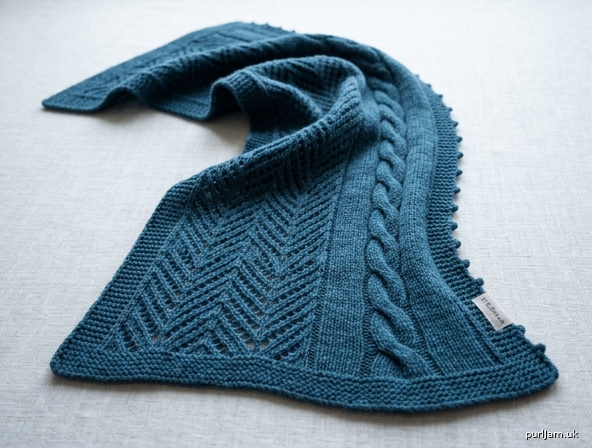
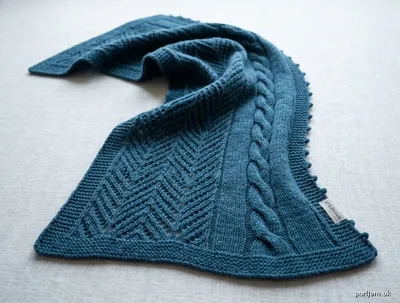
Picot-Edged Cable and Chevron Lace Scarf
An advanced asymmetric scarf: a 3-stitch garter edge, an expanding chevron lace panel, and a framed 4-stitch cable that finishes in alternating picots and slipped stitches. Worked flat from a 16-stitch cast-on, it widens to 45 stitches, then runs even to length.
Difficulty: Advanced
Finished Measurements
Blocked: 10" (25.5 cm) wide × 60" (152.5 cm) long, measured along the garter edge.
Width is the stitch-count edge (bind-off); length is the row-count edge. To change length, work more or fewer 24-row repeats in Section 4.
Materials
Yarn: 400 yd (366 m) worsted-weight wool or wool blend with clear stitch definition (smooth, lightly plied). Two 100 g / 220 yd (201 m) skeins.
Needles: US 8 / 5 mm, straight or a 24" (60 cm) circular, or size to obtain gauge.
Notions:
- Cable needle
- 2 stitch markers (optional extras every 6 lace sts in Section 4)
- Tapestry needle
- Row counter (strongly recommended)
- Blocking mats, T-pins, and wires
Gauge
18 sts and 24 rows = 4" (10 cm) in Chevron Lace (Chart B), blocked.
Framed Cable panel (12 sts) = 2¼" (5.5 cm) wide, blocked.
Swatch at least 12 cable sts + 18 lace sts + 3 garter sts (33 sts) for two 24-row repeats, then wet-block. Row gauge controls length; if you have more rows per 4" (10 cm), the scarf will be shorter at the same row counts.
Abbreviations (US)
BO — bind off
C4F — cable 4 front: slip 2 sts to cn, hold in front, k2, k2 from cn
cn — cable needle
CO — cast on
k — knit
k2tog — knit 2 together (right-leaning decrease)
kw — knitwise
m — marker
M1L — make 1 left: lift the strand between needles from front to back, knit through the back loop (1 st inc’d)
p — purl
pm — place marker
rep — repeat
RS — right side
sk2p — slip 1 knitwise, k2tog, pass slipped st over (left-leaning double decrease; 3 sts → 1 st)
sl — slip
sm — slip marker
ssk — slip, slip, knit: slip 1 knitwise, slip 1 knitwise, knit those 2 sts together through the back loops (left-leaning decrease)
st(s) — stitch(es)
WS — wrong side
wyib — with yarn in back
yo — yarn over
Special Techniques
Picot (beginning of designated WS rows): Using a knitted cast-on, CO 2 sts. BO 2 sts. The stitch remaining on the right needle is the first stitch of the 12-st cable panel — do not work it again. Continue with p1, k2, p4, k2, p1, k1 as written. Net stitch count does not change.
Memory aid: After a RS row that works k4 in the cable panel → picot WS. After a RS row that works C4F → slipped WS.
Pattern Notes
- Worked flat. The RS begins with the 3-st garter edge; the WS begins at the cable/picot edge.
- Two markers divide the fabric: [3 garter | lace/increase panel | 12-st cable]. Slip markers every row.
- M1L is always worked immediately before the cable marker (left side of the lace panel on RS). New stitches are absorbed into the lace on following RS rows.
- During Sections 2–3, leftover stitches before the cable marker are partial repeats. Work them exactly as written; they are count-neutral except for the M1L.
- Brackets
[ ]are the 6-st lace repeat. Work the repeat, then the written remainder, then M1L if called for. - Stitch counts in parentheses are total stitches after that row.
Stitch Patterns and Charts
Scarf layout (Section 4): 3 garter + (6-st lace × 5) + 12 cable = 45 sts.
Symbol Key
| Symbol | RS | WS |
|---|---|---|
k |
knit | purl |
p |
purl | knit |
o |
yo | — |
/ |
k2tog | — |
\ |
ssk | — |
v |
sk2p (3 sts → 1) | — |
C4F |
sl 2 to cn, hold front, k2, k2 from cn | — |
sl |
— | sl 1 kw wyib |
π |
— | picot (CO 2, BO 2; leftover st = first cable st) |
Even-numbered WS rows of the lace panel are purled. Cable-panel WS stitches are worked as they appear (knit the knits, purl the purls), except the first stitch (picot or sl 1).
Chart A — Framed Cable (12 sts, 4-row repeat)
Read RS rows right to left; WS rows left to right. Chart shows the cable panel only (after the second marker on RS; at the start of WS).
 4 (WS) | k  p  k  k  p  p  p  p  k  k  p  sl |
 3 (RS) | p  k  p  p     C4F     p  p  k  p |
 2 (WS) | k  p  k  k  p  p  p  p  k  k  p  π  |
 1 (RS) | p  k  p  p  k  k  k  k  p  p  k  p |
          12 11 10  9  8  7  6  5  4  3  2  1
St 1 of Chart A is the picot/slip edge stitch. Repeat Rows 1–4 of Chart A for the entire scarf after Row 1 of Section 1.
Written cable panel (same as Chart A):
- RS, non-cable (Rows 1, 5, 9… of any 8-row block): p1, k1, p2, k4, p2, k1, p1
- RS, cable (Rows 3, 7, 11…): p1, k1, p2, C4F, p2, k1, p1
- WS, picot (Rows 2, 6, 10…): picot, p1, k2, p4, k2, p1, k1
- WS, slip (Rows 4, 8, 12…): sl 1 kw wyib, p1, k2, p4, k2, p1, k1
Chart B — Chevron Lace (6-st repeat, 24 rows)
Use Chart B for Section 4 (exact repeats to the marker). During Sections 2–3, follow the written rows (partials + M1L). All WS lace sts: purl.
 24 (WS)  purl across lace panel
 23 (RS)  |  o   /   k   \   o   k  |   k1, yo, ssk, k1, k2tog, yo
 22 (WS)  purl
 21 (RS)  |  v   o   k   k   k   o  |   yo, k3, yo, sk2p
 20 (WS)  purl
 19 (RS)  |  \   o   k   o   /   k  |   k1, k2tog, yo, k1, yo, ssk
 18 (WS)  purl
 17 (RS)  |  \   o   k   o   /   k  |   k1, k2tog, yo, k1, yo, ssk
 16 (WS)  purl
 15 (RS)  |  k   o   v   o   k   k  |   k2, yo, sk2p, yo, k1
 14 (WS)  purl
 13 (RS)  |  o   /   k   \   o   k  |   k1, yo, ssk, k1, k2tog, yo
 12 (WS)  purl
 11 (RS)  |  o   /   k   \   o   k  |   k1, yo, ssk, k1, k2tog, yo
 10 (WS)  purl
  9 (RS)  |  v   o   k   k   k   o  |   yo, k3, yo, sk2p
  8 (WS)  purl
  7 (RS)  |  \   o   k   o   /   k  |   k1, k2tog, yo, k1, yo, ssk
  6 (WS)  purl
  5 (RS)  |  \   o   k   o   /   k  |   k1, k2tog, yo, k1, yo, ssk
  4 (WS)  purl
  3 (RS)  |  k   o   v   o   k   k  |   k2, yo, sk2p, yo, k1
  2 (WS)  purl
  1 (RS)  |  o   /   k   \   o   k  |   k1, yo, ssk, k1, k2tog, yo
            6    5   4   3   2   1     (RS: work right → left)
v (sk2p) sits over 3 underlying sts; each o consumes no stitch. Each RS row is stitch-count neutral on a multiple of 6.
Instructions
Cast On
CO 16 sts.
Section 1 — Cable Foundation
Increases every 4 rows. Lace panel begins as 1 knit stitch.
Row 1 (RS): K3, pm, k1, pm, p1, k1, p2, k4, p2, k1, p1. (16 sts: 3 + 1 + 12)
Row 2 (WS): Picot, p1, k2, p4, k2, p1, k1, sm, p1, sm, k3.
Row 3: K3, sm, k1, sm, p1, k1, p2, C4F, p2, k1, p1.
Row 4: Sl 1 kw wyib, p1, k2, p4, k2, p1, k1, sm, p1, sm, k3.
Row 5: K3, sm, knit to m, M1L, sm, p1, k1, p2, k4, p2, k1, p1—1 st inc’d. (17)
Row 6: Picot, p1, k2, p4, k2, p1, k1, sm, purl to m, sm, k3.
Row 7: K3, sm, knit to m, sm, p1, k1, p2, C4F, p2, k1, p1.
Row 8: Sl 1 kw wyib, p1, k2, p4, k2, p1, k1, sm, purl to m, sm, k3.
Repeat Rows 5–8 four more times (5 repeats total). 5 increases → 16 + 5 = 21 sts ✓
Lace panel = 6 sts; 3 + 6 + 12 = 21.
Section 2 — Chevron Lace, Moderate Increases
Increase 1 st on Rows 1, 5, 9, 13, 17, and 21 of each 24-row block (+6 sts per 24 rows). Work the 24-row block twice.
Row 1 (RS): K3, sm, [k1, yo, ssk, k1, k2tog, yo] rep to m, M1L, sm, p1, k1, p2, k4, p2, k1, p1—1 st inc’d.
Row 2 (WS): Picot, p1, k2, p4, k2, p1, k1, sm, purl to m, sm, k3.
Row 3: K3, sm, [k2, yo, sk2p, yo, k1] rep to 1 st before m, k1, sm, p1, k1, p2, C4F, p2, k1, p1.
Row 4: Sl 1 kw wyib, p1, k2, p4, k2, p1, k1, sm, purl to m, sm, k3.
Row 5: K3, sm, [k1, k2tog, yo, k1, yo, ssk] rep to 1 st before m, k1, M1L, sm, p1, k1, p2, k4, p2, k1, p1—1 st inc’d.
Row 6: Rep Row 2.
Row 7: K3, sm, [k1, k2tog, yo, k1, yo, ssk] rep to 2 sts before m, k2, sm, p1, k1, p2, C4F, p2, k1, p1.
Row 8: Rep Row 4.
Row 9: K3, sm, k2tog, [yo, k3, yo, sk2p] rep to m, yo, M1L, sm, p1, k1, p2, k4, p2, k1, p1—1 st inc’d.
Row 10: Rep Row 2.
Row 11: K3, sm, [k1, yo, ssk, k1, k2tog, yo] rep to 3 sts before m, k1, yo, ssk, sm, p1, k1, p2, C4F, p2, k1, p1.
Row 12: Rep Row 4.
Row 13: K3, sm, [k1, yo, ssk, k1, k2tog, yo] rep to 3 sts before m, k1, yo, ssk, M1L, sm, p1, k1, p2, k4, p2, k1, p1—1 st inc’d.
Row 14: Rep Row 2.
Row 15: K3, sm, [k2, yo, sk2p, yo, k1] rep to 4 sts before m, k2, yo, ssk, sm, p1, k1, p2, C4F, p2, k1, p1.
Row 16: Rep Row 4.
Row 17: K3, sm, [k1, k2tog, yo, k1, yo, ssk] rep to 4 sts before m, k1, k2tog, yo, k1, M1L, sm, p1, k1, p2, k4, p2, k1, p1—1 st inc’d.
Row 18: Rep Row 2.
Row 19: K3, sm, [k1, k2tog, yo, k1, yo, ssk] rep to 5 sts before m, k1, k2tog, yo, k2, sm, p1, k1, p2, C4F, p2, k1, p1.
Row 20: Rep Row 4.
Row 21: K3, sm, k2tog, [yo, k3, yo, sk2p] rep to 3 sts before m, yo, k3, M1L, sm, p1, k1, p2, k4, p2, k1, p1—1 st inc’d.
Row 22: Rep Row 2.
Row 23: K3, sm, [k1, yo, ssk, k1, k2tog, yo] rep to m, sm, p1, k1, p2, C4F, p2, k1, p1.
Row 24: Rep Row 4.
Repeat Rows 1–24 once more. 12 increases → 21 + 12 = 33 sts ✓
Lace panel = 18 sts (3 × 6); 3 + 18 + 12 = 33.
Checkpoints: after first 24 rows, 27 sts (12 lace); after second 24 rows, 33 sts (18 lace).
Section 3 — Chevron Lace, Faster Increases
Increase 1 st on every RS row (+12 sts in 24 rows). Work this section once.
Row 1 (RS): K3, sm, [k1, yo, ssk, k1, k2tog, yo] rep to m, M1L, sm, p1, k1, p2, k4, p2, k1, p1—1 st inc’d. (34)
Row 2 (WS): Picot, p1, k2, p4, k2, p1, k1, sm, purl to m, sm, k3.
Row 3: K3, sm, [k2, yo, sk2p, yo, k1] rep to 1 st before m, k1, M1L, sm, p1, k1, p2, C4F, p2, k1, p1—1 st inc’d. (35)
Row 4: Sl 1 kw wyib, p1, k2, p4, k2, p1, k1, sm, purl to m, sm, k3.
Row 5: K3, sm, [k1, k2tog, yo, k1, yo, ssk] rep to 2 sts before m, k2, M1L, sm, p1, k1, p2, k4, p2, k1, p1—1 st inc’d. (36)
Row 6: Rep Row 2.
Row 7: K3, sm, [k1, k2tog, yo, k1, yo, ssk] rep to 3 sts before m, k1, k2tog, yo, M1L, sm, p1, k1, p2, C4F, p2, k1, p1—1 st inc’d. (37)
Row 8: Rep Row 4.
Row 9: K3, sm, k2tog, [yo, k3, yo, sk2p] rep to 2 sts before m, yo, k2, M1L, sm, p1, k1, p2, k4, p2, k1, p1—1 st inc’d. (38)
Row 10: Rep Row 2.
Row 11: K3, sm, [k1, yo, ssk, k1, k2tog, yo] rep to 5 sts before m, k1, yo, ssk, k2, M1L, sm, p1, k1, p2, C4F, p2, k1, p1—1 st inc’d. (39)
Row 12: Rep Row 4.
Row 13: K3, sm, [k1, yo, ssk, k1, k2tog, yo] rep to m, M1L, sm, p1, k1, p2, k4, p2, k1, p1—1 st inc’d. (40)
Row 14: Rep Row 2.
Row 15: K3, sm, [k2, yo, sk2p, yo, k1] rep to 1 st before m, k1, M1L, sm, p1, k1, p2, C4F, p2, k1, p1—1 st inc’d. (41)
Row 16: Rep Row 4.
Row 17: K3, sm, [k1, k2tog, yo, k1, yo, ssk] rep to 2 sts before m, k2, M1L, sm, p1, k1, p2, k4, p2, k1, p1—1 st inc’d. (42)
Row 18: Rep Row 2.
Row 19: K3, sm, [k1, k2tog, yo, k1, yo, ssk] rep to 3 sts before m, k1, k2tog, yo, M1L, sm, p1, k1, p2, C4F, p2, k1, p1—1 st inc’d. (43)
Row 20: Rep Row 4.
Row 21: K3, sm, k2tog, [yo, k3, yo, sk2p] rep to 2 sts before m, yo, k2, M1L, sm, p1, k1, p2, k4, p2, k1, p1—1 st inc’d. (44)
Row 22: Rep Row 2.
Row 23: K3, sm, [k1, yo, ssk, k1, k2tog, yo] rep to 5 sts before m, k1, yo, ssk, k2, M1L, sm, p1, k1, p2, C4F, p2, k1, p1—1 st inc’d. (45)
Row 24: Rep Row 4.
12 increases → 33 + 12 = 45 sts ✓
Lace panel = 30 sts (5 × 6); 3 + 30 + 12 = 45 ✓
Section 4 — Even Chevron Lace
No further increases. 45 sts remain. Work from Chart B over the 30 lace sts (5 exact repeats), or from the written rows below. Optional: place a marker every 6 lace sts.
Row 1 (RS): K3, sm, [k1, yo, ssk, k1, k2tog, yo] rep to m, sm, p1, k1, p2, k4, p2, k1, p1.
Row 2 (WS): Picot, p1, k2, p4, k2, p1, k1, sm, purl to m, sm, k3.
Row 3: K3, sm, [k2, yo, sk2p, yo, k1] rep to m, sm, p1, k1, p2, C4F, p2, k1, p1.
Row 4: Sl 1 kw wyib, p1, k2, p4, k2, p1, k1, sm, purl to m, sm, k3.
Row 5: K3, sm, [k1, k2tog, yo, k1, yo, ssk] rep to m, sm, p1, k1, p2, k4, p2, k1, p1.
Row 6: Rep Row 2.
Row 7: K3, sm, [k1, k2tog, yo, k1, yo, ssk] rep to m, sm, p1, k1, p2, C4F, p2, k1, p1.
Row 8: Rep Row 4.
Row 9: K3, sm, [yo, k3, yo, sk2p] rep to m, sm, p1, k1, p2, k4, p2, k1, p1.
Row 10: Rep Row 2.
Row 11: K3, sm, [k1, yo, ssk, k1, k2tog, yo] rep to m, sm, p1, k1, p2, C4F, p2, k1, p1.
Row 12: Rep Row 4.
Row 13: K3, sm, [k1, yo, ssk, k1, k2tog, yo] rep to m, sm, p1, k1, p2, k4, p2, k1, p1.
Row 14: Rep Row 2.
Row 15: K3, sm, [k2, yo, sk2p, yo, k1] rep to m, sm, p1, k1, p2, C4F, p2, k1, p1.
Row 16: Rep Row 4.
Row 17: K3, sm, [k1, k2tog, yo, k1, yo, ssk] rep to m, sm, p1, k1, p2, k4, p2, k1, p1.
Row 18: Rep Row 2.
Row 19: K3, sm, [k1, k2tog, yo, k1, yo, ssk] rep to m, sm, p1, k1, p2, C4F, p2, k1, p1.
Row 20: Rep Row 4.
Row 21: K3, sm, [yo, k3, yo, sk2p] rep to m, sm, p1, k1, p2, k4, p2, k1, p1.
Row 22: Rep Row 2.
Row 23: K3, sm, [k1, yo, ssk, k1, k2tog, yo] rep to m, sm, p1, k1, p2, C4F, p2, k1, p1.
Row 24: Rep Row 4.
Repeat Rows 1–24 until the garter edge measures 60" (152.5 cm) from the cast-on, or desired length, ending after Row 24 (WS). Stitch count remains 45.
At 24 rows = 4" (10 cm), eleven 24-row repeats in this section yield 44" (112 cm) plus 16" (40.5 cm) from Sections 1–3 ≈ 60" (152.5 cm). If your row gauge differs, measure the garter edge rather than counting repeats.
Bind Off
With RS facing, bind off loosely knitwise. For extra give in the lace, use Jeny’s Surprisingly Stretchy Bind-Off or a sewn bind-off. Do not bind off tightly — the 45-st edge is the short side of the scarf and must flex with blocking.
Finishing
Weave in ends along the WS of matching fabric (garter into garter, purl bumps of the cable, or along a lace decrease line).
Block (required for the lace):
- Soak in lukewarm water with a drop of wool wash for 15–20 minutes. Roll in a towel to remove excess water.
- Pin to 10" (25.5 cm) wide × 60" (152.5 cm) long.
- Pin each picot out so the nubs show along the cable edge.
- Open the chevron eyelets with pins or a blocking wire along the garter edge; do not stretch the cable panel so hard that the C4F flattens.
- Dry completely before removing pins. A light steam over the cable panel (hover the iron; do not press) will sharpen the twists.
Schematic (blocked)
CO (16 sts) ·
             ·  \
              ·   \   picot + cable edge (row-count, ~60")
               ·    \
                ·     \
 garter edge     ·      ············· BO (45 sts, ~10")
 (row-count      ·     /
  ~60")           ·   /
                   · /
                    ·
The first 96 rows (Sections 1–3) form the widening point; Section 4 is a straight 45-st rectangle. Wear with the cable/picot edge down as a decorative hem, or with the garter edge against the neck.
Disclaimer: This pattern was generated by AI and should be reviewed for accuracy before use. While we strive for quality, AI-generated content may contain errors. Please verify measurements, stitch counts, charts, and instructions before beginning your project. Generated by purlJam.uk
Love this pattern?
Save this pattern to your free PurlJam libraryAccess your pattern anytime
Bookmark this page to access your pattern anytime