Type
Crochet
Difficulty
intermediate
Category
custom
AI Thinking Process
Planning
Verification
Pattern
Realistic Monstera Leaf
Intermediate botanical motif — US crochet terms
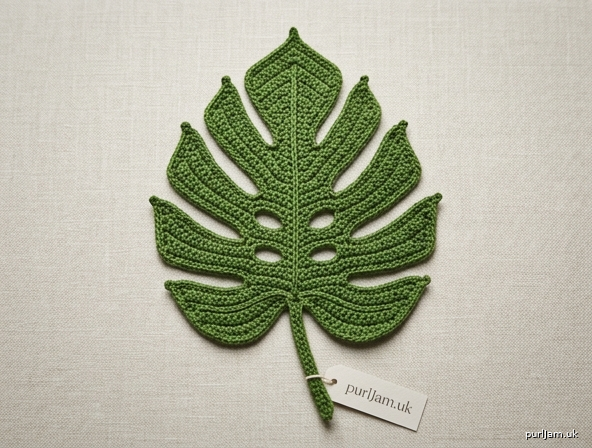
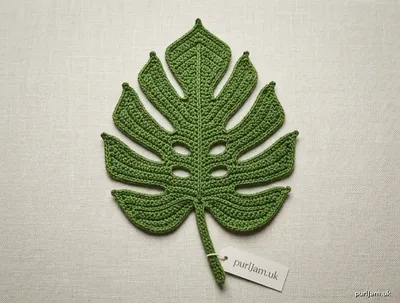
A true-to-life Monstera deliciosa leaf with a heart-shaped base, elongated pointed tip, and five pointed lobes on each side. Deep splits separate the lobes, and open fenestrations sit near the midrib for a mature-leaf look. Worked in fingering-weight cotton on a 2 mm hook so the finished leaf measures about 4.5 inches (11.5 cm) long.
Materials
- Yarn: Fingering-weight cotton (Category 1), solid green or variegated leaf green; approximately 28 yards (26 m)
- Hook: 2.0 mm
- Notions: Tapestry needle, scissors, 6 stitch markers, blocking pins, blocking board
- Optional: Fabric stiffener or 1:1 white glue/water for a firmer display leaf
Gauge
8 sc and 9 rows = 1 inch (2.5 cm) in single crochet with 2.0 mm hook.
Gauge check: Work a 16-sc × 18-row swatch. It should measure 2 × 2 inches. Change hook size if needed so the finished leaf lands between 4 and 5 inches long.
Finished Size
Approximately 4.5 inches (11.5 cm) long (tip to base, excluding stem) × 3.25 inches (8.5 cm) wide at the widest lobes. Stem adds about 1 inch (2.5 cm).
Abbreviations (US)
| Abbr | Meaning |
|---|---|
| ch | chain |
| sc | single crochet |
| hdc | half double crochet |
| dc | double crochet |
| tr | treble crochet |
| dtr | double treble crochet |
| sl st | slip stitch |
| st(s) | stitch(es) |
| sp | space |
| sk | skip |
| sc2tog | single crochet 2 together |
| FO | fasten off |
| PM | place marker |
| RS | right side |
| BLO | back loop only |
| yo | yarn over |
| rep | repeat |
sc2tog: Insert hook in next st, yo, pull up loop; insert hook in following st, yo, pull up loop; yo, pull through all 3 loops on hook.
Pattern Notes
- Turning ch-1 does not count as a stitch. Ch-2 at lobe starts does not count as a stitch.
- Midrib is a foundation chain worked into on both sides (bottom bumps / free loops of the foundation).
- Each lobe is worked out from the midrib and back; you fasten off after each lobe, then rejoin further along the midrib to create the deep Monstera split. Weave in lobe tails as you go or at the end.
- Stitch counts are given in parentheses at the end of each row or lobe step. Inline checks use ✓.
- Work all stitches through both loops unless stated otherwise.
- Leaf is not meant to be reversible; choose a RS and keep lobe joins tidy on the WS.
- Block when finished — shaping is essential for pointed lobes and a flat heart base.
Special stitch — Picot point (used at every lobe tip and the leaf tip)
Ch 2, sl st in top of st just made (or in 2nd ch from hook when working on a chain). Creates a sharp botanical point.
Pattern Instructions
1. Midrib Foundation
With 2.0 mm hook and cotton, ch 35.
Row M1: Sc in 2nd ch from hook and in each ch across. (34 sc)
Do not turn. PM in the first sc (tip end) and in the last sc (base end). The unused loops on the opposite side of the foundation chain are the Side B midrib stitches.
Inline check: 34 sc ≈ 4.25" at gauge ✓
2. Leaf Tip (pointed apex)
Rejoin is not needed — continue with the same yarn at the tip-end marker (first midrib sc).
You will work the tip using the first 3 midrib sc at the tip end (Side A direction first, then rotate for Side B tip finish later if preferred; here the tip is completed as a small pointed cap over both sides).
Tip — Side A half Sl st in midrib sc 1 (tip end), ch 6.
- Row T1: Sc in 2nd ch from hook, hdc in next ch, dc in next ch, tr in next ch, dtr in last ch, sl st in same midrib sc 1. (5 sts on tip arm + join)
- Row T2: Ch 1, turn; working back toward the point along the 5 sts: sl st in dtr, sc in tr, hdc in dc, dc in hdc, tr in sc; picot point, FO. (5 sts + picot)
Tip — Side B half (mirror, using free loops of foundation at tip) Join yarn with sl st in free loop of foundation ch corresponding to midrib sc 1.
- Ch 6. Rep Row T1 and T2 exactly as Side A. FO.
Tip now forms a single elongated point shared by both sides. Midrib sts 1–3 are reserved/covered by tip joins; lobes begin at midrib st 4.
3. Side A — Five Pointed Lobes
Work into the top loops of the midrib sc row (the side you already sc’d into). Lobes run from near the tip toward the base. Leave 2 midrib sc unworked between lobes as split gaps (these become the deep cuts).
Midrib map — Side A (sts 1→34, tip→base):
- Sts 1–3: tip
- Sts 4–6: Lobe A1 (3 sts)
- Sts 7–8: split gap
- Sts 9–12: Lobe A2 (4 sts)
- Sts 13–14: split gap
- Sts 15–19: Lobe A3 (5 sts)
- Sts 20–21: split gap
- Sts 22–25: Lobe A4 (4 sts)
- Sts 26–27: split gap
- Sts 28–31: Lobe A5 (4 sts)
- Sts 32–34: heart base
3 + 2 + 4 + 2 + 5 + 2 + 4 + 2 + 4 + 3 = 34 ✓
Lobe A1 (small, nearest tip)
Join yarn with sl st in midrib sc 4.
Lobe foundation: Ch 9.
Row A1-1 (work back toward midrib in the ch): Sc in 2nd ch from hook, sc in next ch, hdc in next 2 ch, dc in next 2 ch, tr in next 2 ch, sl st in midrib sc 4. (8 sts + join)
Row A1-2: Ch 1, turn; sl st in first tr, sc in next tr, hdc in next 2 dc, dc in next 2 hdc, tr in next sc, tr in last sc; picot point. (8 sts + picot)
Row A1-3: Ch 1, turn; sk picot, sl st in first tr, sc in next tr, hdc in next 2 dc, dc in next 2 hdc, hdc in next sc, sc in next st, sl st in midrib sc 5. (8 sts + join)
Row A1-4: Ch 1, turn; sc in next 2 sts, hdc in next 2 sts, dc in next 2 sts, hdc in next st, sc in next st, sl st in midrib sc 6. (8 sts + join)
FO. (Lobe A1 anchored across midrib sts 4–6 ✓)
Fenestration A1 (hole near midrib between Lobe A1 and A2):
Join yarn with sl st in midrib sc 6 (edge of lobe), ch 4, sk split-gap sts 7–8, sl st in midrib sc 9. FO. (ch-4 fenestration)
Lobe A2 (medium)
Join yarn with sl st in midrib sc 9.
Lobe foundation: Ch 12.
Row A2-1: Sc in 2nd ch from hook, sc in next ch, hdc in next 2 ch, dc in next 3 ch, tr in next 3 ch, dtr in last ch, sl st in midrib sc 9. (11 sts + join)
Row A2-2: Ch 1, turn; sl st in dtr, sc in next tr, hdc in next 2 tr, dc in next 3 dc, tr in next 2 hdc, tr in next sc, dtr in last sc; picot point. (11 sts + picot)
Row A2-3: Ch 1, turn; sk picot, sl st in dtr, sc in next tr, hdc in next tr, dc in next 2 sts, tr in next 3 sts, dc in next 2 sts, hdc in next st, sc in next st, sl st in midrib sc 10. (11 sts + join)
Row A2-4: Ch 1, turn; sc in next 2 sts, hdc in next 2 sts, dc in next 3 sts, hdc in next 2 sts, sc in next 2 sts, sl st in midrib sc 11. (11 sts + join)
Row A2-5: Ch 1, turn; sc in next 3 sts, hdc in next 3 sts, sc in next 3 sts, sl st in next 2 sts, sl st in midrib sc 12. (11 sts + join)
FO. (Lobe A2 across midrib sts 9–12 ✓)
Fenestration A2: Sl st join in midrib sc 12, ch 5, sk sts 13–14, sl st in midrib sc 15. FO. (ch-5 fenestration)
Lobe A3 (largest — widest part of leaf)
Join yarn with sl st in midrib sc 15.
Lobe foundation: Ch 15.
Row A3-1: Sc in 2nd ch from hook, sc in next ch, hdc in next 2 ch, dc in next 3 ch, tr in next 4 ch, dtr in next 2 ch, dtr in last ch, sl st in midrib sc 15. (14 sts + join)
Row A3-2: Ch 1, turn; sl st in first dtr, sc in next dtr, hdc in next dtr, dc in next 2 tr, tr in next 4 sts, dc in next 3 sts, hdc in next 2 sts, sc in last sc; picot point. (14 sts + picot)
Row A3-3: Ch 1, turn; sk picot, sl st in first sc, sc in next hdc, hdc in next 2 sts, dc in next 3 sts, tr in next 4 sts, dc in next 2 sts, hdc in next st, sc in next st, sl st in midrib sc 16. (14 sts + join)
Row A3-4: Ch 1, turn; sc in next 2 sts, hdc in next 3 sts, dc in next 4 sts, hdc in next 3 sts, sc in next 2 sts, sl st in midrib sc 17. (14 sts + join)
Row A3-5: Ch 1, turn; sc in next 3 sts, hdc in next 4 sts, sc in next 3 sts, sl st in next 4 sts, sl st in midrib sc 18. (14 sts + join)
Row A3-6: Ch 1, turn; sc in next 4 sts, hdc in next 2 sts, sc in next 4 sts, sl st in next 4 sts, sl st in midrib sc 19. (14 sts + join)
FO. (Lobe A3 across midrib sts 15–19 ✓)
Fenestration A3: Sl st join in midrib sc 19, ch 5, sk sts 20–21, sl st in midrib sc 22. FO. (ch-5 fenestration)
Lobe A4 (medium)
Join yarn with sl st in midrib sc 22.
Lobe foundation: Ch 12.
Work Rows A2-1 through A2-5 exactly as Lobe A2, but anchor successive rows to midrib sc 22, 23, 24, then 25.
FO. (Lobe A4 across midrib sts 22–25 ✓)
Count confirmation: same 11-st lobe body as A2 ✓
Fenestration A4: Sl st join in midrib sc 25, ch 4, sk sts 26–27, sl st in midrib sc 28. FO. (ch-4 fenestration)
Lobe A5 (medium-small, base side)
Join yarn with sl st in midrib sc 28.
Lobe foundation: Ch 11.
Row A5-1: Sc in 2nd ch from hook, sc in next ch, hdc in next 2 ch, dc in next 3 ch, tr in next 2 ch, tr in last ch, sl st in midrib sc 28. (10 sts + join)
Row A5-2: Ch 1, turn; sl st in first tr, sc in next tr, hdc in next tr, dc in next 3 dc, tr in next 2 hdc, tr in next sc, dtr in last sc; picot point. (10 sts + picot)
Row A5-3: Ch 1, turn; sk picot, sl st in dtr, sc in next tr, hdc in next tr, dc in next 2 sts, tr in next 2 sts, dc in next 2 sts, hdc in next st, sc in next st, sl st in midrib sc 29. (10 sts + join)
Row A5-4: Ch 1, turn; sc in next 2 sts, hdc in next 2 sts, dc in next 2 sts, hdc in next 2 sts, sc in next 2 sts, sl st in midrib sc 30. (10 sts + join)
Row A5-5: Ch 1, turn; sc in next 3 sts, hdc in next 2 sts, sc in next 3 sts, sl st in next 2 sts, sl st in midrib sc 31. (10 sts + join)
FO. (Lobe A5 across midrib sts 28–31 ✓)
Side A complete. Remaining midrib sts 32–34 reserved for heart base.
4. Side B — Five Pointed Lobes (mirror)
Rotate the work so the free loops of the foundation chain face you (opposite side of midrib). Tip half is already made. Use the free-loop midrib stitches that correspond 1:1 with Side A numbering (st 1 at tip, st 34 at base).
Repeat Lobes A1–A5 and all four fenestrations exactly, joining into the matching free-loop midrib stitches and using the same chain lengths, row sequences, picot points, and FO/rejoin splits.
Midrib map — Side B: identical spans (sts 4–6, 9–12, 15–19, 22–25, 28–31) with 2-st gaps and fenestrations ch-4, ch-5, ch-5, ch-4 as on Side A.
Symmetry check: Side B lobe stitch counts = Side A lobe stitch counts (8 / 11 / 14 / 11 / 10 body sts) ✓
5. Heart-Shaped Base
Both sides still have midrib sts 32–34 free (top loops on A, free loops on B).
Base — Side A Join yarn with sl st in midrib sc 32 (Side A).
- Ch 1, sc in sc 32, hdc in sc 33, 5 dc in sc 34 (base end). (1 sc + 1 hdc + 5 dc = 7 sts)
- Do not FO. Ch 1, turn.
- Sc in first dc, hdc in next dc, dc in next dc, hdc in next dc, sc in next dc, sl st in hdc, sl st in sc. (7 sts, curved outer heart edge)
- Sl st lightly down into the side of Lobe A5 near its base join to close the sinus (indent) of the heart. FO.
Base — Side B Join yarn with sl st in free-loop midrib st 32 (Side B). Mirror the Side A base exactly: sc in 32, hdc in 33, 5 dc in 34; turn; sc, hdc, dc, hdc, sc, sl st, sl st; join with sl st into side of Lobe B5. FO.
Heart notch: The pair of 5-dc shells at st 34, one on each side, with the inner sl-st joins into Lobe 5, forms the characteristic Monstera basal lobes and center indent where the stem attaches. (7 sts per side ✓)
6. Stem (petiole)
Join yarn with sl st at the heart notch (between the two base shells at midrib st 34).
Row S1: Ch 1, sc in notch join, sc in adjacent base st on Side A, sc in adjacent base st on Side B. (3 sc)
Rows S2–S10: Ch 1, turn; sc in each sc across. (3 sc each row; 9 rows)
Row S11: Ch 1, turn; sc2tog, sc in last st. (2 sc)
Row S12: Ch 1, turn; sc2tog. (1 sc)
FO, leaving a 6-inch tail.
Stem check: 10 rows at 9 rows/in ≈ 1.1" stem length ✓
7. Center Vein (surface detail)
With RS facing and a long strand of the same yarn (or slightly darker green), surface-sl-st along the midrib from tip base to heart notch:
- Insert hook from RS to WS through the center of midrib sc 2, yo, pull loop to RS; *insert hook through next midrib sc center, yo, pull through fabric and through loop on hook; rep from * through midrib sc 33. FO.
Optional: add one short surface-sl-st branch vein into the lower third of Lobes 3 and 4 on each side (about 4–5 surface sl sts each) for extra realism.
Finishing
- Weave in all ends on the WS with the tapestry needle. Tug lobe picots gently so points sit sharp. Do not let weave-ins close the fenestration chains.
- Block (required):
- Wet-block: soak briefly in cool water, roll in a towel, pin flat on a blocking board.
- Pin the tip elongated; pin each lobe point outward; pin deep splits open toward the midrib; pin fenestrations open (oval or rounded rectangles); pin heart base curves and center notch.
- Target pinned footprint: 4.5" long × 3.25" wide.
- Dry completely.
- Optional stiffen: Paint diluted fabric stiffener or 1:1 glue/water on the WS; reshape; dry flat. Gives a display-ready leaf that holds fenestrations open.
- Use the stem tail to sew the leaf onto a garland, appliqué, or wired stem if desired.
Final Dimensions & Math Summary
| Element | Construction | Count / measure |
|---|---|---|
| Midrib | 34 sc | ≈ 4.25" |
| Tip | ch-6 arms + picot each side | adds ≈ 0.25" |
| Lobes per side | 5 (bodies 8 / 11 / 14 / 11 / 10 sts) | widest ≈ 1.6" per side |
| Full width | Lobe 3 + Lobe 3 | ≈ 3.25" |
| Splits | 2 midrib sts each × 4 | deep cuts |
| Fenestrations | ch-4, ch-5, ch-5, ch-4 per side | open holes |
| Heart base | 5-dc shell × 2 sides | notched base |
| Stem | 3 sc × 10 rows, tapered | ≈ 1.1" |
| Finished leaf | tip through base | ≈ 4.5" long ✓ |
Tips for Success
- Mark midrib stitches 4, 9, 15, 22, 28 (and 32) with markers before starting lobes so joins stay accurate.
- Keep lobe foundation chains neither tight nor loose; they set lobe length.
- If a lobe cups, you are crocheting too tightly — go up 0.25 mm hook for lobes only, or block aggressively.
- For a slightly larger leaf (closer to 5"), use a 2.25 mm hook at the same stitch counts.
- For a hanging vine, make 3–5 leaves in graduated sizes (drop 1 midrib st per lobe span and 1–2 ch per lobe foundation for smaller leaves) and join stems to a crocheted or cord vine.
Enjoy your realistic Monstera leaf!
Disclaimer: This pattern was generated by AI and should be reviewed for accuracy before use. While we strive for quality, AI-generated content may contain errors. Please verify measurements, stitch counts, charts, and instructions before beginning your project. Generated by purlJam.uk
Love this pattern?
Save this pattern to your free PurlJam libraryAccess your pattern anytime
Bookmark this page to access your pattern anytime