Type
Knitting
Difficulty
intermediate
Category
custom
AI Thinking Process
Planning
Verification
Pattern
Shoal of Little Fish Dish Towel
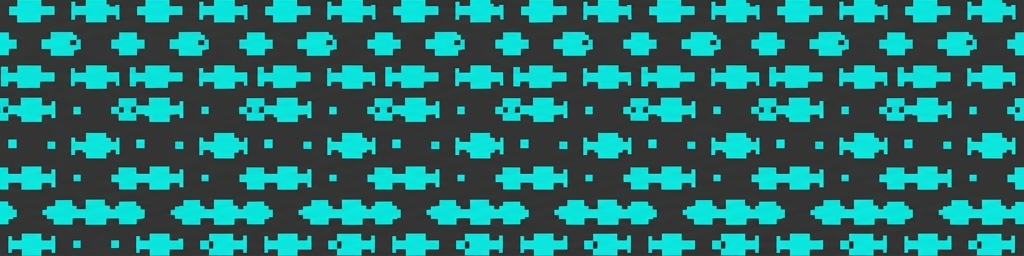
A cheerful beginner dish towel worked flat in a single colour of cotton yarn. The fish are formed entirely from knit and purl stitches (no colourwork, no shaping), so the little shoal appears as a raised texture against a smooth background. The large 32-stitch fish from your source chart has been scaled down proportionately into a tidy 8-stitch × 12-row motif that repeats five times across the width and as many times as you like up the length.
Finished Measurements
- Width: approx. 23 cm (9") after blocking
- Length: your choice — instructions given per repeat so you can stop whenever you like. A typical towel is 30–40 cm (12–16").
Materials
- Yarn: KnitPicks Dishie (100% cotton, worsted weight; approx. 174 m / 190 yds per 100 g ball). 1 ball makes one towel of typical length; buy 2 if making an extra-long towel.
- Needles: 4.5 mm (UK/US 7) straight or circular needles, or size needed to obtain tension.
- Notions: tapestry/darning needle for weaving in ends; scissors; optional stitch markers.
One colour only, as requested.
Tension (Gauge)
20 sts and 28 rows = 10 cm (4") over stocking stitch on 4.5 mm needles, after blocking.
Tension check: 46 sts ÷ 20 sts per 10 cm = 23 cm ≈ 9" ✓
Take time to knit a tension swatch — cotton has little stretch, so an accurate tension keeps your towel at 9" wide.
Sizes
One width (9"). Length is knitter's choice, built from a repeatable motif block.
Abbreviations
- k — knit
- p — purl
- st(s) — stitch(es)
- RS — right side
- WS — wrong side
- rep — repeat
(No increases, decreases, or colour changes are used — this is a beginner knit/purl texture pattern.)
Pattern Notes
- The towel is worked flat, in one piece, from the bottom edge upward.
- Every row begins and ends with a 3-stitch garter border (k3) to prevent curling and give a tidy edge. These 6 border stitches are not part of the fish motif.
- Body stitches: 46 total − 6 border = 40 body sts, which equals 5 fish motifs of 8 sts each (5 × 8 = 40 ✓).
- The fish shape is made by purl bumps on a knit (stocking-stitch) background. On RS rows you knit the background and purl the fish marks; on WS rows you reverse this (purl the background, knit the fish marks) so the raised texture stays on the RS.
- Read the motif carefully: RS rows are read right-to-left in your mind's eye as written, WS rows are the mirror image — but since full stitch sequences are written out for every row below, you can simply follow the words.
Attached Stitch Chart
A separate stitch chart panel is attached to this pattern as its own asset (it is placed immediately after this pattern document, on the following page/panel — not inside this text). Please use that attached panel for the visual grid of the fish motif.
How to read the attached chart:
- The chart shows one 8-stitch × 12-row fish motif (the repeat unit).
- Row direction: Read RS rows (odd) from right to left and WS rows (even) from left to right, exactly as knitted flat.
- Symbols: a blank/knit symbol = knit on RS / purl on WS (the smooth background); the filled/purl symbol = purl on RS / knit on WS (the raised fish mark).
- Colour management: This is a single-colour pattern, so there are no colour changes — ignore any colour-change guidance; only the knit/purl symbol matters.
- Stitch-count integration: The charted motif is 8 sts wide. Work the k3 border, then repeat the 8-st chart 5 times (5 × 8 = 40 sts ✓), then the k3 border = 46 sts per row ✓. Vertically, the chart is 12 rows; repeat those 12 rows as a block for your chosen length.
If you prefer written instructions, the full row-by-row text below is identical to the attached chart — use whichever you find easier.
Instructions
Bottom Border
Cast on 46 sts. Work 6 rows in garter stitch (knit every row). (6 rows ✓)
Establish Side Borders + Begin Fish Body
The fish motif block is 12 rows and uses these written rows. The 8-st repeat is worked 5 times across the 40 body stitches. Border stitches (k3) are shown at each end.
Row 1 (RS): k3, k1, p1, k6; rep from * 5 times, k3. Row 2 (WS): k3, p5, k1, p1, k1; rep from * 5 times, k3. Row 3 (RS): k3, k1, p3, k4; rep from * 5 times, k3. Row 4 (WS): k3, p3, k4, p1; rep from * 5 times, k3. Row 5 (RS): k3, k1, p5, k2; rep from * 5 times, k3. Row 6 (WS): k3, p1, k6, p1; rep from * 5 times, k3. Row 7 (RS): k3, k1, p5, k2; rep from * 5 times, k3. Row 8 (WS): k3, p3, k4, p1; rep from * 5 times, k3. Row 9 (RS): k3, k1, p3, k4; rep from * 5 times, k3. Row 10 (WS): k3, p5, k1, p1, k1; rep from * 5 times, k3. Row 11 (RS): k3, k1, p1, k6; rep from * 5 times, k3. Row 12 (WS): k3, p40, k3. (smooth "water" spacer row between rows of fish)
Stitch check for each row: 3 + (8 × 5) + 3 = 46 sts ✓
These 12 rows form one row of little fish. Repeat Rows 1–12 for your desired length. Each 12-row block adds approximately 4.3 cm (1¾") of length (12 rows ÷ 28 rows per 10 cm).
Choosing your length: subtract about 2.5 cm (1") for the two garter borders (bottom + top), then divide the remaining length by 4.3 cm to get the number of 12-row blocks.
- 30 cm (≈12") towel: work 6 blocks (6 × 12 = 72 body rows).
- 36 cm (≈14") towel: work 7 blocks (7 × 12 = 84 body rows).
- 40 cm (≈16") towel: work 8 blocks (8 × 12 = 96 body rows).
Top Border
After completing your final full 12-row block, work 6 rows in garter stitch (knit every row). (6 rows ✓, matches bottom border)
Cast off all 46 sts knitwise, not too tightly.
Finishing
- Weave in ends on the wrong side using the tapestry needle.
- Block the towel: soak in lukewarm water, gently squeeze (do not wring), pat to shape at 23 cm (9") wide and your chosen length, and lay flat to dry. Blocking evens out the stitches and makes the fish texture "pop."
- Optional hanging loop: with a spare length of yarn, chain or twist a 10 cm cord and sew it to one corner.
What the Finished Towel Looks Like
Please note: I'm a text-based pattern editor and can't produce or attach an actual photograph. Here is a description of the finished piece so you know what to expect:
Picture a smooth cotton rectangle in a single solid colour (say, a soft sea-blue Dishie), about 9" wide. Running across it are neat horizontal rows of small fish, each about the size of a thumbprint, formed by raised purl-stitch texture standing out against the flat knit background. Between each row of fish is a smooth "water" stripe. The five fish in each row swim in the same direction, and the rows stack up the towel like a gentle shoal. Tidy garter-stitch borders frame all four edges. In good side-light the little fish cast soft shadows, making the texture clearly visible even in one colour.
Happy knitting — enjoy your shoal!
Disclaimer: This pattern was generated by AI and should be reviewed for accuracy before use. While we strive for quality, AI-generated content may contain errors. Please verify measurements, stitch counts, and instructions before beginning your project. Generated by purlJam.uk
Access your pattern anytime
Bookmark this page to access your pattern anytime